CALVIN: I’ve decided to stop caring about things. If you care, you just get disappointed all the time. If you don’t care, nothing matters, so you’re never upset. From now on, my rallying cry is, “So what?!”
HOBBES: That’s a tough cry to rally around.
CALVIN: So what?!
Quotations about:
upset
Note not all quotations have been tagged, so Search may find additional quotes on this topic.

Tell yourself, when you feel exasperated and out of all patience, that this mortal life endures but a moment; it will not be long before we shall one and all have been laid to rest.
[ὅταν λίαν ἀγανακτῇς ἢ καὶ δυσπαθῇς, ἀκαριαῖος ὁ ἀνθρώπειος βίος καὶ μετ᾿ ὀλίγον πάντες ἐξετάθημεν.]
Marcus Aurelius (AD 121–180) Roman emperor (161–180), Stoic philosopher
Meditations [To Himself; Τὰ εἰς ἑαυτόν], Book 11, ch. 18 (11.18) (AD 161-180) [tr. Staniforth (1964)]
(Source)
Marcus' 6th point to remember when aggravated by another's actions.
(Source (Greek)). Alternate translations:That whensoever thou doest take on grievously, or makest great woe, little doest thou remember then that a man's life is but for a moment of time, and that within a while we shall all be in our graves.
[tr. Casaubon (1634)]When you are most Angry and Gall'd, remember that Humane Life lasts but a Moment, and that we shall all of us very quickly , be laid in our Graves.
[tr. Collier (1701)]When your anger and resentment is highest, remember human life is but for a moment. We shall be all presently stretched out dead corpses.
[tr. Hutcheson/Moor (1742)]When you are excessively provoked and suffer some real injury, reflect that human life is but of a moment's duration, and that in a short time we shall all be laid in our tombes together.
[tr. Graves (1792)]Consider when thou art much vexed or grieved, that man's life is only a moment, and after a short time we are all laid out dead.
[tr. Long (1862)]When you are most angry and vexed remember that human life lasts but a moment, and that we shall all of us very quickly be laid in our graves.
[tr. Collier/Zimmern (1887)]When sorely provoked and out of patience, remember that man's life is but for a moment; a little while, and we all lie stretched in death.
[tr. Rendall (1898)]When you are vexed or worried overmuch, remember that man’s life is but for a moment, and that in a little we shall all be laid to rest.
[tr. Hutcheson/Chrystal (1902)]When thou art above measure angry or even out of patience, bethink thee that man's life is momentary, and in a little while we shall all have been laid out.
[tr. Haines (Loeb) (1916)]When you are highly indignant or actually suffering, that man's life is but a moment, and in a little we are one and all laid low in death.
[tr. Farquharson (1944)]When you are annoyed beyond measure and losing all patience, remember that human life lasts but a moment, and that in a short while we shall all have been laid to rest.
[tr. Hard (1997 ed. and 2011 ed.)]When you lose your temper, or even feel irritated: that human life is very short. Before long all of us will be laid out side by side.
[tr. Hays (2003)]When you are high in indignation and perhaps losing patience, remember that human life is a mere fragment of time and shortly we are all in our grave.
[tr. Hammond (2006)]Whenever you are excessively disturbed or even suffering, remember that human life lasts only a moment and that in a short time we will all be laid out for burial.
[tr. Needleman/Piazza (2008)]Whenever you are really angry and upset, [remember] that human life is short and soon we will all be in the ground.
[tr. @sentantiq (2020)]
Another very common misconception about politeness is that it is martyrdom; that you have to let everybody else do whatever they want. People say to me, “Doesn’t etiquette all boil down to making other people feel comfortable?” No. there are times when you are going to have to upset people. There are times when you have to upset the whole society.
Judith Martin (b. 1938) American author, journalist, etiquette expert [a.k.a. Miss Manners]
Interview (1997-03), “She Says: Miss Manners,” by Sandy Fernández, Ms magazine, Vol. 7, No. 5 (1997-03/04)
(Source)

ORLANDO:The thorny point
Of bare distress hath ta’en from me the show
Of smooth civility.William Shakespeare (1564–1616) English dramatist and poet
As You Like It, Act 2, sc. 7, l. 99ff (2.7.99-101) (1599)
(Source)

Wretchedness is caused by emotional disturbances, and the happy life by calmness, and disturbance takes two forms — anxiety and fear in expecting evils, ecstatic joy and lustful thoughts in misunderstanding good things, all of which are at variance with with wisdom and reason. Accordingly, if a man possesses self-control and consistency, and is without fear, distress, excitability, or lust, is he not happy? But this is the nature of the wise man always, so he is happy always.
[Atque cum perturbationes animi miseriam, sedationes autem vitam efficiant beatam, duplexque ratio perturbationis sit, quod aegritudo et metus in malis opinatis, in bonorum autem errore laetitia gestiens libidoque versetur, quae omnia cum consilio et ratione pugnent, his tu tam gravibus concitationibus tamque ipsis inter se dissentientibus atque distractis quem vacuum solutum liberum videris, hunc dubitabis beatum dicere? atqui sapiens semper ita adfectus est; semper igitur sapiens beatus est.]
Marcus Tullius Cicero (106–43 BC) Roman orator, statesman, philosopher
Tusculan Disputations [Tusculanae Disputationes], Book 5, ch. 15 (5.15) / sec. 43 (45 BC) [tr. Davie (2017)]
(Source)
(Source (Latin)). Other translations:Now since the Disturbances of the Soul render the Life miserable, but the composure of them happy; and there is a double rank of Passions; in that, Discontent and Fear are terminated on Evils conceiv'd; but excessive Mirth and Lust arise from the misapprehension of good things, since all are inconsistent with Advice and Reason, if you shall see any one clear, emancipated, free from these emotions so vehement, so discordant one with the other, and so distracting, can you make any question of calling him Happy? But the Wise man is always so dispos'd, therefore the Wise man is always Happy.
[tr. Wase (1643)]But as the perturbations of the mind make life miserable, and tranquility renders it happy: and as these perturbations are of two sorts; grief and fear, proceeding from imagined evils, immoderate joy and lust, from the mistake of what is good; and all these are in opposition to reason and counsel; when you see a man at ease, quite free and disengaged from such troublesome commotions, which are so much at variance with one another, can you hesitate to pronounce such a one a happy man? Now the wise man is always in such a disposition: therefore the wise man is always happy.
[tr. Main (1824)]But when the perturbations render life unhappy, while their repose makes it happy -- and since the mode of perturbation is twofold -- sorrow and fear having birth from reputed evils -- the delirium of joy and desire, from the delusion of good, -- when all these are repugnant to counsel and reason, and you see a man void, exempt, free from these excitements, so vehement, so discordant, so distracted by mutual conflicts, -- will you hesitate to pronounce him happy? But the wise man is always thus, and therefore always happy.
[tr. Otis (1839)]But as the perturbations of the mind make life miserable, and tranquillity renders it happy; and as these perturbations are of two sorts, grief and fear, proceeding from imagined evils, and as immoderate joy and lust arise from a mistake about what is good, and as all these feelings are in opposition to reason and counsel; when you see a man at ease, quite free and disengaged from such troublesome commotions, which are so much at variance with one another can you hesitate to pronounce such an one a happy man? Now the wise man is always in such a disposition, therefore the wise man is always happy.
[tr. Yonge (1853)]Now since perturbations of mind create misery, while quietness of mind makes life happy, and since there are two kinds of perturbations, grief and fear having their scope in imagined evils, inordinate joy and desire in mistaken notions of the good, all being repugnant to wise counsel and reason, will you hesitate to call him happy whom you see relieved, released, free from these excitements so oppressive, and so at variance and divided among themselves? Indeed one thus disposed is always happy. Therefore the wise man is always happy.
[tr. Peabody (1886)]
It is the trifles of life that are its bores, after all. Most men can meet ruin calmly, for instance, or laugh when they lie in a ditch with their own knee-joint and their hunter’s spine broken over the double post and rails: it is the mud that has choked up your horn just when you wanted to rally the pack; it’s the whip who carries you off to a division just when you’ve sat down to your turbot; it’s the ten seconds by which you miss the train; it’s the dust that gets in your eyes as you go down to Epsom; it’s the pretty little rose note that went by accident to your house instead of your club, and raised a storm from madame; it’s the dog that always will run wild into the birds; it’s the cook who always will season the white soup wrong — it is these that are the bores of life, and that try the temper of your philosophy.
Ouida (1839–1908) English novelist [pseud. of Maria Louise Ramé]
Under Two Flags, ch. 1 (1867)
(Source)

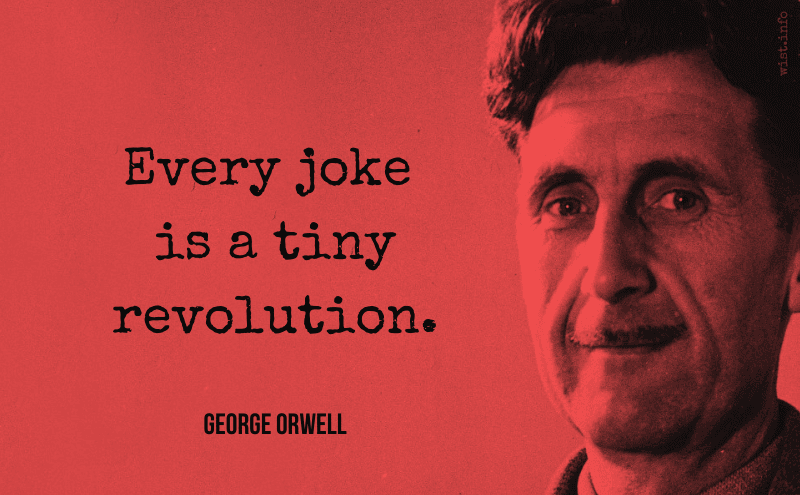
A thing is funny when — in some way that is not actually offensive or frightening — it upsets the established order. Every joke is a tiny revolution. If you had to define humour in a single phrase, you might define it as dignity sitting on a tin-tack. Whatever destroys dignity, and brings down the mighty from their seats, preferably with a bump, is funny. And the bigger the fall, the bigger the joke. It would be better fun to throw a custard pie at a bishop than at a curate.
George Orwell (1903–1950) English journalist, essayist, writer [pseud. of Eric Arthur Blair]
Essay (1945-07-28), “Funny, But Not Vulgar,” Leader Magazine
(Source)
Written in December 1944. More discussion of this quotation: Every Joke Is a Tiny Revolution – Quote Investigator®.

When the enemy is at ease, be able to weary him; when well fed, to starve him; when at rest, to make him move. Appear at places to which he must hasten; move swiftly where he does not expect you.
Sun-Tzu (fl. 6th C. AD) Chinese general and philosopher [a.k.a. Sun Wu]
The Art of War, ch. 6
The powerful — be they church leaders or politicians — always seem to forget the one lesson of history: everything changes. The party in power today is not going to be the party in power in a decade, or next year. The group you made a gentleman’s agreement with this election cycle is going to be a completely different group, with different demands, next one. And yet, the powerful insist on trying to weaken the rules that keep them from being still more powerful, as if that could fend off the day of their fall — and the rise of others, probably their opponents, who will operate under the same weakened rules and ugly precedents. Unfortunately, in those sorts of payback situations, nobody’s a winner.
Graham Ericsson (b. 1961) American technologist, writer, aphorist
Journal (2007-08-29)

Look, Dave … I can see you’re really upset about this …. I honestly think you ought to sit down calmly …. Take a stress pill, and think things over.
Arthur C. Clarke (1917–2008) British writer
2001: A Space Odyssey [HAL 9000] (1968) [with Stanley Kubrick]