If political loyalty is signaled by believing a true story, anyone can fake it. But believing ridiculous and outlandish stories exacts greater cost, and is therefore a better signal of loyalty. If you believe your leader only when he or she tells the truth, what does that prove? In contrast, if you believe your leader even when he or she builds castles in the air, that’s loyalty! Shrewd leaders might sometimes deliberately say nonsensical things as a way to distinguish reliable devotees from fair-weather supporters.
Yuval Noah Harari (b. 1976) Israeli public intellectual, historian, academic, writer [יובל נח הררי]
“Why Fiction Trumps Truth,” New York Times (24 May 2019)
(Source)
Quotations about:
alternate facts
Note not all quotations have been tagged, so Search may find additional quotes on this topic.

The general uncertainty as to what is really happening makes it easier to cling to lunatic beliefs. Since nothing is ever quite proved or disproved, the most unmistakable fact can be impudently denied.
George Orwell (1903–1950) English journalist, essayist, writer [pseud. of Eric Arthur Blair]
Essay (1945-05), “Notes on Nationalism,” Polemic Magazine (1945-10)
(Source)
In nationalist thought there are facts which are both true and untrue, known and unknown. A known fact may be so unbearable that it is habitually pushed aside and not allowed to enter into logical processes, or on the other hand it may enter into every calculation and yet never be admitted as a fact, even in one’s own mind.
George Orwell (1903–1950) English journalist, essayist, writer [pseud. of Eric Arthur Blair]
Essay (1945-05), “Notes on Nationalism,” Polemic Magazine (1945-10)
(Source)
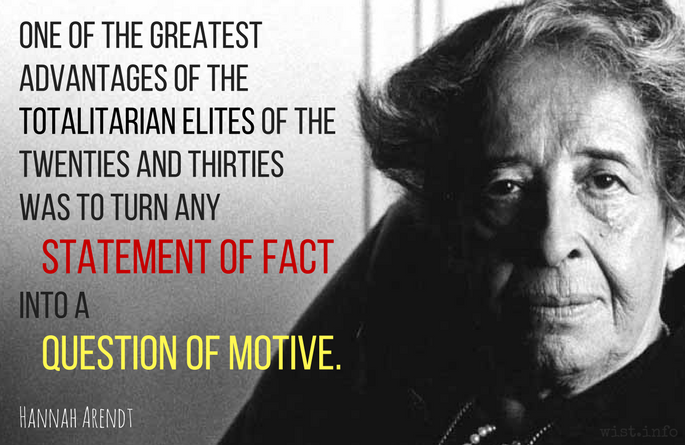
One of the greatest advantages of the totalitarian elites of the twenties and thirties was to turn any statement of fact into a question of motive.
Hannah Arendt (1906–1975) German-American philosopher, political theorist
(Spurious)
This is frequently cited to Arendt, often to The Origins of Totalitarianism, (1951), but is not found as such in her works. The source appears to be a paraphrase of Arendt in a 1999 New Yorker article.
Stuart Elden suggested the following from The Origins of Totalitarianism, Part 3, ch. 11, might be original quotation the paraphrase was built on, though the overall meaning is different:The elite is not composed of ideologists; its members’ whole education is aimed at abolishing their capacity for distinguishing between truth and falsehood, between reality and fiction. Their superiority consists in their ability immediately to dissolve every statement of fact into a declaration of purpose.