In truth, in such a vast number of citizens, there is a great multitude of those men, who either, from fear of punishment, because they are conscious of their own misdeeds, are anxious for fresh changes and revolutions in the republic; or who, on account of some innate insanity of mind, feed upon the discords and seditions of the citizens; or else who, on account of the embarrassment of their estates and circumstances, had rather burn in one vast common conflagration, than in one which consumed only themselves.
[Etenim in tanto civium numero magna multitudo est eorum qui aut propter metum poenae, peccatorum suorum conscii, novos motus conversionesque rei publicae quaerant, aut qui propter insitum quendam animi furorem discordiis civium ac seditione pascantur, aut qui propter implicationem rei familiaris communi incendio malint quam suo deflagrare.]
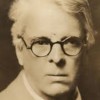
Marcus Tullius Cicero (106–43 BC) Roman orator, statesman, philosopher
Pro Sestio [For Publius Sestius], ch. 46 / sec. 99 (56-02 BC) [tr. Yonge (1891)]
(Source)
(Source (Latin)). Other translations:For in so great a number of citizens there is a great multitude of those who either seek after revolutions and changes of government, on account of their fear of punishment, being conscious of their misdeeds, or who from a certain innate frenzy of mind take delight in civil broils and seditions, or who, on account of pecuniary embarrassments, prefer rather to perish in one common conflagration than in one by themselves.
[tr. Hickie (1888)]For, in so large a body of citizens, there are great numbers of men who, either from fear of punishment, being conscious of their crimes, seek to cause revolution and changes of government; or who, owing to a sort of inborn revolutionary madness, batten on civil discord and sedition; or who, on account of embarrassment in their finances, prefer a general conflagration to their own ruin.
[tr. Gardner (Loeb) (1958)]
Quotations about:
civil disorder
Note not all quotations have been tagged, so Search may find additional quotes on this topic.
The truth unquestionably is, that the only path to a subversion of the republican system of the Country is, by flattering the prejudices of the people, and exciting their jealousies and apprehensions, to throw affairs into confusion, and bring on civil commotion. Tired at length of anarchy, or want of government, they may take shelter in the arms of monarchy for repose and security.
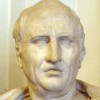
Alexander Hamilton (1757–1804) American statesman, author
Letter (1792-08-18) to George Washington, Enclosure: “Objections and Answers Respecting the Administration,” Objection 14
(Source)
Wisdom is publicly rejected, affairs are pursued with force,
A good speaker is spurned, and the wretched warrior is loved.
Men strive not with educated speeches but instead with insults
attack one another and enter into mutual enmity.
They seize property suddenly not by the right of law but with swords
As they seek sovereignty and wander with the power of the mob.[Pellitur e medio sapientia, vi geritur res,
spernitur orator bonus, horridus miles amatur.
haut doctis dictis certantes nec maledictis
miscent inter sese inimicitiam agitantes,
non ex iure manum consertum, sed magis ferro
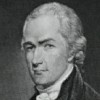
rem repetunt regnumque petunt, vadunt solida vi.]Ennius (239–169 BC) Roman poet, writer [Quintus Ennius]
Annales, Book 8, Sec. 3, l. 262-8
(Source)
On public discourse during wars. Fragment quoted by Cicero in Epistle 171.
Other translations: "Pushed away from the centre good sense, force rules the day, / despised the good orator, the horrid soldier cherished. / Fighting, not with learned words or curses, / they clash with one another, pushing hostilities, / laying hand onto one another not rightfully, but rather with the sword / they seek material gain and strive for power, advancing with brute force."
Let us shun extremes, not only because each extreme is in itself a positive evil, but also because each extreme necessarily engenders its opposite. If we love civil and religious freedom, let us in the day of danger uphold law and order. If we are zealous for law and order, let us prize, as the best safeguard of law and order, civil and religious freedom.
Thomas Babington Macaulay (1800–1859) English writer and politician
Speech on re-election to Parliament, Edinburgh (2 Nov 1852)
(Source)
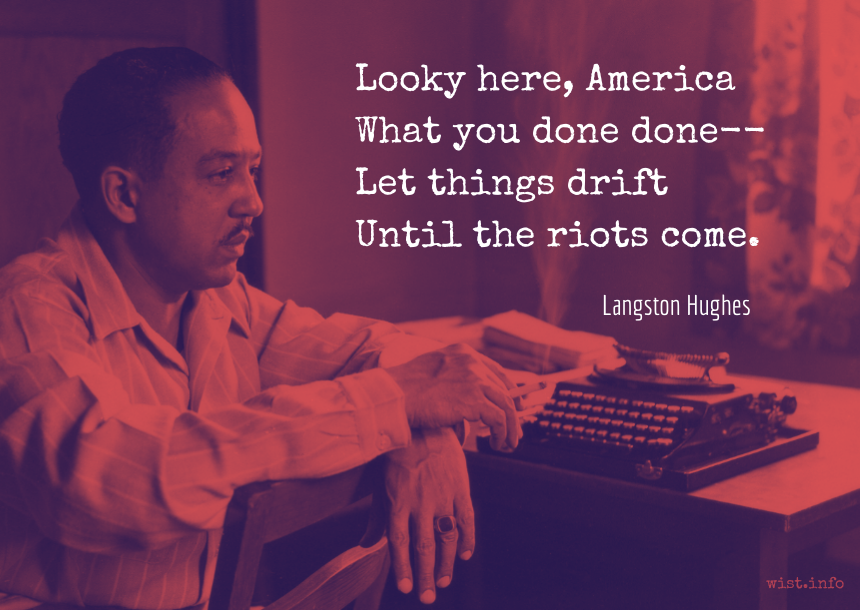
Looky here, America
What you done done —
Let things drift
Until the riots come.
Langston Hughes (1902–1967) American poet, social activist, novelist, playwright
“Beaumont to Detroit: 1943”
(Source)
A rioter with a Molotov cocktail in his hands is not fighting for civil rights any more than a Klansman with a sheet on his back and a mask on his face. They are both more or less what the law declares them: lawbreakers, destroyers of constitutional rights and liberties, and ultimately destroyers of a free America.
Lyndon B. Johnson (1908–1973) American politician, educator, US President (1963–69)
Speech (1965-08-20), White House Conference on Equal Employment Opportunity, Washington, D.C.
(Source)
Discussing the Watts Riots in Los Angeles (11-16 August).
Yes, Gentlemen; if I am asked why we are free with servitude all around us, why our Habeas Corpus Act has not been suspended, why our press is still subject to no censor, why we still have the liberty of association, why our representative institutions still abide in all their strength, I answer, It is because in the year of revolutions we stood firmly by our government in its peril; and, if I am asked why we stood by our government in its peril, when men all around us were engaged in pulling governments down, I answer, It was because we knew that though our government was not a perfect government, it was a good government, that its faults admitted of peaceable and legal remedies, that it had never inflexibly opposed just demands, that we had obtained concessions of inestimable value, not by beating the drum, not by ringing the tocsin, not by tearing up the pavement, not by running to the gunsmiths’ shops to search for arms, but by the mere force of reason and public opinion.
Thomas Babington Macaulay (1800–1859) English writer and politician
Speech on re-election to Parliament, Edinburgh (2 Nov 1852)
(Source)
On the various revolutions and counter-revolutions in Europe in 1848.
Turning and turning in the widening gyre
The falcon cannot hear the falconer;
Things fall apart; the centre cannot hold;
Mere anarchy is loosed upon the world,
The blood-dimmed tide is loosed, and everywhere
The ceremony of innocence is drowned;
The best lack all conviction, while the worst
Are full of passionate intensity.William Butler Yeats (1865–1939) Irish poet and dramatist
“The Second Coming,” ll.1-8 (1920)
(Source)
More examination of this quotation: The Best Lack All Conviction While the Worst Are Full of Passionate Intensity – Quote Investigator. See also Russell and Bukowski.