All the governments of the world adopt elaborate methods of concealing truths which they consider undesirable, and inflict various forms of penalty upon those who spread knowledge which is thought bad for the population This applies especially to knowledge of the kind which is considered seditious, and the kind which is considered obscene. I shall not give instances, since, if I did, I should myself fall under the ban of the law.
Bertrand Russell (1872–1970) English mathematician and philosopher
Education and the Social Order [Education and the Modern World], ch. 1 “The Individual versus the Citizen” (1932)
(Source)
Quotations about:
sedition
Note not all quotations have been tagged, so Search may find additional quotes on this topic.
There are greater forces and means for attacking than for defending the State. The reason is, that reckless and abandoned men need only a nod to set them moving, and their own natural disposition incites them against the State; while honest folk somehow or other show less activity, neglect the beginnings of movements, and are aroused to action at the last moment only by simple necessity; so that sometimes, owing to their hesitation and indolence, while they wish still to enjoy peace even with the loss of dignity, through their own fault they lose both.
[Maioribus praesidiis et copiis oppugnatur res publica quam defenditur, propterea quod audaces homines et perditi nutu impelluntur et ipsi etiam sponte sua contra rem publicam incitantur, boni nescio quo modo tardiores sunt et principiis rerum neglectis ad extremum ipsa denique necessitate excitantur, ita ut non numquam cunctatione ac tarditate, dum otium volunt etiam sine dignitate retinere, ipsi utrumque amittant.]
Marcus Tullius Cicero (106–43 BC) Roman orator, statesman, philosopher
Pro Sestio [For Publius Sestius], ch. 47 / sec. 100 (56-02 BC) [tr. Gardner (Loeb) (1958)]
(Source)
(Source (Latin)). Other translations:The constitution is attacked with greater forces and troops than wherewith it is defended; because audacious and reckless characters are set on by a nod, and are even of their own accord incited against the constitution; whilst the good are for some reason or other slacker, and from having neglected the beginnings of things, are at last aroused to action by mere necessity; so that sometimes, while they are willing to retain their tranquility even without freedom, through their own fault they lose both from their hesitation and tardiness.
[tr. Hickie (1888)]The republic is attacked by greater forces and more numerous bodies than those by which it is defended; because audacious and abandoned men are impelled on by a nod, and are even of their own accord excited by nature to be enemies to the republic. And somehow or other good men are slower in action, and overlooking the first beginnings of things, are at last aroused by necessity itself; so that sometimes through their very delays and tardiness of movement, while they wish to retain their ease even without dignity, they, of their own accord, lose both.
[tr. Yonge (1891)]
In truth, in such a vast number of citizens, there is a great multitude of those men, who either, from fear of punishment, because they are conscious of their own misdeeds, are anxious for fresh changes and revolutions in the republic; or who, on account of some innate insanity of mind, feed upon the discords and seditions of the citizens; or else who, on account of the embarrassment of their estates and circumstances, had rather burn in one vast common conflagration, than in one which consumed only themselves.
[Etenim in tanto civium numero magna multitudo est eorum qui aut propter metum poenae, peccatorum suorum conscii, novos motus conversionesque rei publicae quaerant, aut qui propter insitum quendam animi furorem discordiis civium ac seditione pascantur, aut qui propter implicationem rei familiaris communi incendio malint quam suo deflagrare.]
Marcus Tullius Cicero (106–43 BC) Roman orator, statesman, philosopher
Pro Sestio [For Publius Sestius], ch. 46 / sec. 99 (56-02 BC) [tr. Yonge (1891)]
(Source)
(Source (Latin)). Other translations:For in so great a number of citizens there is a great multitude of those who either seek after revolutions and changes of government, on account of their fear of punishment, being conscious of their misdeeds, or who from a certain innate frenzy of mind take delight in civil broils and seditions, or who, on account of pecuniary embarrassments, prefer rather to perish in one common conflagration than in one by themselves.
[tr. Hickie (1888)]For, in so large a body of citizens, there are great numbers of men who, either from fear of punishment, being conscious of their crimes, seek to cause revolution and changes of government; or who, owing to a sort of inborn revolutionary madness, batten on civil discord and sedition; or who, on account of embarrassment in their finances, prefer a general conflagration to their own ruin.
[tr. Gardner (Loeb) (1958)]
Everywhere inequality is a cause of revolution, but an inequality in which there is no proportion — for instance, a perpetual monarchy among equals; and always it is the desire of equality which rises in rebellion.
Aristotle (384–322 BC) Greek philosopher
Politics [Πολιτικά], Book 5, ch. 1, sec. 11 / 1301b [tr. Jowett (1865)]
(Source)
Other translations:
- "Inequality is always the occasion of sedition, but not when those who are unequal are treated in a different manner correspondent to that inequality. Thus kingly power is unequal when exercised over equals. Upon the whole, those who aim after an equality are the cause of seditions." [tr. Ellis (1912)]
- "For party strife is everywhere due to inequality, where classes that are unequal do not receive a share of power in proportion (for a lifelong monarchy is an unequal feature when it exists among equals); for generally the motive for factious strife is the desire for equality." [tr. Rackham (1932)]
- "Factional conflict is everywhere the result of inequality, at any rate where there is no proportion among those who are unequal (a permanent kingship is unequal if it exists among equal persons); in general, it is equality they seek when they engage in factional conflict." [tr. Lord (1984)]
- "Faction, indeed, is everywhere due to inequality, when unequals do not receive what is proportionate (for example, a permanent kingship is unequal if it exists among equals), since people generally engage in faction in pursuit of equality." [tr. Reeve (2007)]
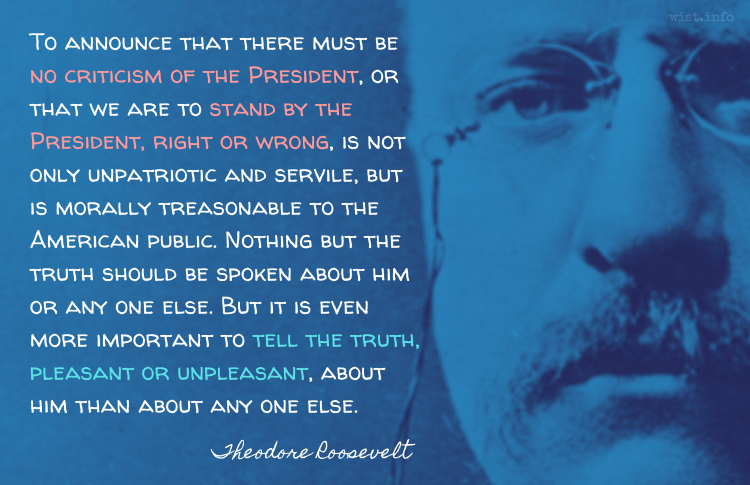
The President is merely the most important among a large number of public servants. He should be supported or opposed exactly to the degree which is warranted by his good conduct or bad conduct, his efficiency or inefficiency in rendering loyal, able, and disinterested service to the nation as a whole. Therefore it is absolutely necessary that there should be full liberty to tell the truth about his acts, and this means that it is exactly as necessary to blame him when he does wrong as to praise him when he does right. Any other attitude in an American citizen is both base and servile. To announce that there must be no criticism of the President, or that we are to stand by the President, right or wrong, is not only unpatriotic and servile, but is morally treasonable to the American public. Nothing but the truth should be spoken about him or any one else. But it is even more important to tell the truth, pleasant or unpleasant, about him than about any one else.
Theodore Roosevelt (1858–1919) American politician, statesman, conservationist, writer; US President (1901–09)
Essay (1918-05-07), “Sedition, A Free Press, and Personal Rule,” Kansas City Star
(Source)
This passage was added to later editions of his essay, "Lincoln and Free Speech,", as printed in The Works of Theodore Roosevelt, vol. 21, The Great Adventure, ch. 7 (1925). It does not appear in the original version of the essay or book.
See also Roosevelt and Roosevelt.