A man who stays long in our American political life, if he has in his soul the generous desire to do effective service for great causes, inevitably grows to regard himself merely as one of many instruments, all of which it may be necessary to use, one at one time, one at another, in achieving the triumph of those causes; and whenever the usefulness of any one has been exhausted, it is to be thrown aside. If such a man is wise, he will gladly do the thing that is next, when the time and the need come together, without asking what the future holds for him. Let the half-god play his part well and manfully, and then be content to draw aside when the god appears. Nor should he feel vain regrets that to another it is given to render greater services and reap a greater reward. Let it be enough for him that he too has served, and that by doing well he has prepared the way for the other man who can do better.
Theodore Roosevelt (1858–1919) American politician, statesman, conservationist, writer; US President (1901–09)
Autobiography, ch. 3 “Practical Politics” (1913)
(Source)
Quotations about:
public servant
Note not all quotations have been tagged, so Search may find additional quotes on this topic.
I shall support every official from the President down who does well, and shall oppose every such official who does ill. I shall not put the personal comfort of the President or of any other public servant above the welfare of the country.
Theodore Roosevelt (1858–1919) American politician, statesman, conservationist, writer; US President (1901–09)
Essay (1918-05), “Lincoln and Free Speech,” Metropolitan Magazine, Vol. 47, No. 6
(Source)
On censorship actions by the Wilson Administration taken against critics of its handling of war efforts.
Reprinted in Appendix C of his The Great Adventure (1918), and as ch. 7 of that book in Vol. 21 of The Works of Theodore Roosevelt (1925), The Great Adventure.
We hold that our loyalty is due solely to the American Republic, and to all our public servants exactly in proportion as they efficiently and faithfully serve the Republic. Our opponents, in flat contradiction of Lincoln’s position, hold that our loyalty is due to the President, not the country; to one man, the servant of the people, instead of to the people themselves. In practice they adopt the fetishism of all believers in absolutism; for every man who parrots the cry of “stand by the President,” without adding the proviso “so far as he serves the Republic” takes an attitude as essentially unmanly as that of any Stuart Royalist who championed the doctrine that the King could do no wrong. No self-respecting and intelligent freeman can take such an attitude.
Theodore Roosevelt (1858–1919) American politician, statesman, conservationist, writer; US President (1901–09)
Essay (1918-05), “Lincoln and Free Speech,” Metropolitan Magazine, Vol. 47, No. 6
(Source)
On censorious actions by the Wilson Administration taken against critics of its handling of war efforts.
Reprinted in Appendix C of his The Great Adventure (1918), and as ch. 7 of that book in Vol. 21 of The Works of Theodore Roosevelt (1925), The Great Adventure.
Authority has always attracted the lowest elements in the human race. All through history mankind has been bullied by scum. Those who lord it over their fellows and toss commands in every direction and would boss the grass in the meadows about which way to bend in the wind are the most depraved kind of prostitutes. They will submit to any indignity, perform any vile act, do anything to achieve power. The worst off-sloughings of the planet are the ingredients of sovereignty. Every government is a parliament of whores.
The trouble is, in a democracy, the whores are us.P. J. O'Rourke (b. 1947) American humorist, editor
Parliament of Whores, “At Home in the Parliament of Whores” (1991)
(Source)
Concluding words of the book.

I am heartily rejoiced that my term is so near its close. I will soon cease to be a servant and will become a sovereign.
James K. Polk (1795–1849) American lawyer, politician, US President (1845–1849)
Diary (1849-02-13)
(Source)
If there’s anything a public servant hates to do it’s something for the public.
Frank McKinney "Kin" Hubbard (1868–1930) American caricaturist and humorist
(Attributed)
The aim of every political constitution is, or ought to be, first to obtain for rulers men who possess most wisdom to discern, and most virtue to pursue, the common good of the society; and in the next place, to take the most effectual precautions for keeping them virtuous whilst they continue to hold their public trust.
James Madison (1751–1836) American statesman, political theorist, US President (1809–17)
The Federalist #57 (19 Feb 1788)
The duty of public men in this Republic is to lead in standards of integrity — both in mind and money.
Dishonor in public life has a double poison. When people are dishonorable in private business, they injure only those with whom they deal or their own chances in the next world. But when there is a lack of honor in Government, the morals of the whole people are poisoned.
Some folks seem to think these are necessary evils in a free government. Or that it is smart politics. Those are deadly sleeping pills. No public man can be just a little crooked.Herbert Hoover (1874–1964) American engineer, bureaucrat, US President (1929–33)
Speech (1951-08-30), “Concerning Honor in Public Life,” Iowa Centennial Celebration, Des Moines, Iowa (radio broadcast)
(Source)
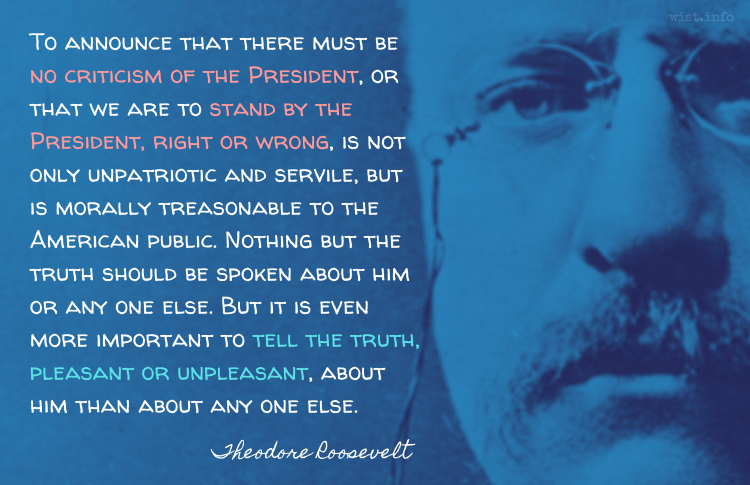
The President is merely the most important among a large number of public servants. He should be supported or opposed exactly to the degree which is warranted by his good conduct or bad conduct, his efficiency or inefficiency in rendering loyal, able, and disinterested service to the nation as a whole. Therefore it is absolutely necessary that there should be full liberty to tell the truth about his acts, and this means that it is exactly as necessary to blame him when he does wrong as to praise him when he does right. Any other attitude in an American citizen is both base and servile. To announce that there must be no criticism of the President, or that we are to stand by the President, right or wrong, is not only unpatriotic and servile, but is morally treasonable to the American public. Nothing but the truth should be spoken about him or any one else. But it is even more important to tell the truth, pleasant or unpleasant, about him than about any one else.
Theodore Roosevelt (1858–1919) American politician, statesman, conservationist, writer; US President (1901–09)
Essay (1918-05-07), “Sedition, A Free Press, and Personal Rule,” Kansas City Star
(Source)
This passage was added to later editions of his essay, "Lincoln and Free Speech,", as printed in The Works of Theodore Roosevelt, vol. 21, The Great Adventure, ch. 7 (1925). It does not appear in the original version of the essay or book.
See also Roosevelt and Roosevelt.
What I call a great minister is one who employs the Way in serving his sovereign. If he cannot do that, he resigns.
[所謂大臣者、以道事君、不可則止。]
Confucius (c. 551- c. 479 BC) Chinese philosopher, sage, politician [孔夫子 (Kǒng Fūzǐ, K'ung Fu-tzu, K'ung Fu Tse), 孔子 (Kǒngzǐ, Chungni), 孔丘 (Kǒng Qiū, K'ung Ch'iu)]
The Analects [論語, 论语, Lúnyǔ], Book 11, verse 24, sec. 3 (11.24.3) (6th C. BC – AD 3rd C.) [tr. Hinton (1998)]
(Source)
Numbered 11.23 by Legge and other early translators, as noted. More recent translators use 11.24, though some use 11.22. All are noted below.
(Source (Chinese)). Other translations:What is called a great minister is one who serves his prince according to what is right; and when he finds he cannot do so, retires.
[tr. Legge (1861), 11.23]Those whom we call 'great ministers' are such as serve their prince conscientiously, and who, when they cannot do so, retire.
[tr. Jennings (1895), 11.23]Men I call statesmen are those who will serve their master according to their sense of duty; who, however, when they find they cannot do that, consistently, with their sense of duty, will resign.
[tr. Ku Hung-Ming (1898)]He who may be called a great minister is one who serves his Prince according to the right, and when that cannot be, resigns.
[tr. Soothill (1910) 11.23]You call a man a great minister when be serves his prince honestly. and retires when he cannot.
[tr. Pound (1933), 11.23]What I call a great minister is one who will only serve is prince while he can do so without infringement of the Way, and as soon as this is impossible, resigns.
[tr. Waley (1938), 11.23]The so-called great minister serves his prince in keeping with The Right Way, and if that is impossible, he quits his post.
[tr. Ware (1950), 11.22]The term "great minister" refers to those who serve their lord according to the Way and who, when this is no longer possible, relinquish office.
[tr. Lau (1979), 11.24]What I call a great minister serves his ruler in accordance with the Way, and when it is impossible to do so he resigns.
[tr. Dawson (1993), 11.22]A great minister is a minister who serves his lord by following the Way, and who resigns as soon as the two are no longer reconcilable.
[tr. Leys (1997), 11.24]Those who are called great ministers use the Way to serve the sovereign. If thye cannot, they should then stop.
[tr. Huang (1997), 11.22]The persons named as the Great Officials, should service the Lords with the benevolent way, and stop if the way does not work.
[tr. Cai/Yu (1998), #284, 11.24]What are called great ministers are those who serve their lord with the way [dao], and when they cannot, resign.
[tr. Ames/Rosemont (1998), 11.24]Those whom one calls great ministers serve their ruler according to the Way, and when they can no longer, they stop.
[tr. Brooks/Brooks (1998), 11:22]What we call "great ministers" are those who seek to serve their lord by means of the Way, and who resign if unable to do so.
[tr. Slingerland (2003), 11.24]The term “great minister” applies to someone who serves the ruler according to the Way. If he cannot do that, he retires.
[tr. Watson (2007), 11.24]The term "great ministers" applies to those who serve their lord in a moral way. If they simply cannot, then they stop.
[tr. Chin (2014), 11.24]