Shame is not of his soul; nor understood,
The greatest evil and the greatest good.[οὐδέ οἱ αἰδὼς
γίγνεται, ἥ τ᾽ ἄνδρας μέγα σίνεται ἠδ᾽ ὀνίνησι.]Homer (fl. 7th-8th C. BC) Greek author
The Iliad [Ἰλιάς], Book 24, l. 44ff (24.44) [Apollo] (c. 750 BC) [tr. Pope (1715-20)]
(Source)
Speaking of Achilles' mistreatment of Hector's corpse. Pope footnotes: "This is obscure. The original is, 'He has no shame, shame which harms men much, and profits them much.' Dr. Leat, following an ancient critic, thinks the passage an interpolation."
Other translations:And shame, a quality
Of so much weight, that both it helps and hurts excessively
Men in their manners, is not known, nor hath the pow’r to be,
In this man’s being.
[tr. Chapman (1611), l. 47ff]Shame, man’s blessing or his curse.
[tr. Cowper (1791), l. 58]
Cowper footnotes: "His blessing, if he is properly influenced by it; his curse in its consequences if he is deaf to its dictates."Nor in him is there sense of shame, which greatly hurts and profits men.
[tr. Buckley (1860)]Conscience, arbiter of good and ill.
[tr. Derby (1864)]Neither hath he shame, that doth both harm and profit men greatly.
[tr. Leaf/Lang/Myers (1891)]That conscience which at once so greatly banes yet greatly boons him that will heed it.
[tr. Butler (1898)]Neither is shame in his heart, the which harmeth men greatly and profiteth them withal.
[tr. Murray (1924)]There is not in him any shame; which does much harm to men but profits them also.
[tr. Lattimore (1951)]He has no shame -- that gift that hinders mortals but helps them, too.
[tr. Fitzgerald (1974)]No shame in the man,
shame that does great harm or drives men on to good.
[tr. Fagles (1990), l. 52ff]Shame and respect no
longer he has, which harm men greatly but profit them also.
[tr. Merrill (2007)]
Quotations about:
goad
Note not all quotations have been tagged, so Search may find additional quotes on this topic.
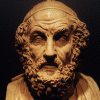
The universe could have been created ugly, and would have functioned. And yet there is beauty everywhere in creation. Beauty gives us an ache, to be worthy of that creation.
Mary Oliver (1935–2019) American poet
Comments at Wellesley College (20 Oct 2010)
(Source)
The last phrase is frequently paraphrased, "We need beauty because it makes us ache to be worthy of it."

A deadline is negative inspiration. Still, it’s better than no inspiration at all.
Rita Mae Brown (b. 1944) American author, playwright
Starting from Scratch: A Different Kind of Writers’ Manual, Part 4 (1988)
(Source)


To avoid dissensions we should ever be on our guard, more especially with those who drive us to argue with them, with those who vex and irritate us, and who say things likely to excite us to anger. When we find ourselves in company with quarrelsome, eccentric individuals, people who openly and unblushingly say the most shocking things, difficult to put up with, we should take refuge in silence, and the wisest plan is not to reply to people whose behavior is so preposterous.
Those who insult us and treat us contumeliously are anxious for a spiteful and sarcastic reply: the silence we then affect disheartens them, and they cannot avoid showing their vexation; they do all they can to provoke us and to elicit a reply, but the best way to baffle them is to say nothing, refuse to argue with them, and to leave them to chew the cud of their hasty anger. This method of bringing down their pride disarms them, and shows them plainly that we slight and despise them.[Sed etiam ille cavendus; est, qui videri potest, quicumque inritat, quicumque incitat, quicumque exasperat, quicumque incentiva luxuriae aut libidinis suggerit. Quando ergo aliquis nobis convitiatur, lacessit, ad violentiam provocat, ad iurgium vocat: tunc silentium exerceamus, tunc muti fieri non erubescamus. Peccator est enim qui nos provocat, qui iniuriam facit et nos similes sui fieri desiderat.
Denique si taceas, si dissimules, solet dicere: Quid taces? Loquere, si audes; sed non audes, mutus es, elinguem te feci. Si ergo taceas, plus rumpitur; victum sese putat, inrisum, posthabitum atque inlusum.]Ambrose of Milan (339–397) Roman theologian, statesman, Christian prelate, saint, Doctor of the Church [Aurelius Ambrosius]
De Officiis Ministrorum [On the Duties of the Clergy], Book 1, ch. 5, sec. 17-18 (AD 386)
(Source)
(Source (Latin)). Another translation:But he also is to be shunned which is visible whosoever he be that provoketh, whosoever he be that inciteth, whosoever he be that exaspereth, whosoever he be that giveth the first breath, that suggesteth the first blast to kindle the coales to luxurie, and lustfulnesse. When some one therefore doth raile at us, doth vexe, provoke to violence, stirre up to wrath, then let us exercise silence; then let us not be ashamed to be dumbe.
For hee is a very sinfull wretch, that provoking, that offering injurie is desirous therein to make us like himselfe. To shut up the matter if thou holdest thy peace, if thou seemest not to regard whatsoever he speakes, he is wont to say, why art thou mute? speake if thou darest? but thou darest not, thou art put to a non-plus, I have made thee lose thy tongue; If therefore thou be silent he is more molested, and ready to breake with anger, because he thinkes himselfe overcome, skorned, deluded, and contemned.
[tr. Humfrey (1637)]
My test of the real worth of a man as a preacher is when his congregation go away, saying, not, “What a beautiful sermon!” but “I will do something.”
François de Sales (1567–1622) French bishop, saint, writer [a.k.a. Francis de Sales, b. François de Boisy]
(Attributed)
(Source)

Where there’s a whip there’s a will, my slugs.
J.R.R. Tolkien (1892–1973) English writer, fabulist, philologist, academic [John Ronald Reuel Tolkien]
The Lord of the Rings, Vol. 3: The Return of the King, Book 6, ch. 2 “The Land of Shadow” [The Orc-driver] (1955)
(Source)
Our chief want in life is someone who shall make us do what we can. This is the service of a friend. With him we are easily great.
Ralph Waldo Emerson (1803–1882) American essayist, lecturer, poet
Essay (1860), “Considerations by the Way,” The Conduct of Life, ch. 7
(Source)
Based on a course of lectures by that name first delivered in Pittsburg, 1851-03.