
Success is relative:
It is what we can make of the mess we have made of things.T. S. Eliot (1888–1965) American-British poet, critic, playwright [Thomas Stearns Eliot]
The Family Reunion, 2.3 (1939)
Quotations about:
spin
Note not all quotations have been tagged, so Search may find additional quotes on this topic.
If one morning I walked on top of the water across the Potomac River, the headline that afternoon would read: “President Can’t Swim.”
Lyndon B. Johnson (1908–1973) American politician, educator, US President (1963–69)
(Attributed)
Frequently attributed to Johnson, usually referencing the last year or two of his presidency, when public opinion turned against him over Vietnam. I am unable to find any actual citable source.

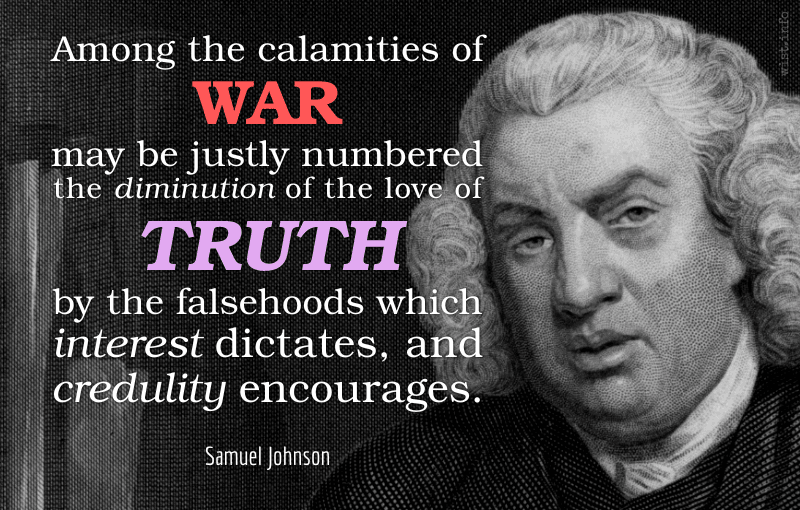
Among the calamities of war, may be justly numbered the diminution of the love of truth, by the falsehoods which interest dictates, and credulity encourages.
Samuel Johnson (1709–1784) English writer, lexicographer, critic
Essay (1758-11-11), The Idler, No. 30
(Source)

This is always the danger with propaganda, that it becomes at last more credible to its disseminators than to its targets.
Garry Wills (b. 1934) American author, journalist, historian
The Kennedy Imprisonment: A Meditation on Power, ch. 18 (1981)
(Source)
Referring to US government efforts in the early 60s to paint Castro's regime in Cuba as weak, eventually leading to the US government itself thinking the regime could be easily toppled.

We confess to small faults to create the impression that we have no great ones.
[Nous n’avouons de petits défauts que pour persuader que nous n’en avons pas de grands.]
François VI, duc de La Rochefoucauld (1613–1680) French epigrammatist, memoirist, noble
Réflexions ou sentences et maximes morales [Reflections; or Sentences and Moral Maxims], ¶327 (1665-1678) [tr. Kronenberger (1959)]
(Source)
First appeared in the 3rd (1671) edition. See also ¶126.
(Source (French)). Other translations:When we own small Faults, it is with a design to make People believe, we have no great ones.
[tr. Stanhope (1694), ¶327]We confess small faults in order to insinuate that we have no great ones.
[pub. Donaldson (1783), ¶127]We confess small faults, by way of insinuating that we have no great ones.
[ed. Carvill (1835), ¶111]We confess our little faults only to persuade others that we have no great ones.
[ed. Gowens (1851), ¶337]We own to small faults to persuade others that we have not great ones.
[tr. Bund/Friswell (1871), ¶327]We admit our petty foibles only to disclaim greater faults.
[tr. Heard (1917), ¶334]We will admit our minor defects, but only to persuade others that we have no major ones.
[tr. FitzGibbon (1957), ¶327]We own up to minor failings, but only so as to convince others that we have no major ones.
[tr. Tancock (1959), ¶327]We confess to small faults only for the purpose of persuading others that we do not possess great ones.
[tr. Whichello (2016), ¶327]We admit to lesser faults in order persuade people that we have no greater ones.
[tr. Chandler, ¶327]

Get your facts first, and then you can distort them as much as you please.
Mark Twain (1835–1910) American writer [pseud. of Samuel Clemens]
Interview (1889) by Rudyard Kipling, Elmira, New York, From Sea to Sea, Part 2, ch. 37 “An Interview with Mark Twain” (1899)
(Source)
Broader context:"Personally I never care for fiction or story-books. What I like to read about are facts and statistics of any kind. If they are only facts about the raising of radishes, they interest me. Just now, for instance, before you came in" -- he pointed to an encyclopædia on the shelves -- "I was reading an article about 'Mathematics.' Perfectly pure mathematics.
"My own knowledge of mathematics stops at 'twelve times twelve,' but I enjoyed that article immensely. I didn't understand a word of it: but facts, or what a man believes to be facts, are always delightful. That mathematical fellow believed in his facts. So do I. Get your facts first, and" -- the voice dies away to an almost inaudible drone -- "then you can distort 'em as much as you please."
Variant: "Get the facts first. You can distort them later."
For more discussion of this quotation, see "Get your facts first, and then you can distort them… (Barry Popik).
I am firm. You are obstinate. He is a pig-headed fool.
Bertrand Russell (1872–1970) English mathematician and philosopher
Comment, The Brains Trust, BBC Radio (1948-04-26)
(Source)
Offered as a game, "Conjugations" (today referred to by linguists as "Russell Conjugations" or "Emotive Conjugations"). The publication The New Statesman and Nation subsequently ran a competition for similar "irregular verbs," which were later printed (1948-05-15), along with the quote from Russell.
Sometimes misattributed to British journalist Katharine Whitehorn.