

We grudge no man a fortune which represents his own power and sagacity, when exercised with entire regard to the welfare of his fellows. […] We grudge no man a fortune in civil life if it is honorably obtained and well used. It is not even enough that it should have gained without doing damage to the community. We should permit it to be gained only so long as the gaining represents benefit to the community. This, I know, implies a policy of a far more active governmental interference with social and economic conditions in this country than we have yet had, but I think we have got to face the fact that such an increase in governmental control is now necessary.
Theodore Roosevelt (1858–1919) American politician, statesman, conservationist, writer; US President (1901–09)
Speech (1910-08-31), “The New Nationalism,” John Brown Memorial Park dedication, Osawatomie, Kansas
(Source)
Quotations about:
national interest
Note not all quotations have been tagged, so Search may find additional quotes on this topic.
There can be no greater error than to expect or calculate upon real favors from nation to nation. It is an illusion which experience must cure, which a just pride ought to discard.
George Washington (1732–1799) American military leader, Founding Father, US President (1789–1797)
Farewell Address (17 Sep 1796) [with A. Hamilton]
It is a bad thing for a nation to raise and to admire a false standard of success; and there can be no falser standard than that set by the deification of material well-being in and for itself.
Theodore Roosevelt (1858–1919) American politician, statesman, conservationist, writer; US President (1901–09)
Speech (1910-04-23), “Citizenship in a Republic [The Man in the Arena],” Sorbonne, Paris
(Source)
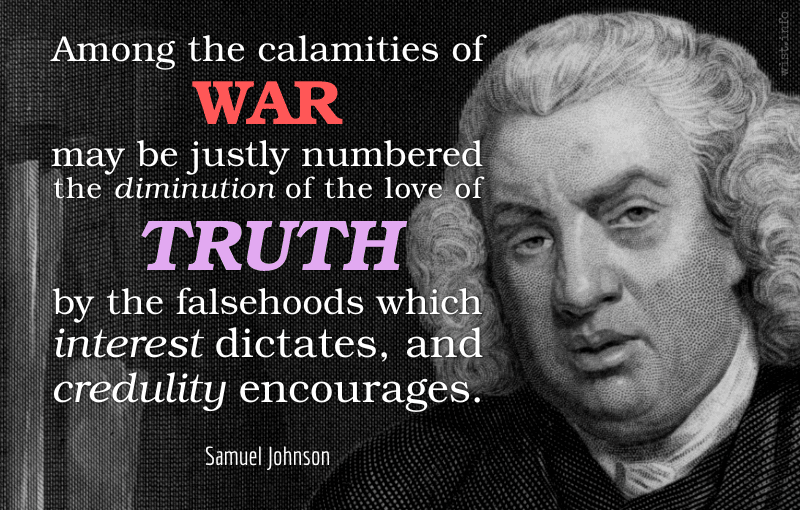
Among the calamities of war, may be justly numbered the diminution of the love of truth, by the falsehoods which interest dictates, and credulity encourages.
Samuel Johnson (1709–1784) English writer, lexicographer, critic
Essay (1758-11-11), The Idler, No. 30
(Source)
Patriotism means to stand by the country. It does not mean to stand by the President or any other public official save exactly to the degree in which he himself stands by the country. It is patriotic to support him in so far as he efficiently serves the country. It is unpatriotic not to oppose him to the exact extent that by inefficiency or otherwise he fails in his duty to stand by the country. In either event, it is unpatriotic not to tell the truth — whether about the President or about any one else.
Theodore Roosevelt (1858–1919) American politician, statesman, conservationist, writer; US President (1901–09)
Essay (1918-05), “Lincoln and Free Speech,” Metropolitan Magazine, Vol. 47, No. 6
(Source)
On war-time censorship by the Wilson Administration taken against critics of its handling of war efforts.
Reprinted in Appendix C of his The Great Adventure (1918), and as ch. 7 of that book in Vol. 21 of The Works of Theodore Roosevelt (1925), The Great Adventure.
See also Roosevelt and Roosevelt.