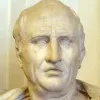
He won over the ignorant masses with shows, building projects, largesses, and banquets. His followers he bound to him by rewards, his opponents by an apparent clemency. In short, he succeeded in bringing a free country, partly because of its fear, partly because of its passivity, to an acceptance of servitude.
[Muneribus, monumentis, congiariis, epulis multitudinem imperitam delenierat; suos praemiis, adversarios clementiae specie devinxerat. Quid multa? Attulerat iam liberae civitati partim metu partim patientia consuetudinem serviendi.]
Marcus Tullius Cicero (106–43 BC) Roman orator, statesman, philosopher
Philippics [Philippicae; Antonian Orations], No. 2, ch. 45 / sec. 116 (2.45/2.116) (44-10-24 BC) [tr. Berry (2006)]
(Source)
Talking of Julius Caesar and his ambitions of becoming a king.
(Source (Latin)). Other translations:He had conciliated the ignorant multitude with gladiatorial shows, with the erection of public buildings, with largesses, with feasts; he had bound his own followers to him with rewards, his opponents with a show of clemency; he had already rendered slavery familiar to a free state, partly by fear, partly by patience.
[tr. King (1877)]He had conciliated the ignorant multitude by presents, by monuments, by largesses of food, and by banquets; he had bound his own party to him by rewards, his adversaries by the appearances of clemency. Why need I say much on such a subject? He had already brought a free city, partly by fear, partly by patience, into a habit of slavery.
[tr. Yonge (1903)]He had won the affections of the ignorant populace by means of entertainments, banquets, largesses, and other public benefactions, while he had bound his immediate followers to him by his liberality, his opponents by an appearance of clemency. In a word, he had so revolutionised public feeling, that partly from fear, and partly from acquiescence, a state which prided itself upon its freedom had become accustomed to subjection.
[ed. Harbottle (1906)]By shows, buildings, largesses, banquets he had conciliated the ignorant crowd; his own followers he had bound to him by rewards, his adversaries by a show of clemency: in brief, he had already brought to a free community -- partly by fear, partly by endurance -- a habit of servitude.
[tr. Ker (Loeb) (1926)]He softened up the ignorant masses with games, buildings, gifts and feasts. He bound his followers to himself with rewards, his opponents with the appearance of clemency. Why go on? He brought to a free state acceptance of slavery, partly through fear, partly through familiarity.
[tr. McElduff (2011)]