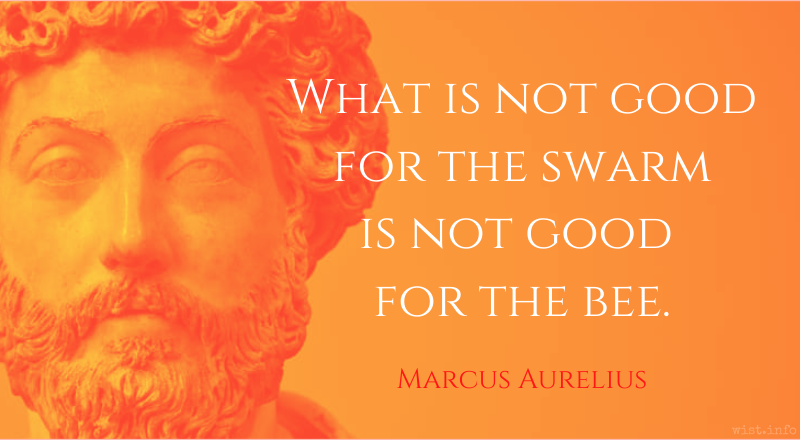
What is not good for the swarm is not good for the bee.
[Τὸ τῷ σμήνει μὴ συμφέρον οὐδὲ τῇ μελίσσῃ συμφέρει.]
Marcus Aurelius (AD 121-180) Roman emperor (161-180), Stoic philosopher
Meditations [To Himself; Τὰ εἰς ἑαυτόν], Book 6, ch. 54 (6.54) (AD 161-180) [tr. Rendall (1898)]
(Source)
(Source (Greek)). Alternate translations:That which is not good for the beehive, cannot be good for the bee.
[tr. Casaubon (1634), 6.49]That which is not for the Interest of the whole Swarm, is not for the Interest of a single Bee.
[tr. Collier (1701); Collier/Zimmern (1887)]What is not the interest of the hive, is not the interest of the bee.
[tr. Hutcheson/Moor (1742)]That which is not for the interest of the whole hive, cannot be so for any single bee.
[tr. Graves (1792), 6.48]That which is not good for the swarm, neither is it good for the bee.
[tr. Long (1862)]What profits not the swarm profits not the bee.
[tr. Hutcheson/Chrystal (1902)]That which is not in the interests of the hive cannot be in the interests of the bee.
[tr. Haines (Loeb) (1916)]What does not benefit the hive is no benefit to the bee.
[tr. Farquharson (1944)]What is no good for the hive is no good for the bee.
[tr. Staniforth (1964)]What brings no benefit to the hive brings none to the bee.
[tr. Hard (1997 ed.)]What injures the hive injures the bee.
[tr. Hays (2003)]What does not benefit the hive does not benefit the bee either.
[tr. Hammond (2006)]What brings no benefit to the hive brings none to the bee.
[tr. Hard (2011 ed.)]What does not benefit the hive does not benefit the bee.
[tr. Gill (2013)]