A rising mass movement attracts and holds a following not by its doctrine and promises but by the refuge it offers from the anxieties, barrenness and meaninglessness of an individual existence. It cures the poignantly frustrated not by conferring on them an absolute truth or by remedying the difficulties and abuses which made their lives miserable, but by freeing them from their ineffectual selves — and it does this by enfolding and absorbing them into a closely knit and exultant corporate whole.
Eric Hoffer (1902–1983) American writer, philosopher, longshoreman
True Believer: Thoughts on the Nature of Mass Movements, Part 2, ch. 5, § 34 (2.5.34) (1951)
(Source)
Quotations about:
solidarity
Note not all quotations have been tagged, so Search may find additional quotes on this topic.
The forest was shrinking, but the trees kept voting for the axe because its handle was made of wood and they thought it was one of the them.
Proverbs, Sayings, and Adages
Turkish Proverb
While this particular phrasing is widely labeled online as a Turkish proverb, it is a fairly recent reformulation of a Talmudic or Turkish set of proverbs, and is not credited solely to the Turks.
The Babylonian Talmud (6th Century AD) includes a passage (Sanhedrin, Perek 4, 39B), indicating it was a common proverb:As this is as people say: From and within the forest comes the ax to it, as the handle for the ax that chops the tree is from the forest itself.
As well as:This is as people say: From and within the forest comes the ax to it, as King David was a descendant of Ruth the Moabite.
This phrase was brought into English in Rev. J. Ray's A Collection of English Proverbs (1678) as a "Hebrew Adage":The axe goes to the wood, from whence it borrowed its helve: [the saying] is used against those who are injurious to those from whom they are derived, or from whom they have received their power.
Ray's work continued in reprint for over a century, well-establishing the phrase in English.
In a similar vein, Metin Yurtbaşı's Dictionary of Turkish Proverbs (1993) includes two such phrases, indexed under "Ingratitude". It attributes these back to Ebüzziya Tevfik, Durüb-ı, Emsâl-i Osmaniyye [Ottoman Proverbs] (1885). First:They struck at the tree with an ax; and the tree said: “The handle is made from my body.”
[Ağaca balta vurmuşlar, “Sapı bedenimden” demiş.]
Second:An ax went into the woods and its handle was of itself.
[Ormana (bir) balta girmiş sapı yine kendisinden (imiş).]
There are a variety of later uses, in books and then in social media, that further evolved the concept into the quotation that leads this entry, which was first tweeted by @mabarsayaaaaa (2018-02-24). In this more political form, it and further variants have also been credited as an African (Yoruba) proverb (often by African tweeters).
For more discussion of the background and origin of this quotation, see:

CHORUS: It is right for women to stand by a woman’s cause.
[ΧΟΡΟΣ: γυναῖκα γὰρ δὴ συμπονεῖν γυναικὶ χρή.]
Euripides (485?-406? BC) Greek tragic dramatist
Helen [Ἑλένη], l. 329 (412 BC) [tr. Lattimore (1956)]
(Source)
Encouraging Helen to learn more about her husband's fate from the prophetess Theonoë, and offering to go with her.(Source (Greek)). Other translations:Thus a woman ought
With friendly aid to share a woman's cares.
[tr. Potter (1783), l. 370ff]For 'tis a woman's duty to exert
Her utmost efforts in a woman's cause.
[tr. Wodhull (1809)]For it is meet that a woman should with a woman labor.
[tr. Buckley (1850)]For, truly, women ought to help each other.
[tr. Coleridge (1891)]That woman woman's burden share, is meet.
[tr. Way (Loeb) (1912)]Women in woman's need must sympathise.
[tr. Sheppard (1925)]For women ought to give each other helping hands.
[tr. Warner (1951)]Women ought to help each other.
[tr. Vellacott (1954)]We are all women;
and it is right for us to shoulder one another's burdens.
[tr. Meagher (1986)]Women should support one another.
[tr. Davie (2002)]For 'tis a woman's bounden duty to share a sister's trouble.
[tr. Athenian Society (2006)]Women should stick together, and help each other out.
[tr. A. Wilson (2007)]We women must help one another.
[tr. Theodoridis (2011)]For woman must with woman toil.
[tr. Ambrose et al. (2018)]For, truly, women ought to help each other.
[tr. Coleridge / Helen Heroization Team]
It seems to me that it is the part of common sense for the world as a whole to protest in its own interest against wholesale persecution, because none of us by ourselves would be strong enough to stand against a big enough group which decided to treat us in the same way. We may have our individual likes and dislikes, but this is a question which far transcends prejudices or inclinations.
Eleanor Roosevelt (1884–1962) American politician, diplomat, activist; First Lady of the US (1933–45)
Column (1943-08-13), “My Day”
(Source)
On the persecution of Jews in Europe.

Why is it that right-wing bastards always stand shoulder to shoulder in solidarity, while liberals fall out among themselves?
Yevgeny Yevtushenko (1933–2017) Russian poet, writer, film director, academic [Евге́ний Евтуше́нко, Evgenij Evtušenko]
In The Observer (15 Dec 1991)
(Source)

Virtue is not left to stand alone. He who practises it will have neighbors.
[德不孤、必有鄰。]
Confucius (c. 551- c. 479 BC) Chinese philosopher, sage, politician [孔夫子 (Kǒng Fūzǐ, K'ung Fu-tzu, K'ung Fu Tse), 孔子 (Kǒngzǐ, Chungni), 孔丘 (Kǒng Qiū, K'ung Ch'iu)]
The Analects [論語, 论语, Lúnyǔ], Book 4, verse 25 (4.25) (6th C. BC – AD 3rd C.) [tr. Legge (1861)]
(Source)
Differing commentary on the text can be found; it may mean that virtue attracts others to its side, or it may be a comment on virtue needing to be practiced in a social setting.
(Source (Chinese)). Other translations:Virtue dwells not alone: she must have neighbors.
[tr. Jennings (1895)]Moral worth is never left alone; society is sure to grow round him.
[tr. Ku Hung-Ming (1898)]Virtue never dwells alone; it always has neighbors.
[tr. Soothill (1910)]Virtue attracts friends.
[tr. Soothill (1910), Alternate]Candidness is not fatherless, it is bound to have neighbors.
[tr. Pound (1933)]Moral force (tê) never dwells in solitude; it will always bring neighbors.
[tr. Waley (1938)]High moral conduct does not remain alone; it is sure to attract neighbors.
[tr. Ware (1950)]Virtue never stands alone. It is bound to have neighbors.
[tr. Lau (1979)]Virtue is not solitary. It is bound to have neighbors.
[tr. Dawson (1993)]Virtue is not solitary; it always has neighbors.
[tr. Leys (1997)]The virtuous are not solitary. They surely have neighbors.
[tr. Huang (1997)]A virtuous person is not alone, certainly has his companions.
[tr. Cai/Yu (1998)]Excellent persons (de) do not dwell alone; they are sure to have neighbors.
[tr. Ames/Rosemont (1998)]Virtue is not solitary; it must have neighbors.
[tr. Brooks/Brooks (1998)]Integrity's never alone. It always has neighbors.
[tr. Hinton (1998)]Virtue is never solitary; it always has neighbors.
[tr. Slingerland (2003)]Virtue is not alone. It invariably has neighbors.
[tr. Watson (2007)]Virtue does not stand alone. It is bound to have neighbors.
[tr. Annping Chin (2014)]A virtuous person is never lonely because there is always a comrade nearby.
[tr. Li (2020)]

Understand, democracy does not require uniformity. Our founders argued. They quarreled. Eventually they compromised. They expected us to do the same. But they knew that democracy does require a basic sense of solidarity — the idea that for all our outward differences, we’re all in this together; that we rise or fall as one.
Barack Obama (b. 1961) American politician, US President (2009–2017)
“Farewell Address,” Chicago (10 Jan 2017)
(Source)

I am an adherent of the ideal of democracy, although I know well the weaknesses of the democratic form of government. Social equality and economic protection of the individual have always seemed to me the important communal aims of the state. Although I am a typical loner in daily life, my consciousness of belonging to the invisible community of those who strive for truth, beauty, and justice keeps me from feeling isolated.
[Ich bekenne mich zum Ideal der Demokratie, trotzdem mir die Nachteile demokratischer Staatsform wohlbekannt sind. Sozialer Ausgleich und wirtschaftlicher Schutz des Individuums erschienen mir stets als wichtige Ziele der staatlichen Gemeinschaft. ch bin zwar im täglichen Leben ein typischer Einspänner, aber das Bewusstsein, der unsichtbaren Gemeinschaft derjenigen anzugehören, die nach Wahrheit, Schönheit und Gerechtigkeit streben, hat das Gefühl der Vereinsamung nicht aufkommen lassen.]
Albert Einstein (1879–1955) German-American physicist
“My Credo Mein Glaubensbekenntnis],” recording for the German League of Human Rights (Autumn 1932)
(Source)
Einstein crafted and recrafted his credo multiple times in this period, and specifics are often muddled by differing translations and by his reuse of certain phrases in later writing.
The surest defense against Evil is extreme individualism, originality of thinking, whimsicality, even — if you will — eccentricity. That is, something that can’t be feigned, faked, imitated; something even a seasoned imposter couldn’t be happy with. Something, in other words, that can’t be shared, like your own skin: not even by a minority. Evil is a sucker for solidity. It always goes for big numbers, for confident granite, for ideological purity, for drilled armies and balanced sheets. Its proclivity for such things has to do with its innate insecurity, but this realization, again, is of small comfort when Evil triumphs.
Joseph Brodsky (1940–1996) Russian-American poet, essayist, Nobel laureate, US Poet Laureate [Iosif Aleksandrovič Brodskij]
Commencement Address, Williams College (24 May 1984)
(Source)

Of course I vote! If you’re a woman, or a person of color, or a person who doesn’t own property, or even a white male who doesn’t belong to the nobility, centuries of struggle and many deaths have bought you the right to vote. I vote to keep faith with peasant rebels and suffragist hunger strikers and civil rights workers braving the lynch mobs of the South, if for no other reason. But there is another reason — because who we vote for has an enormous impact on real peoples’ lives.
Starhawk (b. 1951) American writer, activist, feminist theologian [b. Miriam Simos]
Blog post (2016-11-07), “Pre-Election Day Thoughts”
(Source)

That city [is best to live in,] in which those who are not wronged, no less than those who are wronged, exert themselves to punish the wrongdoers.
Solon (c. 638 BC - 558 BC) Athenian statesman, lawmaker, poet
Quoted in Plutarch, Parallel Lives, “The Life of Solon,” sec. 18.5 [tr. Perrin (1914)]
(Source)
Alt. trans.:
- "That [city is best managed] in which those who are not wronged espouse the cause of those who are, and punish their oppressors." [tr. Stewart, Long (1894)]
- "That [city is best modeled] where those that are not injured try and punish the unjust as much as those that are." [Source]
- "That [city is best modeled] where those who are not injured, are as ready to prosecute and punish offenders, as those who are." [tr. Langhorne, Langhorne (1819)]
- "The city [is best governed of all] where those who have not been wronged show themselves just as ready to punish the offender as thouse who have been." [tr. Scott-Kilvert (1960)]
- Paraphrased as "Justice can be secured in Athens if those who are not injured feel as indignant as those who are," in Earl Warren, "The Law and the Future," Fortune (Nov 1955).
What is not good for the swarm is not good for the bee.
[Τὸ τῷ σμήνει μὴ συμφέρον οὐδὲ τῇ μελίσσῃ συμφέρει.]
Marcus Aurelius (AD 121–180) Roman emperor (161–180), Stoic philosopher
Meditations [To Himself; Τὰ εἰς ἑαυτόν], Book 6, ch. 54 (6.54) (AD 161-180) [tr. Rendall (1898)]
(Source)
(Source (Greek)). Other translations:That which is not good for the beehive, cannot be good for the bee.
[tr. Casaubon (1634), 6.49]That which is not for the Interest of the whole Swarm, is not for the Interest of a single Bee.
[tr. Collier (1701); Collier/Zimmern (1887)]What is not the interest of the hive, is not the interest of the bee.
[tr. Hutcheson/Moor (1742)]That which is not for the interest of the whole hive, cannot be so for any single bee.
[tr. Graves (1792), 6.48]That which is not good for the swarm, neither is it good for the bee.
[tr. Long (1862)]What profits not the swarm profits not the bee.
[tr. Hutcheson/Chrystal (1902)]That which is not in the interests of the hive cannot be in the interests of the bee.
[tr. Haines (Loeb) (1916)]What does not benefit the hive is no benefit to the bee.
[tr. Farquharson (1944)]What is no good for the hive is no good for the bee.
[tr. Staniforth (1964)]What brings no benefit to the hive brings none to the bee.
[tr. Hard (1997 ed.)]What injures the hive injures the bee.
[tr. Hays (2003)]What does not benefit the hive does not benefit the bee either.
[tr. Hammond (2006)]What brings no benefit to the hive brings none to the bee.
[tr. Hard (2011 ed.)]What does not benefit the hive does not benefit the bee.
[tr. Gill (2013)]
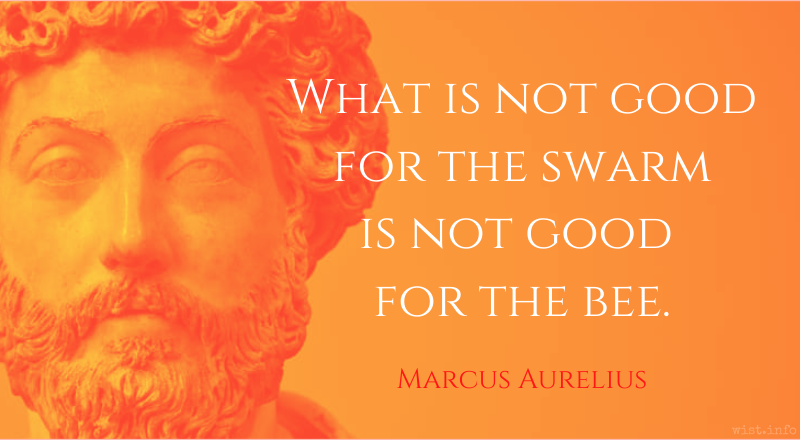

Your Honor, years ago I recognized my kinship with all living beings, and I made up my mind then that I was not one bit better than the meanest on earth. I said then, and I say now, that while there is a lower class, I am in it; and while there is a criminal element, I am of it; and while there is a soul in prison, I am not free.
Eugene V. Debs (1855–1926) American union leader, activist, socialist, politician
Statement to the Court (1918-09-18)
(Source)
On being convicted of sedition for urging resistance to the draft. Often paraphrased:As long as there is a lower class, I am in it. As long as there is a criminal element, I am of it. As long as there is a soul in prison, I am not free.
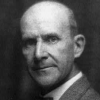
People glorify all sorts of bravery except the bravery they might show on behalf of their nearest neighbors.
George Eliot (1819–1880) English novelist [pseud. of Mary Ann Evans]
Middlemarch, Book 8, ch. 72 (1871-72)
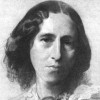
All the gang of those who rule us
Hope our quarrels never stop
Helping them to split and fool us
So they can remain on top.Bertolt Brecht (1898–1956) German poet, playwright, director, dramaturgist
“Solidarity song [Solidaritätslied]” (1931) [tr. Willett]
But this I will advise you to, which is, never to attack whole bodies of any kind; for, besides that all general rules have their exceptions, you unnecessarily make yourself a great number of enemies, by attacking a corps collectively. Among women, as among men, there are good as well as bad; and it may be full as many, or more, good than among men. This rule holds as to lawyers, soldiers, parsons, courtiers, citizens, &c. They are all men, subject to the same passions and sentiments, differing only in the manner, according to their several educations; and it would be as imprudent as unjust to attack any of them by the lump. Individuals forgive sometimes; but bodies and societies never do.
Lord Chesterfield (1694–1773) English statesman, wit [Philip Dormer Stanhope]
Letter to his son, #110 (5 Apr 1746)
(Source)

United we stand, divided we fall.
Aesop (620?-560? BC) Legendary Greek storyteller
Fables [Aesopica], “The Four Oxen and the Lion” (6th C BC) [tr. Jacobs (1894)]
(Source)

Many hands make light warke.
John Heywood (1497?-1580?) English playwright and epigrammist
Proverbes, Part 2, ch. 5 (1546)
(Source)

CYNICAL CAT: Little one, I would like to see anyone — prophet, king or God — persuade a thousand cats to do anything at the same time.
Neil Gaiman (b. 1960) British author, screenwriter, fabulist
Sandman, Book 3. Dream Country, # 18 “A Dream of a Thousand Cats” (1990-08)
(Source)


For the strength of the Pack is the Wolf, and the strength of the Wolf is the Pack.
Rudyard Kipling (1865–1936) English writer
“The Law of the Jungle,” The Second Jungle Book (1899)
Under a government which imprisons any unjustly, the true place for a just man is also a prison.
Henry David Thoreau (1817–1862) American philosopher and writer
Essay (1849-05), “Resistance to Civil Government [On the Duty of Civil Disobedience],” Æsthetic Papers, No. 1, Article 10
(Source)
Based on an 1848 lecture at the Concord Lyceum.