Every group of six or more has its inner circle, its outer circle, and its hangers-on.
Mignon McLaughlin (1913–1983) American journalist and author
The Neurotic’s Notebook, ch. 6 (1963)
(Source)
Quotations about:
group
Note not all quotations have been tagged, so Search may find additional quotes on this topic.

Any collocation of persons, no matter how numerous, how scant, how even their homogeneity, how firmly they profess common doctrine, will presently reveal themselves to consist of smaller groups espousing variant versions of the common creed; and these sub-groups will manifest sub-sub-groups, and so to the final limit of the single individual, and even in this single person conflicting tendencies will express themselves.
Jack Vance (1916–2013) American writer [John Holbrook Vance]
The Languages of Pao, ch. 5, epigraph (1958)
(Source)
The epigraph is attributed to the fictional Adam Ostwald, in his book Human Society.
First published in Satellite Science Fiction magazine (1957-12).

What counts now is not just what we are against, but what we are for. Who leads us is less important than what leads us — what convictions, what courage, what faith — win or lose. A man doesn’t save a century, or a civilization, but a militant party wedded to a principle can.
Adlai Stevenson II (1900–1965) American politician, diplomat, statesman
Speech (1952-07-21), Democratic National Convention, Chicago
(Source)
Of course one does meet brilliant men, but they are isolated. The fashion nowadays is all for groups and societies of every sort. — It is always a sign of mediocrity in people when they herd together, whether their group loyalty is to Solovyev or to Kant or Marx. The truth is only sought by individuals, and they break with those who do not love it enough.
Boris Pasternak (1890–1960) Russian poet, novelist, and literary translator
Doctor Zhivago [До́ктор Жива́го], Part 1, ch. 1 “The Five-O’Clock Express,” sec. 4 [Nikolai Nikolaievich] (1955) [tr. Hayward & Harari (1958), UK ed.]
(Source)
Other translations:Yes, there are gifted men, but the fashion nowadays is all for groups and societies of every sort. Gregariousness is always the refuge of mediocrities, whether they swear by Solovyiëv or Kant or Marx. Only individuals seek the truth, and they shun those whose sole concern is not the truth.
[tr. Hayward & Harari (1958), US ed.]You come across talented people. But now various circles and associations are the fashion. Every herd is a refuge for giftlessness, whether it's a faith in Soloviev, or Kant, or Marx. Only the solitary seek the truth, and they break with all those who don't love it sufficiently.
[tr. Pevear & Volokhonsky (2010)]

No solitary miscreant, scarcely any solitary maniac, would venture on such actions and imaginations, as large communities of sane men have, in such circumstances, entertained as sound wisdom.
Thomas Carlyle (1795–1881) Scottish essayist and historian
Essay (1829-06), “Signs of the Times,” Edinburgh Review No. 98, Art. 7
(Source)
But the thing I must point out is that my despair is of the group itself, the group as it’s assembled. And I’ve never identified with the “local group,” no matter what it identifies itself as. But I do cherish, and love, and am thrilled by individuals. People, one by one as I meet them, I find are wondrous. When you have time to listen and watch them, when you look them in the eyes, you see all the potential of the whole thing, this whole species that has such a wonderful gift that was given by nature. The mind, the ability to objectify and to think abstractly. And we’ve wasted it by everyone wanting a fanny pack and to go to the mall and to be paying 18 percent interest on things that we don’t need, don’t want, don’t work, and can’t give back.
George Carlin (1937–2008) American comedian
Interview (2001-07) by Marc Cooper, The Progressive
(Source)
It always demands a far greater degree of courage for an individual to oppose an organized movement than to let himself be carried along with the stream — individual courage, that is, a variety of courage that is dying out in these times of progressive organization and mechanization. During the war practically the only courage I ran across was mass courage, the courage that comes of being one of a herd, and anyone who examines this phenomenon more closely will find it to be compounded of some very strange elements: a great deal of vanity, a great deal of fear — yes, fear of staying behind, fear of being sneered at fear of independent action, and fear, above all, of taking up a stand against the mass enthusiasm of one’s fellows.
Stefan Zweig (1881–1942) Austrian novelist, playwright, journalist, biographer
Beware of Pity (1939)
Society is like the air, necessary to breathe but insufficient to live on.
George Santayana (1863–1952) Spanish-American poet and philosopher [Jorge Agustín Nicolás Ruíz de Santayana y Borrás]
The Life of Reason, Vol. 2: Reason in Society, ch. 8 “Ideal Society” (1905)
(Source)
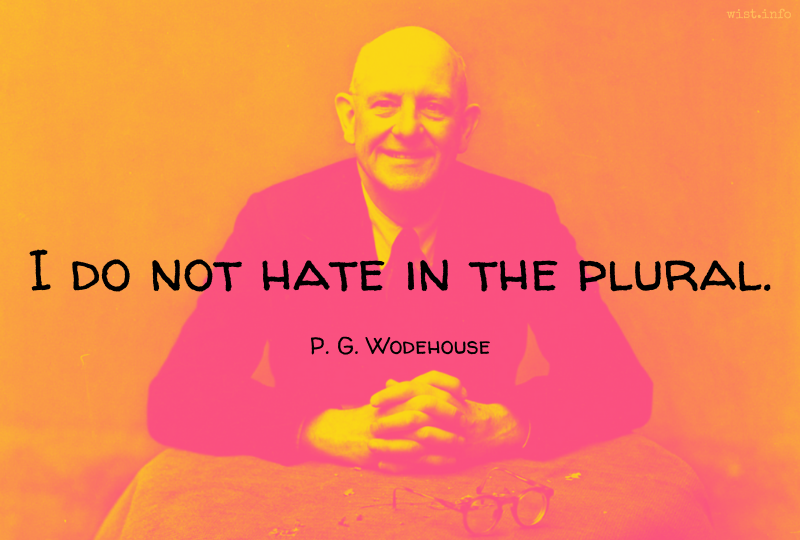
I do not hate in the plural.
P. G. Wodehouse (1881–1975) Anglo-American humorist, playwright and lyricist [Pelham Grenville Wodehouse]
(Attributed)
When asked, as a former WWII internee, whether he hate the Germans (or the Nazis).
George Orwell, writing in 1945 a defense of Wodehouse's actions while an internee, quoted him in a more complex version of this:I never was interested in politics. I’m quite unable to work up any kind of belligerent feeling. Just as I’m about to feel belligerent about some country I meet a decent sort of chap. We go out together and lose any fighting thoughts or feelings.
Remember, that the wit, humor, and jokes of most mixed companies are local. They thrive in that particular soil, but will not often bear transplanting. Every company is differently circumstanced, has its particular cant, and jargon; which may give occasion to wit and mirth, within that circle, but would seem flat and insipid in any other, and therefore will not bear repeating.
Lord Chesterfield (1694–1773) English statesman, wit [Philip Dormer Stanhope]
Letter to his son, #167 (29 Oct 1748)
(Source)

In a courtroom there is no system on trial, no History or historical trend, no ism, anti-Semitism for instance, but a person, and if the defendant happens to be a functionary, he stands accused precisely because even a functionary is still a human being, and it is in this capacity that he stands trial.
Hannah Arendt (1906–1975) German-American philosopher, political theorist
Essay (1964-08), “Personal Responsibility Under Dictatorship,” The Listener Magazine
(Source)
On war crimes trials in general, and the Eichmann trial in particular.
Collected in Responsibility and Judgment, Part 1 "Responsibility" (2003).


There is no such thing as collective guilt or collective innocence; guilt and innocence make sense only if applied to individuals.
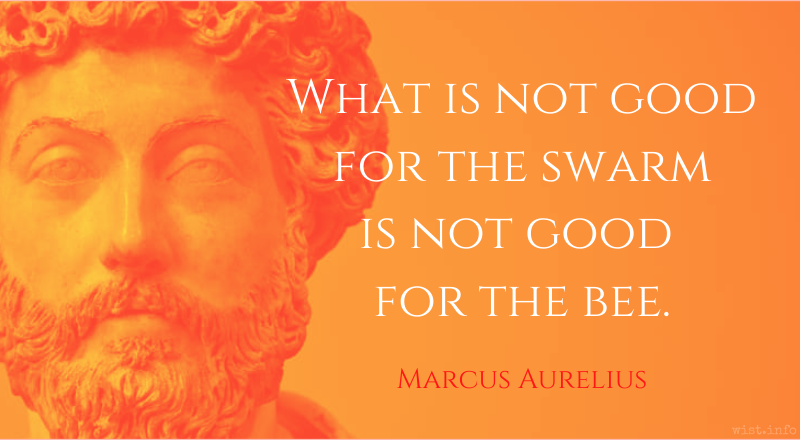
What is not good for the swarm is not good for the bee.
[Τὸ τῷ σμήνει μὴ συμφέρον οὐδὲ τῇ μελίσσῃ συμφέρει.]
Marcus Aurelius (AD 121–180) Roman emperor (161–180), Stoic philosopher
Meditations [To Himself; Τὰ εἰς ἑαυτόν], Book 6, ch. 54 (6.54) (AD 161-180) [tr. Rendall (1898)]
(Source)
(Source (Greek)). Other translations:That which is not good for the beehive, cannot be good for the bee.
[tr. Casaubon (1634), 6.49]That which is not for the Interest of the whole Swarm, is not for the Interest of a single Bee.
[tr. Collier (1701); Collier/Zimmern (1887)]What is not the interest of the hive, is not the interest of the bee.
[tr. Hutcheson/Moor (1742)]That which is not for the interest of the whole hive, cannot be so for any single bee.
[tr. Graves (1792), 6.48]That which is not good for the swarm, neither is it good for the bee.
[tr. Long (1862)]What profits not the swarm profits not the bee.
[tr. Hutcheson/Chrystal (1902)]That which is not in the interests of the hive cannot be in the interests of the bee.
[tr. Haines (Loeb) (1916)]What does not benefit the hive is no benefit to the bee.
[tr. Farquharson (1944)]What is no good for the hive is no good for the bee.
[tr. Staniforth (1964)]What brings no benefit to the hive brings none to the bee.
[tr. Hard (1997 ed.)]What injures the hive injures the bee.
[tr. Hays (2003)]What does not benefit the hive does not benefit the bee either.
[tr. Hammond (2006)]What brings no benefit to the hive brings none to the bee.
[tr. Hard (2011 ed.)]What does not benefit the hive does not benefit the bee.
[tr. Gill (2013)]
There is also this: when we renounce the self and become part of a compact whole, we not only renounce personal advantage but are also rid of personal responsibility. There is no telling to what extremes of cruelty and ruthlessness a man will go when he is freed from the fears, hesitations, doubts and the vague stirrings of decency that go with individual judgement. When we lose our individual independence in the corporateness of a mass movement, we find a new freedom — freedom to hate, bully, lie, torture, murder and betray without shame and remorse. Herein undoubtedly lies part of the attractiveness of a mass movement.
Eric Hoffer (1902–1983) American writer, philosopher, longshoreman
True Believer: Thoughts on the Nature of Mass Movements, Part 3, ch. 14, § 77 (3.14.77) (1951)
(Source)
Democracy postulates community of interest or loyal patriotism. When these are absent it cannot long exist.
William Ralph Inge (1860–1954) English prelate [Dean Inge]
“Our Present Discontents,” Outspoken Essays: First Series (1919)

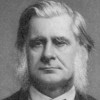
If individuality has no play, society does not advance; if individuality breaks out of all bounds, society perishes.
T. H. Huxley (1825–1895) English biologist [Thomas Henry Huxley]
“Administrative Nihilism” (1871)
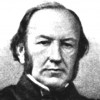
A modern poet has characterized the personality of art and the impersonality of science as follows: Art is I: Science is We.
Claude Bernard (1813–1878) French physiologist, scientist
Bulletin of New York Academy of Medicine, Vol. IV (1928)
Often only the summary at the end is quoted.
Power corresponds to the human ability not just to act but to act in concert. Power is never the property of an individual; it belongs to a group and remains in existence only so long as the group keeps together. When we say of somebody that he is “in power” we actually refer to his being empowered by a certain number of people to act in their name.
Hannah Arendt (1906–1975) German-American philosopher, political theorist
On Violence, ch. 2 (1970)
(Source)
This book is an expansion of her essay (1969-02-27) "Reflections on Violence," The New York Review of Books; this passage is not in the original.
The less justified a man is in claiming excellence for his own self, the more ready he is to claim all excellence for his nation, his religion, his race or his holy cause.
Eric Hoffer (1902–1983) American writer, philosopher, longshoreman
True Believer: Thoughts on the Nature of Mass Movements, Part 1, ch. 2, § 9 (1951)
(Source)
For the strength of the Pack is the Wolf, and the strength of the Wolf is the Pack.
Rudyard Kipling (1865–1936) English writer
“The Law of the Jungle,” The Second Jungle Book (1899)