Note not all quotations have been tagged, so Search may find additional quotes on this topic.
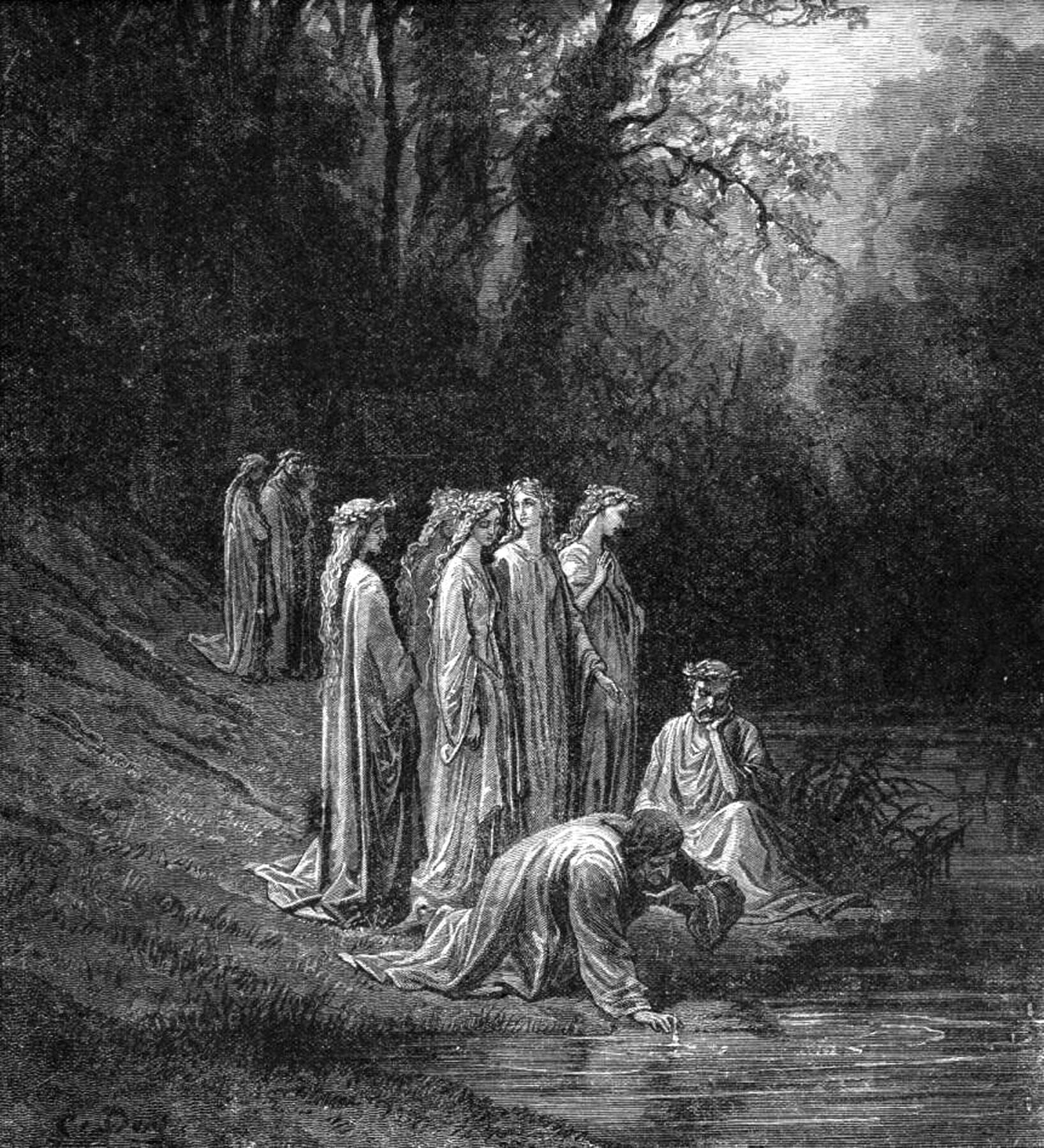
Dore – Purgatorio, Canto 33 – Drinking from the Eunoe (1868)
Reader, had I the space to write at will, I should, if only briefly, sing a praise of that sweet draught. Would I were drinking still!
But I have filled all the pages planned for this, my second, canticle, and Art pulls at its iron bit with iron hand.
[S’io avessi, lettor, più lungo spazio da scrivere, i’ pur cantere’ in parte lo dolce ber che mai non m’avria sazio;
ma perché piene son tutte le carte ordite a questa cantica seconda, non mi lascia più ir lo fren de l’arte.]
Dante Alighieri (1265–1321) Italian poet The Divine Comedy [Divina Commedia], Book 2 “Purgatorio,” Canto 33, l. 136ff (3.136-141) (1314) [tr. Ciardi (1961)]
(Source)
On drinking from the Eunoë, Dante gets meta, breaking the Fourth Wall and, having self-imposed limits on the number of cantos per book and lines in each canto, he uses "Art" as an excuse to draw toward a conclusion.
On the other hand, Sayers notes that Dante "is almost unique among medieval writers" in restraining his writing: "one of the reasons for his enduring readableness."
If breath and vigour, by indulgent Heav'n,
To sing this bev'rage of the Gods were giv'n, What holy rapture would exalt my Song!
To tell the unexhausted sweets that flow
From that blest Fountain o'er the Vale below. And warm, with new desire, the votive Throng!
But now the Muse has run her fatal round,
And mark'd her Circle to the Second Bound.
[tr. Boyd (1802), st. 26-27]
Were further space allow’d,
Then, Reader, might I sing, though but in part,
That beverage, with whose sweetness I had ne’er
Been sated. But, since all the leaves are full,
Appointed for this second strain, mine art
With warning bridle checks me.
[tr. Cary (1814)]
Reader, had I but longer space to write, I might describe to thee, in part, the taste Of draught that's ever sweet, nor waste
The time; but leaves are all already full Appointed for the second canticle, Nor curb nor rein permit me use the will.
[tr. Bannerman (1850)]
If, Reader, I possessed a longer space For writing it, I yet would sing in part Of the sweet draught that ne'er would satiate me;
But inasmuch as full are all the leaves Made ready for this second canticle, The curb of art no farther lets me go.
[tr. Longfellow (1867)]
If I had, reader, longer space to write, I should sing, at all events in part, the sweet draught which never would have sated me; but, for that all the sheets put in frame for this second Canticle are full, the bridle of my art lets me go no further.
[tr. Butler (1885)]
Reader, if longer space to me were rated For writing, I would strive to sing in part That draught so sweet, which never could have sated.
But since is now completely filled the chart Allotted for this second book, there leaves No power to wander more the curb of Art.
[tr. Minchin (1885)]
If I had, Reader, longer space for writing I would yet partly sing the sweet draught which never would have sated me. But, because all the leaves destined for this second canticle are full, the curb of my art lets me go no further.
[tr. Norton (1892)]
If, reader, I had greater space for writing, I would sing, at least in part, of the sweet draught which never would have sated me; but forasmuch as all the pages ordained for this second canticle are filled, the curb of art no further lets me go.
[tr. Okey (1901)]
If, reader, I had more space to write I should sing but in part the sweet draught which never would have sated me; but since all the sheets prepared for this second cantica are full the curb of art does not let me go farther.
[tr. Sinclair (1939)]
If, Reader, for the writing were more space, That sweet fount, whence I ne'er could drink my fill, Would I yet sing, though in imperfect praise.
But seeing that for this second canticle The paper planned is full to the last page, The bridle of art must needs constrain my will.
[tr. Binyon (1943)]
If for my writing, Reader, I'd more space, I'd sing -- at least in part -- those sweets my heart Might aye have drunk nor e'er known weariness;
But since I've filled the pages set apart For this my second cantique, I'll pursue No further, bridled by the curb of art.
[tr. Sayers (1955)]
If, reader, I had greater space for writing I would yet partly sing the sweet draught which never would have sated me.
but since all the pages ordained for this second canticle are filled, the curb of art lets me go no further.
[tr. Singleton (1973)]
Reader, if I had space to write more words, I'd sing, at least in part, of that sweet draught which never could have satisfied my thirst;
But now I have completed every page planned for my poem's second canticle -- I am checked by the bridle of my art!
[tr. Musa (1981)]
If, reader, I had room to write more, My poem could still not tell you everything About the sweet drink of which I could never have had enough.
But since all the pages designed for this Second part of the poem have been filled, The rules of art stop me at this point.
[tr. Sisson (1981)]
If, reader, I had ampler space in which to write, I'd sing -- though incompletely -- that sweet draught for which my thirst was limitless;
but since all of the pages pre-disposed for this, the second canticle, are full, the curb of art will not let me continue.
[tr. Mandelbaum (1982)]
Reader, if I had more space to write, I would speak, partially at least, about that sweet drink, which would never have sated me: but because all the pages determined for the second Canticle are full, the curb of art lets me go no further.
[tr. Kline (2002)]
If, reader, I had more space to write, I would continue to sing in part the sweet drink that could never satiate me, but because all the pages are filled that have been laid out for this second canticle, the bridle of art permits me to go no further.
[tr. Durling (2003)]
If, reader, I'd more space in which to write, then I should sing in part about that drink, so sweet I’d never have my fill of it.
However, since these pages now are full, prepared by rights to take the second song, the reins of art won't let me pass beyond.
[tr. Kirkpatrick (2007)]
If, reader, I had more ample space to write, I should sing at least in part the sweetness of the drink that never would have sated me,
but, since all the sheets readied for this second canticle are full, the curb of art lets me proceed no farther.
[tr. Hollander/Hollander (2007)]
O reader, if I had the space to tell you More, I'd sing something about that sweetest Drink, no quantity of which could ever
End my thirst, but because the pages meant For this canto are already filled, my art prevents me, Affirming limits I am forced to meet.
[tr. Raffel (2010)]
As great minds can express much in a few words, so small minds have the contrary talent of talking a great deal without saying anything at all.
[Comme c’est le caractère des grands esprits de faire entendre en peu de paroles beaucoup de choses, les petits esprits, au contraire, ont le don de beaucoup parler, et de ne rien dire.]
François VI, duc de La Rochefoucauld (1613–1680) French epigrammatist, memoirist, noble Réflexions ou sentences et maximes morales [Reflections; or Sentences and Moral Maxims], ¶142 (1665-1678) [tr. FitzGibbon (1957)]
(Source)
[Comme c’est le caractère des grands esprits de faire entendre avec peu de paroles beaucoup de choses, les petits esprits, en revanche, ont le don de beaucoup parler, et de ne dire rien.]
As great Wits have a peculiar Faculty of saying a great deal in a little; so half witted Fellows have a Talent of talking much, and yet saying nothing.
[tr. Stanhope (1694), ¶143]
As it is the characteristic of great wits to say much in few words, so small wits seem to have the gift of speaking much and saying nothing.
[pub. Donaldson (1783), ¶414; ed. Lepoittevin-Lacroix (1797), ¶137]
It is the characteristic of great wits to say much in a few words; small wits seem to have the gift of speaking much and saying nothing.
[ed. Carvill (1835), ¶419]
As it is the characteristic of great wits; to convey a great deal in a few words, so, on the contrary, small wits have the gift of speaking much and saying nothing.
[ed. Gowens (1851), ¶145]
As it is the mark of great minds to say many things in a few words, so it is that of little minds to use many words to say nothing.
[tr. Bund/Friswell (1871), ¶142]
As it is a trait of powerful intellects to express much in a few words; inversely, small minds talk much and say little.
[tr. Heard (1917), ¶142]
It is a mark of great minds to say much in a few words. On the other hand, small minds possess the gift of talking much and saying nothing.
[tr. Stevens (1939), ¶142]
As it is the mark of great minds to convey much in few words, so small minds are skilled at talking at length and saying little.
[tr. Kronenberger (1959), ¶142]
As the stamp of great minds is to suggest much in a few words, so, contrariwise, little minds have the gift of talking a great deal and saying nothing.
[tr. Tancock (1959), ¶142]
As it is the character of great minds to make many things understood in few words; so small minds, on the contrary, have the gift of speaking much, and saying nothing.
[tr. Siniscalchi (1994)]
Just as great spirits make much understood with few words, small ones have the gift of speaking very much without saying anything.
[tr. Whichello (2016)]