

No member of a crew is praised for the rugged individuality of his rowing.
Alfred North Whitehead (1861–1947) English mathematician and philosopher
“Harvard: The Future,” sec. 5, The Atlantic Monthly (Sep 1936)
(Source)
Reprinted in Essays in Science and Philosophy, Part 3 (1947). Often misattributed to Ralph Waldo Emerson.
Quotations by:
Whitehead, Alfred North

Nothing is more curious than the self-satisfied dogmatism with which mankind at each period of its history cherishes the delusion of the finality of its existing modes of knowledge.
Alfred North Whitehead (1861–1947) English mathematician and philosopher
“John Dewey and His Influence” (1), The Philosophy of John Dewey [ed. P. Schlipp] (1939)
The thorough skeptic is a dogmatist. He enjoys the delusion of complete futility.
Alfred North Whitehead (1861–1947) English mathematician and philosopher
“Mathematics and the Good,” The Philosophy of Alfred North Whitehead, ed. Paul A. Schilpp (1941)
Ninety percent of our lives is governed by emotion. Our brains merely register and act upon what is telegraphed to them by our bodily experience. Intellect is to emotion as our clothes are to our bodies; we could not very well have civilized life without clothes, but we would be in a poor way if we had only clothes without bodies.
Alfred North Whitehead (1861–1947) English mathematician and philosopher
(10 Jun 1943), Dialogues of Alfred North Whitehead [rec. L. Price (1954)]
There are no whole truths; all truths are half-truths. It is trying to treat them as whole truths that plays the devil.
Alfred North Whitehead (1861–1947) English mathematician and philosopher
(Attributed)
Every really new idea looks crazy at first.
Alfred North Whitehead (1861–1947) English mathematician and philosopher
(Attributed)
Where there is a creed, there is a heretic around the corner or in his grave.
Alfred North Whitehead (1861–1947) English mathematician and philosopher
Adventures of Ideas, 4.3 (1933)
Machiavelli wrote rules for a short-term success.
Alfred North Whitehead (1861–1947) English mathematician and philosopher
Dialogues of Alfred North Whitehead, 18 July 1939 [rec. Lucien Price] (1954)
Ideas won’t keep. Something must be done about them.
Alfred North Whitehead (1861–1947) English mathematician and philosopher
Dialogues of Alfred North Whitehead, 28 Apr 1939 (1954)
The events which we see, and which look like freaks of chance, are only the last steps in long lines of causation.
Alfred North Whitehead (1861–1947) English mathematician and philosopher
Dialogues of Alfred North Whitehead, 5 May 1943 [rec. Lucien Price (1954)]
Dogmatism is the anti-Christ of learning.
Alfred North Whitehead (1861–1947) English mathematician and philosopher
Modes of Thought, 1.3 (1938)
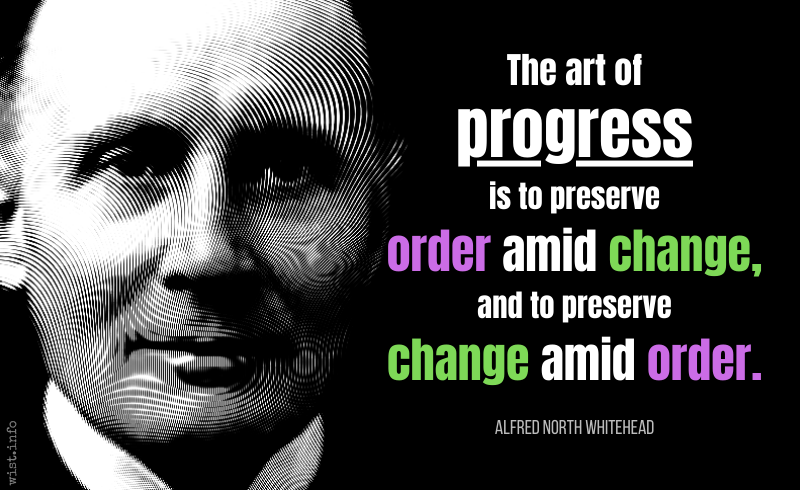
The art of progress is to preserve order amid change, and to preserve change amid order.
Alfred North Whitehead (1861–1947) English mathematician and philosopher
Process and Reality: An Essay in Cosmology (1929)
(Source)
Based on his Gifford Lectures, University of Edinburgh (1927-28), on process philosophy.
How shallow, puny, and imperfect are efforts to sound the depths in the nature of things. In philosophical discussion, the merest hint of dogmatic certainty as to finality of statement is an exhibition of folly.
Alfred North Whitehead (1861–1947) English mathematician and philosopher
Process and Reality: An Essay in Cosmology, Preface (1929)
(Source)
The book is a collection of his Gifford Lectures, University of Edinburgh (1927-1928).
It is the business of the future to be dangerous.
Alfred North Whitehead (1861–1947) English mathematician and philosopher
Science and the Modern World (1925)
In formal logic, a contradiction is the signal of a defeat: but in the evolution of real knowledge it marks the first step in progress towards a victory. This is one great reason for the utmost toleration of variety of opinion. Once and forever, this duty of toleration has been summed up in the words, “let both grow together until the harvest.”
Alfred North Whitehead (1861–1947) English mathematician and philosopher
Science and the Modern World, ch. 12 (1925)
Reference is to Matthew 13:30.
The function of University is to enable you to shed details in favor of principles.
Alfred North Whitehead (1861–1947) English mathematician and philosopher
The Aims of Education and Other Essays, II (1929)
We think in generalities, but we live in detail.
Alfred North Whitehead (1861–1947) English mathematician and philosopher
Essay (1926-08), “The Education of an Englishman,” Atlantic Monthly
(Source)
This is often slightly misquoted as "... but we live in details."
If a dog jumps in your lap, it is because he is fond of you. If a cat does the same thing, it is because your lap is warmer.
Alfred North Whitehead (1861–1947) English mathematician and philosopher
In Lucien Price, ed., Dialogues of Alfred North Whitehead, Dialogue 25, 1941-12-10 (1954)
(Source)
In the conditions of modern life the rule is absolute, the race which does not value trained intelligence is doomed. Not all your heroism, not all your social charm, not all your wit, not all your victories on land or at sea, can move back the finger of fate. To-day we maintain ourselves. To-morrow science will have moved forward yet one more step, and there will be no appeal from the judgment which will then be pronounced on the uneducated.
Alfred North Whitehead (1861–1947) English mathematician and philosopher
Speech (1916-01), “The Aims of Education — a Plea for Reform,” Presidential Address to the Mathematical Association
(Source)
Collected in The Organisation of Thought: Educational and Scientific, ch. 1 (1917).