When legislative power is united with executive power in a single person or in a single body of the magistracy, there is no liberty, because one can fear that the same monarch or senate that makes tyrannical laws will execute them tyrannically.
Nor is there liberty if the power of judging is not separate from legislative power and from executive power. If it were joined to legislative power, the power over the life and liberty of the citizens would be arbitrary, for the judge would be the legislator. If it were joined to executive power, the judge could have the force of an oppressor.
All would be lost if the same man or the same body of principal men, either of nobles, or of the people, exercised these three powers: that of making the laws, that of executing public resolutions, and that of judging the crimes or the disputes of individuals.[Lorsque, dans la même personne ou dans le même corps de magistrature, la puissance législative est réunie à la puissance exécutrice, il n’y a point de liberté ; parce qu’on peut craindre que le même monarque ou le même sénat ne fasse des loix tyranniques, pour les exécuter tyranniquement.
Il n’y a point encore de liberté, si la puissance de juger n’est pas séparée de la puissance législative, & de l’exécutrice. Si elle étoit jointe à la puissance législative, le pouvoir sur la vie & la liberté des citoyens seroit arbitraire; car le juge seroit législateur. Si elle étoit jointe à la puissance exécutrice, le juge pourroit avoir la force d’un oppresseur.
Tout seroit perdu, si le même homme, ou le même corps des principaux, ou des nobles, ou du peuple, exerçoient ces trois pouvoirs; celui de faire des loix, celui d’exécuter les résolutions publiques, & celui de juger les crimes ou les différends des particuliers.]Charles-Lewis de Secondat, Baron de Montesquieu (1689-1755) French political philosopher
Spirit of Laws [The Spirit of the Laws; De l’esprit des lois], Book 11, ch. 6 (1748) [tr. Cohler/Miller/Stone (1989)]
(Source)
(Source (French)). Other translations:When the legislative and executive powers are united in the same person, or in the same body of magistrates, there can be no liberty; because apprehensions may arise, lest the same monarch or senate should enact tyrannical laws, to execute them in a tyrannical manner.
Again, there is no liberty if the judiciary power be not separated from the legislative and executive. Were it joined with the legislative, the life and liberty of the subject would be exposed to arbitrary control; for the judge would be then the legislator. Were it joined to the executive power, the judge might behave with violence and oppression.
There would be an end of every thing, were the same man, or the same body, whether of the nobles or of the people, to exercise those three powers, that of enacting laws, that of executing the public resolutions, and of trying the causes of individuals.
[tr. Nugent (1750)]There would be an end of everything, were the same man, or the same body, whether of the nobles or of the people, to exercise those three powers, that of enacting laws, that of executing the public resolutions, and that of judging the crimes or differences of individuals.
[ed. Guterman (1963)]When in the same person or in the same body of magistracy the legislative authority is combined with the executive authority, there is no freedom, because one can fear lest the same monarch or the same senate make tyrannical laws in order to carry them out tyrannically.
Again there is no freedom if the authority to judge is not separated from the legislative and executive authorities. If it were combined with the legislative authority, power over the life and liberty of the citizens would be arbitrary, for the judge would be the legislator. If it were combined with the executive authority, the judge could have the strength of an oppressor.
All would be lost if the same man or the same body of principals, or of nobles, or of the people, exercised these three powers: that of making laws, that of executing public resolutions, and that of judging crimes or disputes between individuals.
[tr. Stewart (2018)]
Quotations about:
executive
Note not all quotations have been tagged, so Search may find additional quotes on this topic.
Being an executive does not require very developed frontal lobes, but rather a combination of charisma, a capacity to sustain boredom, and the ability to shallowly perform on harrying schedules. Add to these tasks the “duty” of attending opera performances.
Nassim Nicholas Taleb (b. 1960) Lebanese-American essayist, statistician, risk analyst, aphorist
The Black Swan, Part 2, ch. 11 “How to Look for Bird Poop” (2007)
(Source)

The [American] Founding Fathers never believed that tyranny could arise out of the executive office, because they did not see this office in any different light but as the execution of what the legislation has decreed in various forms. I leave it at that. We know today that the greatest danger of tyranny is, of course, the executive.
Hannah Arendt (1906-1975) German-American philosopher, political theorist
Interview (1973-10) with Roger Errera, Office de Radiodiffusion-Télévision Française (ORTF)
Arendt was referring specifically to the Watergate Scandal and Nixon's abuse of power.
Parts of this interview were turned into an episode of the French TV series "Un certain regard," directed by Jean-Claude Lubtchansky, first broadcast 1974-07-06. (Source (Video))
These executives, who have risen to the top, have come to be responsible trustees, impartial umpires, and expert brokers for a plurality of economic interests, including those of all the millions of small property holders who hold stock in the great American enterprises, but also the wage workers and the consumers who benefit from the great flow of goods and services. These executives, it is held, are responsible for the refrigerator in the kitchen and the automobile in the garage — as well as all the planes and bombs that now guard Americans from instant peril. […] Full of the know-how that made America great; efficient, straightforward, honest, the chief executives, it is often said, ought really to be allowed to run the government, for if only such men were in charge there would be no waste, no corruption, no infiltration.
C. Wright Mills (1916-1962) American sociologist, academic, author [Charles Wright Mills]
The Power Elite, ch. 6 (1956)
(Source)
I attended to some of the business on my table to-day. Many matters of minor importance and of detail remain on my table to be attended to. The public have no idea of the constant accumulation of business requiring the President’s attention. No President who performs his duties faithfully and conscientiously can have any leisure. If he entrusts the details and smaller matters to subordinates constant errors will occur. I prefer to supervise the whole operations of the government myself rather than entrust the public business to subordinates, and this makes my duties very great.
James K. Polk (1795-1849) American lawyer, politician, US President (1845-1849)
Diary (1848-12-29)
(Source)
Although in our country the Chief Magistrate must almost of necessity be chosen by a party and stand pledged to its principles and measures, yet in his official action he should not be the President of a part only, but of the whole people of the United States. While he executes the laws with an impartial hand, shrinks from no proper responsibility, and faithfully carries out in the executive department of the Government the principles and policy of those who have chosen him, he should not be unmindful that our fellow-citizens who have differed with him in opinion are entitled to the full and free exercise of their opinions and judgments, and that the rights of all are entitled to respect and regard.
James K. Polk (1795-1849) American lawyer, politician, US President (1845-1849)
Inaugural Address (4 Mar 1845)
(Source)
It must be made a sacred maxim, that the militia obey the executive power, which represents the whole people in the execution of laws. To suppose arms in the hands of citizens, to be used at the individual discretion, except in private self-defence, or by partial orders of towns, counties, or districts of a state, is to demolish every constitution, and lay the laws prostrate, so that liberty can be enjoyed by no man; it is a dissolution of the government. The fundamental law of the militia is, that it be created, directed and commanded by the laws, and ever for the support of the laws.
John Adams (1735-1826) American lawyer, Founding Father, statesman, US President (1797-1801)
A Defence of the Constitutions of Government of the United States of America, Vol. 3, ch. 3 “Marchamond Nedham: Errors of Government and Rules of Policy” (1787)
(Source)
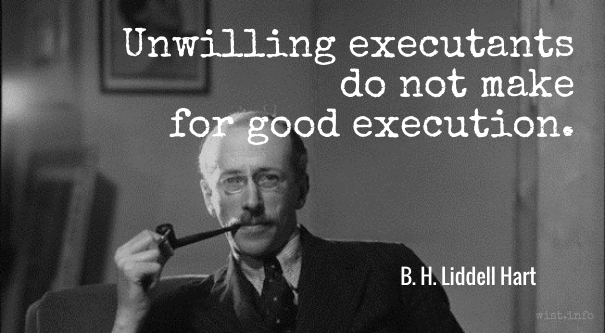
Unwilling executants do not make for good execution.
B. H. Liddell Hart (1895-1970) English soldier, military historian (Basil Henry Liddell Hart)
The German Generals Talk, ch. 4 (1948)
Recently I asked three corporate executives what decisions they had made in the last year that they would not have made were it not for their it not for their corporate plans. All had difficulty in identifying one such decision. Since each of their plans were marked “secret” or “confidential,” I asked them how their competitors might benefit from the possession of their plans. Each answered with embarrassment that their competitors would not benefit. Yet these executives were strong advocates of corporate planning.
Russell L. Ackoff (1919-2009) American organizational theorist, consultant, management scientist
“A Concept of Corporate Planning” (1969)
An excellent master is always better than an excellent law. Let your laws be ever so good, if the lawmakers are bad, all will come to nothing.
Thomas Brooks (1608-1680) English Puritan divine, writer
Heaven on Earth (1654)