The mind is a strange machine which can combine the materials offered to it in the most astonishing ways, but without materials from the external world it is powerless.
Bertrand Russell (1872-1970) English mathematician and philosopher
Conquest of Happiness, Part 2, ch. 11 “Zest” (1930)
(Source)
Quotations about:
input
Note not all quotations have been tagged, so Search may find additional quotes on this topic.
Too many cooks may spoil the broth, but it only takes one to burn it.
Julia Child (1912-2004) American chef and writer
(Attributed)
Referring to the Women's Suffrage Movement, as quoted by Madeleine Bingham, Something's Burning: The Bad Cook's Guide (1968) [unverified]. Sometimes said to be in the Introduction to her Julia Child's Kitchen, (1975), but not found there.
Why would we worry what others think of us if their opinions did not change us?
James Richardson (b. 1950) American poet
Vectors: Aphorisms and Ten-Second Essays, #387 (2001)

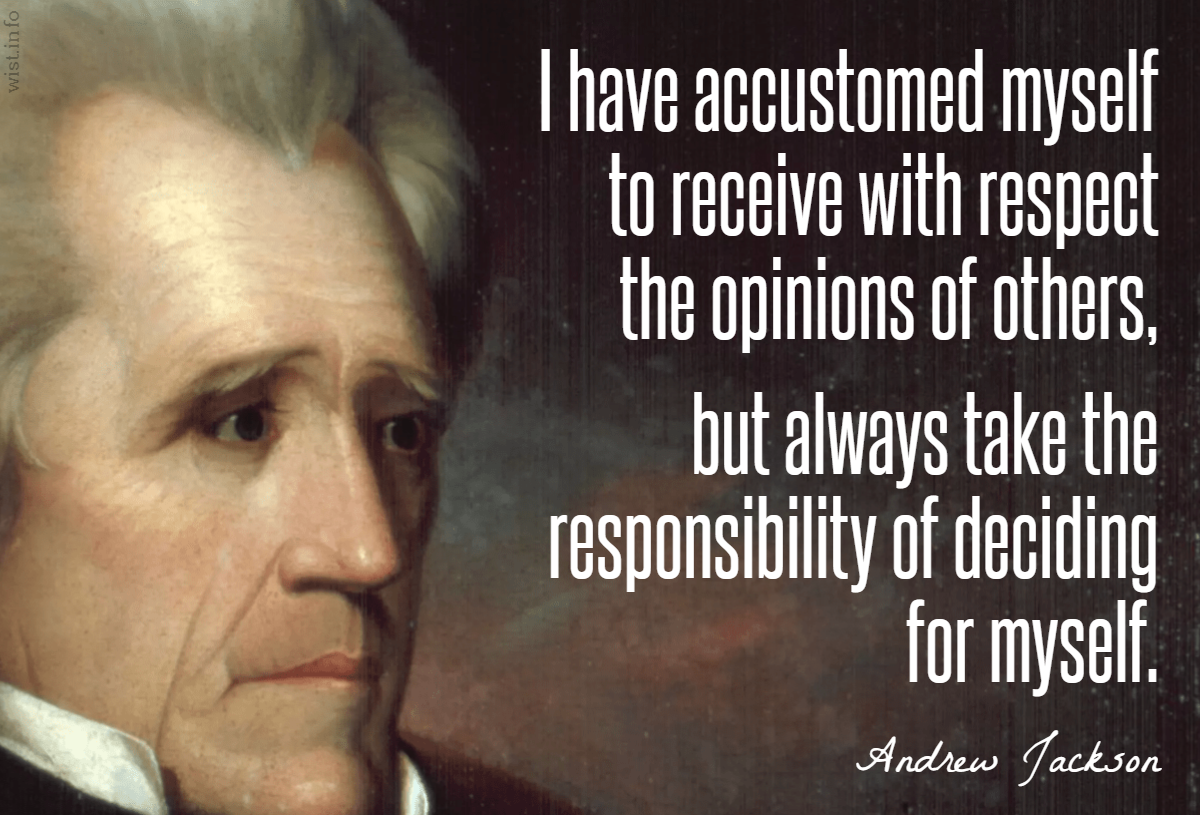
I have accustomed myself to receive with respect the opinions of others, but always take the responsibility of deciding for myself.
Andrew Jackson (1767-1845) American politician, general, US President (1829-1837)
(Attributed)
Quoted by John F. Kennedy in the foreword to T. Sorensen, Decision-Making in the White House: The Olive Branch or the Arrows (1963)
When my information changes, I alter my conclusions. What do you do, sir?
John Maynard Keynes (1883-1946) English economist
(Attributed)
Reply to a criticism of having changed his position on monetary policy. Quoted in Paul Samuelson, "The Keynes Centenary" The Economist, Vol. 287 (1983), but possibly apocryphal (see here).
Variants:
- "When events change, I change my mind. What do you do?"
- "When the facts change, I change my mind. What do you do, sir?"
- "When someone persuades me that I am wrong, I change my mind. What do you do?"

Wo be to him that reads but one book.
George Herbert (1593-1633) Welsh priest, orator, poet.
Jacula Prudentum, or Outlandish Proverbs, Sentences, &c. (compiler), # 1146 (1651 ed.)
(Source)
See this Latin proverb.
On two occasions I have been asked, — “Pray, Mr. Babbage, if you put into the machine wrong figures, will the right answers come out?” In one case a member of the Upper, and in the other a member of the Lower, House put this question. I am not able rightly to apprehend the kind of confusion of ideas that could provoke such a question.
Charles Babbage (1791-1871) English mathematician, computer pioneer, philosopher
Passages from the Life of a Philosopher, ch. 5 “Difference Engine No. 1” (1864)
(Source)