Great perils have this beauty, that they bring to light the fraternity of strangers.
[Les grands périls ont cela de beau qu’ils mettent en lumière la fraternité des inconnus.]
Victor Hugo (1802–1885) French writer, journalist, human rights activist, politician
Les Misérables, Part 4 “Saint Denis,” Book 12 “Corinth,” ch. 4 (4.12.4) (1862) [tr. Wilbour (1862)]
(Source)
On the varied Parisians working together at building the barricades.
(Source (French)). Alternate translations:Great dangers have this beauty about them, that they throw light on the fraternity of strangers.
[tr. Wraxall (1862)]Great perils have this fine characteristic, that they bring to light the fraternity of strangers.
[tr. Hapgood (1887)]It is the ennobling quality of danger that it brings to light the fraternity of strangers.
[tr. Denny (1976)]Great perils share this beauty, that they bring to light the fraternity of strangers.
[tr. Wilbour/Fahnestock/MacAfee (1987)]That is the beauty of great danger, it brings out the fraternity of strangers.
[tr. Donougher (2013)]
Quotations about:
fraternity
Note not all quotations have been tagged, so Search may find additional quotes on this topic.
The world is my country, all mankind are my brethren, and to do good is my religion.
Thomas Paine (1737–1809) American political philosopher and writer
(Attributed)
This is widely attributed to Paine, in respectable sources, and usually (when a source is given) from The Rights of Man (1791) or The Age of Reason (1795). But a search of the text of the latter shows none of the three clauses appear in it. In The Rights of Man, Paine did write, "My country is the world, and my religion is to do good," which is close but not the same (and is sometimes cited with the different word order of the subject quote).
The three clauses appear (with a fourth, "I believe in One God and no more") on the 1923 plaque at the location of Paine's last residence, on Grove St. in Greenwich Village, NY, but with no citation (though one is sometimes applied). But the attribution of this phrase to Paine (including citing it to The Age of Reason) predates the plaque (e.g., 1913). I've not been able to find a reliable citation for this quote.
HENRY: This story shall the good man teach his son;
And Crispin Crispian shall ne’er go by
From this day to the ending of the world,
But we in it shall be remember’d, —
We few, we happy few, we band of brothers.
For he to-day that sheds his blood with me,
Shall be my brother; be he ne’er so vile,
This day shall gentle his condition:
And gentlemen in England, now a-bed,
Shall think themselves accurs’d, they were not here,
And hold their manhoods cheap, whiles any speaks,
That fought with us upon Saint Crispin’s day.William Shakespeare (1564–1616) English dramatist and poet
Henry V, Act 4, sc. 3, l. 58ff (4.3.58-69) (1599)
(Source)

All State propaganda exalts comradeship, for it is this gregarious herd-sense and herd-smell which keeps people from thinking and so reconsiles them to the destruction of their private lives.
Cyril Connolly (1903–1974) English intellectual, literary critic and writer.
“Ecce Gubernator,” The Unquiet Grave (1945)
(Source)
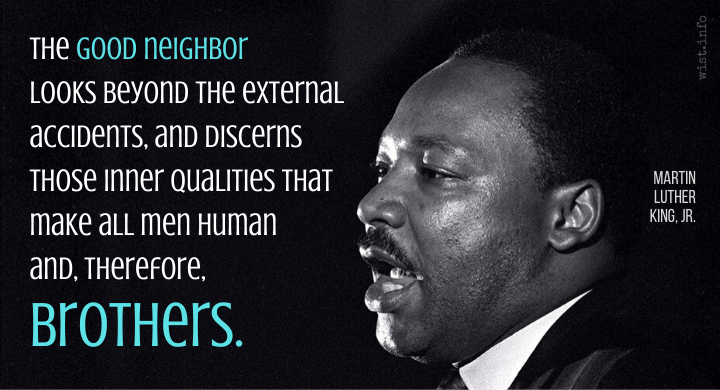
The good neighbor looks beyond the external accidents, and discerns those inner qualities that make all men human and, therefore, brothers.
Martin Luther King, Jr. (1929–1968) American clergyman, civil rights leader, social activist, preacher
“On Being a Good Neighbor,” sec. 1, sermon, A Gift of Love (1963)
(Source)