

Of lingering and gain-seeking make an end;
Think, while there’s time, how soon Death’s pyre may blaze;
And some brief folly mix with prudent ways:
At the fit hour ’tis sweet to unbend.[Verum pone moras et studium lucri
nigrorumque memor, dum licet, ignium
misce stultitiam consiliis brevem:
dulce est desipere in loco.]Horace (65–8 BC) Roman poet, satirist, soldier, politician [Quintus Horatius Flaccus]
Odes [Carmina], Book 4, # 12, l. 25ff (4.12.25-28) (13 BC) [tr. Marshall (1908)]
(Source)
The last line is often given alone as "It is sweet to let the mind unbend on occasion."
Usually subtitled by translators "To Virgil" or "Invitation to Virgil." There has been great controversy amongst scholars whether the Virgil mentioned in the ode refers to the famous poet who composed the Aeneid, among other works. The two knew each other, but that Virgil died in 19 BC. Some suggest this was an older poem of Horace's, finished and inserted into this later, final volume by him.
(Source (Latin)). Other translations:Think Life is short, forget thy fears,
And eager thoughts of Gain,
Short Folly mix with graver Cares,
'Tis decent sometimes to be vain.
[tr. Creech (1684)]Come, quit those covetous thoughts, those knitted brows,
Think on the last black embers, while you may,
And be for once unwise. When time allows,
'Tis sweet the fool to play.
[tr. Conington (1872)]But lay aside delay, and the desire of gain; and, mindful of the gloomy [funeral] flames, intermix, while you may, your grave studies with a little light gayety: it is delightful to give a loose on a proper occasion.
[tr. Smart/Buckley (1853)]To the winds with base lucre and pale melancholy ! --
In the flames of the pyre these, alas! will be vain,
Mix your sage ruminations with glimpses of folly, --
'T is delightful at times to be somewhat insane!
[tr. Martin (1864)]But put aside delays and care of gain,
Warned, while yet time, by the dark death-fires; mix
With thought brief thoughtlessness; to be unwise
In time and place is sweet.
[tr. Bulwer-Lytton (1870)]Then lay aside delays, pursuit of gain, and, mindful fo the funeral pyre, intermix, while it is permitted, a temporary foolishness with thy worldly plans. There is pleasure in indulging in folly on special occasions.
[tr. Elgood (1893)]Quick! ere the lurid death-fire's day,
Drive thou the lust of gain away!
Thy wisdom with unwisdom grace:
'Tis well to rave, in time and place.
[tr. Gladstone (1894)]Come! a truce to delay, and the desire of gain!
And, all mindful, in time, of the dark fun'ral fires.
Mingle with your grave plans some little folly's fling,
Sweet is folly at fitting times.
[tr. Phelps (1897)]Mingle a little folly with your wisdom; a little nonsense now and then is pleasant.
[Source (1908)]But put aside delay and thirst for gain, and, mindful of Death’s dark fires, mingle, while thou mayst, brief folly with thy wisdom. ’Tis sweet at the fitting time to cast serious thoughts aside.
[tr. Bennett (Loeb) (1912), "The Delights of Spring"]Quick, quit your usury. Time is fleet.
Think, while you may, of funeral flames,
And blend brief folly with your aims;
Folly, in folly's hour, is sweet.
[tr. Mills (1924)]Then come at once and pause for breath
In chasing wealth. Remembering death
And death's dark fires, mix, while you may,
Method and madness, work and play.
Folly is sweet, well-timed.
[tr. Michie (1963)]Don’t linger, don’t stop to be sensible,
Let a little folly mix with your wisdom,
Be aware of death’s dark fires:
Frivolity is sweet, in season.
[tr. Raffel (1983)]And, heedful of death's black fire, consent for a while
To mix a little pleasure in with your prudence.
It's right to be foolish when the time is right.
[tr. Ferry (1997)]Be mindful, while you may,
of black-smoked funeral pyres
and blend a bit of folly with your wisdom.
O it is sweet at the proper time
to play the fool!
[tr. Alexander (1999)]But abolish delay, and desire for profit,
and, remembering death’s sombre flames, while you can,
mix a little brief foolishness with your wisdom:
it’s sweet sometimes to play the fool.
[tr. Kline (2015), "Spring"]
Roald Dahl had Willy Wonka use the thematically similar line "A little nonsense now and then / Is relished by the wisest men" in both his screenplay for the movie Willy Wonka and the Chocolate Factory (1971) and in the book Charlie and the Great Glass Elevator. For more information in this variant and its possible origins, see Quote Origin: A Little Nonsense Now and Then is Relished by the Wisest Men – Quote Investigator®.
Quotations about:
revelry
Note not all quotations have been tagged, so Search may find additional quotes on this topic.
ODYSSEUS: He wants to go forth, full of wine and glee,
To his brother Cyclops for wild revelry.[ΟΔΥΣΣΕΥΣ: ἐπὶ κῶμον ἕρπειν πρὸς κασιγνήτους θέλει
Κύκλωπας ἡσθεὶς τῷδε Βακχίου ποτῷ.]Euripides (485?-406? BC) Greek tragic dramatist
Cyclops [Κύκλωψ], l. 445ff (c. 424-23 BC) [tr. Way (Loeb) (1916)]
(Source)
Regarding the Cyclops keeping he and his men prisoner, and who he has introduced to the wonders of wine.
(Source (Greek)). Alternate translations:ULYSSES: By wine enliven'd, he resolves to go
And revel with his brethren.
[tr. Wodhull (1809)]ULYSSES: Delighted with the Bacchic drink he goes
To call his brother Cyclops -- who inhabit
A village upon Aetna not far off.
[tr. Shelley (1824)]ODYSSEUS: Delighted with this liquor of the Bacchic god, he fain would go a-reveling with his brethren.
[tr. Coleridge (1913)]ODYSSEUS: He wants to go to his brother Cyclopes for a revel since he is delighted with this drink of Dionysus.
[tr. Kovacs (1994)]
Ah, shall my white feet in the dances gleam
The livelong night again? Ah, shall I there
Float through the Bacchanal’s ecstatic dream,
Tossing my neck into the dewy air? —
Like to a fawn that gambols mid delight
Of pastures green.[ἆρ᾽ ἐν παννυχίοις χοροῖς
θήσω ποτὲ λευκὸν
πόδ᾽ ἀναβακχεύουσα, δέραν
865εἰς αἰθέρα δροσερὸν ῥίπτουσ᾽,
ὡς νεβρὸς χλοεραῖς ἐμπαί-
ζουσα λείμακος ἡδοναῖς]Euripides (485?-406? BC) Greek tragic dramatist
Bacchæ [Βάκχαι], l. 862ff, Strophe 1 [Chorus/Χορός] (405 BC) [tr. Way (1898)]
(Source)
(Source (Greek)). Other translations:When shall I join the midnight dance,
With agile step my comrades lead,
And as our festive choirs advance
Triumphant over enaml'd mead,
My heaving bosom to the dewy gale
Expand, high bounding like a fawn
Who gambols o'er the verdant lawn.
[tr. Wodhull (1809)]Shall I move my white foot in the night-long dance, aroused to a frenzy, throwing my head to the dewy air, like a fawn sporting in the green pleasures of the meadow.
[tr. Buckley (1850)]O when, through the long night,
With fleet foot glancing white,
Shall I go dancing in my revelry,
My neck cast back, and bare
Unto the dewy air,
Like sportive fawn in the green meadow's glee?
[tr. Milman (1865)]Then shall it be that all night long
My feet shall hurry through the dance,
Then shall I in new jollity
Toss to the dewy breeze my neck,
As jocund as the tender fawn
Who sports athwart the grassy mead.
[tr. Rogers (1872), l. 823ff]Will this white foot e’er join the night-long dance? what time in Bacchic ecstasy I toss my neck to heaven’s dewy breath, like a fawn, that gambols ’mid the meadow’s green delights.
[tr. Coleridge (1891)]Will they ever come to me, ever again,
The long long dances,
On through the dark till the dim stars wane?
Shall I feel the dew on my throat, and the stream
Of wind in my hair? Shall our white feet gleam
In the dim expanses?
Oh, feet of a fawn to the greenwood fled,
Alone in the grass and the loveliness.
[tr. Murray (1902)]When shall I dance once more
with bare feet the all-night dances,
tossing my head for joy
in the damp air, in the dew,
as a running fawn might frisk
for the green joy of the wide fields.
[tr. Arrowsmith (1960)]Shall I in night-long dances
ever set white
foot in bacchic celebration, hurling
my throat to the dewy air of heaven,
like a fawn playing in the green
pleasures of a meadow?
[tr. Kirk (1970)]O for long nights of worship, gay
With the pale gleam of dancing feet,
With head tossed high to the dewy air --
Pleasure mysterious and sweet!
O for the joy of a fawn at play
In the fragrant meadow's green delight.
[tr. Vellacott (1973)]I seek release to as calm
of green hills, white thighs
Flashing in the grass
The dew-soaked air kissing my throat.
[...]
But gently, as the dance of the young deer, swathed
In emerald meadow.
[tr. Soyinka (1973)]In the nocturnal choruses
shall I ever set my stepping
in bacchanti sing, to toss my throat into the dewy sky?
like a frolicking fawn in the greening joy of the meadowland?
[tr. Neuburg (1988)]When, oh when,
in an all-night trance
shall I dance again,
bare feet flashing, head rushing
through the coolness of leaves,
like a fawn that frolics
in the green delights of the forest.
[tr. Cacoyannis (1982)]Will I set my bare foot
Then in dancing vigils
Rousing bacchic frenzy,
Shake my throat in the dewy air,
Like a fawn in green joy
Sporting in a meadow?
[tr. Blessington (1993)]Shall I ever move
my white feet in the all-night dances
breaking forth into Bacchic frenzy
tossing my neck back
into the dewy air
like a fawn sporting amid the green delights of the meadow?
[tr. Esposito (1998)]To dance the long night!
Shall I ever set my white foot
so, to worship Bacchus?
Toss my neck to the dewy skies
as a young fawn frisks
in green delight of pasture?
[tr. Woodruff (1999)]Will I ever celebrate
All night with white foot
Flashing in the Bakkhic dance?
Well I ever fling back
My head and let the air
Of heaven touch my throat
With dew, like a fawn at play
In the green joy of meadows?
[tr. Gibbons/Segal (2000), l. 884ff]Shall I ever in the nightlong dances
move my white feet
in ecstasy? Shall I toss
my head to the dewy heaven
like a fawn that plays
amid green meadow delights?
[tr. Kovacs (2002)]Soon shall we know again
The night-long dance,
Silver moonlit feet,
Head, in bliss, flung back
To the icy air.
A fawn at play in meadows.
[tr. Teevan (2002)]I wish!
I wish that one day I’d be able to take part in the Bacchic dances, those all night dances of joy!
I wish that one day I’d be able to see my white feet kick high to the rhythm of those dances!
And
I wish that one day I could rush with my fawn skin through the cool breeze like a fawn does.
[tr. Theodoridis (2005)]Shall I ever in nightlong dances
Shake my fair white foot
in Bacchus' madness, tossing my
Hair to the nightwind of heav'n?
Like a fawn frolicking races
through green meadow pastures ....
[tr. Valerie (2005)]O when will I be dancing,
leaping barefoot through the night,
flinging back my head in ecstasy,
in the clear, cold, dew-fresh air --
like a playful fawn celebrating
its green joy across the meadows.
[tr. Johnston (2008), l. 1060ff]Shall I dance them again, the nightlong dances?
Dance again with bare feet in the dew?
Shall I toss my head and skip through the open fields
as a fawn slipped free ...?
[tr. Robertson (2014)]Am I to dance?
To lift my feet the whole night through
with the frenzy of a god inside me?
Shall I bare my throat to the dewy air
like a fawn at play in the meadow,
where joy is green and wide?
[tr. Pauly (2019)]Shall I soon be free again to dance, to toss my head all night in the dew-filled air? Like a fawn [...] playing in the green joy of a meadow.
[tr. Behr/Foster (2019)]Shall I ever, in choruses that last all night long,
set in motion my gleaming white
foot in a Bacchic revel as I thrust my throat
toward the upper air wet with dew, yes, thrusting it forward.
-- just like a fawn playfully
skipping around in the green delights of a meadow
[tr. Buckley/Sens/Nagy (2020)]
Drink and dance and laugh and lie,
Love, the reeling midnight through,
For tomorrow we shall die!
(But, alas, we never do.)Dorothy Parker (1893–1967) American writer, poet, wit
“The Flaw in Paganism,” Death and Taxes (1931)
(Source)
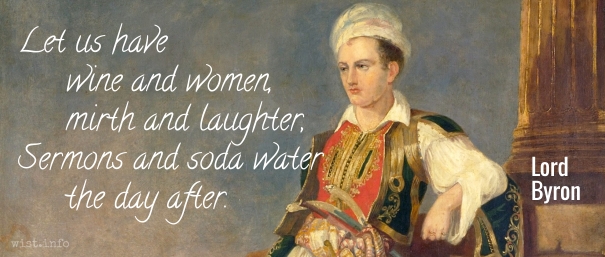
Let us have wine and women, mirth and laughter,
Sermons and soda water the day after.
So, we’ll go no more a-roving
So late into the night,
Though the heart be still as loving,
And the moon be still as bright.For the sword outwears its sheath,
And the soul wears out the breast,
And the heart must pause to breathe,
And love itself have rest.Though the night was made for loving,
And the day returns too soon,
Yet we’ll go no more a-roving
By the light of the moon.George Gordon, Lord Byron (1788–1824) English poet
“So We’ll Go No More A-Roving” (1817)
(Source)
Included in a letter to his friend Thomas Moore (28 Feb 1817), in which he complained he'd been up too late on too many night during the Carnival in Venice.
On with the dance! let joy be unconfined;
No sleep till morn, when Youth and Pleasure meet
To chase the glowing Hours with flying feet.George Gordon, Lord Byron (1788–1824) English poet
Childe Harold’s Pilgrimage, Canto 3, st. 22 (1818)
(Source)