Love, like fire, must be constantly in motion; it dies when it ceases to have hopes or fears.
[L’amour, aussi bien que le feu, ne peut subsister sans un mouvement continuel, et il cesse de vivre dès qu’il cesse d’espérer ou de craindre.]
François VI, duc de La Rochefoucauld (1613–1680) French epigrammatist, memoirist, noble
Réflexions ou sentences et maximes morales [Reflections; or Sentences and Moral Maxims], ¶75 (1665-1678) [tr. Stevens (1939)]
(Source)
This maxim appeared in the 1st (1665) edition.
(Source (French)). Other translations:Love can no more continue without a constant Motion, than Fire can; and when once you take Hope and Fear away, you take from it its very Life and Being.
[tr. Stanhope (1694), ¶76]Love, like fire, cannot subsist without constant motion; it ceases to exist, as soon as it ceases to hope or fear.
[pub. Donaldson (1783), ¶273; ed. Lepoittevin-Lacroix (1797), ¶73]Love, like fire, subsists by continual motion: when it ceases to hope or fear, it ceases to exist.
[ed. Carvill (1835), ¶234]Love, like fire, cannot subsist without continual movement; as soon as it ceases to hope and fear, it ceases to exist.
[ed. Gowens (1851), ¶76]Neither love nor fire can subsist without perpetual motion; both cease to live so soon as they cease to hope, or to fear.
[tr. Bund/Friswell (1871), ¶75]Love is like a flame; it can never be still, and dies when it ceases to hope or to fear.
[tr. Heard (1917), ¶75]Love, like fire, needs constant motion; when it ceases to hope, or to fear, love dies.
[tr. FitzGibbon (1957), ¶75]Love, like fire, must constantly leap and dart; when it can neither hope nor fear, it dies.
[tr. Kronenberger (1959), ¶75]Love, like fire, cannot survive without continual movement, and it ceases to live as soon as it ceases to hope or fear.
[tr. Tancock (1959), ¶75]Love as well as fire cannot subsist without continual motion; and it stops living from the moment it ceases either to hope or fear.
[tr. Whichello (2016) ¶75]
Quotations about:
tension
Note not all quotations have been tagged, so Search may find additional quotes on this topic.

SEMPRONIUS: Oh! think what anxious moments pass between
The birth of plots, and their last fatal periods,
Oh! ’tis a dreadful interval of time,
Filled up with horror all, and big with death!
Destruction hangs on every word we speak,
On every thought, till the concluding stroke
Determines all, and closes our design.Joseph Addison (1672–1719) English essayist, poet, statesman
Cato, Act 1, sc. 3, l. 50ff (1713)
(Source)

Money is a singular thing. It ranks with love as man’s greatest source of joy. And with death as his greatest source of anxiety.
John Kenneth Galbraith (1908–2006) Canadian-American economist, diplomat, author
The Age of Anxiety, ch. 6 “The Rise and Fall of Money” (1977)
(Source)
Even cowards can endure hardship; only the brave can endure suspense.
Mignon McLaughlin (1913–1983) American journalist and author
The Neurotic’s Notebook, ch. 3 (1963)
(Source)

When a people are confronted with problems that are both incomprehensible and unbearable, they lash out not at those who contrived the problems but at those who expose them. When they are confronted by moral problems that they find insoluble, or perhaps intolerable, they blame the moralists. The anxieties, tensions, revulsions of our day create an atmosphere in which it is almost impossible to think clearly and dispassionately about just those problems which most imperatively require reason and objectivity — problems of adjustment to fundamental change.
Henry Steele Commager (1902–1998) American historian, writer, activist
Speech (1971-04-10), “The University and the Community of Learning,” Kent State University, Ohio
(Source)
Please don’t tell me to relax — it’s only my tension that’s holding me together.
Ashleigh Brilliant (b. 1933) Anglo-American epigramist, aphorist, cartoonist
Pot-Shots, # 595

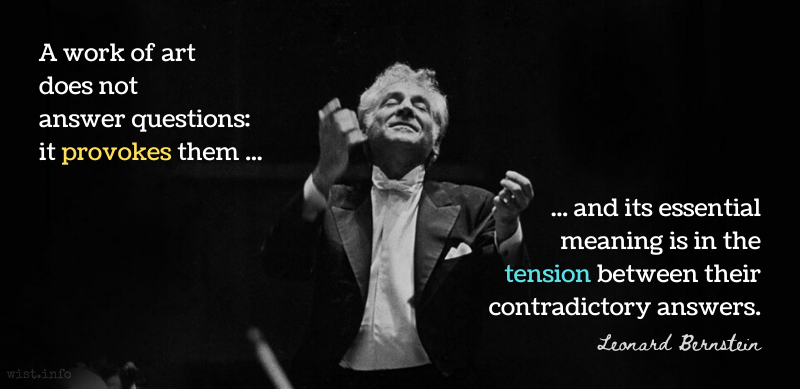
A work of art does not answer questions: it provokes them; and its essential meaning is in the tension between their contradictory answers.
Leonard Bernstein (1918–1990) American conductor, composer, author, music lecturer, pianist
“A Sabbatical Report,” sec. 1, New York Times (24 Oct 1965)
(Source)
Reprinted in The Infinite Variety of Music (1966)
A peacefulness follows any decision, even the wrong one.
Rita Mae Brown (b. 1944) American author, playwright
(Attributed)

What man actually needs is not a tensionless state but rather the striving and struggling for a worthwhile goal, a freely chosen task.
Viktor Frankl (1905–1997) German-American psychologist, writer
Man’s Search for Meaning, Part 2 (1946)
(Source)
Actually, we who engage in nonviolent direct action are not the creators of tension. We merely bring to the surface the hidden tension that is already alive. We bring it out in the open, where it can be seen and dealt with. Like a boil that can never be cured so long as it is covered up but must be opened with all its ugliness to the natural medicines of air and light, injustice must be exposed, with all the tension its exposure creates, to the light of human conscience and the air of national opinion before it can be cured.
Martin Luther King, Jr. (1929–1968) American clergyman, civil rights leader, social activist, preacher
Letter from Birmingham Jail (16 Apr 1963)
(Source)
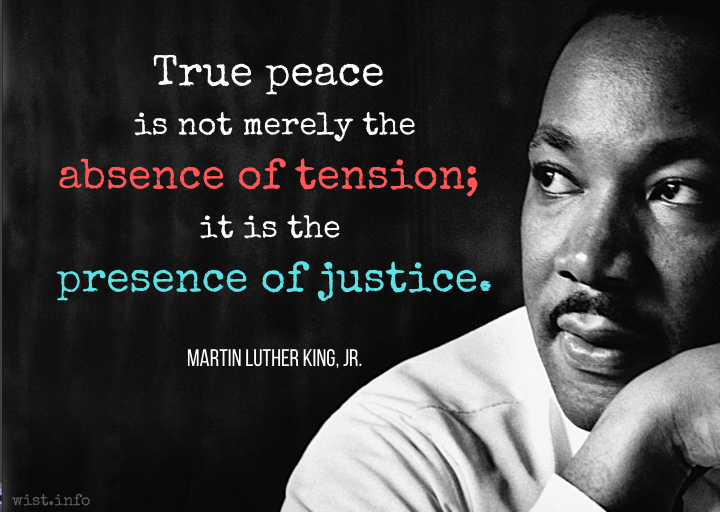
True peace is not merely the absence of tension; it is the presence of justice.
Martin Luther King, Jr. (1929–1968) American clergyman, civil rights leader, social activist, preacher
Stride Toward Freedom, ch. 2 “Montgomery Before the Protest” (1958)
(Source)
Response to a Montgomery resident who complained that race relations had been so "peaceful and harmonious" before King and other protesters arrived.