

We must … make the kingdom of God a reality in this world by works of love.
Albert Schweitzer (1875-1965) Alsatian philosopher, physician, philanthropist, polymath
“Religion and Modern Civilization,” Christian Century magazine (1934)
Quotations by:
Schweitzer, Albert
Faith which refuses to face indisputable facts is but little faith.
Albert Schweitzer (1875-1965) Alsatian philosopher, physician, philanthropist, polymath
“The Conception of the Kingdom of God in the Transformation of Eschatology,” epilog to E. Mozley, The Theology of Albert Schweitzer for Christian Enquirers (1951)
To enable it to do its work naturally, every new idea must be in some way embedded in what is old.
Albert Schweitzer (1875-1965) Alsatian philosopher, physician, philanthropist, polymath
“The Conception of the Kingdom of God in the Transformation of Eschatology” (1951)
A man can only do what he can do. But if he does that each day he can sleep at night and do it again the next day.
Albert Schweitzer (1875-1965) Alsatian philosopher, physician, philanthropist, polymath
(Attributed)
As we acquire more knowledge, things do not become more comprehensible, but more mysterious.
Albert Schweitzer (1875-1965) Alsatian philosopher, physician, philanthropist, polymath
(Attributed)
I don’t know what your destiny will be, but one thing I know: the only ones among you who will be really happy are those who have sought and found how to serve.
Albert Schweitzer (1875-1965) Alsatian philosopher, physician, philanthropist, polymath
(Attributed)
The tragedy of life is what dies inside a man while he lives.
Albert Schweitzer (1875-1965) Alsatian philosopher, physician, philanthropist, polymath
(Attributed)
Example is not the main thing in influencing others. It is the only thing.
Albert Schweitzer (1875-1965) Alsatian philosopher, physician, philanthropist, polymath
(Attributed)
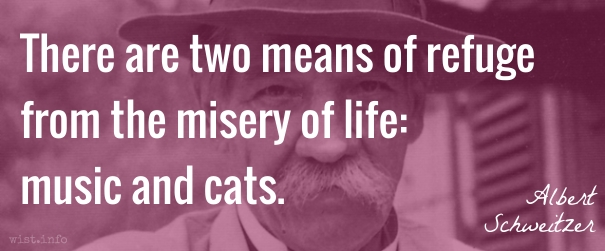
There are two means of refuge from the misery of life: music and cats.
[Zweierlei eignet sich als Zuflucht vor den Widrigkeiten des Lebens: Musik und Katzen.]
Albert Schweitzer (1875-1965) Alsatian philosopher, physician, philanthropist, polymath
(Attributed)
Widely attributed to Schweitzer, but no original source found.
Man is a clever animal, who behaves like an imbecile.
Albert Schweitzer (1875-1965) Alsatian philosopher, physician, philanthropist, polymath
(Attributed)
Strike out courageously! Do not ask where your efforts will take you on the infinite oceans! It is my will that you should swim.
Albert Schweitzer (1875-1965) Alsatian philosopher, physician, philanthropist, polymath
Christianity and the Religions of the World (1939)
Only those who respect the personality of others can be of real use to them.
Albert Schweitzer (1875-1965) Alsatian philosopher, physician, philanthropist, polymath
Memoirs of Childhood and Youth, ch. 5 (1925) [tr. Campion (1949)]
Ever since the world’s far-off lands were discovered, what has been the conduct of the white peoples to the coloured ones? […] Who can describe the injustice and the cruelties that in the course of centuries they have suffered at the hands of Europeans? […] If a record could be compiled of all that has happened between the white and the coloured races, it would make a book containing numbers of pages which the reader would have to turn over unread because their contents would be too horrible. We and our civilization are burdened, really, with a great debt. We are not free to confer benefits on these men, or not, as we please; it is our duty. Anything we give them is not benevolence but atonement.
Albert Schweitzer (1875-1965) Alsatian philosopher, physician, philanthropist, polymath
On the Edge of the Primeval Forest, ch. 11 (1922) [tr. Campion (1928)]
To the question whether I am a pessimist or an optimist, I answer that my knowledge is pessimistic, but my willing and hoping are optimistic.
Albert Schweitzer (1875-1965) Alsatian philosopher, physician, philanthropist, polymath
Out of My Life and Thought, An Autobiography, Epilogue (1933) [tr. Campion]
See also Gramsci.
Just as the water of the streams we see is small in amount compared to that which flows underground, so the idealism which becomes visible is small in amount compared with what men and women bear locked in their hearts, unreleased or scarcely released. To unbind what is bound, to bring the underground waters to the surface: mankind is waiting and longing for such as can do that.
Albert Schweitzer (1875-1965) Alsatian philosopher, physician, philanthropist, polymath
Out of My Life and Thought: An Autobiography, ch. 9 (1933) [tr. Campion]
Sincerity is the foundation of the spiritual life.
Albert Schweitzer (1875-1965) Alsatian philosopher, physician, philanthropist, polymath
Out of My Life and Thought, ch. 21 [tr. Campion (1933)]
Just as the wave cannot exist for itself, but is ever a part of the heaving surface of the ocean, so must I never live my life for itself, but always in the experience which is going on around me. It is an uncomfortable doctrine which the true ethics whisper into my ear. You are happy, they say; therefore you are called upon to give much.
Albert Schweitzer (1875-1965) Alsatian philosopher, physician, philanthropist, polymath
Philosophy of Civilisation, vol. 2 “Civilization and Ethics,” ch. 26 (1949)
Trans. CT Campion
What is nationalism? It is an ignoble patriotism.
Albert Schweitzer (1875-1965) Alsatian philosopher, physician, philanthropist, polymath
The Philosophy of Civilization: The Decay and Restoration of Civilization, ch. 3 (1923) [tr. Campion (1923)]
The noble kind of patriotism … aims at ends that are worthy of the whole of mankind.
Albert Schweitzer (1875-1965) Alsatian philosopher, physician, philanthropist, polymath
The Philosophy of Civilization: The Decay and Restoration of Civilization, ch. 4 (1923) [tr. Campion (1923)]
Anyone who proposes to do good must not expect people to roll stones out of their way, but must accept their lot calmly, even if people roll a few stones upon it.
Albert Schweitzer (1875-1965) Alsatian philosopher, physician, philanthropist, polymath
The Spiritual Life: Selected Writings of Albert Schweitzer (1947)
Not one of us knows what effect his life produces, and what he gives to others; that is hidden from us and must remain so, though we are often allowed to see some little fraction of it, so that we may not lose courage. The way in which power works is a mystery.
Albert Schweitzer (1875-1965) Alsatian philosopher, physician, philanthropist, polymath
The Spiritual Life: Selected Writings of Albert Schweitzer (1947)
We cannot abdicate our conscience to an organization, nor to a government. ‘Am I my brother’s keeper?’ Most certainly I am! I cannot escape my responsibility by saying the State will do all that is necessary. It is a tragedy that nowadays so many think and feel otherwise.
Albert Schweitzer (1875-1965) Alsatian philosopher, physician, philanthropist, polymath
The Spiritual Life (1947)
Faith which refuses to face indisputable facts is but little faith. Truth is always gain, however hard it is to accommodate ourselves to it. To linger in any kind of untruth proves to be a departure from the straight way of faith.
Albert Schweitzer (1875-1965) Alsatian philosopher, physician, philanthropist, polymath
The Spiritual Life (1947)
Knowing all truth is less than doing a little bit of good.
Albert Schweitzer (1875-1965) Alsatian philosopher, physician, philanthropist, polymath
The Thoughts of Albert Schweitzer