“So what’s the point of showing me something I can’t see?”
“So that you understand that just because you see something, it doesn’t mean to say it’s there. And if you don’t see something, it doesn’t mean to say it’s not there. It’s only what your senses bring to your attention.”Douglas Adams (1952–2001) English author, humorist, screenwriter
Hitchhiker’s Guide No. 5, Mostly Harmless, ch. 17 (1992)
(Source)
Random and the bird Guide.
Quotations about:
demonstration
Note not all quotations have been tagged, so Search may find additional quotes on this topic.

But this we can say with certainty: a government and a society that silences those who dissent is one that has lost its way. This we can say: that what is essential in a free society is that there should be an atmosphere where those who wish to dissent and even to demonstrate can do so without fear of recrimination or vilification.
Henry Steele Commager (1902–1998) American historian, writer, activist
Essay (1965-12-18), “The Problem of Dissent,” Saturday Review
(Source)
Reprinted in Freedom and Order, Part 6 (1966).
The rich and respectable have always had their ways of making their discontent heard; the poor and unorganized must resort to protests and marches and demonstrations.
Henry Steele Commager (1902–1998) American historian, writer, activist
Essay (1965-12-18), “The Problem of Dissent,” Saturday Review
(Source)
Reprinted in Freedom and Order, Part 6 (1966).

Christ by his crucifixion demonstrated exactly what the assault of cruelty on the innocent means; and the subsequent services devised by the early church commemorated the beauty of the virtue that was slain and the beastliness shown by the slayer, and reiterated the warning that this was the kind of crime man was inherently likely to commit unless he watched himself. There could be no more proper medicine for the human disease. But the church has poured as much of the draft as possible down the drain by its attempts to account for the crucifixion of Christ as an atonement for the sins of man instead of a demonstration of them.
Rebecca West (1892–1983) British author, journalist, literary critic, travel writer [pseud. for Cicily Isabel Fairfield]
“Pleasure Be Your Guide,” The Nation, “Living Philosophies” series #10 (25 Feb 1939)
(Source)
Adapted into Clifton Fadiman, I Believe: The Personal Philosophies of Certain Eminent Men and Women of Our Time (1952).

A man’s action is only a picture-book of his creed.
Ralph Waldo Emerson (1803–1882) American essayist, lecturer, poet
“Poetry and Imagination,” Letters and Social Aims (1876)
(Source)

The mediocre teacher tells. The good teacher explains. The superior teacher demonstrates. The great teacher inspires.
William Arthur Ward (1921–1994) American aphorist, author, educator
Thoughts of a Christian Optimist (1968)
(Source)

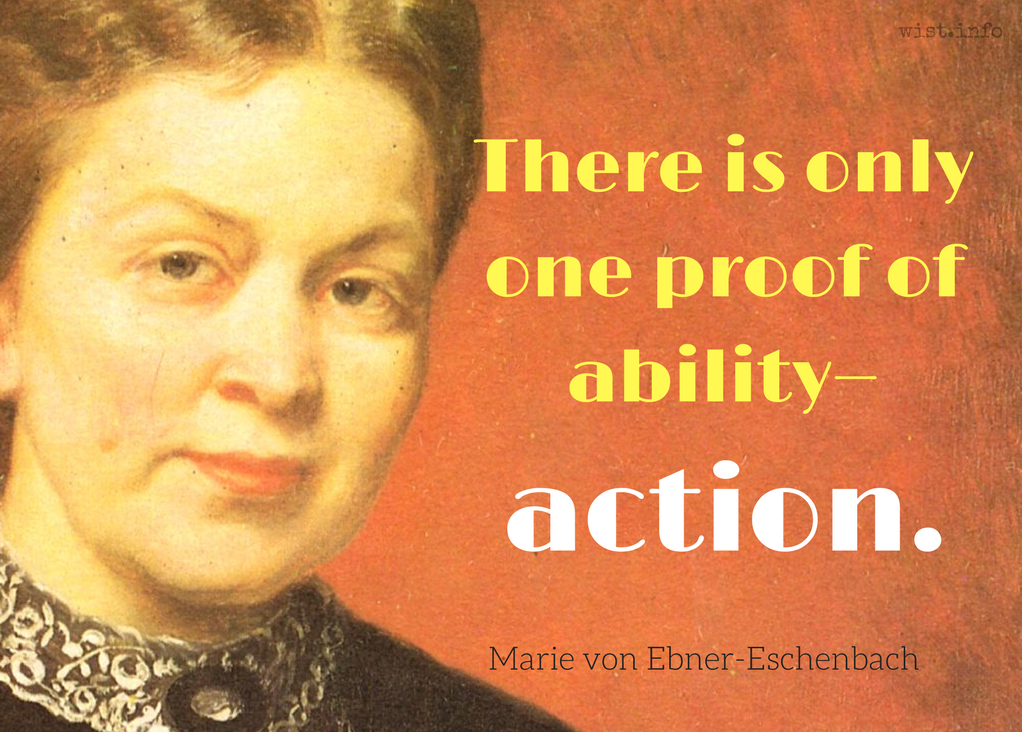
There is only one proof of ability — action.
[Für das Können gibt es nur einen Beweis: das Tun.]
Marie von Ebner-Eschenbach (1830–1916) Austrian writer
Aphorisms [Aphorismen], No. 91 (1880) [tr. Wister (1883)]
(Source)
(Source (German)). Other translation:There is only one proof of ability: doing it.
[tr. Scrase/Mieder (1994)]

Agnosticism, in fact, is not a creed, but a method, the essence of which lies in the rigorous application of a single principle. That principle is of great antiquity; it is as old as Socrates; as old as the writer who said, “Try all things, hold fast by that which is good”; it is the foundation of the Reformation, which simply illustrated the axiom that every man should be able to give a reason for the faith that is in him, it is the great principle of Descartes; it is the fundamental axiom of modern science. Positively the principle may be expressed: In matters of the intellect, follow your reason as far as it will take you, without regard to any other consideration. And negatively: In matters of the intellect, do not pretend that conclusions are certain which are not demonstrated or demonstrable. That I take to be the agnostic faith, which if a man keep whole and undefiled, he shall not be ashamed to look the universe in the face, whatever the future may have in store for him.