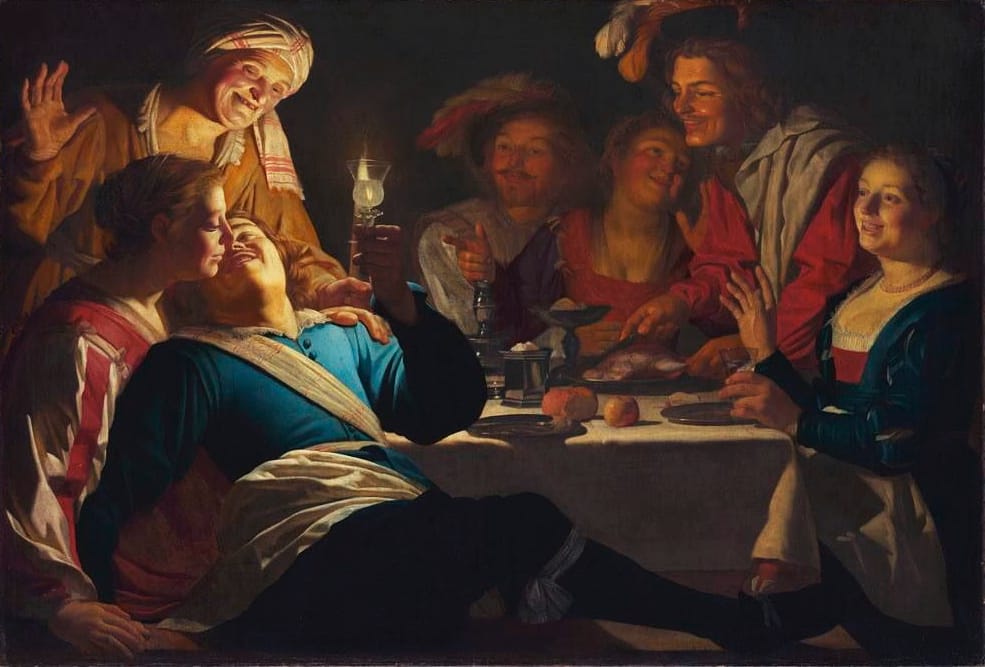
And not many days after the younger son gathered all together, and took his journey into a far country, and there wasted his substance with riotous living.
[καὶ μετ᾽ οὐ πολλὰς ἡμέρας συναγαγὼν πάντα ὁ νεώτερος υἱὸς ἀπεδήμησεν εἰς χώραν μακρὰν καὶ ἐκεῖ διεσκόρπισεν τὴν οὐσίαν αὐτοῦ ζῶν ἀσώτως.]
The Bible (The New Testament) (AD 1st - 2nd C) Christian sacred scripture
Luke 15: 13, “Parable of the Prodigal Son” (Jesus) [KJV (1611)]
(Source)
Set up in the Parable of the Prodigal Son (in fact, the verse where he is being prodigal).
No Synoptic parallels.
(Source (Greek)). Alternate translations:A few days later, the younger son got together everything he had and left for a distant country where he squandered his money on a life of debauchery.
[JB (1966); NJB (1985)]After a few days the younger son sold his part of the property and left home with the money. He went to a country far away, where he wasted his money in reckless living.
[GNT (1992 ed.)]Soon afterward, the younger son gathered everything together and took a trip to a land far away. There, he wasted his wealth through extravagant living.
[CEB (2011)]A few days later the younger son gathered all he had and traveled to a distant region, and there he squandered his wealth in dissolute living.
[NRSV (2021 ed.)]
Quotations about:
spendthrift
Note not all quotations have been tagged, so Search may find additional quotes on this topic.

To what extremes, O cursèd lust for gold
will you not drive man’s appetite?
[Per che non reggi tu, o sacra fame
de l’oro, l’appetito de’ mortali?]Dante Alighieri (1265-1321) Italian poet
The Divine Comedy [Divina Commedia], Book 2 “Purgatorio,” Canto 22, l. 40ff (22.40-41) [Statius] (1314) [tr. Musa (1981)]
(Source)
Statius is quoting Virgil (whose shade stands in front of him) from The Aeneid, Book 3, ll. 56-57:Quid non mortalia pectora cogis,
Auri sacra fames?
Unlike the phrase in that pagan book, which is purely about the corrupting power of greed and gold-lust, Dante's Italian and some translators make reference to a "holy hunger," a virtue/rule of proper attitude toward money and spending, criticized here for it not restraining humans from the sins of being either spendthrifts or misers -- a nod to Aristotle making sin about extremes and virtue about moderation. See Ciardi, Durling, Kirkpatrick, Princeton, and Sayers for more discussion.
(Source (Italian)). Alternate translations:Why, thou cursed thirst
Of gold! dost not with juster measure guide
The appetite of mortals?
[tr. Cary (1814)]Why should'st thou not restrain accursèd thirst
Of gold, the appetite of mortals lost?
[tr. Bannerman (1850)]To what impellest thou not, O cursed hunger
Of gold, the appetite of mortal men?
[tr. Longfellow (1867)]Why restrainest thou not, O holy hunger of gold, the desire of mortals?
[tr. Butler (1885)]To what lengths, O thou cursed thirst of gold,
Dost thou not rule the mortal appetite?
[tr. Minchin (1885)]O cursed hunger of gold, to what dost thou not impel the appetite of mortals?
[tr. Norton (1892)]Wherefore dost thou not regulate the lust of mortals, O hallowed hunger of gold?
[tr. Okey (1901)]To what, O cursed hunger for gold, dost thou not drive the appetite of mortals?
[tr. Sinclair (1939)]O hallowed hunger of gold, why dost thou not
The appetite of mortal men control?
[tr. Binyon (1943)]With what constraint constran'st thou not the lust
Of mortals, thou devoted greed of gold!
[tr. Sayers (1955)]To what do you not drive man's appetite,
O cursèd gold-lust!
[tr. Ciardi (1961)]Why do you not control the appetite
Of mortals, O you accurst hunger for gold?
[tr. Sisson (1981)]Why cannot you, o holy hunger
for gold, restrain the appetite of mortals?
[tr. Mandelbaum (1982)]O sacred hunger for gold, why do you not rule human appetite?
[tr. Kline (2002)]Why do you, O holy hunger for gold, not
govern the appetite of mortals?
[tr. Durling (2003)]You, awestruck hungering for gold! Why not
impose a rule on mortal appetite?
[tr. Kirkpatrick (2007)]To what end, O cursèd hunger for gold,
do you not govern the appetite of mortals?
[tr. Hollander/Hollander (2007)]Accursed craving for money, what is there, in
This world, you don't lead human beings to?
[tr. Raffel (2010)]

A miser grows rich by seeming poor; an extravagant man grows poor by seeming rich.
William Shenstone (1714-1763) English poet
“Of Men and Manners,” sec. 86, Men and Manners (1804)
(Source)
A prodigal starts with ten thousand pounds, and dies worth nothing; a miser starts with nothing, and does worth ten thousand pounds. It has been asked which has had the best of it? I should presume the prodigal; he has spent a fortune — but the miser has only left one; — he has lived rich, to die poor; the miser has lived poor, to die rich; and if the prodigal quits life in debt to others, the miser quits it, still deeper in debt to himself.
Charles Caleb "C. C." Colton (1780-1832) English cleric, writer, aphorist
Lacon: Or, Many Things in Few Words, Vol. 2, § 131 (1822)
(Source)

The Prodigal robs his Heir, the Miser himself.
Thomas Fuller (1654-1734) English physician, preacher, aphorist, writer
Gnomologia: Adages and Proverbs (compiler), # 4722 (1732)
(Source)