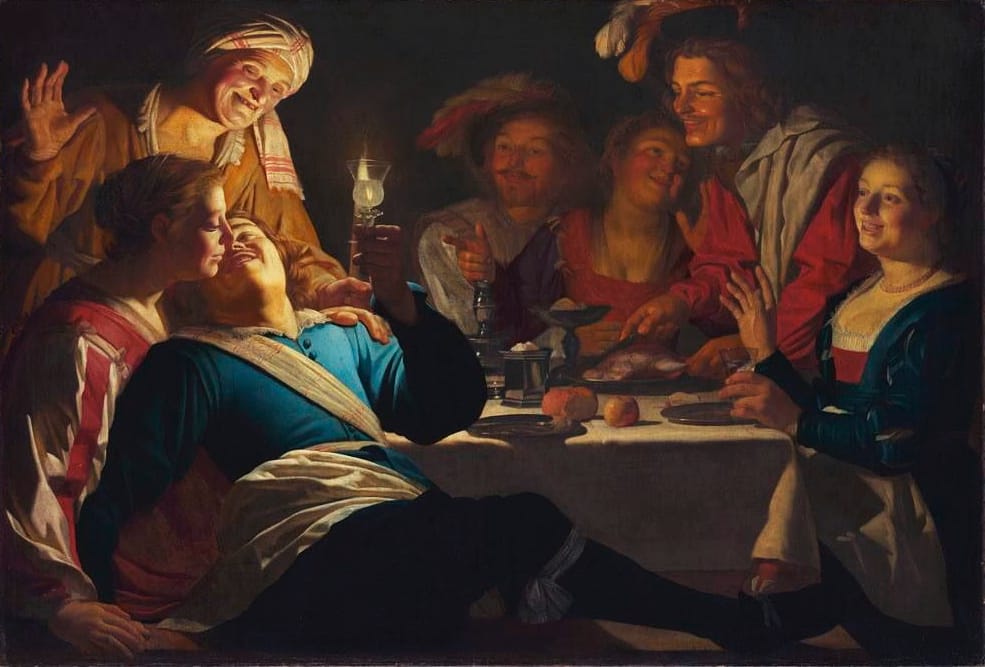
And not many days after the younger son gathered all together, and took his journey into a far country, and there wasted his substance with riotous living.
[καὶ μετ᾽ οὐ πολλὰς ἡμέρας συναγαγὼν πάντα ὁ νεώτερος υἱὸς ἀπεδήμησεν εἰς χώραν μακρὰν καὶ ἐκεῖ διεσκόρπισεν τὴν οὐσίαν αὐτοῦ ζῶν ἀσώτως.]
The Bible (The New Testament) (AD 1st - 2nd C) Christian sacred scripture
Book 3. Gospel of Luke 15:13 (Luke 15:13), “Parable of the Prodigal Son” (Jesus) [KJV (1611)]
(Source)
Set up in the Parable of the Prodigal Son (in fact, the verse where he is being prodigal).
No Synoptic parallels.
(Source (Greek)). Alternate translations:A few days later, the younger son got together everything he had and left for a distant country where he squandered his money on a life of debauchery.
[JB (1966); NJB (1985)]After a few days the younger son sold his part of the property and left home with the money. He went to a country far away, where he wasted his money in reckless living.
[GNT (1992 ed.)]Soon afterward, the younger son gathered everything together and took a trip to a land far away. There, he wasted his wealth through extravagant living.
[CEB (2011)]A few days later the younger son gathered all he had and traveled to a distant region, and there he squandered his wealth in dissolute living.
[NRSV (2021 ed.)]
Quotations about:
spendthrift
Note not all quotations have been tagged, so Search may find additional quotes on this topic.

To what extremes, O cursèd lust for gold
will you not drive man’s appetite?
[Per che non reggi tu, o sacra fame
de l’oro, l’appetito de’ mortali?]Dante Alighieri (1265–1321) Italian poet
The Divine Comedy [Divina Commedia], Book 2 “Purgatorio,” Canto 22, l. 40ff (22.40-41) [Statius] (1314) [tr. Musa (1981)]
(Source)
Statius is quoting Virgil (whose shade stands in front of him) from The Aeneid, Book 3, ll. 56-57:Quid non mortalia pectora cogis,
Auri sacra fames?
Unlike the phrase in that pagan book, which is purely about the corrupting power of greed and gold-lust, Dante's Italian and some translators make reference to a "holy hunger," a virtue/rule of proper attitude toward money and spending, criticized here for it not restraining humans from the sins of being either spendthrifts or misers -- a nod to Aristotle making sin about extremes and virtue about moderation. See Ciardi, Durling, Kirkpatrick, Princeton, and Sayers for more discussion.
(Source (Italian)). Other translations:Why, thou cursed thirst
Of gold! dost not with juster measure guide
The appetite of mortals?
[tr. Cary (1814)]Why should'st thou not restrain accursèd thirst
Of gold, the appetite of mortals lost?
[tr. Bannerman (1850)]To what impellest thou not, O cursed hunger
Of gold, the appetite of mortal men?
[tr. Longfellow (1867)]Why restrainest thou not, O holy hunger of gold, the desire of mortals?
[tr. Butler (1885)]To what lengths, O thou cursed thirst of gold,
Dost thou not rule the mortal appetite?
[tr. Minchin (1885)]O cursed hunger of gold, to what dost thou not impel the appetite of mortals?
[tr. Norton (1892)]Wherefore dost thou not regulate the lust of mortals, O hallowed hunger of gold?
[tr. Okey (1901)]To what, O cursed hunger for gold, dost thou not drive the appetite of mortals?
[tr. Sinclair (1939)]O hallowed hunger of gold, why dost thou not
The appetite of mortal men control?
[tr. Binyon (1943)]With what constraint constran'st thou not the lust
Of mortals, thou devoted greed of gold!
[tr. Sayers (1955)]To what do you not drive man's appetite,
O cursèd gold-lust!
[tr. Ciardi (1961)]Why do you not control the appetite
Of mortals, O you accurst hunger for gold?
[tr. Sisson (1981)]Why cannot you, o holy hunger
for gold, restrain the appetite of mortals?
[tr. Mandelbaum (1982)]O sacred hunger for gold, why do you not rule human appetite?
[tr. Kline (2002)]Why do you, O holy hunger for gold, not
govern the appetite of mortals?
[tr. Durling (2003)]You, awestruck hungering for gold! Why not
impose a rule on mortal appetite?
[tr. Kirkpatrick (2007)]To what end, O cursèd hunger for gold,
do you not govern the appetite of mortals?
[tr. Hollander/Hollander (2007)]Accursed craving for money, what is there, in
This world, you don't lead human beings to?
[tr. Raffel (2010)]

A miser grows rich by seeming poor; an extravagant man grows poor by seeming rich.
William Shenstone (1714–1763) English poet
“Of Men and Manners,” sec. 86, Men and Manners (1804)
(Source)
A prodigal starts with ten thousand pounds, and dies worth nothing; a miser starts with nothing, and does worth ten thousand pounds. It has been asked which has had the best of it? I should presume the prodigal; he has spent a fortune — but the miser has only left one; — he has lived rich, to die poor; the miser has lived poor, to die rich; and if the prodigal quits life in debt to others, the miser quits it, still deeper in debt to himself.
Charles Caleb "C. C." Colton (1780–1832) English cleric, writer, aphorist
Lacon: Or, Many Things in Few Words, Vol. 2, § 131 (1822)
(Source)

The Prodigal robs his Heir, the Miser himself.
Thomas Fuller (1654–1734) English physician, preacher, aphorist, writer
Gnomologia: Adages and Proverbs (compiler), # 4722 (1732)
(Source)