Separations are the tonics of Love, but beware of overdoses.
Minna Antrim (1861–1950) American epigrammatist, writer
Sweethearts and Beaux (1905)
(Source)
See Propertius.
Quotations about:
apart
Note not all quotations have been tagged, so Search may find additional quotes on this topic.

I never want to be away from you again, except at work, in the restroom, or when one of us is at a movie the other does not want to see.
Lemony Snicket (b. 1970) American author, screenwriter, musician (pseud. for Daniel Handler)
The Beatrice Letters (2006)

Short absence quickens love; long absence kills it.
Victor de Riqueti, Marquis de Mirabeau (1715–1786) French economist
(Attributed)
Attributed in J. De Finod (ed. and tr.), A Thousand Flashes of French Wit, Wisdom, and Wickedness (1881)
See Propertius.
Absence and a friendly neighbor washes away love.

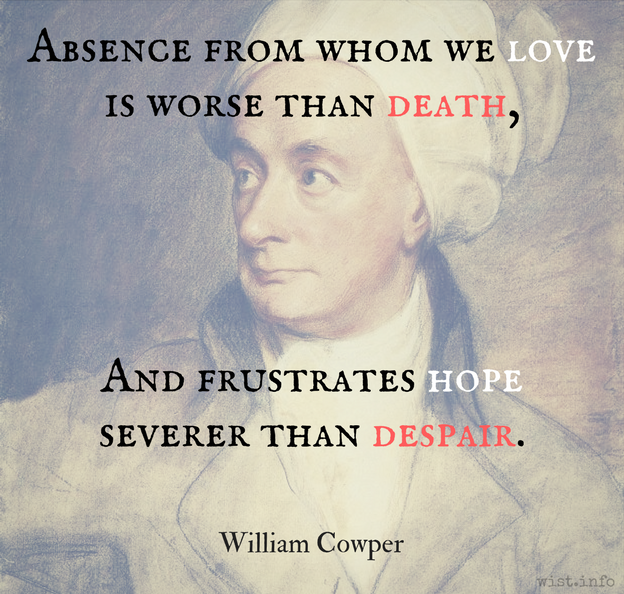
Absence from whom we love is worse than death,
And frustrate hope severer than despair.
William Cowper (1731–1800) English poet
“Hope, like the short-lived ray that gleams awhile”
(Source)
People sometimes say about a man who lives alone: “He doesn’t like society.” That’s often like saying that a man doesn’t like to take walks because he doesn’t willingly walk in the forest of Bondy at night.
[On dit quelquefois d’un homme qui vit seul : il n’aime pas la Société. C’est souvent comme si on disait d’un homme qu’il n’aime pas la promenade, sous le prétexte qu’il ne se promène pas volontiers le soir dans la forêt de Bondy.]
Nicolas Chamfort (1741–1794) French writer, epigrammist (b. Nicolas-Sébastien Roch)
Products of Perfected Civilization [Produits de la Civilisation Perfectionée], Part 1 “Maxims and Thoughts [Maximes et Pensées],” ch. 4, ¶ 275 (1795) [tr. Siniscalchi (1994)]
(Source)
(Source (French)). Other translations:People sometimes say of a man who lives alone: He does not like Society; but this is very often the same as saying that a man does not like walking because he will not willingly walk at evening in the forest of Bondy.
[tr. Mathers (1926)]Sometimes it is said of a man who lives alone, “He does not like society.” Often it is as though one were to say that a man did not like walking because he would not willingly walk at night in the forest of Bondy.
[tr. Merwin (1969)]One sometimes says of a man who lives alone: "He dislikes society." It is often as though people said of a man that he did not like walking, alleging that he is loth to walk of an evening in the Forest of Bondy.
[tr. Pearson (1973)]It is sometimes said of a man who lives alone that he does not like society. This is like saying of a man he does not like going for walks because he is not fond of walking at night in the forêt de Bondy.
[tr. de Botton, Status Anxiety (2004)]

Absence, that common cure of love.
Miguel de Cervantes (1547–1616) Spanish novelist
Don Quixote, Part 1, Book 3, ch. 10 (1605) [tr. Motteux (1701)]
(Source)
See Propertius.

Absence weakens ordinary passions, but inflames great ones, as the wind extinguishes a candle, but fans a fire.
[L’absence diminue les médiocres passions, et augmente les grandes, comme le vent éteint les bougies et allume le feu.]
François VI, duc de La Rochefoucauld (1613–1680) French epigrammatist, memoirist, noble
Réflexions ou sentences et maximes morales [Reflections; or Sentences and Moral Maxims], ¶276 (1665-1678) [tr. Stevens (1939)]
(Source)
Present in the 1st (1665) edition. The manuscript reads:L’absence fait que les médiocres passions diminuent, et que les grandes croissent, comme le vent éteint les bougies et allume le feu.
See Bussy-Rabutin (1660), and a related theme from Propertius (c. 20 BC).
(Source (French)). Other translations:Absence cools Moderate Passions, and Enflames Violent ones; Just as the Wind blows out Candles, but Kindles Fires.
[tr. Stanhope (1694), ¶277; (1706), ¶276]Absence destroys small passions, and increases great ones; as the wind extinguishes tapers, and kindles fires.
[pub. Donaldson (1783), ¶334; ed. Lepoittevin-Lacroix (1797), ¶257]Absence destroys small passions, and increases great ones; the wind extinguishes tapers, and kindles fires.
[ed. Carvill (1835), ¶295]Absence diminishes moderate passions and increases great ones, as the wind extinguishes tapers and adds fury to fire.
[ed. Gowens (1851), ¶286]Absence extinguishes small passions and increases great ones, as the wind will blow out a candle, and blow in a fire.
[tr. Bund/Friswell (1871), ¶276]The same wind snuffs candles yet kindles fires; so, where absence kills a little love, it fans a great one.
[tr. Heard (1917), ¶284]Absence diminishes small loves and increases great ones, as the wind blows out the candle and blows up the bonfire.
[tr. FitzGibbon (1957), ¶276]Absence weakens lukewarm feelings but intensifies great ones, as wind snuffs out candles but feeds fire.
[tr. Kronenberger (1959), ¶276]Absence lessens moderate passions and intensifies great ones, as the wind blows out a candle but fans up a fire.
[tr. Tancock (1959), ¶276]Absence diminishes mediocre passions and increases great ones, as the wind blows out candles and fans fire.
Bartlett's (1980), ¶276; < 1973?)]Absence diminishes moderate passions and magnifies great ones, as the wind blows out candles but kindles fire.
[tr. Whichello (2016) ¶276]

Absence is to love what wind is to fire;
It extinguishes the small, it enkindles the great.[L’absence est a l’amour ce qu’est au feu le vent;
Il eteint le petit, il allume le grand.]Roger de Rabutin, Comte de Bussy (1618–1693) French soldier, libertine, writer [a.k.a. Roger Bussy-Rabutin]
Histoire amoureuse des Gaules, “Maximes d’amour [Maxims of Love]” (1660)