

Everyone is as God has made him, and oftentimes a great deal worse.
Miguel de Cervantes (1547–1616) Spanish novelist
Don Quixote, 11.5
Quotations by:
Cervantes, Miguel de
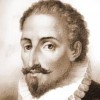
The brave man carves out his fortune, and every man is the son of his own works.
Miguel de Cervantes (1547–1616) Spanish novelist
Don Quixote, Part 1, Book 1, ch. 4 (1605)
Those two fatal words, Mine and Thine.
Miguel de Cervantes (1547–1616) Spanish novelist
Don Quixote, Part 1, Book 2, ch. 11 (1605) [tr. Motteux & Ozell (1743)]
(Source)
Alt trans.:
- "Oh happy age, which our first parents called the age of gold! not because gold, so much adored in this iron-age, was then easily purchased, but because those two fatal words, mine and thine, were distinctions unknown to the people of those fortunate times." [Full version of the above]
- "Happy the age, happy the time, to which the ancients gave the name of golden, not because in that fortunate age the gold so coveted in this our iron one was gained without toil, but because they that lived in it knew not the two words 'mine' and 'thine'!" [tr. Ormsby (1885)]
- "Happy age, and happy days were those, to which the ancients gave the name of golden; not, that gold, which in these our iron-times, is so much esteemed, was to be acquired without trouble, in that fortunate period; but, because people then, were ignorant of those two words MINE and THINE." [tr. Smollett (1976), as Part 1, Book 1, ch. 3]
There’s not the least thing can be said or done, but people will talk and find fault.
Miguel de Cervantes (1547–1616) Spanish novelist
Don Quixote, Part 1, Book 2, ch. 4 (1605)
Absence, that common cure of love.
Miguel de Cervantes (1547–1616) Spanish novelist
Don Quixote, Part 1, Book 3, ch. 10 (1605) [tr. Motteux (1701)]
(Source)
See Propertius.
I never thrust my nose into another man’s porridge.
Miguel de Cervantes (1547–1616) Spanish novelist
Don Quixote, Part 1, Book 3, ch. 11 (1605) [tr. Motteaux and Ozell (1743)]
Be brief, for no discourse can please when too long.
Miguel de Cervantes (1547–1616) Spanish novelist
Don Quixote, Part 1, Book 3, ch. 7 (1605)
Delay always breeds danger; to protract a great design is often to ruin it.
Miguel de Cervantes (1547–1616) Spanish novelist
Don Quixote, Part 1, Book 4, ch. 2 (1605) [tr. Motteux and Ozell (1743)]
Think before thou speakest.
Miguel de Cervantes (1547–1616) Spanish novelist
Don Quixote, Part 1, Book 4, ch. 3 (1605) [tr. Motteux and Ozell (1743)]
The proof of the pudding is in the eating.
Miguel de Cervantes (1547–1616) Spanish novelist
Don Quixote, Part 1, Book 4, ch. 10 (1605) [tr. Motteau and Ozell (1743)]
I’d be as good a king of my estate as any other King; and being so, I should do as I liked; and doing as I liked, I should take my pleasure; and taking my pleasure, I should be contented; and when one’s content, there’s nothing more to desire; and when there’s nothing more to desire, there’s an end of it.
[Tan Rey seria yo de mi estado, como cada uno del suyo: y siendolo, haria lo que quisiesse: y haziendo lo que quisiesse, haria mi gusto: y haziendo mi gusto, estaria contento: y en estando uno contento, no tiene mas que dessear: y no teniendo mas qu essear, acabose.]
Miguel de Cervantes (1547–1616) Spanish novelist
Don Quixote, Part 1, ch. 50 [Sancho] (1605) [tr. Cohen (1950)]
(Source)
On being a king.
(Source (Spanish)). Other translations:I should be as much king of my own dominion as any other king; and being so, I would do what I pleased; and, doing what I pleased, I should have my will; and, having my will, I should be contented; and, being content, there is no more to be desired: and when there is no more to desire, there's an end of it.
[tr. Motteux* (1700-1703); Part 1, ch. 39]The first thing I would do in my government, I would have nobody to control me, I would be absolute: and who but I: now, he that is absolute, can do what he likes; he that can do what he likes, can take his pleasure; he that can take his pleasure, can be content; and he that can be content, has no more desire; so the matter is over.
[tr. Motteux*; Part 1, ch. 39]I should be as much king of my own dominion, as any one of his: and being so, I would do what I pleased, and doing what I pleased, I should have my will, and having my will, I should be contented; and when one is contented, there is no more to be desired; and when there is no more to be desired, there is an end of it.
[tr. Jarvis (1819), Part 1, Book 4, ch. 23]I shall be as much king of my realm as any other of his; and being so I should do as I liked, and doing as I liked I should please myself, and pleasing myself I should be content, and when one is content he has nothing more to desire, and when one has nothing more to desire there is an end of it.
[tr. Ormsby (1885); Vol. 1, ch. 50]I shall be as much a king of my realm as any other of his; and being so I should do as I liked, and doing as I liked I should please myself, and pleasing myself I should be content, and when one is content he has nothing more to desire, and when one has nothing more to desire there is an end of it.
[ed. Pérezgonzález (2006); Vol. 1, ch. 50]
* I am unclear on why the two Motteux translations are so different; both sources list Pierre Antoine Motteux as the translator, and I can't find anything in the two texts
A proverb is a short sentence based on long experience.
Miguel de Cervantes (1547–1616) Spanish novelist
Don Quixote, Part 2 (1615)
There are but two families in the world, Have-much and Have-little.
Miguel de Cervantes (1547–1616) Spanish novelist
Don Quixote, Part 2, Book 3, ch. 20 (1615) [tr. Motteux and Ozell (1743)]
More popularly given as "The Haves and the Have-Nots."
Tell me what company thou keepst, and I’ll tell thee what thou art.
Miguel de Cervantes (1547–1616) Spanish novelist
Don Quixote, Part 2, Book 3, ch. 23 (1615)
He preaches well that lives well, quoth Sancho; that’s all the Divinity I understand.
Miguel de Cervantes (1547–1616) Spanish novelist
Don Quixote, Part 2, Book 3, ch. 29 (1615) [tr. Motteux & Ozell (1743)]
Death and sleep make us all alike, rich and poor, high and low.
Miguel de Cervantes (1547–1616) Spanish novelist
Don Quixote, Part 2, Book 4, ch. 43 (1615) [tr. Motteux and Ozell (1743)]