Take heed not to be transformed into a Caesar, not to be dipped in the purple dye; for it does happen.
[Ὅρα μὴ ἀποκαισαρωθῇς, μὴ βαφῇς: γίνεται γάρ.]
Marcus Aurelius (AD 121-180) Roman emperor (161-180), Stoic philosopher
Meditations [To Himself; Τὰ εἰς ἑαυτόν], Book 6, ch. 30 (6.30.1) (AD 161-180) [tr. Farquharson (1944)]
(Source)
Advising himself on the dangers of becoming emperor. Marcus coined a new Greek verb here (ἀποκαισαρόομαι), "to become like Caesar" (more broadly, "to assume the monarchy").
(Source (Greek)). Alternate translations:Take heed, lest of a philosopher thou become a mere Caesar in time, and receive a new tincture from the court. For it may happen if thou dost not take heed.
[tr. Casaubon (1634), 6.27]Have a care you han't too much of an Emperour in you, and that you don't fall into the liberties and Pride of your Predecessors. These Humours are easily learn'd, therefore guard against the Infection.
[tr. Collier (1701)]Take care you don’t degenerate into the manners of the Cesars, or be tinctured by them.
[tr. Hutcheson/Moor (1742)]Beware, when you take the title of Cæsar, that you do not insensibly assume too much of the Emperor; nor be infected with the haughty manners of some of your predecessors; for there is a possibility of such an event.
[tr. Graves (1792), 6.27]Take care that thou art not made into a Caesar, that thou art not dyed with this dye; for such things happen.
[tr. Long (1862)]Have care that you have not too much of a Cæsar in you, and that you are not dyed with that dye. This is easily learned, therefore guard against the infection.
[tr. Collier/Zimmern (1887)]See that you be not be-Cæsared, steeped in that dye, as too often happens.
[tr. Rendall (1898)]See to it that you fall not into Caesarism: avoid that stain, for it may come to you.
[tr. Hutcheson/Chrystal (1902)]See thou be not Caesarified, nor take that dye, for there is the possibility.
[tr. Haines (Loeb) (1916)]Be careful not to affect the monarch too much, or to be too deeply dyed with the purple; for this can well happen.
[tr. Staniforth (1964)]Take care that you are not turned into a Caesar, that you are not stained with the purple; for such things do come about.
[tr. Hard (1997 ed.; 2011 ed.)]To escape imperialization -- that indelible stain. It happens.
[tr. Hays (2003)]Take care not to be Caesarified, or dyed in purple: it happens.
[tr. Hammond (2006)]Take care you are not turned into a Caesar, or stained with the purple; these things do happen.
[tr. Gill (2013)]Beware of being Caesarified, be not stained by desire for power.
[ed. Taplin (2016)]
Quotations about:
emperor
Note not all quotations have been tagged, so Search may find additional quotes on this topic.
When after the destruction of Brutus and Cassius there was no longer any army of the Commonwealth, when Pompeius was crushed in Sicily, and when, with Lepidus pushed aside and Antonius slain, even the Julian faction had only Cæsar left to lead it, then, dropping the title of triumvir, and giving out that he was a Consul, and was satisfied with a tribune’s authority for the protection of the people, Augustus won over the soldiers with gifts, the populace with cheap corn, and all men with the sweets of repose, and so grew greater by degrees, while he concentrated in himself the functions of the Senate, the magistrates, and the laws.
He was wholly unopposed, for the boldest spirits had fallen in battle, or in the proscription, while the remaining nobles, the readier they were to be slaves, were raised the higher by wealth and promotion, so that, aggrandised by revolution, they preferred the safety of the present to the dangerous past.
Nor did the provinces dislike that condition of affairs, for they distrusted the government of the Senate and the people, because of the rivalries between the leading men and the rapacity of the officials, while the protection of the laws was unavailing, as they were continually deranged by violence, intrigue, and finally by corruption.
[Postquam Bruto et Cassio caesis nulla iam publica arma, Pompeius apud Siciliam oppressus, exutoque Lepido, interfecto Antonio, ne Iulianis quidem partibus nisi Caesar dux reliquus, posito triumviri nomine, consulem se ferens et ad tuendam plebem tribunicio iure contentum, ubi militem donis, populum annona, cunctos dulcedine otii pellexit, insurgere paulatim, munia senatus, magistratuum, legum in se trahere, nullo adversante, cum ferocissimi per acies aut proscriptione cecidissent, ceteri nobilium, quanto quis servitio promptior, opibus et honoribus extollerentur ac novis ex rebus aucti, tuta et praesentia quam vetera et periculosa mallent. Neque provinciae illum rerum statum abnuebant, suspecto senatus populique imperio ob certamina potentium et avaritiam magistratuum, invalido legum auxilio, quae vi, ambitu, postremo pecunia turbabantur.]
Tacitus (c.56-c.120) Roman historian, orator, politician [Publius or Gaius Cornelius Tacitus]
Annals Book 1, ch. 2 [tr. Church & Brodribb (1876)]
(Source)
Alt. trans.:After the deaths of Brutus and Cassius had disarmed the people, with Sextus Pompeius crushed off Sicily (in the naval defeat off Pelorum, 36BC), with Lepidus discarded and Antony’s life ended, the Julian faction itself would have been leaderless but for Octavian. Relinquishing his title of triumvir, he professed himself a plain consul, content to wield only a tribune’s authority in safeguarding the commons.
Seducing the military with gifts, the people with cheap grain, the world with the delights of peace, he gradually gained power, taking to himself the duties of the senate, the magistracy and the law, unopposed. The boldest had fallen in the field or been proscribed, the remaining nobility, raised to wealth and high office by their propensity for servitude, profiting from the turn of events, preferred security and their present situation to the dangers of the old order.
Nor did the provinces oppose this state of affairs, the power of the senate and people having been discredited by the quarrels among the great and the magistrates’ avarice, there being no help from a legal system skewed by force, favouritism and in the end bribery.
[tr. Kline (2017)]When the killing of Brutus and Cassius had disarmed the Republic; when Pompey had been crushed in Sicily, and, with Lepidus thrown aside and Antony slain, even the Julian party was leaderless but for the Caesar; after laying down his triumviral title and proclaiming himself a simple consul content with tribunician authority to safeguard the commons, he first conciliated the army by gratuities, the populace by cheapened corn, the world by the amenities of peace, then step by step began to make his ascent and to unite in his own person the functions of the senate, the magistracy, and the legislature.
Opposition there was none: the boldest spirits had succumbed on stricken fields or by proscription-lists; while the rest of the nobility found a cheerful acceptance of slavery the smoothest road to wealth and office, and, as they had thriven on revolution, stood now for the new order and safety in preference to the old order and adventure.
Nor was the state of affairs unpopular in the provinces, where administration by the Senate and People had been discredited by the feuds of the magnates and the greed of the officials, against which there was but frail protection in a legal system for ever deranged by force, by favouritism, or (in the last resort) by gold.
[tr. Jackson [Loeb (1931)]]After the public was disarmed by the murders of Brutus and Cassius, when Pompey had been defeated in Sicily, Lepidus discarded, and Antony had been killed, even the Julian party had Caesar as the remaining leader. Once he gave up the name of triumvir and was declaring himself a consul, happy to safeguard the common people with tribunal powers, he won over the army with payments, the people with food grants, and everyone else with pleasing peace.
Then, bit by bit, he began to arrogate to himself the duties of the senate, the executive offices, and the law because there was no one opposing him since the boldest men had died either in battle or by proscription. The remaining nobles discovered themselves increased by honors and wealth as soon as they accepted servitude: they preferred the present safety to ancient dangers.
The provinces too were not opposed to this state of affairs because the rule of the Senate and People there had been undermined by the struggles of the powerful and avarice of the officers against which there was the weak defense of laws which were corrupted by force, by nepotism and, finally, bribery.
[tr. @sententiq (2020)]
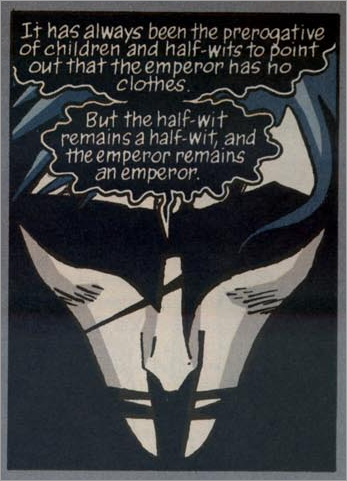
DREAM: It has always been the prerogative of children and half-wits to point out that the emperor has no clothes. But the half-wit remains a half-wit, and the emperor remains an emperor.
Neil Gaiman (b. 1960) British author, screenwriter, fabulist
Sandman, Book 9. The Kindly Ones, # 60 “The Kindly Ones: 4” (1994-06)
(Source)