Every man calls barbarous anything he is not accustomed to.
[Chacun appelle barbarie, ce qui n’est pas de son usage.]
Michel de Montaigne (1533–1592) French essayist
Essays, Book 1, ch. 30 (1.30), “Of Cannibals [Des Cannibales]” (1578) [tr. Screech (1987), 1.31]
(Source)
Some translators use the 1588 sequence of chapters, not the 1595, and so identify this as ch. 31.
(Source (French)). Alternate translations:Men call that barbarisme which is not common to them.
[tr. Florio (1603)]Every one gives the title of barbarism to everything that is not in use in his own country.
[tr. Cotton (1686)]Everyone gives the denomination of barbarism to what is not the custom of his country.
[tr. Friswell (1868)]Every one gives the title of barbarism to everything that is not in use in his own country.
[tr. Cotton/Hazlitt (1877)]Every one calls "barbarism" whatever he is not accustomed to.
[tr. Ives (1925), 1.31]Each man calls barbarism whatever is not his own practice.
[tr. Frame (1943)]Everyone calls barbarism what is not customary to him.
[ed. Rat (1958), 1.31]Everyone calls what he is not accustomed to barbarity.
[tr. Atkinson/Sices (2012)]
Quotations about:
barbarity
Note not all quotations have been tagged, so Search may find additional quotes on this topic.

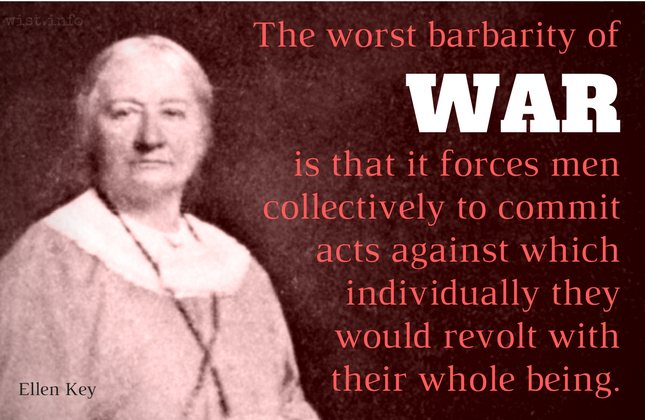
The worst barbarity of war is that it forces men collectively to commit acts against which individually they would revolt with their whole being.
Ellen Key (1849–1926) Swedish feminist and writer
War, Peace, and the Future, ch. 6 (1916) [tr. Norberg]
(Source)

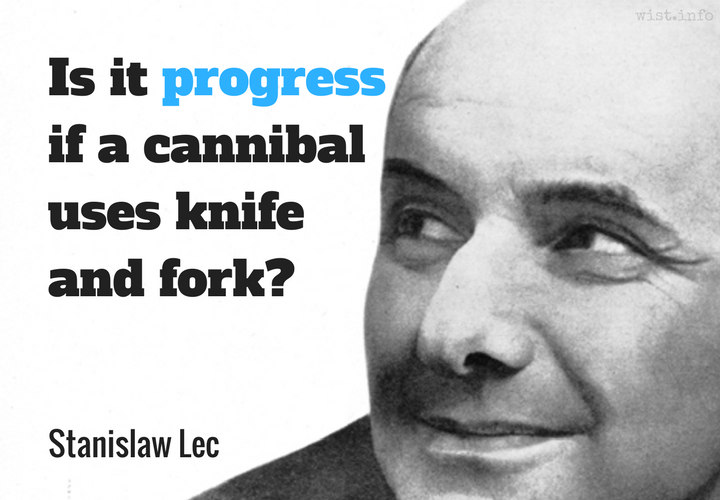
Is it progress if a cannibal uses knife and fork?
[Czy jeżeli ludożerca je widelcem i nożem to postęp?]
Stanislaw Lec (1909–1966) Polish aphorist, poet, satirist
Unkempt Thoughts [Myśli nieuczesane] (1957) [tr. Gałązka (1962)]
(Source)

There is a capacity of virtue in us, and there is a capacity of vice to make your blood creep.
Ralph Waldo Emerson (1803–1882) American essayist, lecturer, poet
Journal (1831)