“It is simplicity itself,” said [Holmes]; “my eyes tell me that on the inside of your left shoe, just where the firelight strikes it, the leather is scored by six almost parallel cuts. Obviously they have been caused by someone who has very carelessly scraped round the edges of the sole in order to remove crusted mud from it. Hence, you see, my double deduction that you had been out in vile weather, and that you had a particularly malignant boot-slitting specimen of the London slavey.
“As to your practice, if a gentleman walks into my rooms smelling of iodoform, with a black mark of nitrate of silver upon his right forefinger, and a bulge on the right side of his top-hat to show where he has secreted his stethoscope, I must be dull, indeed, if I do not pronounce him to be an active member of the medical profession.
I could not help laughing at the ease with which he explained his process of deduction. “When I hear you give your reasons,” I remarked, “the thing always appears to me to be so ridiculously simple that I could easily do it myself, though at each successive instance of your reasoning I am baffled until you explain your process. And yet I believe that my eyes are as good as yours.”Arthur Conan Doyle (1859–1930) British writer and physician
Story (1891-07), “A Scandal in Bohemia,” ch. 1, The Strand Magazine, Vol. 2, No. 1
(Source)
Quotations about:
conclusions
Note not all quotations have been tagged, so Search may find additional quotes on this topic.
I will tell you my rule. Talk about those subjects you have had long in your mind, and listen to what others say about subjects you have studied but recently. Knowledge and timber shouldn’t be much used till they are seasoned.
Oliver Wendell Holmes, Sr. (1809–1894) American poet, essayist, scholar
Article (1858-04), “Autocrat of the Breakfast-Table,” Atlantic Monthly
(Source)
Collected in Autocrat of the Breakfast-Table, ch. 6 (1858).
When you’re surrounded by people who share the same set of assumptions as you, you start to think that’s reality.
Emily Levine (1944–2019) American humorist, writer, actress, speaker
“A Theory of Everything,” TED Talk, Monterey, California (Feb 2002)
(Source)

No real belief, however trifling and fragmentary it may seem, is ever truly insignificant; it prepares us to receive more of its like, confirms those which resembled it before, and weakens others; and so gradually it lays a stealthy train in our inmost thoughts, which may someday explode into overt action, and leave its stamp upon our character for ever.
William Kingdon Clifford (1845–1879) English mathematician and philosopher
“The Ethics of Belief,” Part 1 “The Duty of Inquiry,” Lecture, London (11 Apr 1876)
(Source)

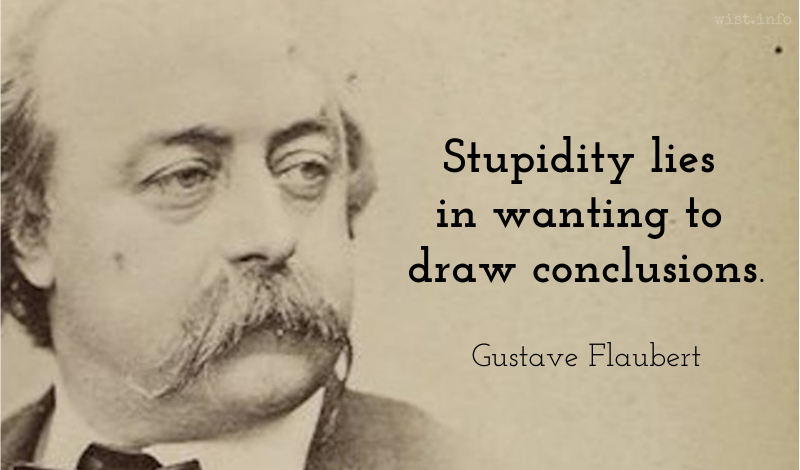
Stupidity lies in wanting to draw conclusions.
[L’ineptie consiste à vouloir conclure. […] Oui, la bêtise consiste à vouloir conclure.]
Gustave Flaubert (1821–1880) French writer, novelist
Letter to Louis Bouilhet (4 Sep 1850)
(Source)
The phrase is used twice in the letter. The initial phrase is usually translated to "foolishness" or "folly," the second to "stupidity."
It was not the absence of intelligence which led us into trouble but our unwillingness to draw unpleasant conclusions from it.
H. A. de Weerd (1902–1979) American military historian, author [Harvey Arthur de Weerd]
“Strategic Surprise in the Korean War,” Orbis (1962)
On the US decision in 1950 to call China's bluff by advancing above the 38th parallel.
Agnosticism, in fact, is not a creed, but a method, the essence of which lies in the rigorous application of a single principle. That principle is of great antiquity; it is as old as Socrates; as old as the writer who said, “Try all things, hold fast by that which is good”; it is the foundation of the Reformation, which simply illustrated the axiom that every man should be able to give a reason for the faith that is in him, it is the great principle of Descartes; it is the fundamental axiom of modern science. Positively the principle may be expressed: In matters of the intellect, follow your reason as far as it will take you, without regard to any other consideration. And negatively: In matters of the intellect, do not pretend that conclusions are certain which are not demonstrated or demonstrable. That I take to be the agnostic faith, which if a man keep whole and undefiled, he shall not be ashamed to look the universe in the face, whatever the future may have in store for him.
The judgments which Johnson passed on books were, in his own time, regarded with superstitious veneration, and, in our time, are generally treated with indiscriminate contempt. They are the judgments of a strong but enslaved understanding. The mind of the critic was hedged round by an uninterrupted fence of prejudices and superstitions. Within his narrow limits, he displayed a vigour and an activity which ought to have enabled him to clear the barrier that confined him. How it chanced that a man who reasoned on his premises so ably, should assume his premises so foolishly, is one of the great mysteries of human nature.
Thomas Babington Macaulay (1800–1859) English writer and politician
“Samuel Johnson,” The Edinburgh Review (Sep 1831)
(Source)
Review of John Croker's 1831 edition of James Boswell, The Life of Samuel Johnson.