I don’t particularly care about the usual. If you want to get an idea of a friend’s temperament, ethics, and personal elegance, you need to look at him under the tests of severe circumstances, not under the regular rosy glow of daily life. Can you assess the danger a criminal poses by examining only what he does on an ordinary day? Can we understand health without considering wild diseases and epidemics? Indeed the normal is often irrelevant.
Nassim Nicholas Taleb (b. 1960) Lebanese-American essayist, statistician, risk analyst, aphorist
The Black Swan, Introduction (2007)
(Source)
Quotations about:
extraordinary
Note not all quotations have been tagged, so Search may find additional quotes on this topic.

There are seasons in human affairs, when qualities fit enough to conduct the common business of life, are feeble and useless; and when men must trust to emotion, for that safety which reason at such times can never give.
Sydney Smith (1771–1845) English clergyman, essayist, wit
Lecture (1804-1806), Moral Philosophy, No. 27 “On Habit, Part 2” Royal Institution, London
(Source)
Collected in Elementary Sketches of Moral Philosophy (1849).
Quoted by Theodore Roosevelt in his speech (1901-09-05), "Brotherhood and the Heroic Virtues," Grand Army of the Republic Veterans Reunion, Burlington, Vermont, collected in Roosevelt's The Strenuous Life (1902).
FAITH, n. Belief without evidence in what is told by one who speaks without knowledge of things without parallel.
Ambrose Bierce (1842–1914?) American writer and journalist
“Faith,” The Cynic’s Word Book (1906)
(Source)
Included in The Devil's Dictionary (1911). Originally published in the "Devil's Dictionary" column in the San Francisco Wasp (1884-06-07).

If it is usual to be strongly impressed with things rare and extraordinary, how comes it then that Virtue is taken so little notice of?
[S’il est ordinaire d’être vivement touché des choses rares, pourquoi le sommes-nous si peu de la vertu?]
Jean de La Bruyère (1645–1696) French essayist, moralist
The Characters [Les Caractères], ch. 2 “Of Personal Merit [Du Mérite Personnel],” § 20 (2.20) (1688) [Browne ed. (1752)]
(Source)
(Source (French)). Other translations:If 'tis common to be Toucht with things Rare, how comes it that we are so little toucht with Virtue?
[Bullord ed. (1696)]If 'tis common to be touch'd with things rare, how comes it we are so little touch'd with Virtue?
[Curll ed. (1713)]If it be usual to be strongly impressed by things that are scarce, why are we so little impressed by virtue?
[tr. Van Laun (1885)]If it is usual to be strongly attracted by things that are rare, why has virtue so little attraction for us?
[tr. Stewart (1970)]

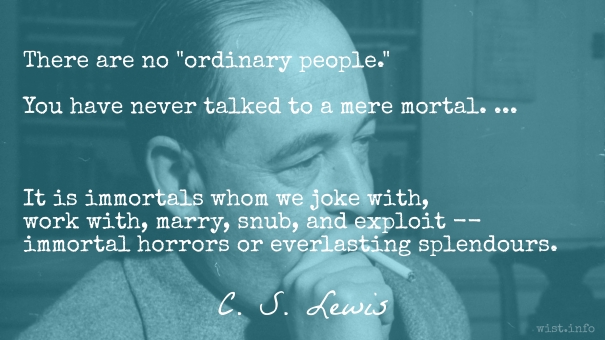
There are no ordinary people. You have never talked to a mere mortal. Nations, cultures, arts, civilisations — these are mortal, and their life is to ours as the life of a gnat. But it is immortals whom we joke with, work with, marry, snub, and exploit — immortal horrors or everlasting splendours. This does not mean that we are to be perpetually solemn: We must play. But our merriment must be of that kind (and it is, in fact, the merriest kind) which exists between people who have, from the outset, taken each other seriously — no flippancy, no superiority, no presumption. And our charity must be a real and costly love, with deep feeling for the sins in spite of which we love the sinner — no mere tolerance, or indulgence which parodies love as flippancy parodies merriment. Next to the Blessed Sacrament itself, your neighbour is the holiest object presented to your senses. If he is your Christian neighbour, he is holy in almost the same way, for in him also Christ vere latitat — the glorifier and the glorified, Glory Himself, is truly hidden.
C. S. Lewis (1898–1963) English writer, literary scholar, lay theologian [Clive Staples Lewis]
“The Weight of Glory,” sermon, Oxford University Church of St Mary the Virgin (8 Jun 1941)