To expose vices to everyone’s laughter is to deal them a mighty blow. People easily endure reproofs, but they cannot at all endure being made fun of. People have no objection to being considered wicked, but they are not willing to be considered ridiculous.
[C’est une grande atteinte aux vices que de les exposer à la risée de tout le monde. On souffre aisément des répréhensions, mais on ne souffre point la raillerie. On veut bien être méchant, mais on ne veut point être ridicule.]
Molière (1622–1673) French playwright, actor [stage name for Jean-Baptiste Poquelin]
Tartuffe, or the Hypocrite [Le Tartuffe, ou L’Imposteur], Preface (1669-03) [tr. Kerr]
(Source)
Moliere's preface explained once more the history of attacks on and suppression of his play, following up on the several petitions he had made to King Louis XIV. While the play had been first performed in 1664, it was only in 1669 that its final version was removed from the ban placed on it by Church officials.
(Source (French)). Other translations:To expose vices to the ridicule of all the world is a severe blow to them. Reprehensions are easily suffered, but not so ridicule. People do not mind being wicked; but they object to being made ridiculous.
[tr. Van Laun (1876)]Displaying vice to mockery of men deals it a great blow. Men will put up with admonition but are loath to be mocked. One might be willing to be wicked; one cannot bear to appear foolish.
[tr. Steiner (2008)]
Quotations about:
make fun of
Note not all quotations have been tagged, so Search may find additional quotes on this topic.

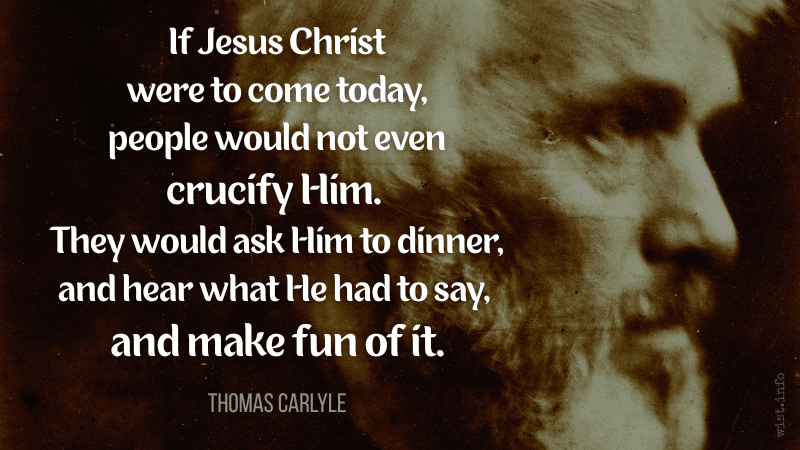
If Jesus Christ were to come today, people would not even crucify Him. They would ask Him to dinner, and hear what He had to say, and make fun of it.
Thomas Carlyle (1795–1881) Scottish essayist and historian
Remark (1850-01-12)
(Source)
Remark quoted by Joseph Neuberg in a letter to his sister. The letter was published in an essay (1884-08), "Carlyle and Neuberg," MacMillan's Magazine, Vol. 50. The author is not noted, but was a friend of Neuberg and his sister.
The same letter is cited in David A. Wilson, Life of Carlyle, Vol. 4 "Carlyle at His Zenith (1848-1853), ch. 10 (1927).

My pain may be the reason for somebody’s laugh, but my laugh must never be the reason for somebody’s pain.
Charlie Chaplin (1889–1977) English comic actor, film director, composer
(Attributed)
If you can’t stop the bad thoughts from coming to visit, at least you can make fun of them while they’re hanging around.