No man, for any considerable period, can wear one face to himself, and another to the multitude, without finally getting bewildered as to which may be the true.
Nathaniel Hawthorne (1804–1864) American writer
The Scarlet Letter, ch. 20 “The Minister in a Maze” (1850)
(Source)
See La Rochefoucauld.
Quotations about:
meme
Note not all quotations have been tagged, so Search may find additional quotes on this topic.

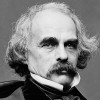
Never open the door to a lesser evil, for other and greater ones invariably slink in after it.
[Nunca se le ha de abrir la puerta al menor mal, que siempre vendrán tras él otros muchos, y mayores, en celada.]
Baltasar Gracián y Morales (1601–1658) Spanish Jesuit priest, writer, philosopher
The Art of Worldly Wisdom [Oráculo Manual y Arte de Prudencia], § 31 (1647) [tr. Jacobs (1892)]
(Source)
(Source (Spanish)). Other translations:We must not open the door to the least evil, for others, and those greater too, which lie in ambush come always after.
[Flesher ed. (1685)]Never open the door to an evil, however small, for other and greater ones will creep in after it from their ambush.
[tr. Duff (1877)]Never open the door to a small misfortune, for many more always creep in behind it, and greater ones, under its protection.
[tr. Fischer (1937)]Never open the door to the least of evils, for many other, greater ones lurk outside.
[tr. Maurer (1992)]
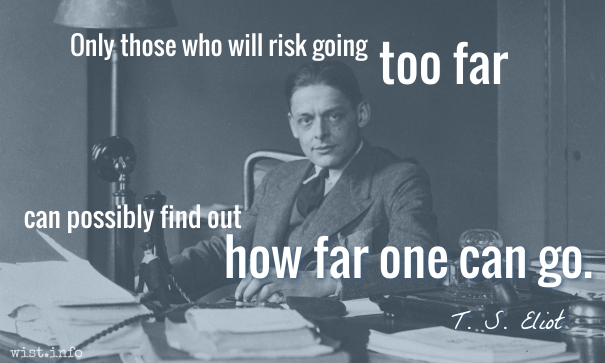
Only those who will risk going too far can possibly find out how far one can go.
T. S. Eliot (1888–1965) American-British poet, critic, playwright [Thomas Stearns Eliot]
Preface to Transit of Venus: Poems by Harry Crosby (1931)
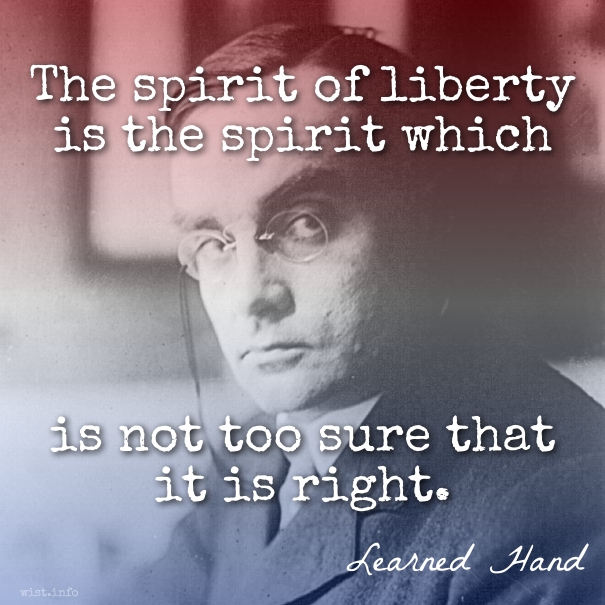
The spirit of liberty is the spirit which is not too sure that it is right; the spirit of liberty is the spirit which seeks to understand the mind of other men and women; the spirit of liberty is the spirit which weighs their interests alongside its own without bias; the spirit of liberty remembers that not even a sparrow falls to earth unheeded; the spirit of liberty is the spirit of Him who, near two thousand years ago, taught mankind that lesson it has never learned but never quite forgotten; that there may be a kingdom where the least shall be heard and considered side by side with the greatest.
Learned Hand (1872–1961) American jurist
“The Spirit of Liberty,” speech, “I Am an American Day,” New York (1941-05-21)
(Source)
All change is not growth; all movement is not forward.
Ellen Glasgow (1874–1945) American author
In Clifton Fadiman, I Believe: The Personal Philosophies of Certain Eminent Men and Women of Our Time (1939 ed.)
(Source)
One half of the world cannot understand the pleasures of the other.

I love America more than any other country in the world and, exactly for this reason, I insist on the right to criticize her perpetually.
James Baldwin (1924–1987) American novelist, playwright, activist
Notes of a Native Son, “Autobiographical Notes” (1955)
(Source)

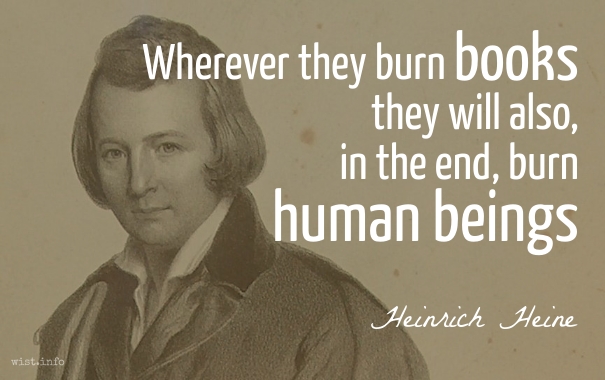
Wherever they burn books they will also, in the end, burn human beings.
[Dort, wo man Bücher verbrennt, verbrennt man auch am Ende Menschen.]
Heinrich Heine (1797–1856) German poet and critic
Almansor: A Tragedy, l. 245 (1823)
Alt trans:
- "Where they burn books, at the end they also burn people."
- "Where they burn books, they will also burn people."
- "It is there, where they burn books, that eventually they burn people."
- "Where they burn books, so too will they in the end burn human beings."
- "Where they burn books, they also burn people."
- "Them that begin by burning books, end by burning men."
- "Wherever books are burned, sooner or later men are also burned."
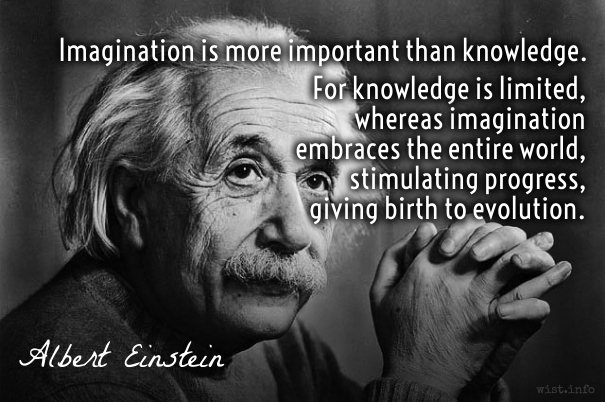
I am enough of an artist to draw freely upon my imagination. Imagination is more important than knowledge. For knowledge is limited, whereas imagination embraces the entire world, stimulating progress, giving birth to evolution.
Albert Einstein (1879–1955) German-American physicist
“What Life Means to Einstein,” Interview with G. Viereck, Saturday Evening Post (26 Oct 1929)
(Source)
Quoted as "I am enough of an artist to draw freely upon my imagination. Imagination is more important than knowledge. Knowledge is limited. Imagination encircles the world," in Viereck, Glimpses of the Great (1930).
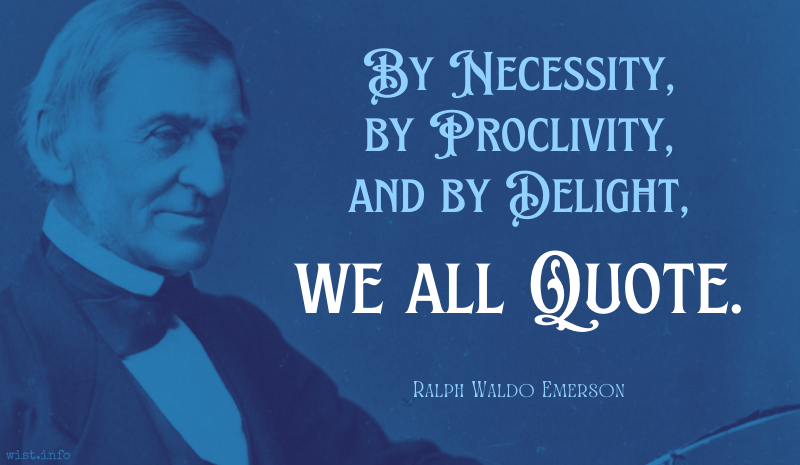
Our debt to tradition through reading and conversation is so massive, our protest or private addition so rare and insignificant, — and this commonly on the ground of other reading or hearing, — that, in a large sense, one would say there is no pure originality. All minds quote. Old and new make the warp and woof of every moment. There is no thread that is not a twist of these two strands. By necessity, by proclivity, and by delight, we all quote.
Ralph Waldo Emerson (1803–1882) American essayist, lecturer, poet
“Quotation and Originality,” Letters and Social Aims (1876)
(Source)
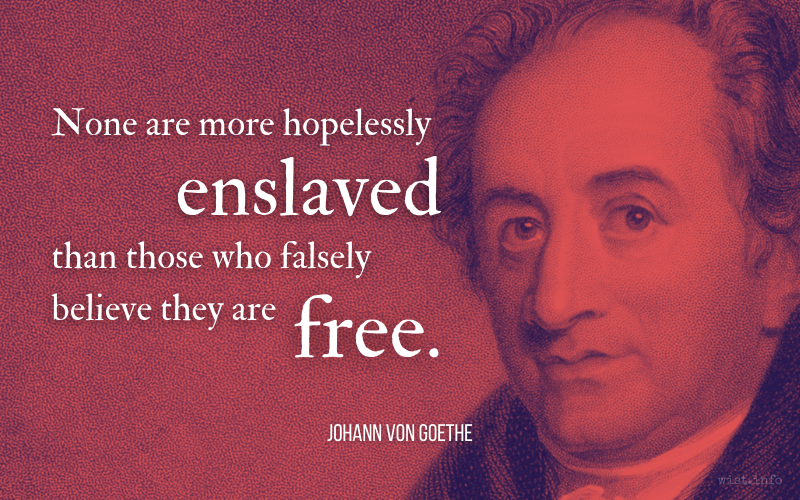
None are more hopelessly enslaved than those who falsely believe they are free.
[Niemand ist mehr Sklave als der sich für frei hält ohne es zu sein.]
Johann Wolfgang von Goethe (1749–1832) German poet, statesman, scientist
Elective Affinities [Die Wahlverwandtschaften], Part 2, ch. 5, “From Ottilie’s Journal [Aus Ottiliens Tagebuche]” (1809) [tr. Wenckstern (1853)]
(Source)
(Source (German)). Another translation:No one is more a slave than the man who thinks himself free while he is not.
[Niles ed. (1872)]No one is more a slave than he who thinks he is free without being so.
[tr. Hollingdale (1971)]
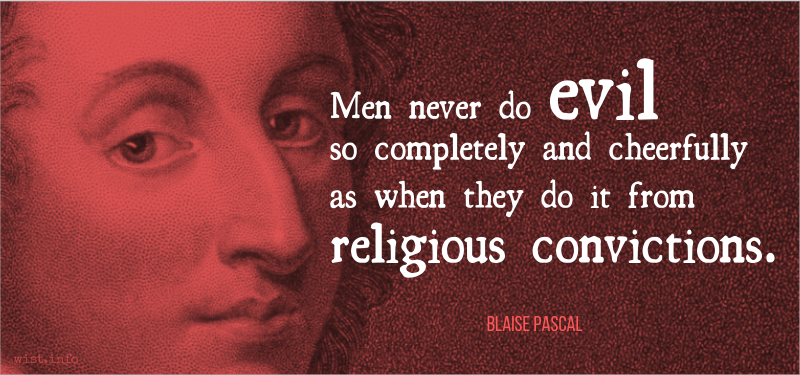
Men never do evil so completely and cheerfully as when they do it from religious convictions.
[Jamais on ne fait le mal si pleinement et si gaiement, que quand on le fait par un faux principe de conscience.]
Blaise Pascal (1623–1662) French scientist and philosopher
Pensées, ch. 14, Appendix: Polemical Fragments #895 (1669) [tr. Trotter (1910)]
(Source)
Also labeled as Part 2, Article 17, # 53. Sometimes also shown in slightly shorter French as "Jamais on ne fait le mal si pleinement et si gaiement que quand on le fait par conscience."(Source (French)). Other translations:
- "We never do evil so fully and cheerfully as when we do it out of conscience." [#813 (#895), tr. Krailsheimer]
- "We never do evil so completely and cheerfully as when we do it out of conscience." [Miscellaneous Thoughts 7: Sellier #658/Lafuma #813, tr. Ariew]
- "Men never do evil so completely and cheerfully as when they do it conscientiously."
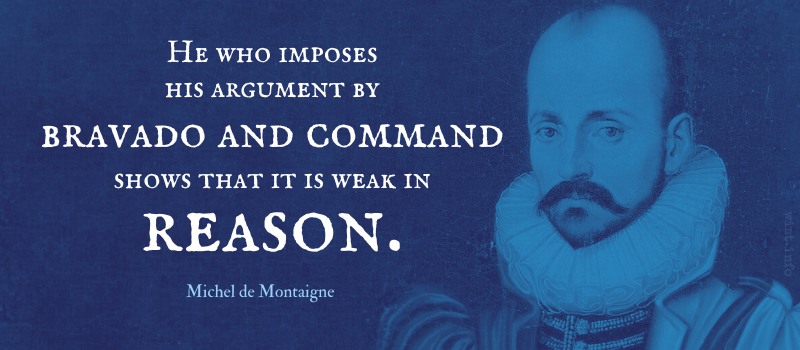
He who imposes his argument by bravado and command shows that it is weak in reason.
[Qui establit son discours par braverie et commandement, montre que la raison y est foible.]
Michel de Montaigne (1533–1592) French essayist
Essays, Book 3, ch. 11 (3.11), “Of Cripples [Des Boyteux]” (1587) [tr. Frame (1943)]
(Source)
(Source (French)). Other translations:He that with braverie and by comaundement will establish his discourse, declareth his reason to be weake.
[tr. Florio (1603), "Of the Lame or Cripple"]Who will establish his Discourse by Authority and Huffing, discovers his Reason to be very weak.
[tr. Cotton (1686)]He who will establish this proposition by authority and huffing discovers his reason to be very weak.
[tr. Cotton/Hazlitt (1877), "On the Lame"]He who establishes his argument by defiance and by command shews that his reasoning is weak.
[tr. Ives (1925)]Any man who supports his opinion with challenges and commands demonstrates that his reasons for it are weak.
[tr. Screech (1987), "On the Lame"]He who establishes his argument by noise and command shows that his reason is weak.
[Source]
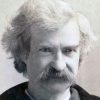
It is not best that we should all think alike; it is differences of opinion that make horse races.
Mark Twain (1835–1910) American writer [pseud. of Samuel Clemens]
The Tragedy of Pudd’nhead Wilson, ch. 19, epigraph (1894)

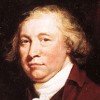
Certainly, Gentlemen, it ought to be the happiness and glory of a representative to live in the strictest union, the closest correspondence, and the most unreserved communication with his constituents. Their wishes ought to have great weight with him; their opinions high respect; their business unremitted attention. It is his duty to sacrifice his repose, his pleasure, his satisfactions, to theirs, — and above all, ever, and in all cases, to prefer their interest to his own.
But his unbiased opinion, his mature judgment, his enlightened conscience, he ought not to sacrifice to you, to any man, or to any set of men living. These he does not derive from your pleasure, — no, nor from the law and the Constitution. They are a trust from Providence, for the abuse of which he is deeply answerable. Your representative owes you, not his industry only, but his judgment; and he betrays, instead of serving you, if he sacrifices it to your opinion.
Edmund Burke (1729–1797) Anglo-Irish statesman, orator, philosopher
Speech to the electors of Bristol (3 Nov 1774)

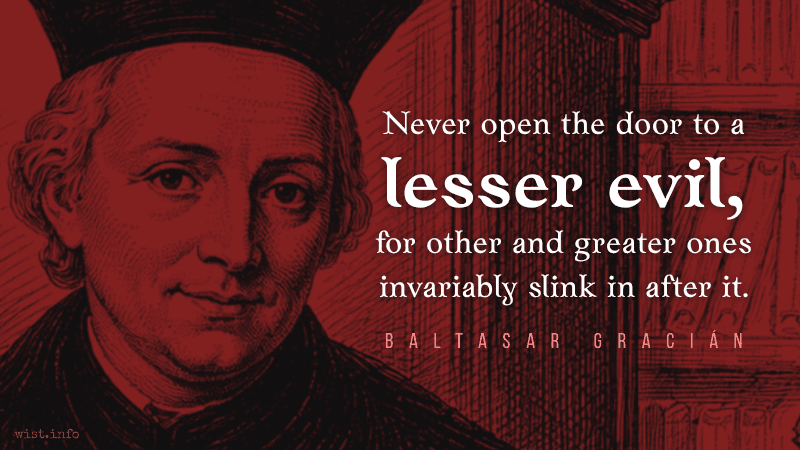
The sad truth of the matter is that most evil is done by people who never made up their minds to be or do either evil or good.
Hannah Arendt (1906–1975) German-American philosopher, political theorist
Life of the Mind, Vol. 1 “Thinking,” Part 3, ch. 18 “The two-in-one” (1977)
(Source)
Sometimes shortened as: "The sad truth is that most evil is done by people who never make up their minds to be good or evil."
Originally printed as an essay (1977-11-28), "Thinking -- III," The New Yorker (1977-12-05). That version is slightly longer:The sad truth of the matter is that most evil is done by people who never made up their minds to be either good or bad or to do either good or evil.