If Jesus Christ were to come today, people would not even crucify Him. They would ask Him to dinner, and hear what He had to say, and make fun of it.
Thomas Carlyle (1795–1881) Scottish essayist and historian
Remark (1850-01-12)
(Source)
Remark quoted by Joseph Neuberg in a letter to his sister. The letter was published in an essay (1884-08), "Carlyle and Neuberg," MacMillan's Magazine, Vol. 50. The author is not noted, but was a friend of Neuberg and his sister.
The same letter is cited in David A. Wilson, Life of Carlyle, Vol. 4 "Carlyle at His Zenith (1848-1853), ch. 10 (1927).
Quotations about:
meme
Note not all quotations have been tagged, so Search may find additional quotes on this topic.
You don’t become great by trying to be great. You become great by wanting to do something, then doing it so hard that you become great in the process.
Randall Munroe (b. 1984) American webcomic writer, roboticist, programmer
XKCD, # 896 “Marie Curie” (9 May 2011)
(Source)


By doing good we become good.
Jean-Jacques Rousseau (1712–1778) French philosopher and writer
Emile, ch. 4 (1762) [tr. Foxley (1911)]
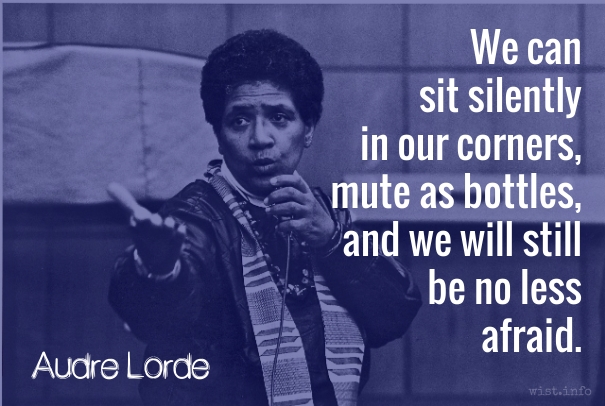
We can sit in our corners, mute forever, while our sisters and ourselves are wasted, while our children are distorted and destroyed, while our earth is poisoned. We can sit silently in our corners, mute as bottles, and we will still be no less afraid.
Audre Lorde (1934–1992) American writer, feminist, civil rights activist
“The Transformation of Silence into Language and Action,” The Cancer Journals (1980)
(Source)
Originally given as a speech at the Modern Language Association meeting (28 Dec 1977).
“Money does not bring happiness” — only the wherewithal, perhaps, to endure its absence.
Barbara Ehrenreich (1941–2022) American feminist, journalist, political activist
Fear of Falling: The Inner Life of the Middle Class, ch. 6 (1990)


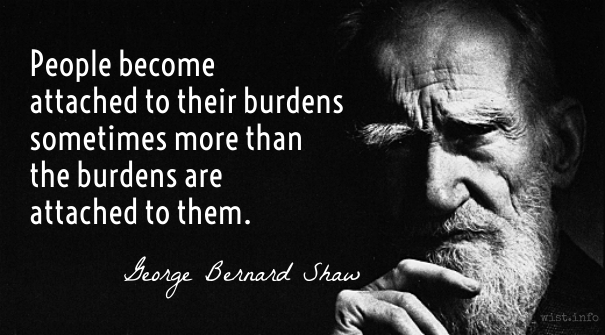
People become attached to their burdens sometimes more than the burdens are attached to them.
George Bernard Shaw (1856–1950) Irish playwright and critic
A Treatise on Parents and Children (1910)
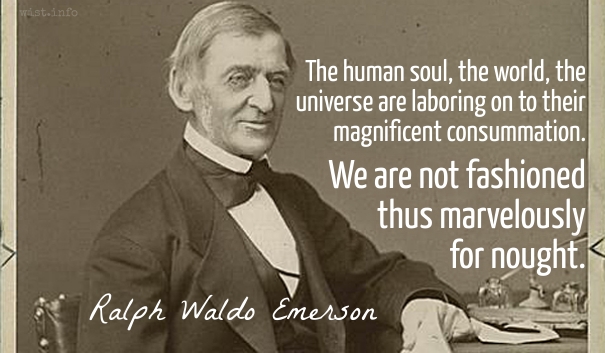
The human soul, the world, the universe are laboring on to their magnificent consummation. We are not fashioned thus marvelously for nought.
Ralph Waldo Emerson (1803–1882) American essayist, lecturer, poet
Journal (1820-12)
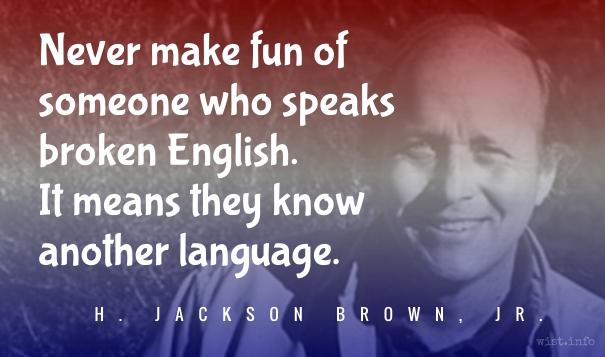
Never make fun of someone who speaks broken English. It means they know another language.
H. Jackson "Jack" Brown, Jr. (b. 1940) American writer
Life’s Little Instruction Book, Vol. 3, #1427 (1993)
(Source)
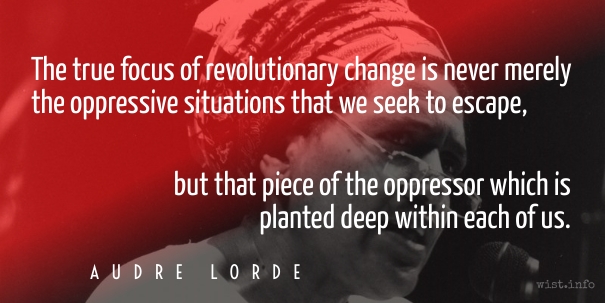
The true focus of revolutionary change is never merely the oppressive situations that we seek to escape, but that piece of the oppressor which is planted deep within each of us.
Audre Lorde (1934–1992) American writer, feminist, civil rights activist
“Age, Race, Class, and Sex: Women Redefining Difference,” Copeland Colloquium, Amherst College (Apr 1980)
Reprinted in Sister Outsider (1984)
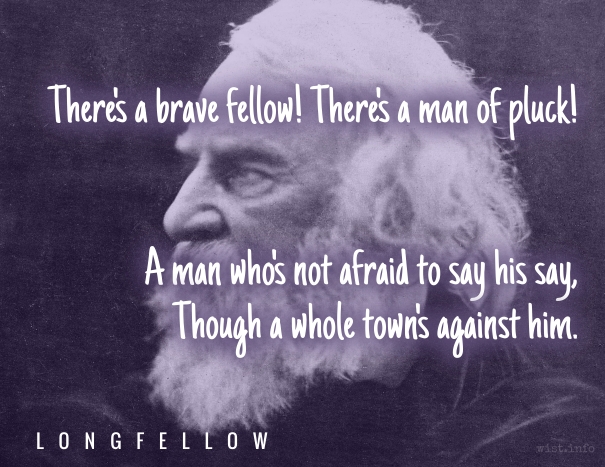
There’s a brave fellow! There’s a man of pluck!
A man who’s not afraid to say his say,
Though a whole town’s against him.
The first thing to learn in intercourse with others is non-interference with their own peculiar ways of being happy, provided those ways do not assume to interfere by violence with ours.
William James (1842–1910) American psychologist and philosopher
“What Makes a Life Significant,” Lecture, Harvard (1899)
Reprinted in Talks to Teachers on Psychology, Part 2, Lecture 3.
It is far more impressive when others discover your good qualities without your help.
Judith Martin (b. 1938) American author, journalist, etiquette expert [a.k.a. Miss Manners]
(Attributed)
Widely attributed to Martin, but no citeable source found. Some sources point to Reader's Digest which, on research, was not helpful.

Sow good services: sweet remembrances will grow from them.
Germaine de Staël (1766–1817) Swiss-French writer, woman of letters, critic, salonist [Anne Louise Germaine de Staël-Holstein, Madame de Staël, Madame Necker]
(Attributed)
In J. D. Finod (trans.), A Thousand Flashes of French Wit, Wisdom, and Wickedness (1880).

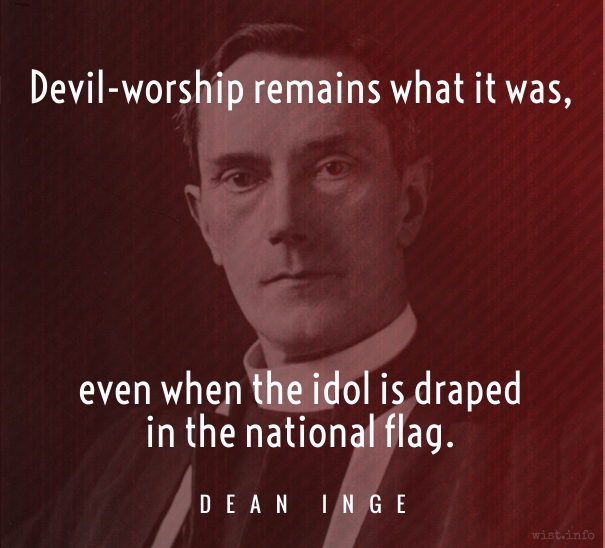
Devil-worship remains what it was, even when the idol is draped in the national flag.
William Ralph Inge (1860–1954) English prelate [Dean Inge]
“Patriotism,” Outspoken Essays: First Series (1915)
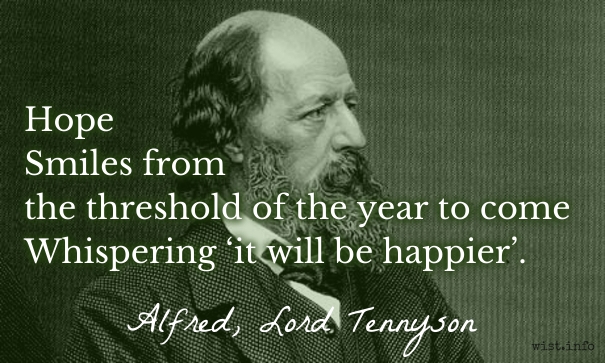
Hope
Smiles from the threshold of the year to come
Whispering “it will be happier.”
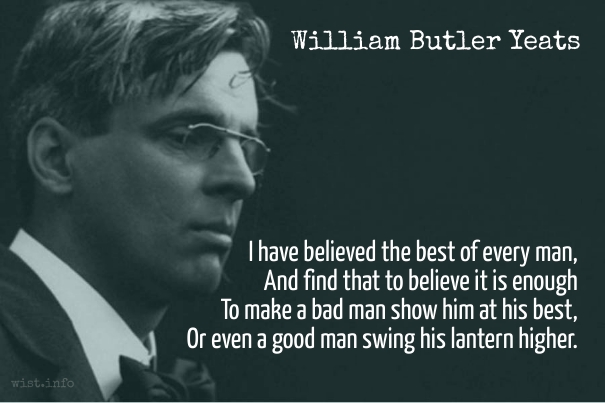
I have believed the best of every man,
And find that to believe it is enough
To make a bad man show him at his best,
Or even a good man swing his lantern higher.
William Butler Yeats (1865–1939) Irish poet and dramatist
Deirdre (1907)
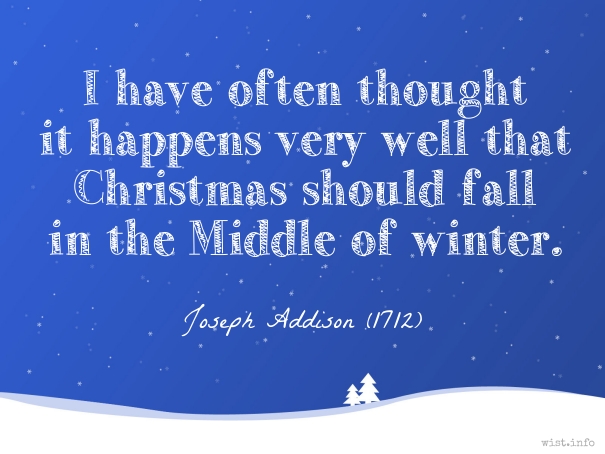
“I have often thought,” says Sir Roger, “it happens very well that Christmas should fall out in the middle of winter. It is the most dead uncomfortable time of the year, when the poor people would suffer very much from their poverty and cold, if they had not good cheer, warm fires, and Christmas gambols to support them. I love to rejoice their poor hearts at this season, and to see the whole village merry in my great hall.”
Joseph Addison (1672–1719) English essayist, poet, statesman
Essay (1712-01-08), The Spectator, No. 269
(Source)
Quoting Roger de Coverley. While the more frequent shorter excerpt (as in the image) conjures up enjoyment of the winter season, the broader quote demonstrates a noblesse oblige regarding the poor in winter.

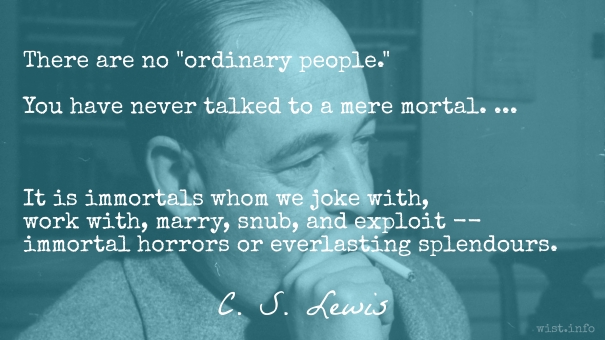
There are no ordinary people. You have never talked to a mere mortal. Nations, cultures, arts, civilisations — these are mortal, and their life is to ours as the life of a gnat. But it is immortals whom we joke with, work with, marry, snub, and exploit — immortal horrors or everlasting splendours. This does not mean that we are to be perpetually solemn: We must play. But our merriment must be of that kind (and it is, in fact, the merriest kind) which exists between people who have, from the outset, taken each other seriously — no flippancy, no superiority, no presumption. And our charity must be a real and costly love, with deep feeling for the sins in spite of which we love the sinner — no mere tolerance, or indulgence which parodies love as flippancy parodies merriment. Next to the Blessed Sacrament itself, your neighbour is the holiest object presented to your senses. If he is your Christian neighbour, he is holy in almost the same way, for in him also Christ vere latitat — the glorifier and the glorified, Glory Himself, is truly hidden.
C. S. Lewis (1898–1963) English writer, literary scholar, lay theologian [Clive Staples Lewis]
“The Weight of Glory,” sermon, Oxford University Church of St Mary the Virgin (8 Jun 1941)
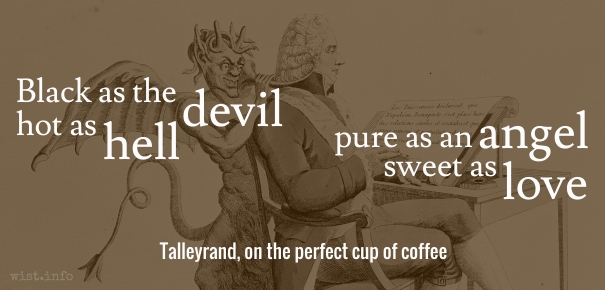
Black as the devil, hot as hell, pure as an angel, sweet as love.
[Noir comme le diable, chaud comme l’enfer, pur comme un ange, doux comme l’amour.]
Charles-Maurice de Talleyrand-Périgord (1754–1838) French secularized clergyman, statesman, wit, diplomat
(Attributed)
(Source)
Elements of a good cup of coffee.

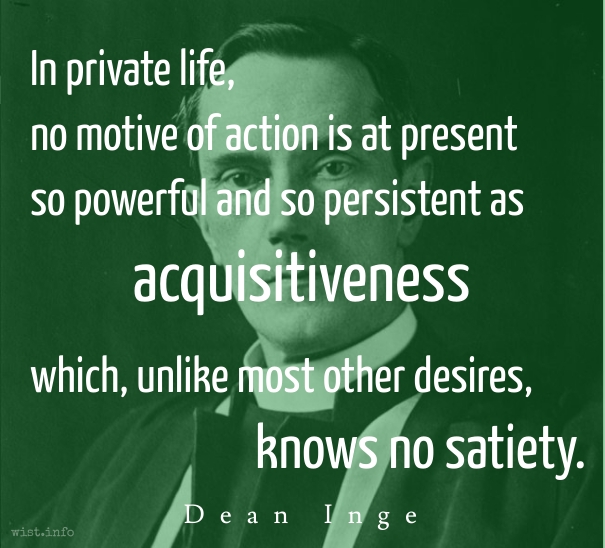
In private life, no motive of action is at present so powerful and so persistent as acquisitiveness, which, unlike most other desires, knows no satiety.
William Ralph Inge (1860–1954) English prelate [Dean Inge]
“Patriotism,” Outspoken Essays: First Series (1915)
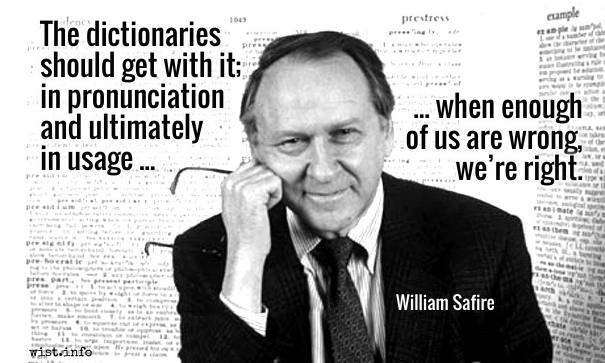
The dictionaries should get with it; in pronunciation and ultimately in usage, when enough of us are wrong, we’re right.
William Safire (1929–2009) American author, columnist, journalist, speechwriter
Language Maven Strikes Again, “Drudgery It Ain’t” (1990)
(Source)
Often paraphrased: "The thing about language is that, when enough of us are wrong, we're right."
The secret of being miserable is to have leisure to bother about whether you are happy or not. The cure for it is occupation, because occupation means pre-occupation; and the pre-occupied person is neither happy nor unhappy, but simply alive and active, which is pleasanter than any happiness until you are tired of it.
George Bernard Shaw (1856–1950) Irish playwright and critic
Treatise on Parents and Children, “Children’s Happiness” (1914)
(Source)
If you don’t have confidence, you’ll always find a way not to win.
Carl Lewis (b. 1961) American Olympic athlete
(Attributed)

Self-hatred leads to the need either to dominate or to be dominated.
Gloria Steinem (1934–2026) American feminist, journalist, activist
Revolution from Within: A Book of Self-Esteem, “A Personal Preference” (1992)

There is no such thing as a single-issue struggle, because we do not lead single-issue lives.
Audre Lorde (1934–1992) American writer, feminist, civil rights activist
“Learning from the 60s,” speech, Malcolm X weekend, Harvard University (Feb 1982)
(Source)
Reprinted in Sister Outsider (1984).
Yet the day is not far distant when the man who dies leaving behind him millions of available wealth, which was his to administer during his life, will pass away “unwept, unhonoured and unsung,” no matter to what uses he leaves the dross which he cannot take with him. The man who dies thus rich dies disgraced.
Andrew Carnegie (1835–1919) American industrialist and philanthropist
“The Gospel of Wealth,” Part 1, North American Review (1889-06)
(Source)
Collected in The Gospel of Wealth and Other Timely Essays (1900).
None knowes the weight of anothers burthen.
George Herbert (1593–1633) Welsh priest, orator, poet.
Jacula Prudentum, or Outlandish Proverbs, Sentences, &c. (compiler), # 880 (1651 ed.)
(Source)
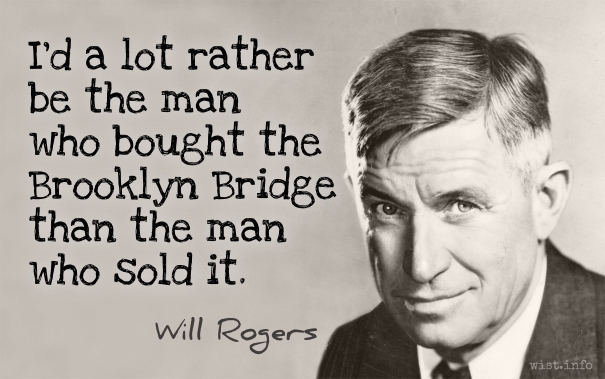
Call me a “rube” and a “hick,” but I’d a lot rather be the man who bought the Brooklyn Bridge than the man who sold it.
Will Rogers (1879–1935) American humorist
(Attributed)
Widely attributed to Rogers, though I cannot find a primary source for it.
Variants:
- "They may call me a rube and a hick ..."
- "Call me a rube ..."
- "You could call me a hick or call me a rube ..."
I think that’s all anybody wants. To belong. To be people.
Robert A. Heinlein (1907–1988) American writer
Friday [Friday Jones] (1982)

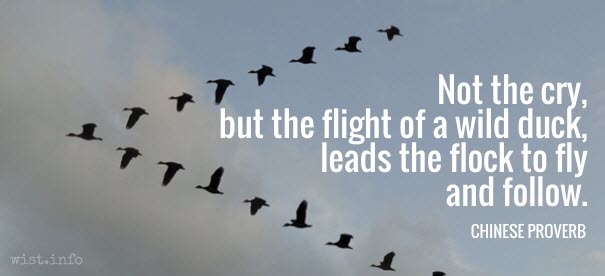
Not the cry, but the flight of a wild duck, leads the flock to fly and follow.
Proverbs, Sayings, and Adages
Chinese proverb
First recorded by Jean Paul [Johann Paul Friedrich Richter] (1763-1825), Levana, sec. 8 (1807): "Nicht das Geschrei, sagt ein chinesischer Autor, sondern der Ausflug einer wilden Ente treibt die Heerde zur Folge und zum Nachfliegen." (See H. A., A Book of Thoughts (1865))

Value yourself according to the burdens you carry, and you will find everything a burden.
James Richardson (b. 1950) American poet
Vectors: Aphorisms and Ten-Second Essays, # 52 (2001)

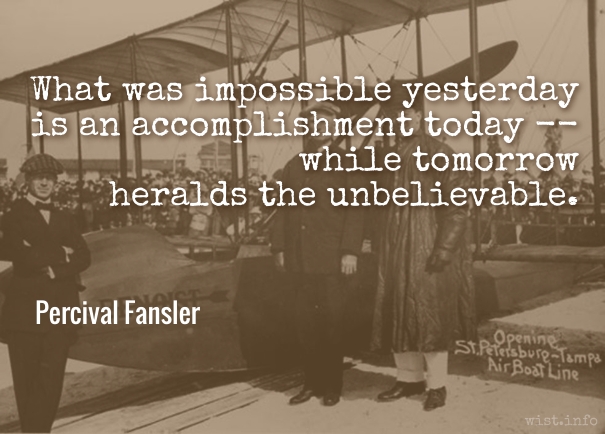
What was impossible yesterday is an accomplishment today — while tomorrow heralds the unbelievable.
Percival E. Fansler (1883–1937) American engineer, businessman, entrepreneur
Speech, First Scheduled Commercial Airline Flight, St. Petersburg, Florida (1 Jan 1914)
Stupidity is the same as evil if you judge by the results.
Margaret Atwood (b. 1939) Canadian writer, literary critic, environmental activist
Surfacing, ch. 3 (1972)
(Source)


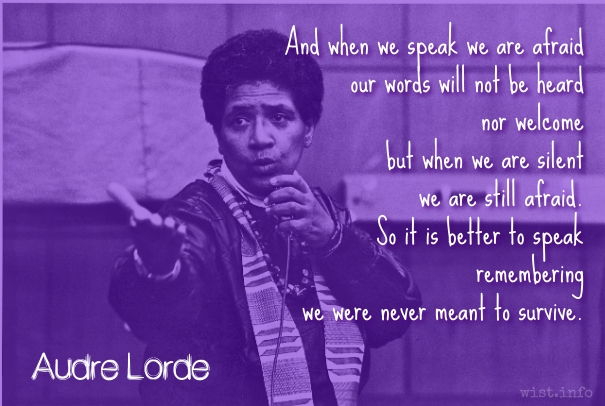
And when we speak we are afraid
our words will not be heard
nor welcome
but when we are silent
we are still afraid.
So it is better to speak
remembering
we were never meant to survive.
Audre Lorde (1934–1992) American writer, feminist, civil rights activist
“A Litany for Survival,” The Black Unicorn (1978)
Democracy postulates community of interest or loyal patriotism. When these are absent it cannot long exist.
William Ralph Inge (1860–1954) English prelate [Dean Inge]
“Our Present Discontents,” Outspoken Essays: First Series (1919)

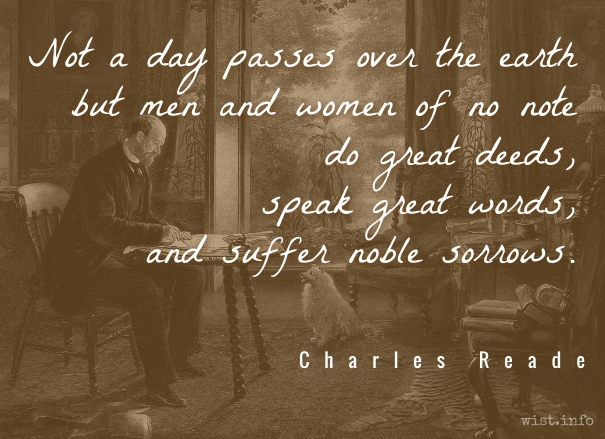
Not a day passes over the earth but men and women of no note do great deeds, speak great words, and suffer noble sorrows.
Charles Reade (1814–1884) English novelist and dramatist
The Cloister and the Hearth, ch. 1 (1861)
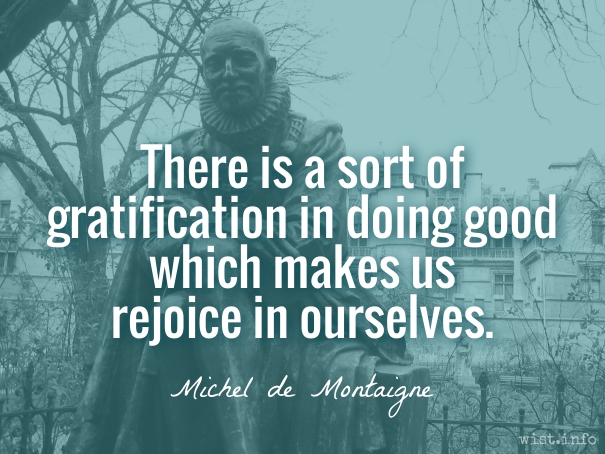
There is a sort of gratification in doing good which makes us rejoice in ourselves, and a generous pride that accompanies a good conscience.
[Il y a certes je ne sçay quelle congratulation, de bien faire, qui nous resjouit en nous mesmes, et une fierté genereuse, qui accompagne la bonne conscience.]
Michel de Montaigne (1533–1592) French essayist
Essays, Book 3, ch. 2 (3.2), “Of Repentance [Du Repentir]” (1586) [tr. Frame (1943)]
(Source)
First appeared in the 1588 edition.
(Source (French)). Other translations:There is truely I wot not what kinde of congratulation, of well doing, which rejoyceth us in our selves, and a generous jollitie, that accompanieth a good conscience.
[tr. Florio (1603)]There is a kind of I know not what congratulation in well-doing, that gives us an inward Satisfaction, and a certain generous Boldness that accompanies a good Conscience.
[tr. Cotton (1686)]There is a kind of, I know not what, congratulation in well-doing that gives us an inward satisfaction, and a generous boldness that accompanies a good conscience.
[tr. Cotton/Hazlitt (1877)]There is surely I know not what self-gratification in doing well, which rejoices us ourselves, and a noble pride which attends a good conscience.
[tr. Ives (1925)]There is an unutterable delight in acting well which makes us inwardly rejoice; a noble feeling of pride accompanies a good conscience.
[tr. Screech (1987)]

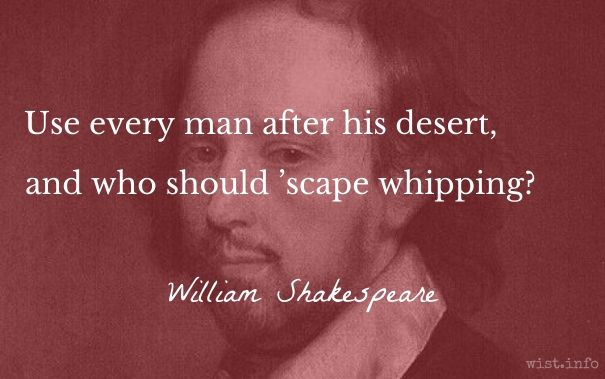
HAMLET: Use every man after his desert, and who should ‘scape whipping?
William Shakespeare (1564–1616) English dramatist and poet
Hamlet, Act 2, sc. 2, l. 555ff (2.2.555) (c. 1600)
(Source)

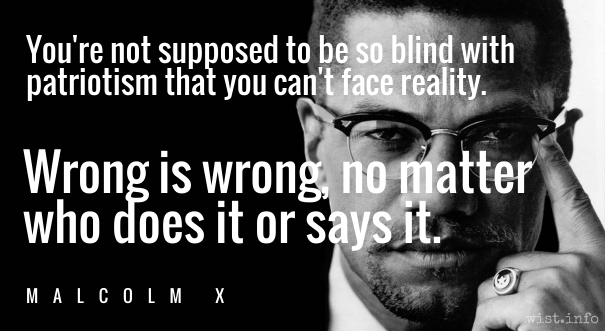
You’re not supposed to be so blind with patriotism that you can’t face reality. Wrong is wrong, no matter who does it or says it.
Malcolm X (1925–1965) American revolutionary, religious leader [b. Malcolm Little]
“Prospects for Freedom in 1965,” speech, New York (7 Jan 1965)
(Source)

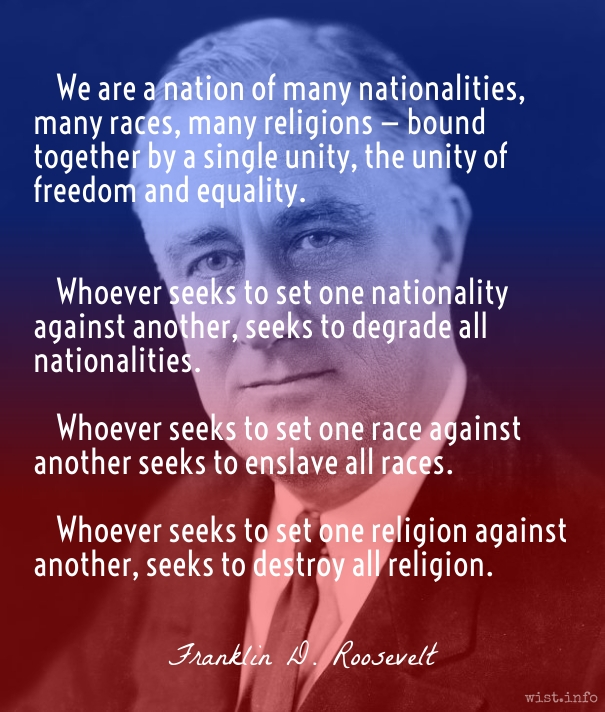
We are a nation of many nationalities, many races, many religions — bound together by a single unity, the unity of freedom and equality. Whoever seeks to set one nationality against another, seeks to degrade all nationalities. Whoever seeks to set one race against another seeks to enslave all races. Whoever seeks to set one religion against another, seeks to destroy all religion.
Franklin Delano Roosevelt (1882–1945) American lawyer, politician, statesman; US President (1933–45)
Speech (1940-11-01), Campaign Address, Brooklyn Academy of Music, New York
(Source)
Be wiser than other people, if you can; but do not tell them so.
Lord Chesterfield (1694–1773) English statesman, wit [Philip Dormer Stanhope]
Letter to his son, #104 (29 Nov 1745)
(Source)

Terrorism’s goal is to commit frightening, high-profile crimes that scare people into making rash, expensive decisions that make the world look like the terrorists would like to see it.
Cory Doctorow (b. 1971) Canadian-British blogger, journalist, activist, author
“How terrorists trick Western governments in doing their work for them,” Boingboing.net (16 Nov 2015)
(Source)


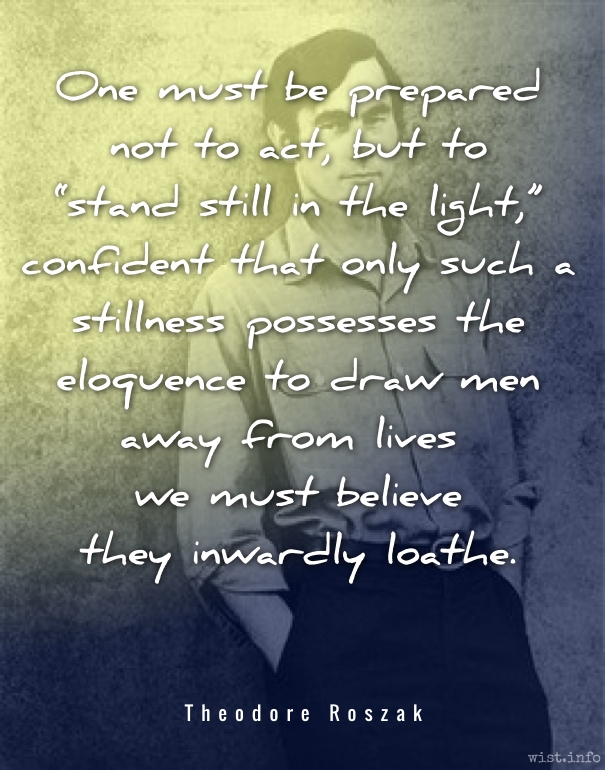
One must be prepared not to act, but to “stand still in the light,” confident that only such a stillness possesses the eloquence to draw men away from lives we must believe they inwardly loathe.
Theodore Roszak (1933–2011) American historian and author
The Making of the Counter Culture, ch. 8 (1969)
Administrivia: (2015-11-13) A Picture Is Worth a Thousand Words (but shouldn’t use that many)
So I’ve been doing a graphic / visualization / meme for one quotation a day (out of the five I usually do) for a month now, and it seems to be both popular and pretty sustainable (at least until I get a job), so I will continue doing so.
You can see the list to date by clicking on the “Visual Quotes (memes)” link in the sidebar; I’m tagging each of them with a tag of “meme”. You can also visit PixTeller, which is where I’m building these; I think they’ve definitely improved since the first few I did as I’ve learned more about the tool and what works (and what doesn’t work as well).
If you have any suggestions for improvement in this effort, please leave me a comment.
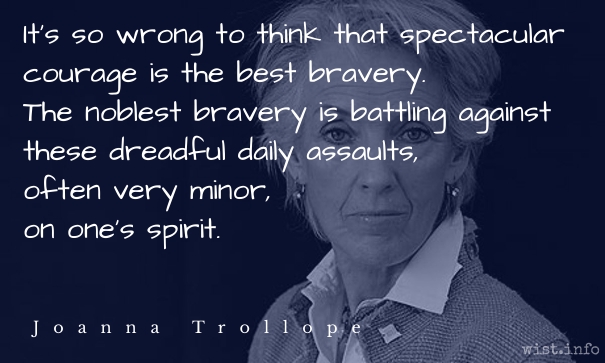
It’s so wrong to think that spectacular courage is the best bravery. The noblest bravery is battling against these dreadful daily assaults, often very minor, on one’s spirit.
Joanna Trollope (b. 1943) British writer [pseud. Caroline Harvey]
The Rector’s Wife (1991)

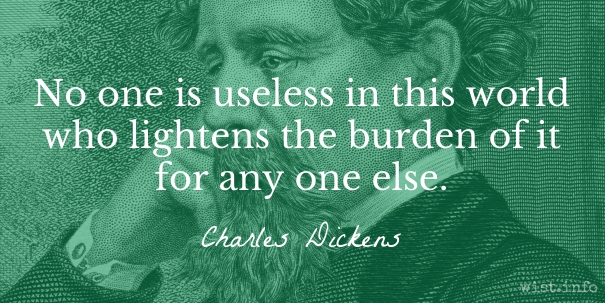
No one is useless in this world who lightens the burden of it for any one else.
Charles Dickens (1812–1870) English writer and social critic
Our Mutual Friend, ch. 9 (1864-65)
MALVOLIO: In my
stars I am above thee, but be not afraid of greatness.
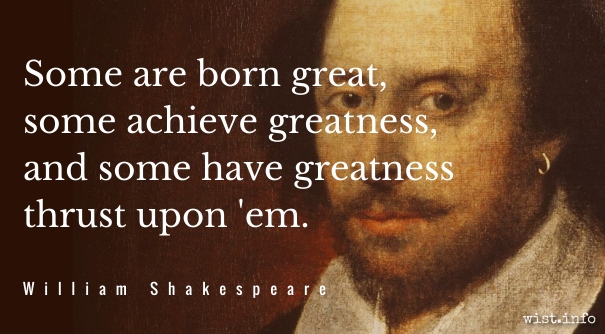
Some are born great, some achieve greatness, and
some have greatness thrust upon ’em.
William Shakespeare (1564–1616) English dramatist and poet
Twelfth Night, Act 2, Sc. 5, l. 147ff (2.5.147–150) (1601)
(Source)
The phrase appears three times in the play:This was parodied in Joseph Heller, Catch-22, ch. 9 (1955), writing regarding Major Major: “Some men are born mediocre, some men achieve mediocrity, and some men have mediocrity thrust upon them.” See also Boorstin.
- As above, Malvolio reading the forged love letter he thinks is from Olivia.
- Act 3, sc. 4, l. 42ff, Malvolio recalling the phrases from the letter.
- Act 5, sc. 1, l. 393ff, the Fool reciting the second half of the phrase.
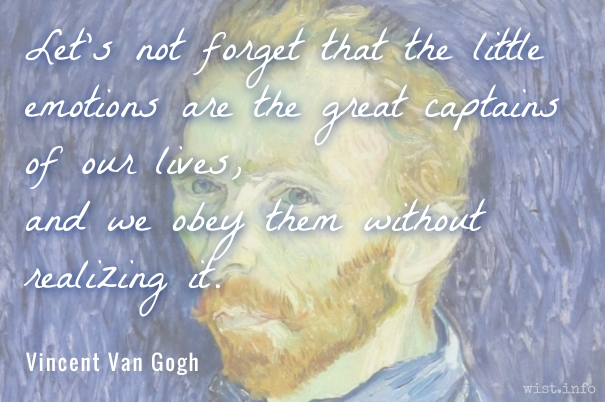
Let’s not forget that the little emotions are the great captains of our lives, and we obey them without realizing it.

The function of leadership is to produce more leaders, not more followers.
Ralph Nader (b. 1934) American attorney, author, lecturer, political activist
Time Leadership Conference, Washington, DC (Sep 1976)
(Source)
In "Leadership: The Biggest Issue," Time (8 Nov 1976).

Believe nothing against another but upon good Authority: Nor report what may hurt another, unless it be a greater hurt to others to conceal it.
William Penn (1644–1718) English writer, philosopher, politician, statesman
Some Fruits of Solitude, #145 (1693)
Love and business and family and religion and art and patriotism are nothing but shadows of words when a man’s starving.
O. Henry (1862–1910) American short story writer [pseud. for William Sydney Porter]
“Cupid à la Carte,” Heart of the West (1907)
You must not tell lies because if you do you will find yourself unable to believe anything that is told to you.
George Bernard Shaw (1856–1950) Irish playwright and critic
The Intelligent Woman’s Guide to Socialism, Capitalism, Sovietism, and Fascism, ch. 74 (1928)
He who fasteth and doth no Good, saveth his Bread but loseth his Soul.
Thomas Fuller (1654–1734) English physician, preacher, aphorist, writer
Gnomologia: Adages and Proverbs (compiler), # 2382 (1732)
(Source)

A good solution applied with vigor now is better than a perfect solution applied ten minutes later.
George S. Patton (1885–1945) American soldier
(Attributed)
Although men are accused of not knowing their own weakness, yet perhaps as few know their own strength. It is in men as in soils, where sometimes there is a vein of gold, which the owner knows not of.
Jonathan Swift (1667–1745) English writer and churchman
“Thoughts on Various Subjects” (1706)
(Source)


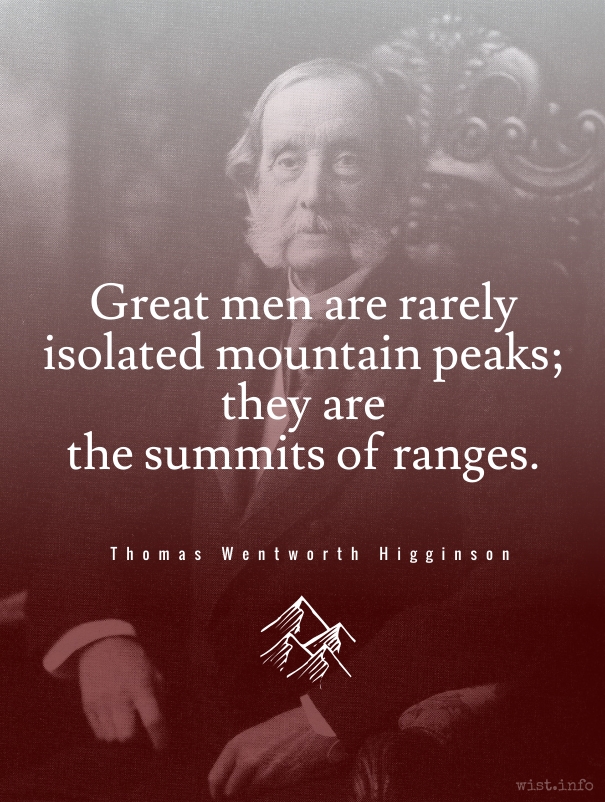
Great men are rarely isolated mountain peaks; they are the summits of ranges.
Thomas Wentworth Higginson (1823–1911) American minister, author, abolitionist, soldier
“A Plea for Culture,” Atlantic Essays (1871)
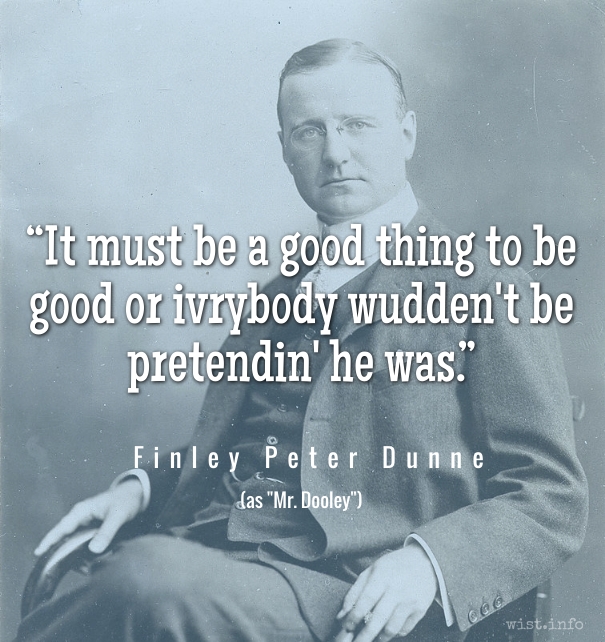
It must be a good thing to be good or ivrybody wudden’t be pretendin’ he was.
[It must be a good thing to be good, or everybody wouldn’t be pretending he was.]
Finley Peter Dunne (1867–1936) American humorist and journalist
Observations by Mr. Dooley, “Hypocrisy” (1902)
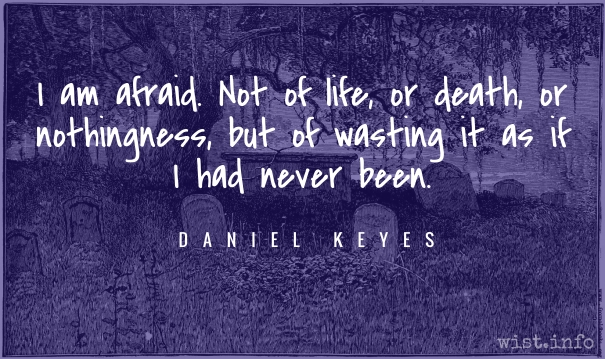
I am afraid. Not of life, or death, or nothingness, but of wasting it as if I had never been.
Daniel F. Keyes (1927–2014) American author
Flowers for Algernon (novel) (1966)
Adventure is something you seek for pleasure, or even for profit, like a gold rush or invading a country; for the illusion of being more alive than ordinarily, the thing you will to occur; but experience is what really happens to you in the long run; the truth that finally overtakes you.
Katherine Anne Porter (1890–1980) American journalist, essayist, author, political activist [b. Callie Russell Porter]
“St. Augustine and the Bullfight” (1955)


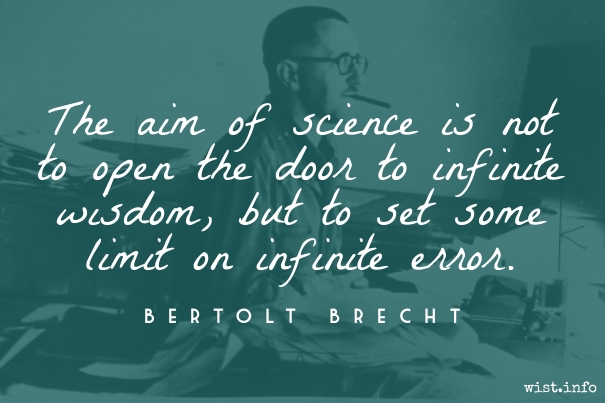
ANDREA: The aim of science is not to open the door to infinite wisdom, but to set some limit on infinite error.
Bertolt Brecht (1898–1956) German poet, playwright, director, dramaturgist
Life of Galileo [Leben des Galilei], sc. 13 (1939)
We are very near to greatness: one step and we are safe: can we not take the leap?
Ralph Waldo Emerson (1803–1882) American essayist, lecturer, poet
Journal (1841-10-28)

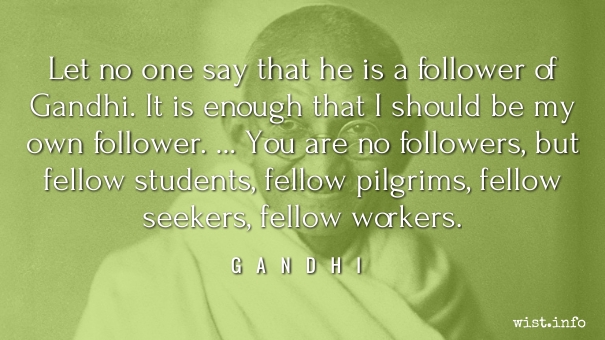
Let no one say that he is a follower of Gandhi. It is enough that I should be my own follower. I know what an inadequate follower I am of myself, for I cannot live up to the convictions I stand for. You are no followers, but fellow students, fellow pilgrims, fellow seekers, fellow workers.
Mohandas Gandhi (1869–1948) Indian lawyer, anti-colonial nationalist, political ethicist [Mahatma Gandhi]
In Harijan (2 Mar 1940)
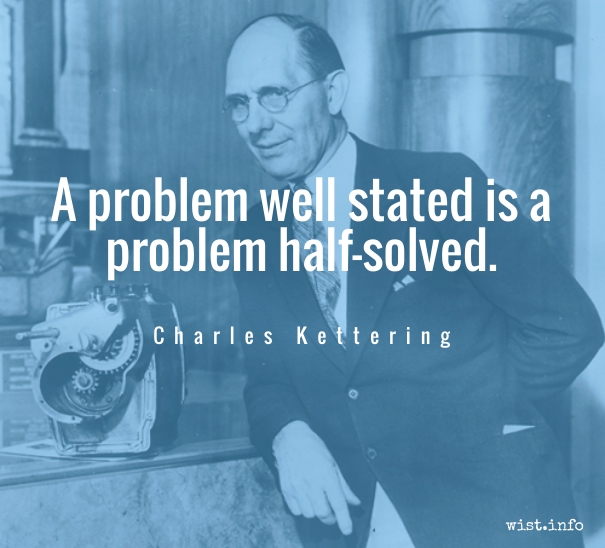
A problem well stated is a problem half-solved.
Charles F. Kettering (1876–1958) American inventor, engineer, researcher, businessman
(Attributed)
Sometimes attributed to John Dewey.
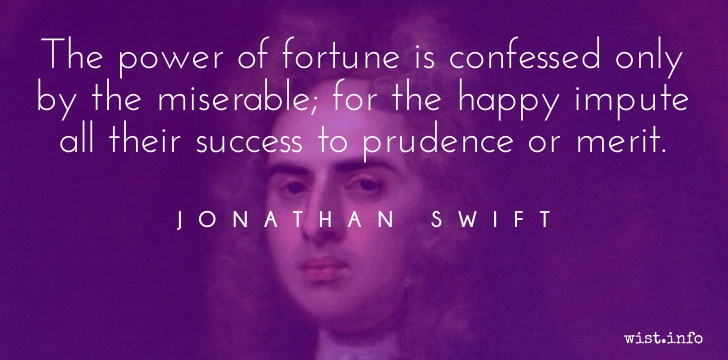
The power of fortune is confessed only by the miserable; for the happy impute all their success to prudence or merit.
Jonathan Swift (1667–1745) English writer and churchman
“Thoughts on Various Subjects” (1706)
(Source)
There are three kinds of lies: lies, damned lies, and statistics.
Benjamin Disraeli (1804–1881) English politician and author
(Attributed)
(Source)
Attributed by Mark Twain in "Chapters from My Autobiography" (Apr 1904), North American Review (7 Sep 1906): "Figures often beguile me, particularly when I have the arranging of them myself; in which case the remark attributed to Disraeli would often apply with justice and force: 'There are three kinds of lies: lies, damned lies, and statistics.'"
The phrase has not been found in any of Disraeli's works, and he is considered unlikely to be the originator. Variants of the phrase date back a century or more from Twain's reference. More discussion about this quotation here:

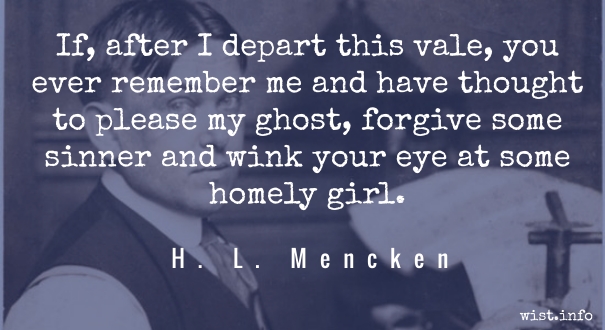
If, after I depart this vale, you ever remember me and have thought to please my ghost, forgive some sinner and wink your eye at some homely girl.
H. L. Mencken (1880–1956) American writer and journalist [Henry Lewis Mencken]
“Epitaph,” Smart Set (3 Dec 1921)
Like other idealisms, patriotism varies from a noble devotion to a moral lunacy.
William Ralph Inge (1860–1954) English prelate [Dean Inge]
“Our Present Discontents,” Outspoken Essays: First Series (1919)
Administrivia: (2015-10-09) A Picture Is Worth a Thousand Words
I’m trying an experiment. While I love the text format for quotations (it’s searchable, if nothing else), the fact is that the “hot” (and “cool”) thing in online quotations is the visual quotation / meme. I’m playing with a few tools to do this (there are a lot of online resources) to see if it’s a sustainable effort — i.e., if i can do them painlessly enough that I will do them on a regular basis (say, one each day).
I don’t plan on getting fancy — image of the person in the background, simple formatting, probably minimal citation. You can see an example here. I wish there were an easy way to include the link to the quote in the image, but that hand-transcribing of URLs is a pain in the neck for readers; a simple “wist.info” bug will have to suffice.
Feedback is welcome.
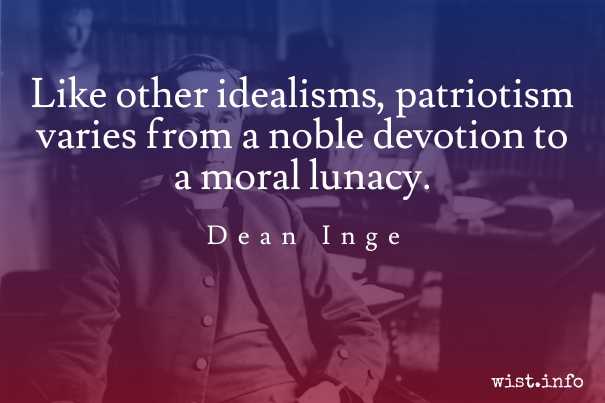
Patience is not very different from courage. It just takes longer.
James Richardson (b. 1950) American poet
Vectors: Aphorisms and Ten-Second Essays, # 54 (2001)
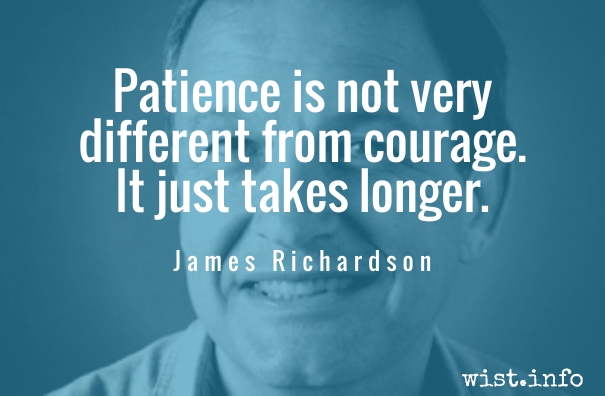
Whoever destroys a soul, it is considered as if he destroyed an entire world. And whoever saves a life, it is considered as if he saved an entire world.
The Talmud (AD 200–500) Collection of Jewish rabbinical writings
Mishnah Sanhedrin 4:9; Yerushalmi Talmud, Tractate Sanhedrin 37a
(Source)
Other translations: "Whoever destroys a single life is as guilty as though he had destroyed the entire world; and whoever rescues a single life earns as much merit as though he had rescued the entire world."
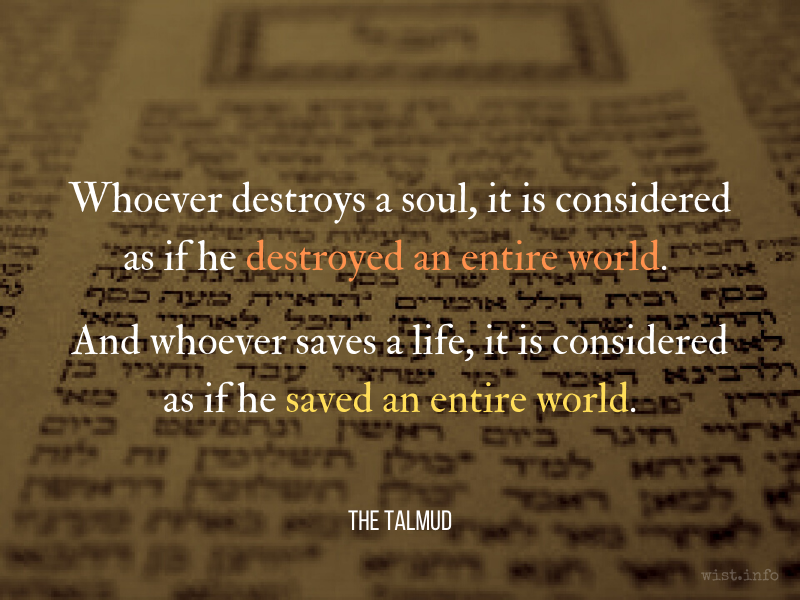

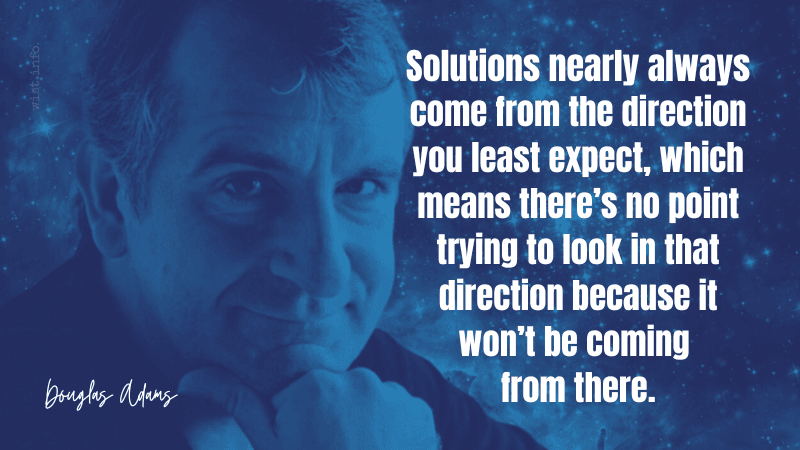
Solutions nearly always come from the direction you least expect, which means there’s no point trying to look in that direction because it won’t be coming from there.
Douglas Adams (1952–2001) English author, humorist, screenwriter
The Salmon of Doubt, Part 3 “And Everything,” “The Salmon of Doubt,” ch. 5 (2002) [ed. Peter Guzzardi]
(Source)
Noted as an observation Dirk Gently "mentioned a lot to people."

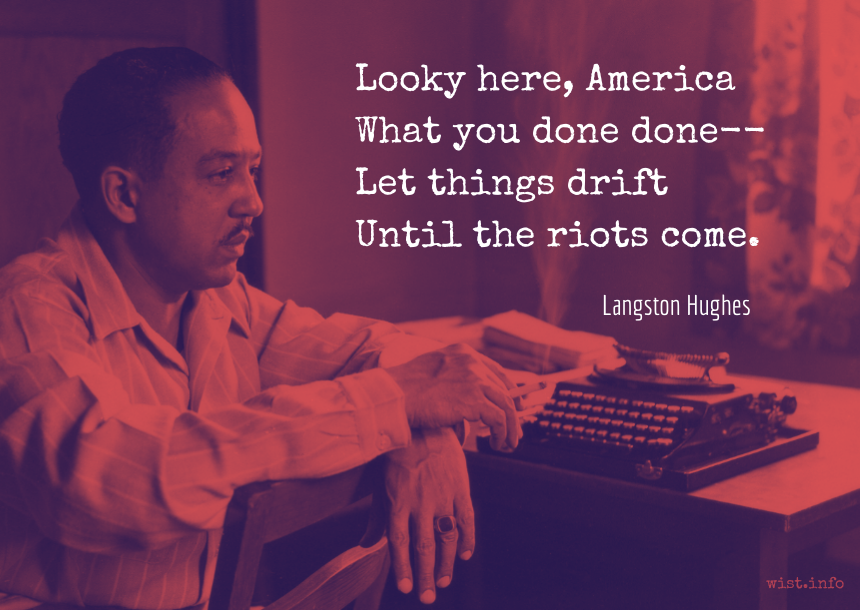
Looky here, America
What you done done —
Let things drift
Until the riots come.
Langston Hughes (1902–1967) American poet, social activist, novelist, playwright
“Beaumont to Detroit: 1943”
(Source)
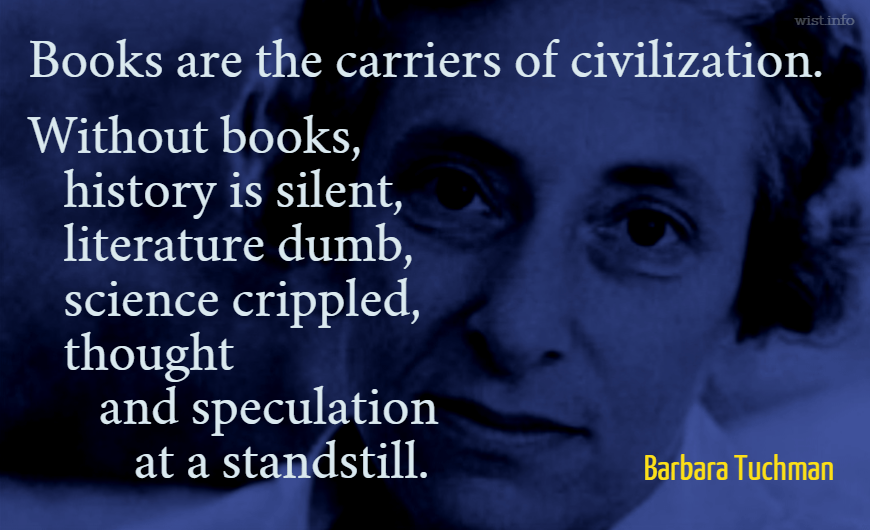
Books are the carriers of civilization. Without books, history is silent, literature, dumb, science crippled, thought and speculation at a standstill. Without books, the development of civilization would have been impossible. The are engines of change (as the poet said), windows on the world, and lighthouses erected in the sea of time. They are companions, teachers, magicians, bankers of the treasures of the mind. Books are humanity in print.
Barbara W. Tuchman (1912–1989) American historian and author
“The Book,” Lecture, Library of Congress (1979-10-17)
(Source)
Reprinted in Authors' League Bulletin (1979-11/12) and as "Papyrus to Paperbacks: The World That Books Made," Washington Post (1979-12-30).

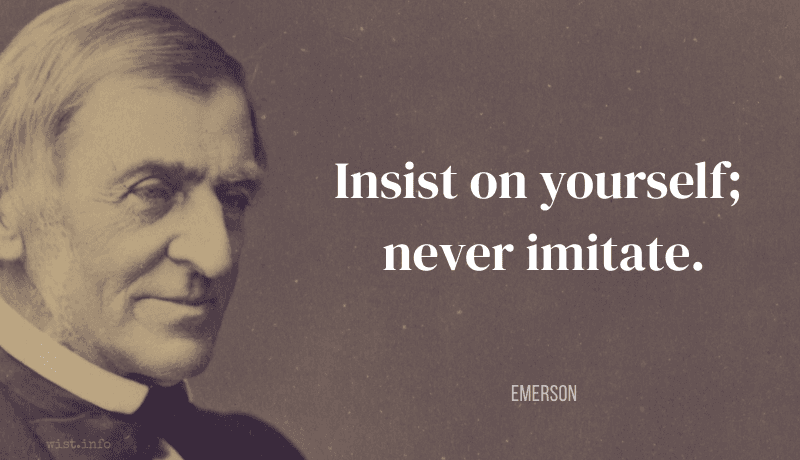
Insist on yourself; never imitate.
Ralph Waldo Emerson (1803–1882) American essayist, lecturer, poet
Essay (1841), “Self-Reliance,” Essays: First Series, No. 2
(Source)
This essay was inspired by his reading of Walter Savage Landor in 1833, with passages pulled from his lecture "Individualism," last in his course on "The Philosophy of History" (1836–1837), with other passages from the lectures "School," "Genius," and "Duty" in his course on "Human Life" (1838–1839).
The best fame is a writer’s fame. It’s enough to get a table at a good restaurant, but not enough that you get interrupted when you eat.
Fran Lebowitz (b. 1950) American journalist, essayist
Panel Discussion (1993-05-24), “Fame in the 20th Century,” Clive James (moderator), Joseph Papp Public Theater, New York City
(Source)
Reported in William Grimes, "The New Fame, or, How a Nobody Can Be Somebody," New York Times (1993-05-26).


A man does not sin by commission only, but often by omission.
[Ἀδικεῖ πολλάκις ὁ μὴ ποιῶν τι, οὐ μόνον ὁ ποιῶν τι.]
Marcus Aurelius (AD 121–180) Roman emperor (161–180), Stoic philosopher
Meditations [To Himself; Τὰ εἰς ἑαυτόν], Book 9, ch. 5 (9.5) (AD 161-180) [tr. Staniforth (1964)]
(Source)
(Source (Greek)). Other translations:Not he only that committeth, but he also that omitteth something, is oftentimes unjust.
[tr. Casaubon (1634), 9.4]Omissions no less than Commissions, are oftentimes Branches of Injustice.
[tr. Collier (1701)]Men are often unjust by omissions, as well as by actions.
[tr. Hutcheson/Moor (1742)]A man is as often guilty of injustice by omitting to do what he ought, as by doing what he ought not to do.
[tr. Graves (1792), 9.4]He often acts unjustly who does not do a certain thing; not only he who does a certain thing.
[tr. Long (1862)]Omissions no less than commission are oftentimes part of injustice.
[tr. Collier/Zimmern (1887)]Wrong comes often of not doing as well as doing.
[tr. Rendall (1898)]Men are often unjust by omissions as well as by actions.
[tr. Hutcheson/Chrystal (1902)]There is often an injustice of omission as well as of commission.
[tr. Haines (Loeb) (1916)]Often he who omits an act does injustice, not only he who commits an act.
[tr. Farquharson (1944)]A person often acts unjustly by what he fails to do, and not only by what he does.
[tr. Hard (1997 ed., 2011 ed.)]And you can also commit injustice by doing nothing.
[tr. Hays (2003)]There can often be wrongs of omission as well as commission.
[tr. Hammond (2006)]Very often an unjust act is done by not doing something, not only by doing something.
[tr. Needleman/Piazza (2008)]One may often injure by omission, not only by action.
[ed. Taplin (2016)]


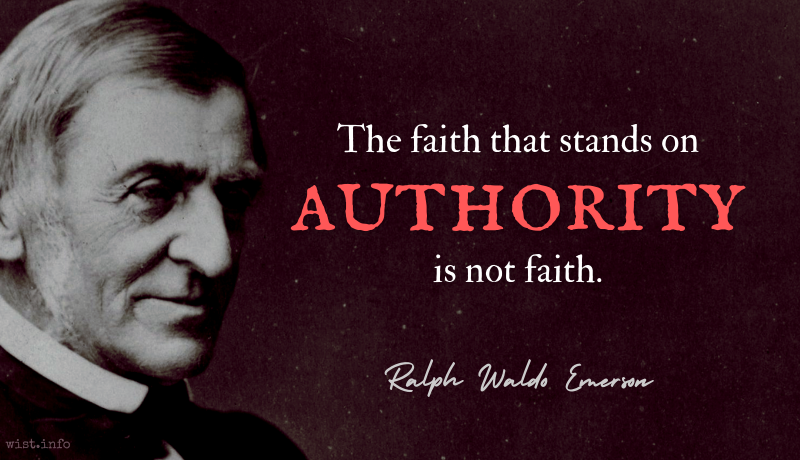
The faith that stands on authority is not faith. The reliance on authority measures the decline of religion, the withdrawal of the soul.
Ralph Waldo Emerson (1803–1882) American essayist, lecturer, poet
“The Over-Soul,” Essays: First Series, ch. 9 (1841)
(Source)
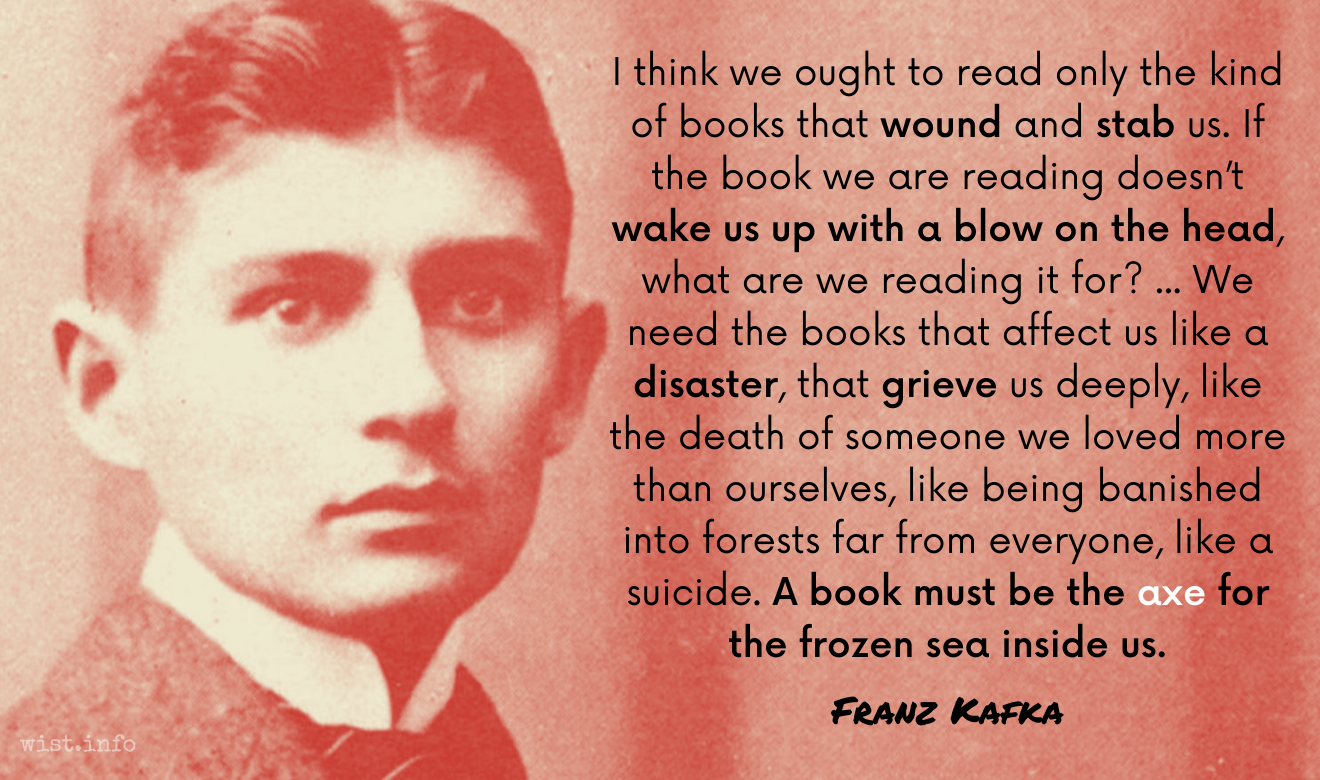
I think we ought to read only the kind of books that wound and stab us. If the book we are reading doesn’t wake us up with a blow on the head, what are we reading it for? So that it will make us happy, as you write? Good Lord, we would be happy precisely if we had no books, and the kind of books that make us happy are the kind we could write ourselves if we had to. But we need the books that affect us like a disaster, that grieve us deeply, like the death of someone we loved more than ourselves, like being banished into forests far from everyone, like a suicide. A book must be the axe for the frozen sea inside us. That is my belief.
[Ich glaube, man sollte überhaupt nur solche Bücher lesen, die einen beißen und stechen. Wenn das Buch, das wir lesen, uns nicht mit einem Faustschlag auf den Schädel weckt, wozu lesen wir dann das Buch? Damit es uns glücklich macht, wie Du schreibst? Mein Gott, glücklich wären wir eben auch, wenn wir keine Bücher hätten, und solche Bücher, die uns glücklich machen, könnten wir zur Not selber schreiben. Wir brauchen aber die Bücher, die auf uns wirken wie ein Unglück, das uns sehr schmerzt, wie der Tod eines, den wir lieber hatten als uns, wie wenn wir in Wälder verstoßen würden, von allen Menschen weg, wie ein Selbstmord, ein Buch muß die Axt sein für das gefrorene Meer in uns. Das glaube ich.]
Franz Kafka (1883–1924) Czech-Austrian Jewish writer
Letter (1904-01-27) to Oskar Pollak [tr. Winston (1977)]
(Source)
This passage (in translation) is frequently only partially quote, particularly the final "ice axe" line, making parallel translations difficult. I have tried to give as full quotations as I could find.
(Source (German)). Other translations:Altogether, I think we ought to read only books that bite and sting us. If the book we are reading doesn't shake us awake like a blow to the skull, why botehr reading it in the first place? So that it can make us happy, as you put it? Good God, we'd be just as happy if we had no books at all; books that make us happy we could, in a pinch, also write ourselves. What we need are books that hit us like a most painful misfortune, like the death of someone we loved more than we love ourselves, that make us feel as though we had been banished to the woods, far from any human presence, like a suicide. A book must be the ax for the frozen sea within us. That is what I believe.
[tr. Pawel (1984)]If the book we are reading does not wake us, as with a fist hammering on our skulls, then why do we read it? Good God, we also would be happy if we had no books and such books that make us happy we could, if need be, write ourselves. What we must have are those books that come on us like ill fortune, like the death of one we love better than ourselves, like suicide. A book must be an ice axe to break the sea frozen inside us.
[E.g. (1987)]The books we need are the kind that act upon us like a misfortune, that make us suffer like the death of someone we love more than ourselves, that make us feel as though we were no the verge of suicide, or losrt in a forest remote from all human habitation -- a book should serve as the ax for the frozen sea within us.
[tr. Rahv (1952)]A book should be an ice-axe to break the frozen sea within us.
[E.g.]A book must be an ice-axe to break the seas frozen inside our soul.
[E.g.]
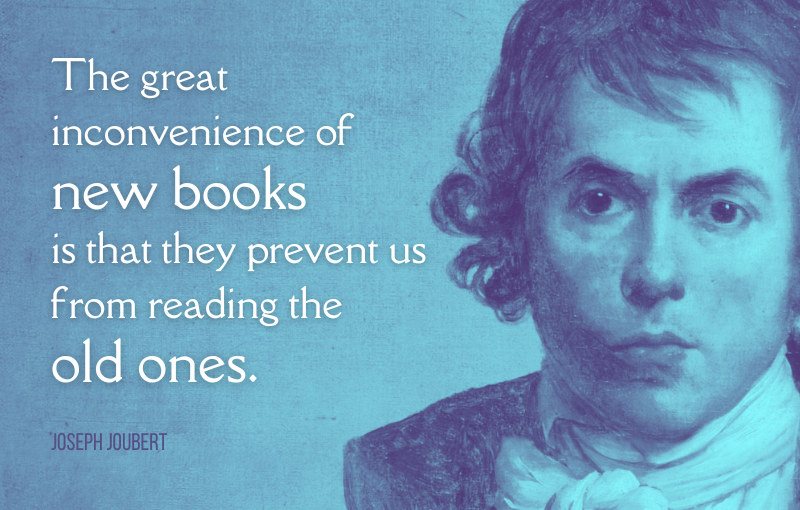
The great inconvenience of new books is that they prevent us from reading the old ones.
[C’est le grand inconvénient des livres nouveaux: ils nous empêchent de lire les anciens.]
Joseph Joubert (1754–1824) French moralist, philosopher, essayist, poet
Pensées [Thoughts], ch. 18 “Du Siècle [On the Age],” ¶ 57 (1850 ed.) [tr. Auster (1983), 1808]
(Source)
(Source (French)). Other translations:The great drawback in new books is that they prevent our reading older ones.
[tr. Attwell (1896), ¶ 250]That is the great drawback of new books: they keep us from reading the old.
[tr. Collins (1928), ch. 17]
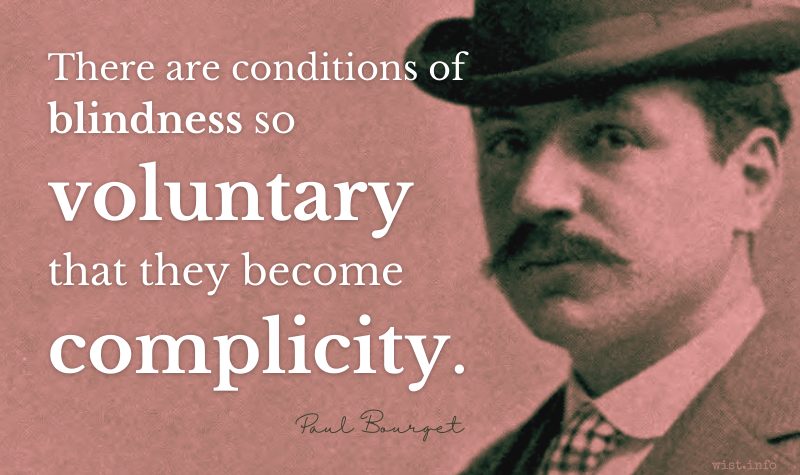
There are conditions of blindness so voluntary that they become complicity.

If nature has made any one thing less susceptible, than all others, of exclusive property, it is the action of the thinking power called an Idea; which an individual may exclusively possess as long as he keeps it to himself; but the moment it is divulged, it forces itself into the possession of every one, and the reciever cannot dispossess himself of it. it’s peculiar character too is that no one possesses the less, because every other possesses the whole of it. He who recieves an idea from me, recieves instruction himself, without lessening mine; as he who lights his taper at mine, recieves light without darkening me.
Thomas Jefferson (1743–1826) American political philosopher, polymath, statesman, US President (1801–09)
Letter (1813-08-13) to Isaac McPherson
(Source)
Dictatorships foster oppression, dictatorships foster servitude, dictatorships foster cruelty; more abominable is the fact that they foster idiocy.
[Las dictaduras fomentan la opresión, las dictaduras fomentan el servilismo, las dictaduras fomentan la cureldad; más abominable es el hecho de que fomentan la idiotez.]
Jorge Luis Borges (1899–1986) Argentine writer
Speech (1946), “Hurry, Hurry [De’le, De’le],” Argentine Society of Letters [JLB 57]
(Source)
(Source (Spanish)). Given at a dinner in his honor after he had been fired from his library position by the new Juan Peron government for having signed a pro-democracy statement, and then appointed as a regional poultry and rabbit inspector.

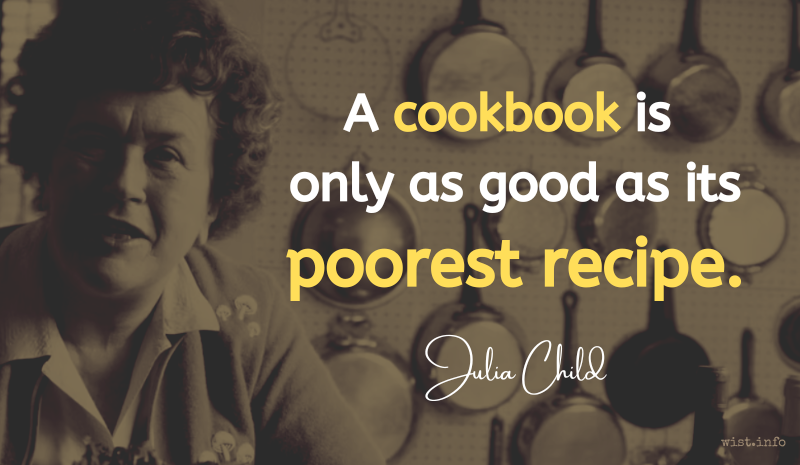
A cookbook is only as good as its poorest recipe.
Julia Child (1912–2004) American chef and writer
Quoted in Frank Prial, “Light’s Still on Julia Child,” New York Times (1997-10-08)
(Source)
Apparently a phrase she used frequently, as she drew on numerous cookbooks as source material and reference for her own. Another use can be found in an interview with Mike Sager, "What I've Learned: Julia Child," Esquire (1 Jun 2000).
Often given (perhaps from other occurrences) as "A cookbook is only as good as its worst recipe." For example, her obituary by Regina Schrambling, "Julia Child, the French Chef for a Jell-O Nation, Dies at 91," New York Times (13 Aug 2004).

There can be no effective control of corporations while their political activity remains. To put an end to it will be neither a short nor an easy task, but it can be done. We must have complete and effective publicity of corporate affairs, so that people may know beyond peradventure whether the corporations obey the law and whether their management entitles them to the confidence of the public. It is necessary that laws should be passed to prohibit the use of corporate funds directly or indirectly for political purposes; it is still more necessary that such laws should be thoroughly enforced. Corporate expenditures for political purposes, and especially such expenditures by public-service corporations, have supplied one of the principal sources of corruption in our political affairs.
Theodore Roosevelt (1858–1919) American politician, statesman, conservationist, writer; US President (1901–09)
Speech (1910-08-31), “The New Nationalism,” John Brown Memorial Park dedication, Osawatomie, Kansas
(Source)

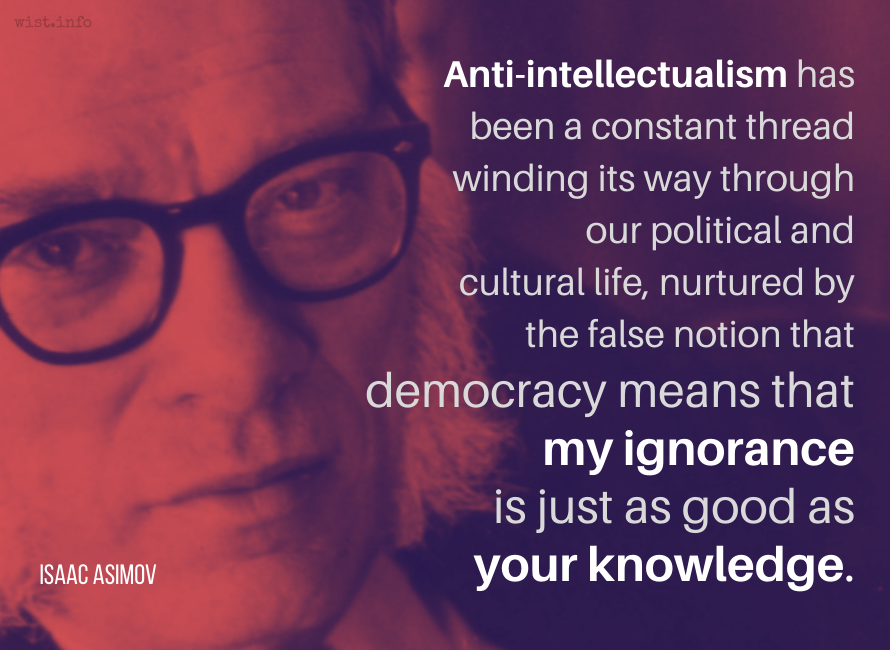
There is a cult of ignorance in the United States, and there always has been. Anti-intellectualism has been a constant thread winding its way through our political and cultural life, nurtured by the false notion that democracy means that “my ignorance is just as good as your knowledge.”
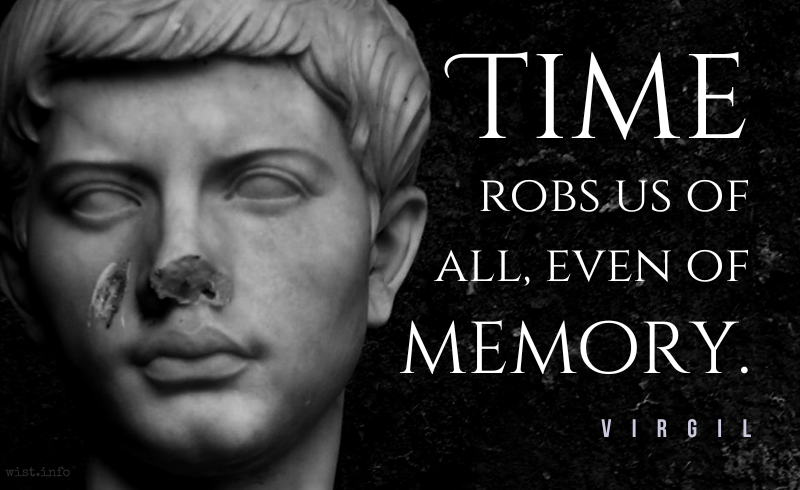
Time robs us of all, even of memory.
[Omnia fert aetas, animum quoque.]
Virgil (70–19 BC) Roman poet [b. Publius Vergilius Maro; also Vergil]
Eclogues [Eclogae, Bucolics, Pastorals], No. 9 “Lycidas and Moeris,” l. 51 (9.51) [Moeris] (42-38 BC) [tr. Fairclough (Loeb) (1916)]
(Source)
(Source (Latin)). Other translations:Age all things wasts: the minde too.
[tr. Ogilby (1649)]The rest I have forgot, for Cares and Time
Change all things, and untune my Soul to Rhyme.
[tr. Dryden (1709), ll. 70-71]Ah! age, which pilfers all, not e'en the memory spares!
[tr. Wrangham (1830), l. 60]Age bears away all things, even the mind itself.
[tr. Davidson (1854)]Time carries all -- our memories e'en -- away.
[tr. Calverley (c. 1871)]Time steals everything, memory among the rest.
[tr. Wilkins (1873)]Now memory scarce can aught recall;
The note is lost, the voice, the all.
[tr. King (1882), ll. 901-902]Alas! Old age bears hard on everything;
On memory most.
[tr. Palmer (1883)]Time carries all things, even our wits, away.
[tr. Greenough (1895)]Age bears away all things, even the memory itself.
[tr. Bryce (1897)]Time runs away with all things, the mind too.
[tr. Mackail (1899)]How time wears all things out!
Even the memory.
[tr. Mackail/Cardew (1908)]Ah, time takes all we have, the memory too.
[tr. Williams (1915)]Time bears away
All things, even the mind.
[tr. Royds (1922)]Time carries everything away, even our memory.
[tr. Rieu (1949)]Age robs us of all things,
Even the mind.
[tr. Johnson (1960)]Time bears all away, even memory.
[tr. Day Lewis (1963)]Time takes all we have away from us.
[tr. Ferry (1999)]Time takes away all things, memory too.
[tr. Kline (2001)]
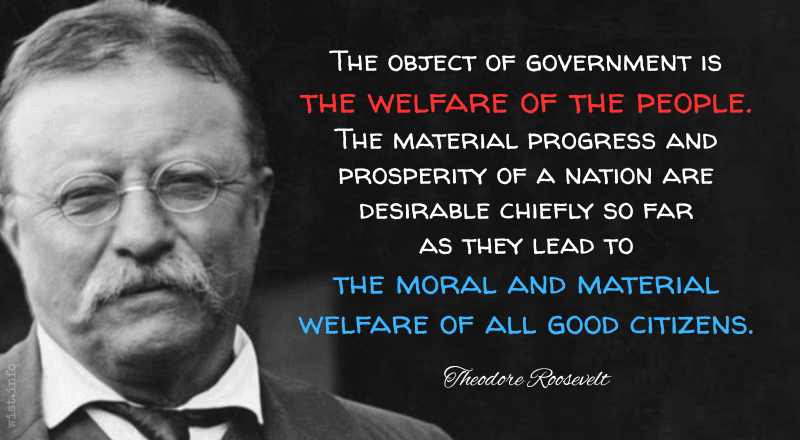
The object of government is the welfare of the people. The material progress and prosperity of a nation are desirable chiefly so far as they lead to the moral and material welfare of all good citizens.
Theodore Roosevelt (1858–1919) American politician, statesman, conservationist, writer; US President (1901–09)
Speech (1910-08-31), “The New Nationalism,” John Brown Memorial Park dedication, Osawatomie, Kansas
(Source)
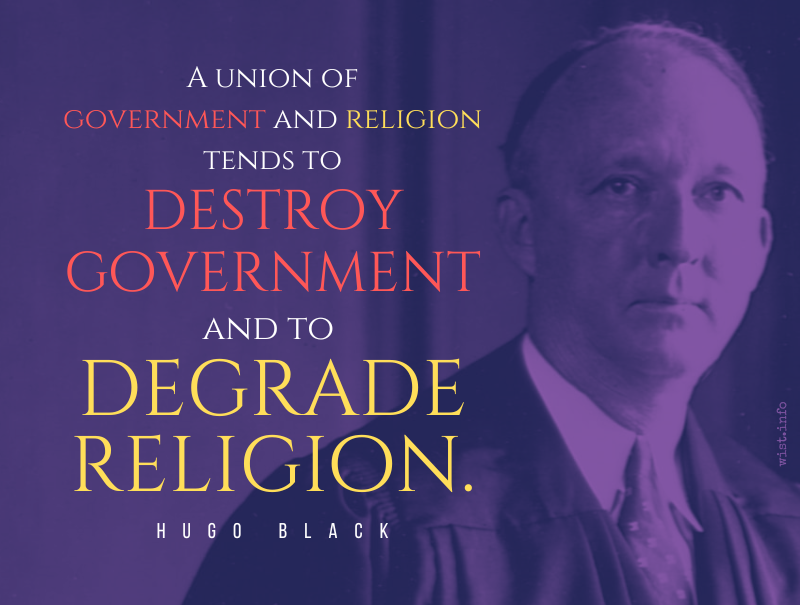
But the purposes underlying the Establishment Clause go much further than that. Its first and most immediate purpose rested on the belief that a union of government and religion tends to destroy government and to degrade religion. The history of governmentally established religion, both in England and in this country, showed that whenever government had allied itself with one particular form of religion, the inevitable result had been that it had incurred the hatred, disrespect and even contempt of those who held contrary beliefs. That same history showed that many people had lost their respect for any religion that had relied upon the support of government to spread its faith.
The Establishment Clause thus stands as an expression of principle on the part of the Founders of our Constitution that religion is too personal, too sacred, too holy, to permit its “unhallowed perversion” by a civil magistrate.
Hugo Black (1886–1971) American politician and jurist; US Supreme Court Justice (1937–71)
Engel v. Vitale, 370 U.S. 421, 431–432 (1962) [majority opinion]
(Source)
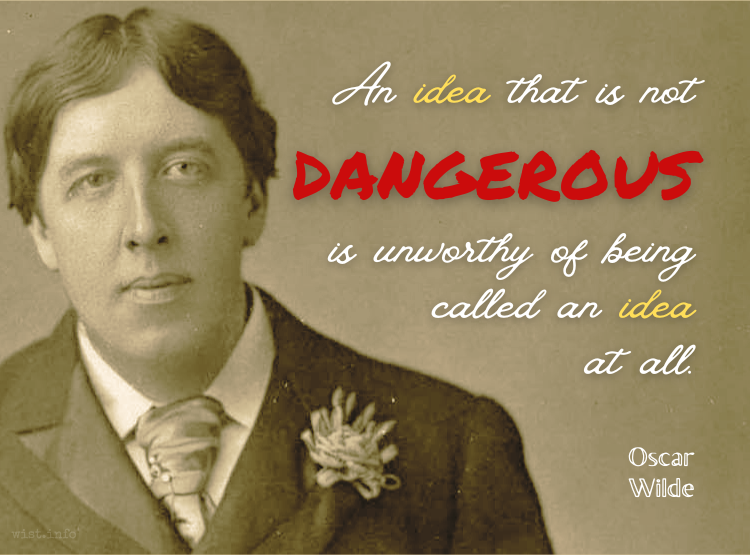
An idea that is not dangerous is unworthy of being called an idea at all.
Oscar Wilde (1854–1900) Irish poet, wit, dramatist
“The Critic as Artist,” Part 2 [Gilbert], Intentions (1891)
(Source)
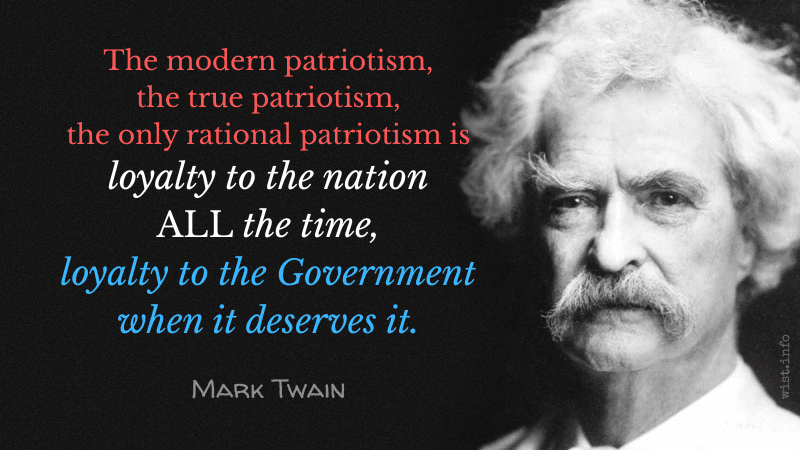
Remember this, take it to heart, live by it, die for it if necessary: that our patriotism is medieval, outworn, obsolete; that the modern patriotism, the true patriotism, the only rational patriotism is loyalty to the nation all the time, loyalty to the Government when it deserves it.
Mark Twain (1835–1910) American writer [pseud. of Samuel Clemens]
Story (1905-02-02), “The Czar’s Soliloquy,” North American Review, Vol. 180, No. 580 (1905-03)
(Source)
Advice that Russian mothers should be giving their children.
Sometimes paraphrased: "Patriotism is supporting your country all the time, and your government when it deserves it."
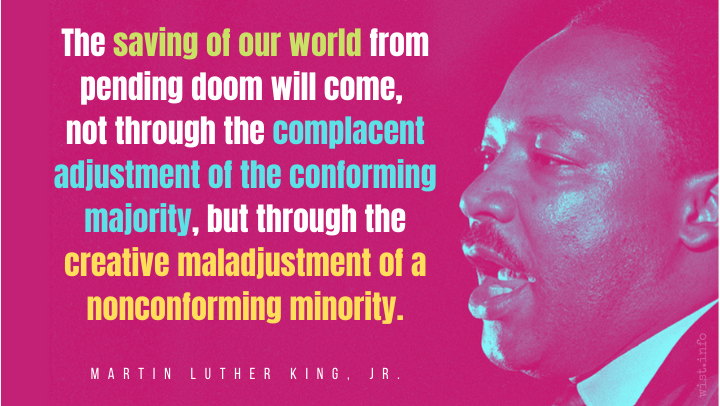
The saving of our world from pending doom will come, not through the complacent adjustment of the conforming majority, but through the creative maladjustment of a nonconforming minority.
Martin Luther King, Jr. (1929–1968) American clergyman, civil rights leader, social activist, preacher
Strength to Love, ch. 2 “Transformed Nonconformist,” sec. 3 (1963)
(Source)
I have always been fond of the West African proverb “Speak softly and carry a big stick; you will go far.”
Theodore Roosevelt (1858–1919) American politician, statesman, conservationist, writer; US President (1901–09)
Letter (1900-01-26) to Henry L. Sprague
(Source)
The letter to Sprague is is the first known use by Roosevelt of his future catch phrase. It attained more fame when he used it in a speech at the Minnesota State Fair (1901-09-02) (two versions found):There is a homely adage which runs "Speak softly and carry a big stick; you will go far." If the American nation will speak softly and yet build and keep at a pitch of highest training a thoroughly efficient Navy, the Monroe Doctrine will go far.
[Speech (1901-09-02), "A Nation of Pioneers," Minnesota State Fair, Minneapolis]A good many of you are probably acquainted with the old proverb "Speak softly and carry a big stick -- you will go far."
[Minneapolis Tribune (1901-09-03)]
Other significant references:Right here let me make as vigorous a plea as I know how in favor of saying nothing that we do not mean, and of acting without hesitation up to whatever we say. A good many of you are probably acquainted with the old proverb, 'Speak softly and carry a big stick -- you will go far.' If a man continually blusters, if he lacks civility, a big stick will not save him from trouble, and neither will speaking softly avail, if back of the softness there does not lie strength, power.
[Speech (1903-04-02), Chicago]One the main lessons to learn from this war is embodied in the homely proverb: "Speak softly and carry a big stick."
[America and the World War, ch. 2 "The Belgian Tragedy" (1915)]The only safe rule [in foreign policy] is to promise little, and faithfully keep to every promise; to "speak softly and carry a big stick."
[Theodore Roosevelt: An Autobiography, ch. 15 "The Peace of Righteousness" (1913)]
More discussion here:
I met, not long ago, a young man who aspired to become a novelist. Knowing that I was in the profession, he asked me to tell him how he should set to work to realize his ambition. I did my best to explain. “The first thing,” I said, “is to buy quite a lot of paper, a bottle of ink, and a pen. After that you merely have to write.”
Aldous Huxley (1894–1963) English novelist, essayist and critic
“Sermons in Cats,” Music at Night and Other Essays (1931)
(Source)

After silence that which comes nearest to expressing the inexpressible is music.
Aldous Huxley (1894–1963) English novelist, essayist and critic
“The Rest is Silence,” Music at Night and Other Essays (1931)
(Source)
The most wasted of all days is that on which one has not laughed.
[La plus perdue de toutes les journées est celle où l’on n’a pas ri.]
Nicolas Chamfort (1741–1794) French writer, epigrammist (b. Nicolas-Sébastien Roch)
Products of Perfected Civilization [Produits de la Civilisation Perfectionée], Part 1 “Maxims and Thoughts [Maximes et Pensées],” ch. 1, ¶ 80 (1795) [tr. Morley (1887)]
(Source)
Often attributed to a more contemporary comedian (Groucho Marx, Charlie Chaplin) or writers such as Ben Burroughs, Grigori Alexandrov. It is arguably a clear enough sentiment that others might reinvent it.
(Source (French)). Other translations:The most lost of all days, is that in which we have not laughed.
[Source (1803)]The most completely lost of all days is that on which one has not laughed.
[Source (1891)]The worst wasted of all days is that during which one has not laughed.
[tr. Hutchinson (1902), "The Cynic's Breviary"]Of all days, the day on which one has not laughed is the one most surely wasted.
[tr. Mathers (1926)]That of all days is the most completely wasted in which one did not once laugh.
[tr. Merwin (1969)]The day that we have most lost is the one on which we have not laughed.
[Siniscalchi (1994)]
Other versions:More history of the quotation: A Day Without Laughter is a Day Wasted – Quote Investigator®.
- "A day without laughter is a day wasted." [attr. to Chaplin]
- "The most lost of all days is that in which one has not laughed."
- "The most wasted day of all is that in which we have not laughed."


The government must be the trustee for the little man because no one else will be. The powerful can usually help themselves — and frequently do.
Adlai Stevenson II (1900–1965) American politician, diplomat, statesman
Speech (1955-10-29), “The Crisis in Agriculture,” Democratic Rally, Duluth, Minnesota
(Source)
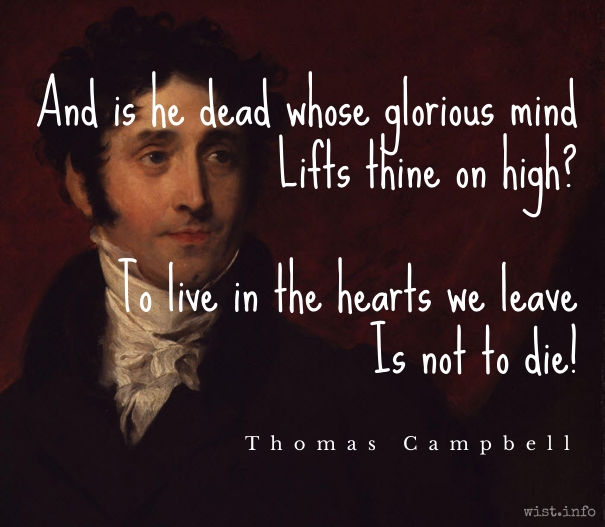
And is he dead whose glorious mind
Lifts thine on high?
To live in the hearts we leave
Is not to die!
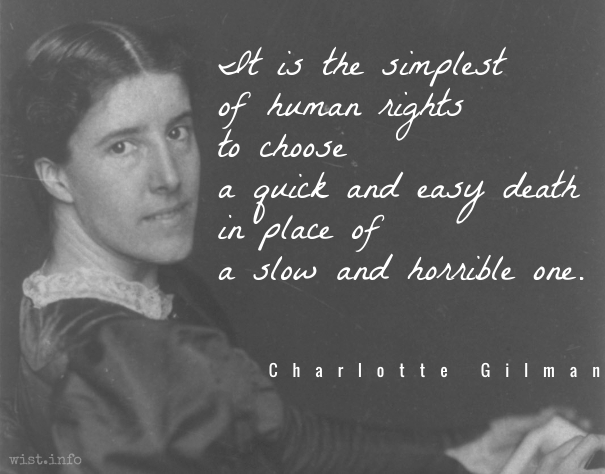
Human life consists in mutual service. No grief, pain, misfortune, or “broken heart,” is excuse for cutting off one’s life while any power of service remains. But when all usefulness is over, when one is assured of an unavoidable and imminent death, it is the simplest of human rights to choose a quick and easy death in place of a slow and horrible one.
Charlotte Perkins Gilman (1860–1935) American sociologist, writer, reformer, feminist
Suicide note (1935-08-17)
(Source)
Gilman, an advocate for euthanasia, took her own life through an overdose of chloroform, after having been diagnosed with incurable breast cancer in January 1932. In both her autobiography and her suicide note, she said she "chose chloroform over cancer."
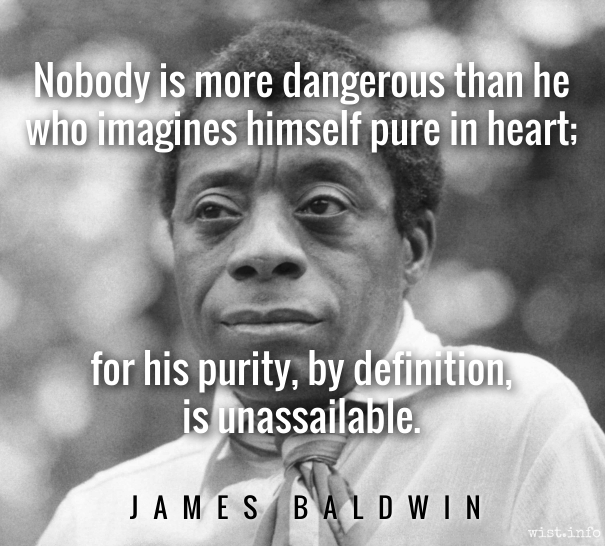
Nobody is more dangerous than he who imagines himself pure in heart; for his purity, by definition, is unassailable.
James Baldwin (1924–1987) American novelist, playwright, activist
“The Black Boy Looks at the White Boy,” Esquire (May 1961)
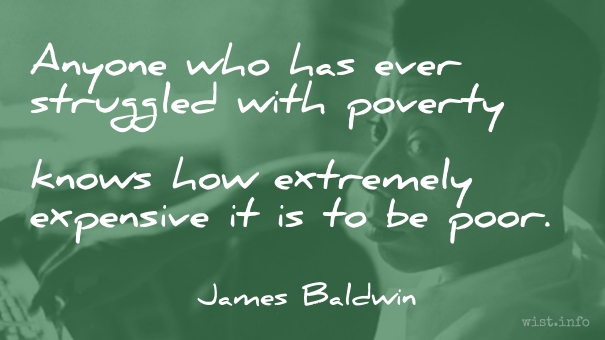
Anyone who has ever struggled with poverty knows how extremely expensive it is to be poor.
James Baldwin (1924–1987) American novelist, playwright, activist
“Fifth Avenue, Uptown: a Letter from Harlem,” Esquire (Jul 1960)
(Source)
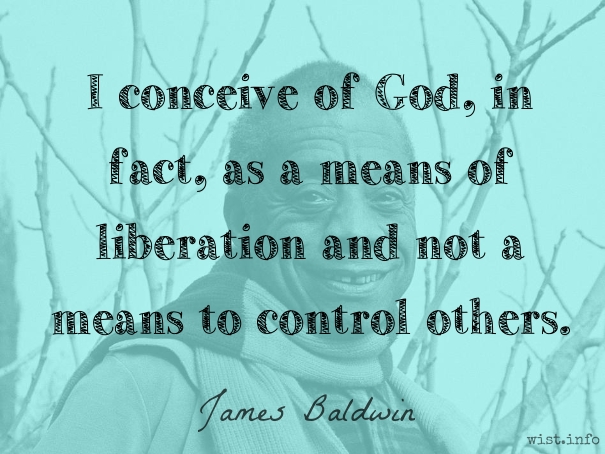
I conceive of God, in fact, as a means of liberation and not a means to control others.
James Baldwin (1924–1987) American novelist, playwright, activist
“In Search of a Majority,” Speech, Kalamazoo College (Feb 1960)
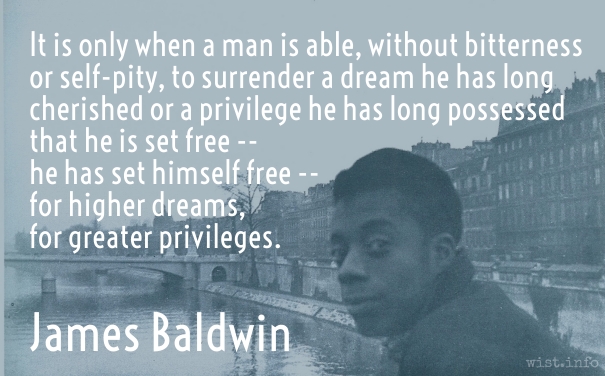
Any real change implies the breakup of the world as one has always known it, the loss of all that gave one an identity, the end of safety. And at such a moment, unable to see and not daring to imagine what the future will now bring forth, one clings to what one knew, or dreamed that one possessed. Yet, it is only when a man is able, without bitterness or self-pity, to surrender a dream he has long cherished or a privilege he has long possessed that he is set free — he has set himself free — for higher dreams, for greater privileges.
James Baldwin (1924–1987) American novelist, playwright, activist
“Faulkner and Desegregation,” Partisan Review (Fall 1956)
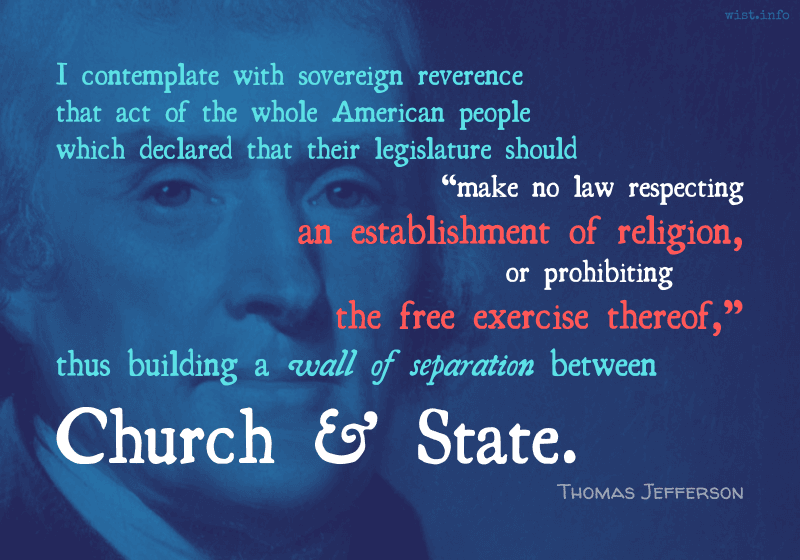
Believing with you that religion is a matter which lies solely between Man & his God, that he owes account to none other for his faith or his worship, that the legitimate powers of government reach actions only, & not opinions, I contemplate with sovereign reverence that act of the whole American people which declared that their legislature should “make no law respecting an establishment of religion, or prohibiting the free exercise thereof,” thus building a wall of separation between Church & State. adhering to this expression of the supreme will of the nation in behalf of the rights of conscience, I shall see with sincere satisfaction the progress of those sentiments which tend to restore to man all his natural rights, convinced he has no natural right in opposition to his social duties.
Thomas Jefferson (1743–1826) American political philosopher, polymath, statesman, US President (1801–09)
Letter (1802-01-01) to the Danbury Baptists
(Source)
Addressed to "messrs. Nehemiah Dodge, Ephraim Robbins, & Stephen S. Nelson, a committee of the Danbury Baptist association in the state of Connecticut."
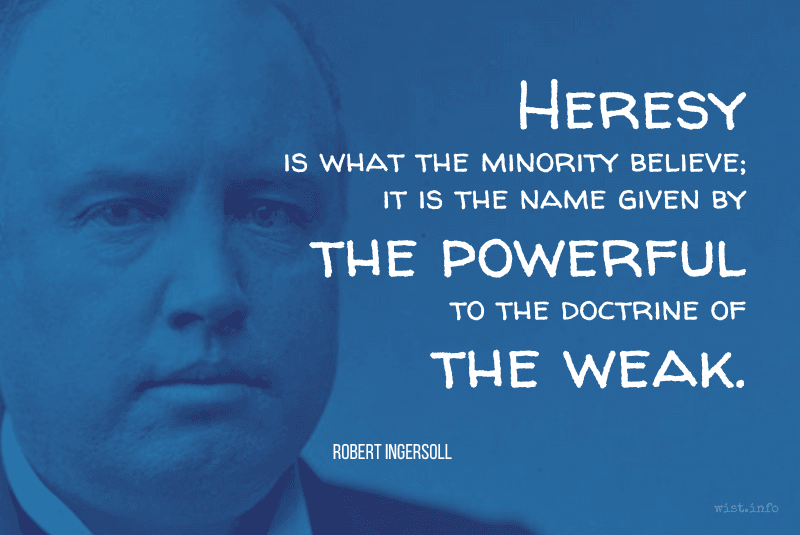
Whoever has an opinion of his own, and honestly expresses it, will be guilty of heresy. Heresy is what the minority believe; it is the name given by the powerful to the doctrine of the weak.
Robert Green Ingersoll (1833–1899) American lawyer, freethinker, orator
Lecture (1874-05-03), “Heretics and Heresies,” Free Religious Society, Kingsbury Hall, Chicago
(Source)
Collected in The Gods and Other Lectures (1876).
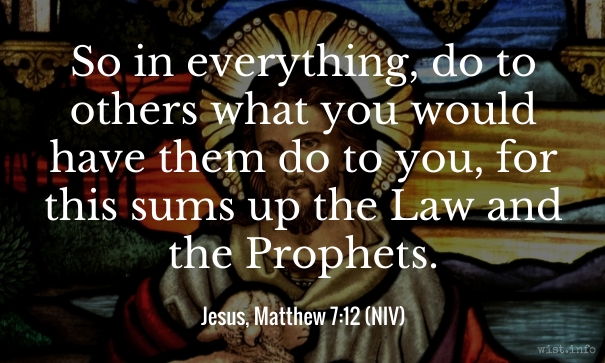
Therefore all things whatsoever ye would that men should do to you, do ye even so to them: for this is the law and the prophets.
[Πάντα οὖν ὅσα ἐὰν θέλητε ἵνα ποιῶσιν ὑμῖν οἱ ἄνθρωποι, οὕτως καὶ ὑμεῖς ποιεῖτε αὐτοῖς· οὗτος γάρ ἐστιν ὁ νόμος καὶ οἱ προφῆται.]
The Bible (The New Testament) (AD 1st - 2nd C) Christian sacred scripture
Book 1. Gospel of Matthew 7:12 (Matt 7:12), “The Golden Rule” (Jesus) [KJV (1611)]
(Source)
Popularly, "Do unto others as you would have them do unto you."
This passage is paralleled in Luke 6:31.
(Source (Greek)). Other translations:So always treat others as you would like them to treat you; that is the meaning of the Law and the Prophets.
[JB (1966)]So always treat others as you would like them to treat you; that is the Law and the Prophets.
[NJB (1985)]Do for others what you want them to do for you: this is the meaning of the Law of Moses and of the teachings of the prophets.
[GNT (1992 ed.)]Therefore, you should treat people in the same way that you want people to treat you; this is the Law and the Prophets.
[CEB (2011)]So in everything, do to others what you would have them do to you, for this sums up the Law and the Prophets.
[NIV (2011 ed.)]In everything do to others as you would have them do to you; for this is the law and the prophets.
[NRSV (2021 ed.)]
Note: The "Golden Rule" has been expressed in many ways by many religious and philosophical teachers. Several of these in WIST are or will be cross-referenced to this particular quotation (as trackbacks, and through the golden rule topic tag), not to lend it sectarian primacy, but because this is the best-known formulation of it in the Western world.

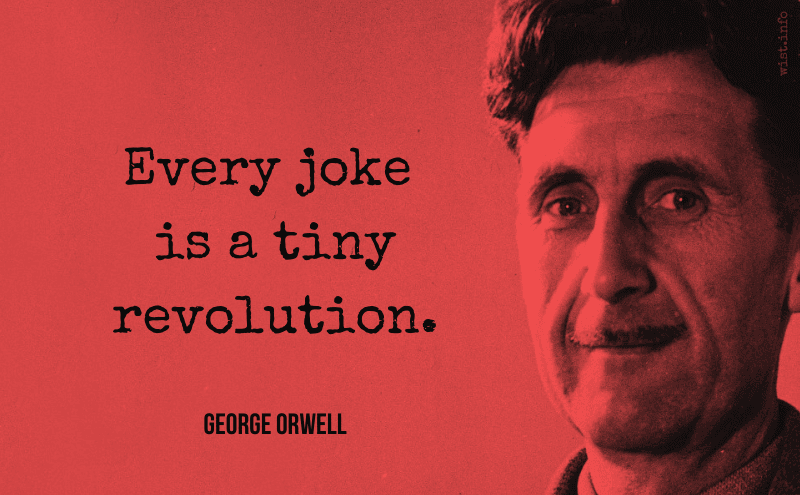
A thing is funny when — in some way that is not actually offensive or frightening — it upsets the established order. Every joke is a tiny revolution. If you had to define humour in a single phrase, you might define it as dignity sitting on a tin-tack. Whatever destroys dignity, and brings down the mighty from their seats, preferably with a bump, is funny. And the bigger the fall, the bigger the joke. It would be better fun to throw a custard pie at a bishop than at a curate.
George Orwell (1903–1950) English journalist, essayist, writer [pseud. of Eric Arthur Blair]
Essay (1945-07-28), “Funny, But Not Vulgar,” Leader Magazine
(Source)
Written in December 1944. More discussion of this quotation: Every Joke Is a Tiny Revolution – Quote Investigator®.
Freedom is not a gift received from a State or a leader but a possession to be won every day by the effort of each and the union of all.
Albert Camus (1913–1960) Algerian-French novelist, essayist, playwright
“Bread and Freedom” (1957), Resistance, Rebellion, and Death [tr. O’Brien (1961)]
I give you a new commandment: love one another; you must love one another just as I have loved you. It is by your love for one another, that everyone will recognise you as my disciples.
[Ἐντολὴν καινὴν δίδωμι ὑμῖν ἵνα ἀγαπᾶτε ἀλλήλους καθὼς ἠγάπησα ὑμᾶς ἵνα καὶ ὑμεῖς ἀγαπᾶτε ἀλλήλους. ἐν τούτῳ γνώσονται πάντες ὅτι ἐμοὶ μαθηταί ἐστε ἐὰν ἀγάπην ἔχητε ἐν ἀλλήλοις.]
The Bible (The New Testament) (AD 1st - 2nd C) Christian sacred scripture
Book 4. Gospel of John 13:34ff (John 13:34–35) (Jesus) [NJB (1985)]
(Source)
No Synoptic parallels. See also John 15:12.
(Source (Greek)). Other translations:A new commandment I give unto you, That ye love one another; as I have loved you, that ye also love one another. By this shall all men know that ye are my disciples, if ye have love one to another.
[KJV (1611)]I give you a new commandment:
love one another;
just as I have loved you,
you also must love one another.
By this love you have for one another,
everyone will know that you are my disciples.
[JB (1966)]And now I give you a new commandment: love one another. As I have loved you, so you must love one another. If you have love for one another, then everyone will know that you are my disciples.
[GNT (1976)]I give you a new commandment: Love each other. Just as I have loved you, so you also must love each other. This is how everyone will know that you are my disciples, when you love each other.
[CEB (2011)]A new command I give you: Love one another. As I have loved you, so you must love one another. By this all men will know that you are my disciples, if you love one another.
[NIV (2011 ed.)]I give you a new commandment, that you love one another. Just as I have loved you, you also should love one another. By this everyone will know that you are my disciples, if you have love for one another.
[NRSV (2021 ed.)]
Knowledge is power.
[Nam et ipsa scientia potestas est.]
Francis Bacon (1561–1626) English philosopher, scientist, author, statesman
Sacred Meditations [Meditationes Sacræ], “Of Heresies [De Hæresibus]” (1597)
Alt. trans.: "Knowledge itself is power."

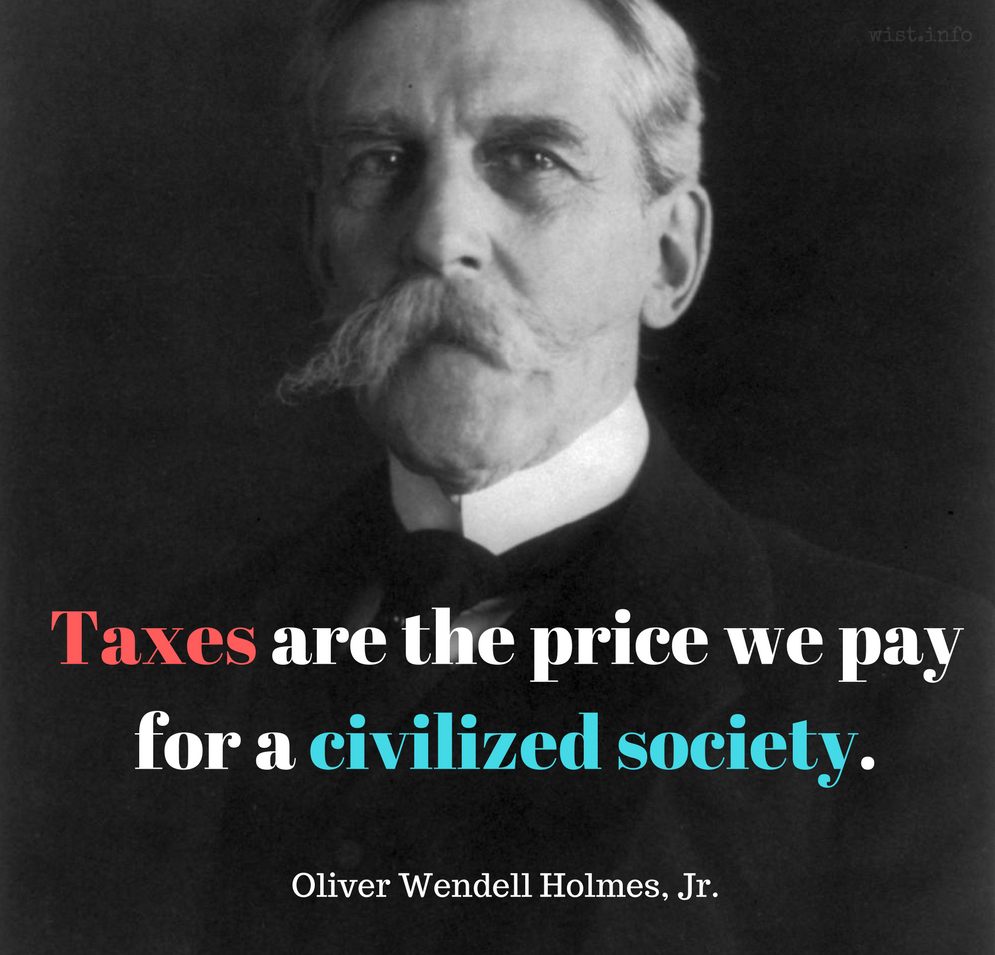
Taxes are what we pay for civilized society.
Oliver Wendell Holmes, Jr. (1841–1935) American jurist, Supreme Court Justice
Compania General De Tabacos De Filipinas v. Collector of Internal Revenue, 275 U.S. 87, 100 (1927) [Dissent]
(Source)
Full text is "Taxes are what we pay for civilized society, including the chance to insure.
References are also found (without citation) to a 1904 speech, "Taxes are the price we pay for a civilized society" (this variation is quoted by the IRS above the entrance of their headquarters). Bartlett's (1980) cites the above wording, but incorrectly claims it was in 1904.
In Felix Frankfurter, Mr. Justice Holmes and the Supreme Court (1938), Holmes is quoted as rebuking a secretary's query about hating to pay taxes: "No, young feller. I like to pay taxes. With them I buy civilization."
More information here.
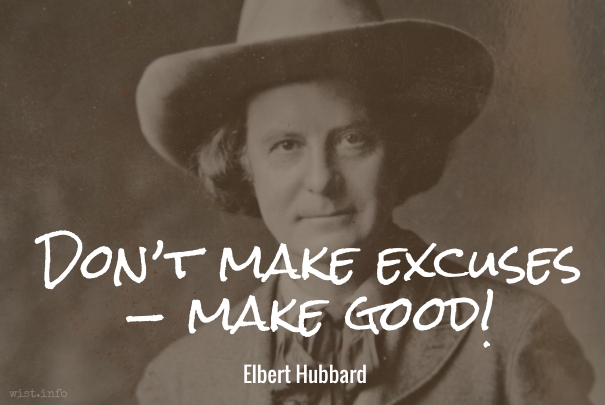
Don’t make excuses — make good!
Elbert Hubbard (1856–1915) American writer, businessman, philosopher
A Thousand and One Epigrams (1911)
Do not keep on with a mockery of friendship after the substance is gone — but part, while you can part friends. Bury the carcass of friendship: it is not worth embalming.

In my heart there may be doubt that I deserve the Nobel award over other men of letters whom I hold in respect and reverence — but there is no question of my pleasure and pride in having it for myself.
John Steinbeck (1902–1968) American writer
Speech (1962-12-10), Nobel Prize acceptance, Stockholm
(Source)

You will always find those who think they know what is your duty better than you know it.
Ralph Waldo Emerson (1803–1882) American essayist, lecturer, poet
Essay (1841), “Self-Reliance,” Essays: First Series, No. 2
(Source)
This essay was inspired by his reading of Walter Savage Landor in 1833, with passages pulled from his lecture "Individualism," last in his course on "The Philosophy of History" (1836–1837), with other passages from the lectures "School," "Genius," and "Duty" in his course on "Human Life" (1838–1839).

In the depth of winter, I finally learned that within me there lay an invincible summer.
Albert Camus (1913–1960) Algerian-French novelist, essayist, playwright
“Return to Tipasa,” Summer (1954)
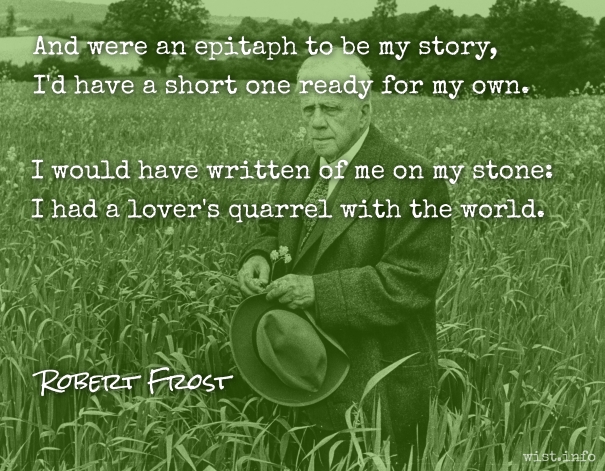
And were an epitaph to be my story,
I’d have a short one ready for my own.
I would have written of me on my stone:
I had a lover’s quarrel with the world.
Robert Frost (1874–1963) American poet
“The Lesson for Today,” A Witness Tree (1942)
Initially read before the Phi Beta Kappa Society, Harvard (20 Jun 1941)
No catalogue of horrors ever kept men from war. Before the war you always think that it’s not you that dies. But you will die, brother, if you go to it long enough.
Ernest Hemingway (1899–1961) American writer
“Notes on the Next War: A Serious Topical Letter,” Esquire (Sep 1935)


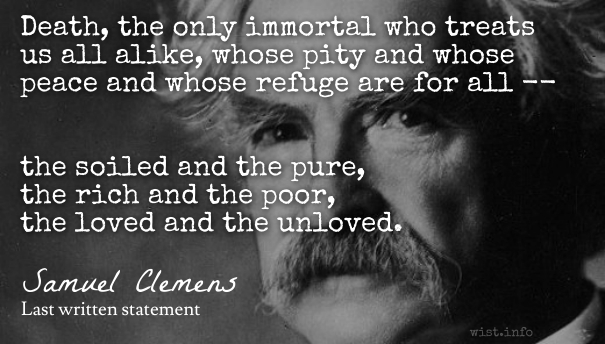
Death, the only immortal who treats us all alike, whose pity and whose peace and whose refuge are for all — the soiled and the pure, the rich and the poor, the loved and the unloved.
Mark Twain (1835–1910) American writer [pseud. of Samuel Clemens]
Last written note
(Source)Recorded by A. Paine (his literary executor), Mark Twain: A Biography, Vol III, Part 2, ch. 293 (1912).
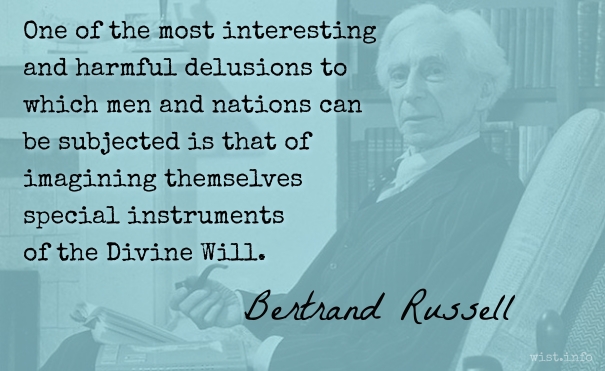
One of the most interesting and harmful delusions to which men and nations can be subjected is that of imagining themselves special instruments of the Divine Will.
Bertrand Russell (1872–1970) English mathematician and philosopher
“Ideas That Have Harmed Mankind,” Unpopular Essays (1950)
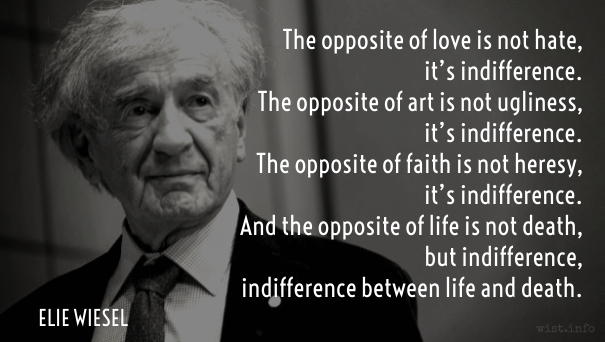
Indifference, to me, is the epitome of evil.
The opposite of love is not hate, it’s indifference.
The opposite of art is not ugliness, it’s indifference.
The opposite of faith is not heresy, it’s indifference.
And the opposite of life is not death, but indifference,
indifference between life and death.
Elie Wiesel (1928–2016) Romanian-American novelist, professor, political activist, Nobel Laureate.
“One Must Not Forget,” interview by Alvin P. Sanoff, US News & World Report (27 Oct 1986)
See also Nietzsche.

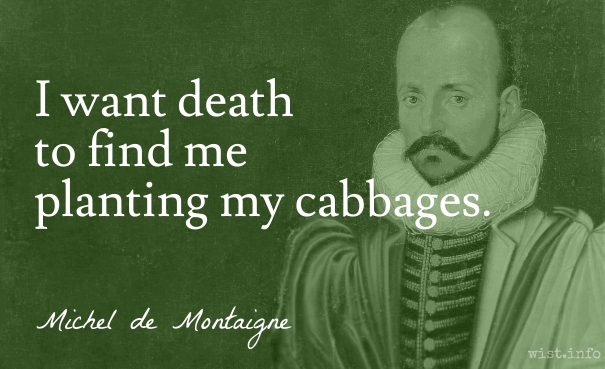
I want a man to act, and to prolong the functions of life as long as he can; and I want death to find me planting my cabbages, but careless of death, and still more of my unfinished garden.
[Je veux qu’on agisse, et qu’on allonge les offices de la vie, tant qu’on peut: et que la mort me trouve plantant mes choux ; mais nonchallant d’elle, et encore plus de mon jardin imparfait.]
Michel de Montaigne (1533–1592) French essayist
Essays, Book 1, ch. 19 (1.19), “That to Philosophize Is to Learn to Die [Que Philosopher, c’est apprendre à mourir]” (1572-03) [tr. Frame (1943)]
(Source)
Published in the 1580 ed.; the second clause (on prolonging the normal activities of life as long as possible) was added in the 1595 ed.
(Source (French)). Other translations:I would have a man to be doing, and to prolong his lives offices, as much as lieth in him, and let death seize upon me, whilst I am setting my cabiges, carelesse of her darte, but more of my unperfect garden.
[tr. Florio (1603)]I would always have a man to be doing, and, as much as in him lies, to extend, and spin out the Offices of life; and then let Death take me planting Cabages, but without any careful thought of him, and much less of my Garden’s not being finished.
[tr. Cotton (1686)]I would always have a man to be doing, and spinning out the offices of life as far as possible; and though death should seize me planting my cabbages, I should not be concerned at it, much less for leaving my garden unfinished.
[tr. Friswell (1868)]I would always have a man to be doing, and, as much as in him lies, to extend and spin out the offices of life; and then let death take me planting my cabbages, indifferent to him, and still less of my gardens not being finished.
[tr. Cotton/Hazlitt (1877)]I desire that a man should act, and prolong the employments of life as long as he can, and that death may find me planting my cabbages, but indifferent regarding it, and even more regarding my unfinished garden.
[tr. Ives (1925)]I want death to find me planting my cabbages, but caring little for it, and even less about the imperfections of my garden.
[tr. Rat (1958)]I want us to be doing things, prolonging life’s duties as much as we can; I want Death to find me planting my cabbages, neither worrying about it nor the unfinished gardening.
[tr. Screech (1987)]I wish for us to be doing, and to carry on with our responsibilities in life while we still can. I want death to find me planting my cabbages, indifferent to it, with my garden still a work in progress.
[tr. HyperEssays (2024)]
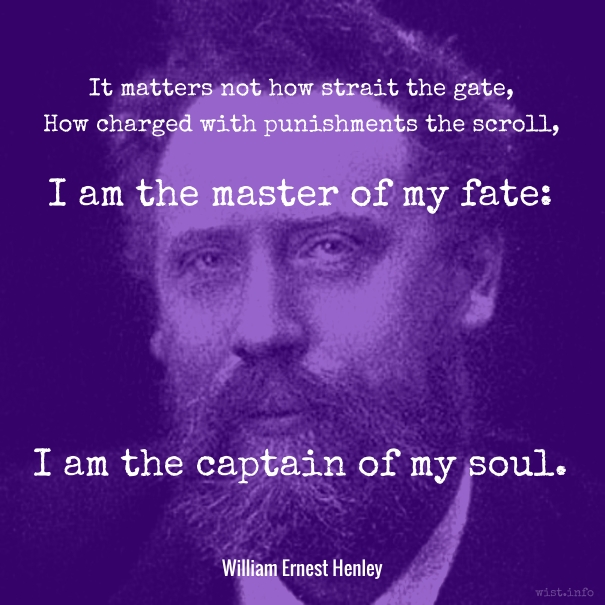
It matters not how strait the gate,
How charged with punishments the scroll,
I am the master of my fate:
I am the captain of my soul.
William Ernest Henley (1849–1903) English poet, critic, editor
“Invictus” (1875)

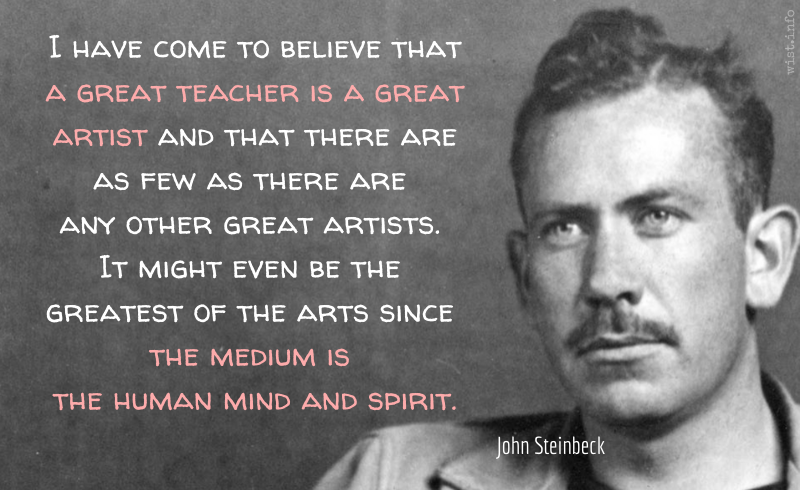
I have come to believe that a great teacher is a great artist and that there are as few as there are any other great artists. It might even be the greatest of the arts since the medium is the human mind and spirit.
John Steinbeck (1902–1968) American writer
“…like captured fireflies” (1955)
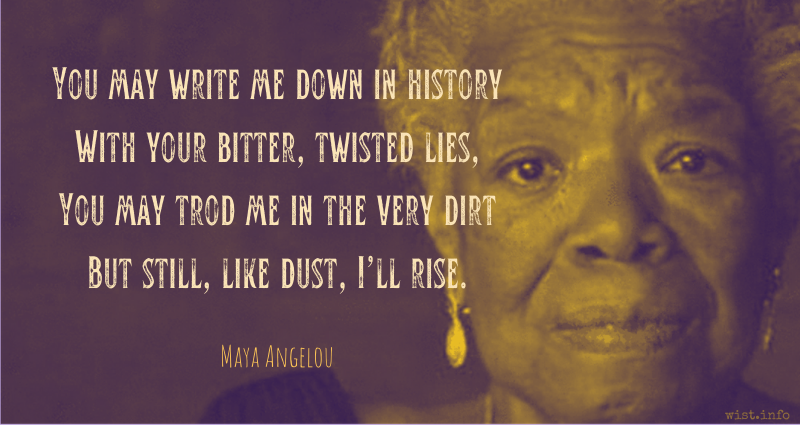
You may write me down in history
With your bitter, twisted lies,
You may trod me in the very dirt
But still, like dust, I’ll rise.
Maya Angelou (1928–2014) American poet, memoirist, activist [b. Marguerite Ann Johnson]
“Still I Rise,” And Still I Rise (1978)
(Source)

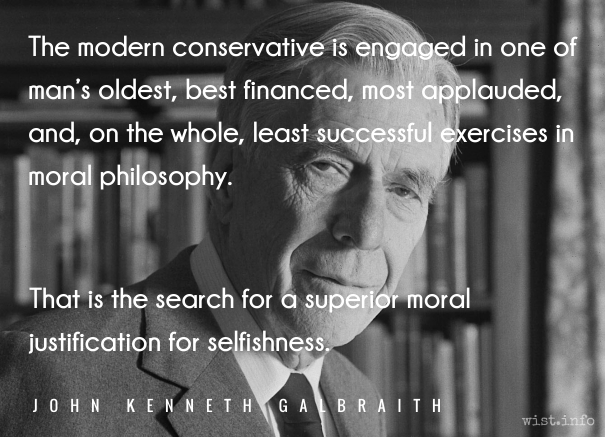
The modern conservative is not even especially modern. He is engaged, on the contrary, in one of man’s oldest, best financed, most applauded, and, on the whole, least successful exercises in moral philosophy. That is the search for a superior moral justification for selfishness. It is an exercise which always involves a certain number of internal contradictions and even a few absurdities. The conspicuously wealthy turn up urging the character-building value of privation for the poor. The man who has struck it rich in minerals, oil, or other bounties of nature is found explaining the debilitating effect of unearned income from the state. The corporate executive who is a superlative success as an organization man weighs in on the evils of bureaucracy. Federal aid to education is feared by those who live in suburbs that could easily forgo this danger, and by people whose children are in public schools. Socialized medicine is condemned by men emerging from Walter Reed Hospital. Social Security is viewed with alarm by those who have the comfortable cushion of an inherited income. Those who are immediately threatened by public efforts to meet their needs — whether widows, small farmers, hospitalized veterans, or the unemployed — are almost always oblivious to the danger.
John Kenneth Galbraith (1908–2006) Canadian-American economist, diplomat, author
Speech (1963-12-13), “Wealth and Poverty,” National Policy Committee on Pockets of Poverty
(Source)
Galbraith used variations on this quote over the years.
- The above quotation was from a speech given, that was then entered into the Congressional Record, Vol. 109, Senate (1963-12-18).
- This material was reworked into an article "Let us begin: An invitation to action on poverty," in Harper's (1964-03), which was in turn again entered into the Congressional Record, Vol. 110 (1964).
- One of the last is most often cited: "The modern conservative is engaged in one of man’s oldest exercises in moral philosophy, that is the search for a superior moral justification for selfishness. It is an exercise which always involves a certain number of internal contradictions and even a few absurdities. The conspicuously wealthy turn up urging the character-building value of privation for the poor." ["Stop the Madness," Interview with Rupert Cornwell, Toronto Globe and Mail (2002-07-06)]
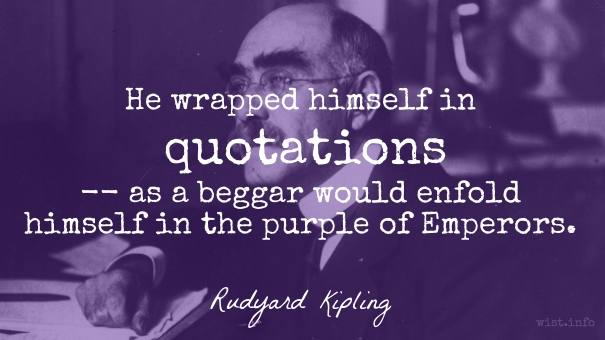
He wrapped himself in quotations — as a beggar would enfold himself in the purple of Emperors.
Rudyard Kipling (1865–1936) English writer
Many Inventions, “The Finest Story in the World” (1893)
(Source)
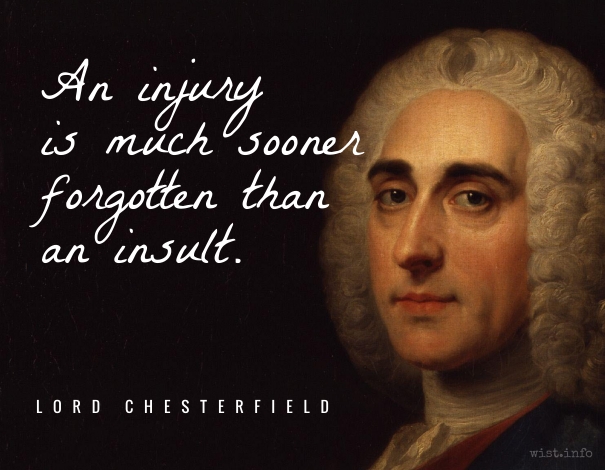
There is nothing that people bear more impatiently, or forgive less, than contempt; and an injury is much sooner forgotten than an insult.
Lord Chesterfield (1694–1773) English statesman, wit [Philip Dormer Stanhope]
Letter to his son, #112 (9 Oct 1746)
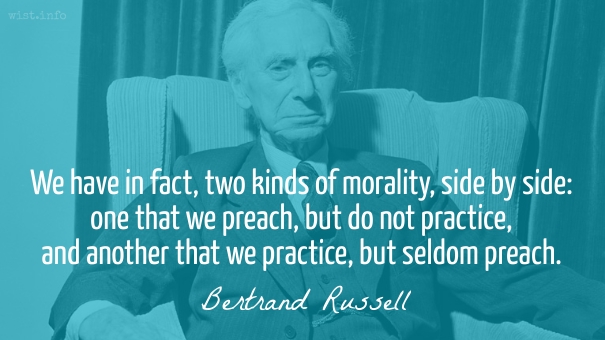
There are large parts of the Christian ethic which are universally admitted to be too good for this wicked world. We have in fact, two kinds of morality, side by side: one that we preach, but do not practice, and another that we practice, but seldom preach.
Bertrand Russell (1872–1970) English mathematician and philosopher
“Eastern and Western Ideals of Happiness,” Sceptical Essays (1928)
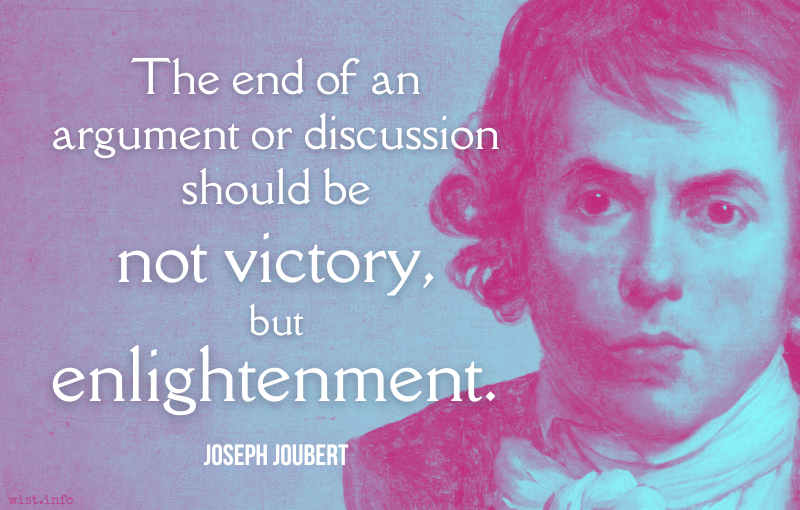
The end of an argument or discussion should be, not victory, but enlightenment.
[Le but de la dispute ou de la discussion ne doit pas être la victoire, mais l’amélioration.]
Joseph Joubert (1754–1824) French moralist, philosopher, essayist, poet
Pensées [Thoughts], “De la Famille et de la Société, etc. [On the Family and Society],” ¶ 41 (1850 ed.) [tr. Collins (1928), ch. 7]
(Source)
(Source (French)). Other translations:The aim of disputation and discussion should not be victory, but improvement.
[tr. Calvert (1866), ch. 8]The aim of argument, or of discussion, should not be victory, but progress.
[tr. Lyttelton (1899), ch. 7, ¶ 31]
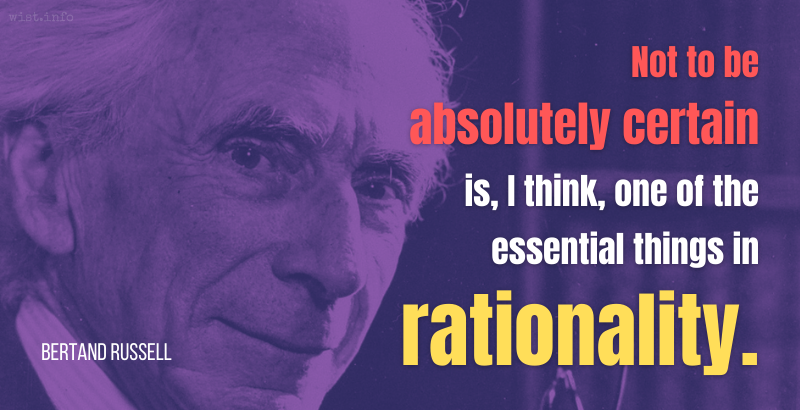
Not to be absolutely certain is, I think, one of the essential things in rationality.
Bertrand Russell (1872–1970) English mathematician and philosopher
“Am I an Atheist or an Agnostic?” sec. “Don’t Be Too Certain!” (1949)
(Source)
Originally given as a speech, "Agnosticism v. Atheism," Rationalist Press Assoc. Annual Dinner, London (1949-05-20), then printed as "Agnosticism v. Atheism," The Literary Guide and Rationalist Review (1949-07), then released as an essay under this title later in 1949.
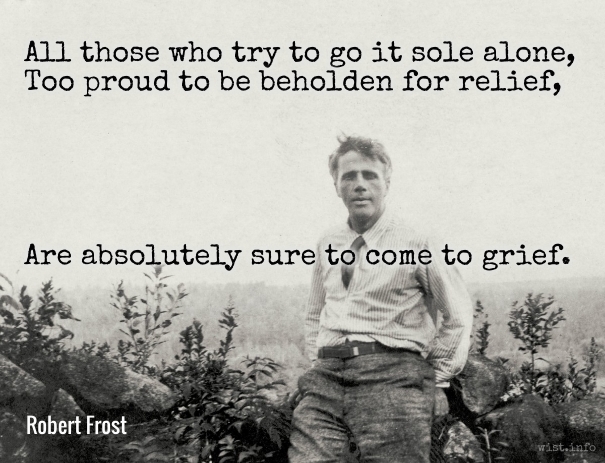
All those who try to go it sole alone,
Too proud to be beholden for relief,
Are absolutely sure to come to grief.
Robert Frost (1874–1963) American poet
“Haec Fabula Docet” (1947)
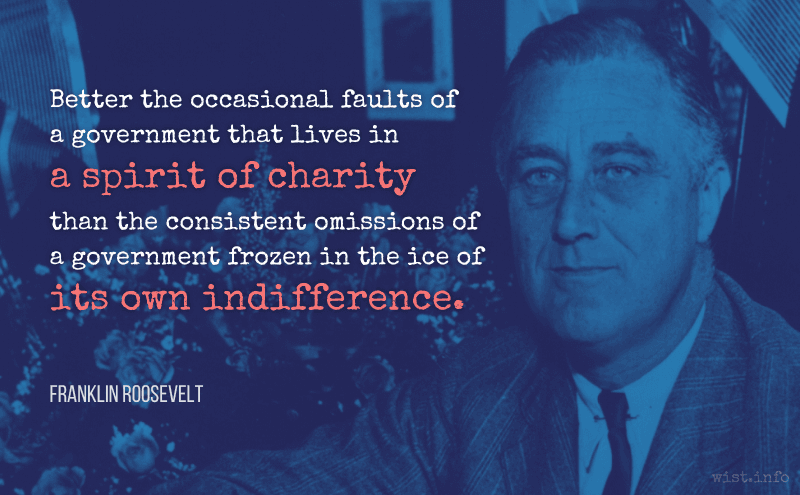
Governments can err, presidents do make mistakes, but the immortal Dante tells us that Divine justice weighs the sins of the cold-blooded and the sins of the warm-hearted on different scales. Better the occasional faults of a government that lives in a spirit of charity than the consistent omissions of a government frozen in the ice of its own indifference.
Franklin Delano Roosevelt (1882–1945) American lawyer, politician, statesman; US President (1933–45)
Speech (1936-06-27), Acceptance, Renomination for President, Democratic National Convention, Philadelphia
(Source)
(Source (Audio), 10:40)
Of all the diversions of life, there is none so proper to fill up its empty spaces as the reading of useful and entertaining authors.
Joseph Addison (1672–1719) English essayist, poet, statesman
Essay (1711-06-18), The Spectator, No. 94
(Source)

Zeus, who guided mortals to be wise,
has established his fixed law —
wisdom comes through suffering.
Trouble, with its memories of pain,
drips in our hearts as we try to sleep,
so men against their will
learn to practice moderation.
Favours come to us from gods
seated on their solemn thrones —
such grace is harsh and violent.τὸν φρονεῖν βροτοὺς ὁδώ-
σαντα, τὸν [πάθει μάθος]
θέντα κυρίως ἔχειν.
στάζει δ’ ἀνθ’ ὕπνου πρὸ καρδίας
μνησιπήμων πόνος· καὶ παρ’ ἄ-
κοντας ἦλθε σωφρονεῖν.
δαιμόνων δέ που χάρις βίαιος
σέλμα σεμνὸν ἡμένων.
Aeschylus (525–456 BC) Greek dramatist (Æschylus)
Agamemnon, ll. 175-183 [tr. Johnston (2007)]
(Source)
Other translations:The first Hamilton alternate was used, slightly modified, by Robert Kennedy in his speech on the assassination of Martin Luther King, Jr. (4 Apr 1968). Kennedy's family used it as an epitaph on his grave Arlington National Cemetery: "Even in our sleep, pain which cannot forget, falls drop by drop upon the heart, until in our own despair, against our will, comes wisdom, through the awful grace of God."
- "It is through suffering that learning comes." [In Arnold Toynbee, "Christianity and Civilization" (1947), Civilization on Trial (1948)]
- "God, whose law it is that he who learns must suffer. And even in our sleep pain that cannot forget, falls drop by drop upon the heart, and in our own despite, against our will, comes wisdom to us by the awful grace of God." [tr. Hamilton (1930)]
- "Guide of mortal man to wisdom, he who has ordained a law, knowledge won through suffering. Drop, drop -- in our sleep, upon the heart sorrow falls, memory’s pain, and to us, though against our very will, even in our own despite, comes wisdom by the awful grace of God." [tr. Hamilton (1937)]
See here for more discussion.

Formerly there were those who said: You believe things that are incomprehensible, inconsistent, impossible because we have commanded you to believe them; go then and do what is unjust because we command it. Such people show admirable reasoning. Truly, whoever is able to make you absurd is able to make you unjust. If the God-given understanding of your mind does not resist a demand to believe what is impossible, then you will not resist a demand to do wrong to that God-given sense of justice in your heart. As soon as one faculty of your soul has been dominated, other faculties will follow as well. And from this derives all those crimes of religion which have overrun the world.
[Il y a eu des gens qui ont dit autrefois: Vous croyez des choses incompréhensibles, contradictoires, impossibles, parce que nous vous l’avons ordonné; faites donc des choses injustes parce que nous vous l’ordonnons. Ces gens-là raisonnaient à merveille. Certainement qui est en droit de vous rendre absurde est en droit de vous rendre injuste. Si vous n’opposez point aux ordres de croire l’impossible l’intelligence que Dieu a mise dans votre esprit, vous ne devez point opposer aux ordres de malfaire la justice que Dieu a mise dans votre coeur. Une faculté de votre âme étant une fois tyrannisée, toutes les autres facultés doivent l’être également. Et c’est là ce qui a produit tous les crimes religieux dont la terre a été inondée.]
Voltaire (1694–1778) French writer [pseud. of Francois-Marie Arouet]
Questions sur les miracles (1765)
(Source)
Commonly translated: "Those who can make you believe absurdities can make you commit atrocities."


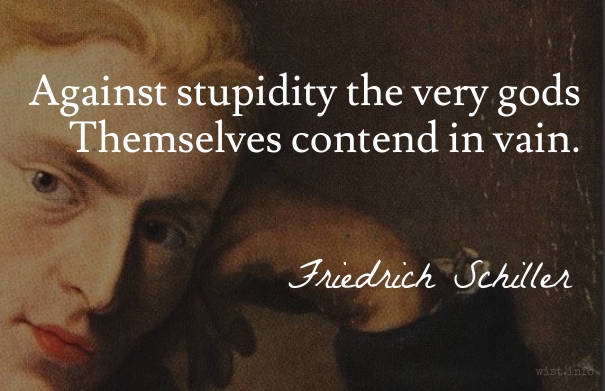
Against stupidity the very gods
Themselves contend in vain.[Mit der Dummheit kämpfen Götter selbst vergebens]
Friedrich Schiller (1759–1805) German poet, playwright, critic [Johann Christoph Friedrich von Schiller]
The Maid of Orleans [Die Jungfrau von Orleans], Act III, sc. vi (1801) [tr. Swanwick]Alt. trans:
- "Against stupidity the gods themselves contend in vain."
- "Against stupidity the gods themselves labor in vain."
- "Against stupidity the gods themselves fight unvictorious."
- "Against stupidity even the gods contend in vain."
- "With stupidity the gods themselves contend in vain."
- "With stupidity the gods themselves struggle in vain."

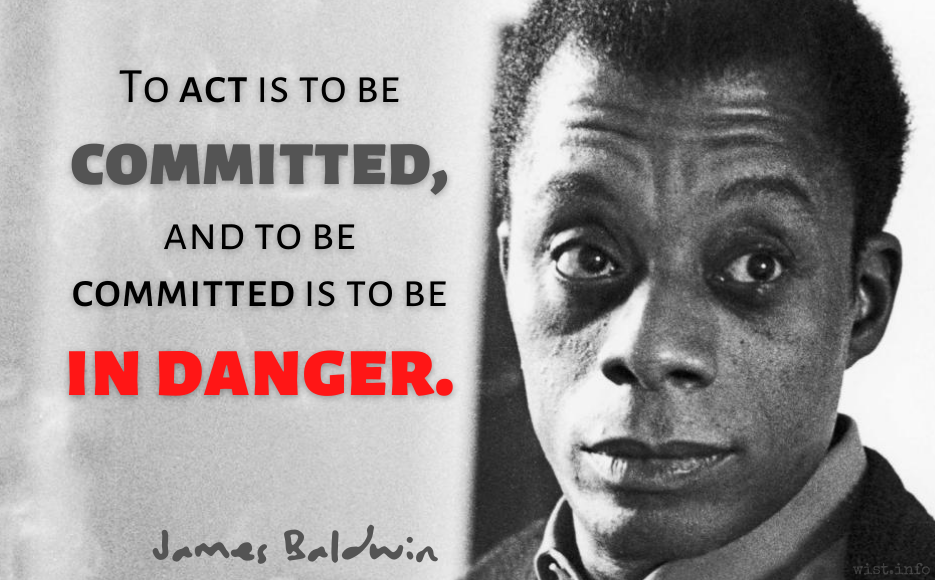
To act is to be committed, and to be committed is to be in danger.
James Baldwin (1924–1987) American novelist, playwright, activist
“My Dungeon Shook,” The Fire Next Time (1963)
(Source)
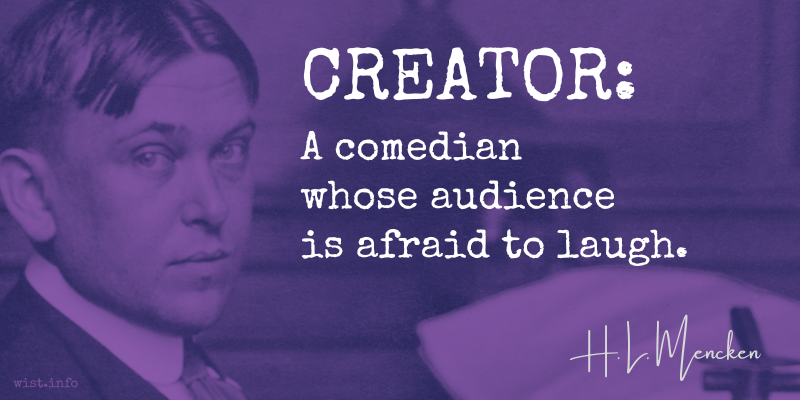
CREATOR. A comedian whose audience is afraid to laugh.
H. L. Mencken (1880–1956) American writer and journalist [Henry Lewis Mencken]
A Book of Burlesques, “The Jazz Webster” (1924)
(Source)
The A Little Book in C Major, ch. 4, § 18 (1916), has an alternate definition. This was expanded in Burlesques to include the above, which then became the sole definition in Chrestomathy, ch. 30 "Sententiae" (1949).
Sometimes misattributed to Voltaire.
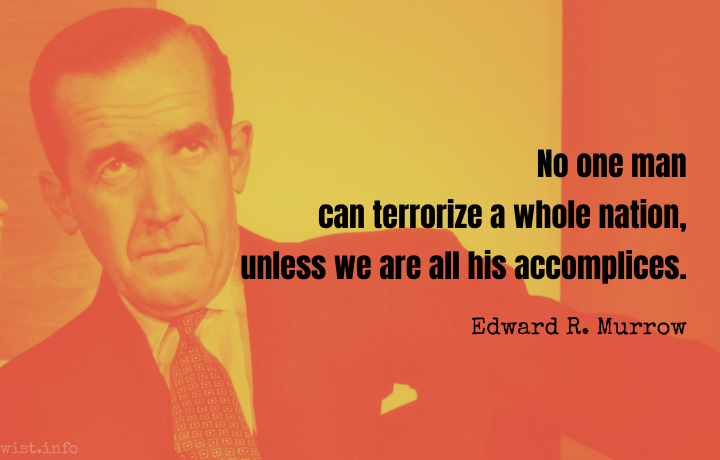
No one man can terrorize a whole nation, unless we are all his accomplices.
Edward R. Murrow (1908–1965) American journalist
See It Now (7 Mar 1954)
(Source)
Comment to the production team before the episode on Senator Joseph R McCarthy’s Communist witch hunt.
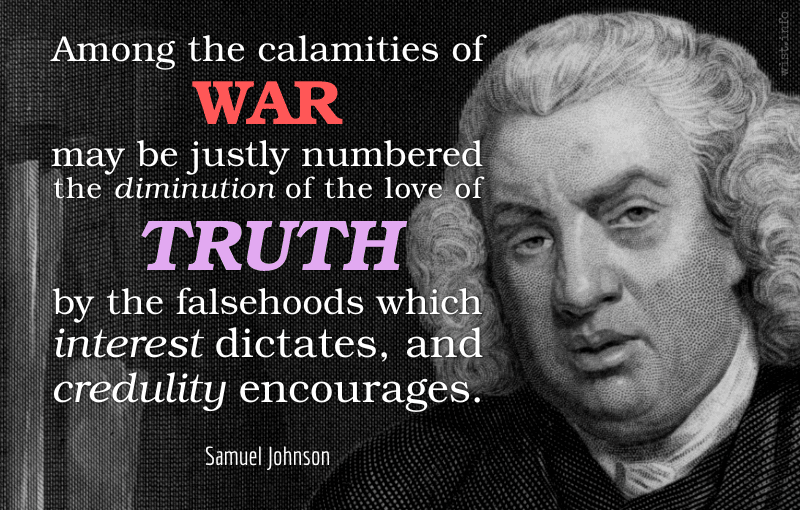
Among the calamities of war, may be justly numbered the diminution of the love of truth, by the falsehoods which interest dictates, and credulity encourages.
Samuel Johnson (1709–1784) English writer, lexicographer, critic
Essay (1758-11-11), The Idler, No. 30
(Source)
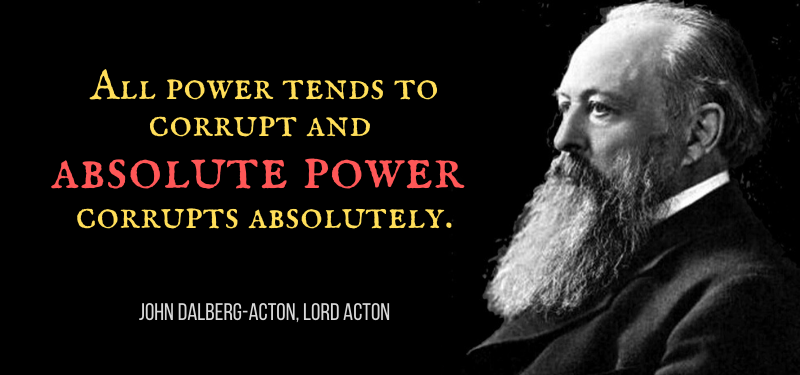
I cannot accept your canon that we are to judge Pope and King unlike other men, with a favourable presumption that they did no wrong. If there is any presumption it is the other way against holders of power, increasing as the power increases. Historic responsibility has to make up for the want of legal responsibility. All power tends to corrupt and absolute power corrupts absolutely. Great men are almost always bad men, even when they exercise influence and not authority: still more when you superadd the tendency or the certainty of corruption by authority. There is no worse heresy than that the office sanctifies the holder of it.
John Dalberg, Lord Acton (1834–1902) British historian, politician, writer
Letter (1887-04-05) to Mandell Creighton
(Source)
Often paraphrased, "Power corrupts, and absolute power corrupts absolutely."
There is an alternate, probably spurious version of this quote, for which I have been unable to find an actual citation (except where it is mis-cited to this letter to Bp. Creighton): "And remember, where you have a concentration of power in a few hands, all too frequently men with the mentality of gangsters get control. History has proven that. All power corrupts; absolute power corrupts absolutely." As the word "gangster" has only been traced back to 1886, and that in the US, its use by Acton (esp. in a modern sense) seems unlikely.
We have always known that heedless self-interest was bad morals; we know now that it is bad economics.
Franklin Delano Roosevelt (1882–1945) American lawyer, politician, statesman; US President (1933–45)
Speech (1937-01-20), Inaugural Address, Washington, D.C.
(Source)
(Source (Audio)). Regarding the Stock Market Crash and ensuing Great Depression.

The prestige of government has undoubtedly been lowered considerably by the prohibition law. For nothing is more destructive of respect for the government and the law of the land than passing laws which cannot be enforced. It is an open secret that the dangerous increase of crime in the United States is closely connected with this.
Albert Einstein (1879–1955) German-American physicist
“My First Impression of the U.S.A.” (1921)
(Source)
Later published as "Some Notes on my American Impressions" in The World As I See It (1949)

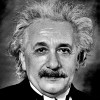
The test of our progress is not whether we add more to the abundance of those who have much; it is whether we provide enough for those who have too little.
The most beautiful thing we can experience is the mysterious. It is the source of all true art and science. He to whom this emotion is a stranger, who can no longer pause to wonder and stand rapt in awe, is as good as dead: his eyes are closed. This insight into the mystery of life, coupled though it may be with fear, has also given rise to religion. To know that what is impenetrable to us really exists, manifesting itself as the highest wisdom and the most radiant beauty which our dull faculties can comprehend only in their most primitive forms — this knowledge, this feeling, is at the center of true religiousness. In this sense, and in this sense only, I belong in the ranks of devoutly religious men.
Albert Einstein (1879–1955) German-American physicist
“What I Believe,” Forum and Century (Oct 1930)
(Source)
Einstein crafted and recrafted his credo multiple times in this period, and specifics are often muddled by differing translations and by his reuse of certain phrases in later writing. The Forum and Century entry appears to be the earliest. Some important variants:The most beautiful experience we can have is the mysterious. It is the fundamental emotion that stands at the cradle of true art and true science. Whoever does not know it and can no longer wonder, no longer marvel, is as good as dead, and his eyes are dimmed. It was the experience of mystery -- even if mixed with fear -- that engendered religion. A knowledge of the existence of something we cannot penetrate, our perceptions of the profoundest reason and the most radiant beauty, which only in their most primitive forms are accessible to our minds: it is this knowledge and this emotion that constitute true religiosity. In this sense, and only this sense, I am a deeply religious man.
— "The World As I See It [Mein Weltbild]" [tr. Bargmann (1954)]The fairest thing we can experience is the mysterious. It is the fundamental emotion which stands at the cradle of true art and true science. He who knows it not and can no longer wonder, no longer feel amazement, is as good as dead, a snuffed-out candle. It was the experience of mystery -- even if mixed with fear -- that engendered religion. A knowledge of the existence of something we cannot penetrate, of the manifestations of the profoundest reason and the most radiant beauty, which are only accessible to our reason in their most elementary forms -- it is this knowledge and this emotion that constitute the truly religious attitude; in this sense, and in this alone, I am a deeply religious man.
— "The World As I See It [Mein Weltbild]" [tr. Harris (1934)]The most beautiful and deepest experience a man can have is the sense of the mysterious. It is the underlying principle of religion as well as all serious endeavor in art and science. He who never had this experience seems to me, if not dead, then at least blind. To sense that behind anything that can be experienced there is a something that our mind cannot grasp and whose beauty and sublimity reaches us only indirectly and as a feeble reflection, this is religiousness. In this sense I am religious.
[Das Schönste und Tiefste, was der Mensch erleben kann, ist das Gefühl des Geheimnisvollen. Es liegt der Religion sowie allem tieferen Streben in Kunst und Wissenschaft zugrunde. Wer dies nicht erlebt hat, erscheint mir, wenn nicht wie ein Toter, so doch wie ein Blinder. Zu empfinden, dass hinter dem Erlebbaren ein für unseren Geist Unerreichbares verborgen sei, dessen Schönheit und Erhabenheit uns nur mittelbar und in schwachem Widerschein erreicht, das ist Religiosität. In diesem Sinne bin ich religiös.]
— Variant in "My Credo [Mein Glaubensbekenntnis]" (Aug 1932)
See parallel sentiments here, here, and here.

Many forms of Government have been tried, and will be tried in this world of sin and woe. No one pretends that democracy is perfect or all-wise. Indeed, it has been said that democracy is the worst form of Government except all those other forms that have been tried from time to time.
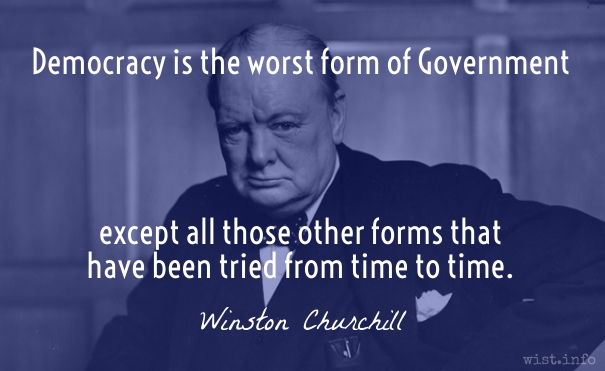
I confess I am a little cynical on some topics, and when a whole nation is roaring Patriotism at the top of its voice, I am fain to explore the cleanness of its hands and purity of its heart.
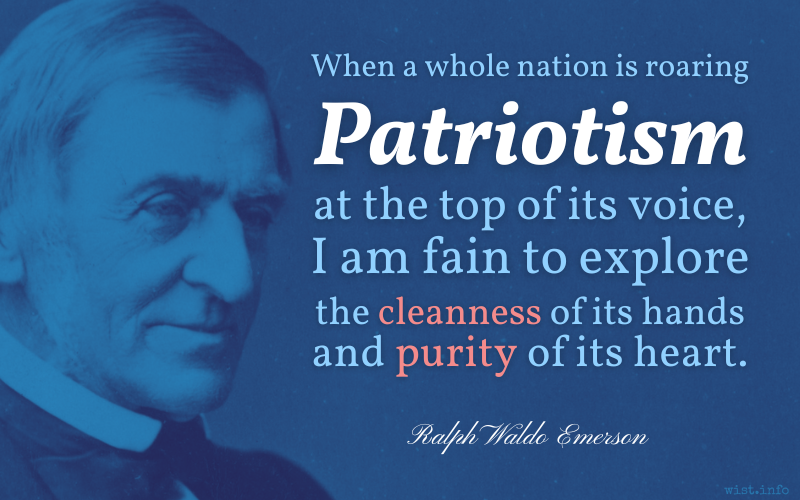
I love deadlines. I love the whooshing noise they make as they go by.
Douglas Adams (1952–2001) English author, humorist, screenwriter
Attributed in Richard Dawkins, “A Lament for Douglas Adams,” The Guardian (2001-05-13)
(Source)
Memorial to his friend, Adams; later collected in The Salmon of Doubt, Part 4 "Epilogue" (2002) [ed. Peter Guzzardi]. Many variants exist, e.g., "What I love the most about deadlines is the whooshing sound they make as they go by."

The punishment which the wise suffer who refuse to take part in the government is to live under the government of worse men.
Plato (c.428–347 BC) Greek philosopher
Republic, Book 1, 347c
(Source)
Translation as paraphrased by Ralph Waldo Emerson in his essay (1870) "Eloquence," Society and Solitude, ch. 4.
Other translations:More discussion here.
- "One of the penalties for refusing to participate in politics, is that you end up being governed by your inferiors."
- The Constitution Party (1952-68) used on their letterhead the variant, "The penalty good men pay for indifference to public affairs is to be ruled by evil men."
- "The price of apathy is to be ruled by evil men."
- "Those who are too smart to engage in politics are punished by being governed by those who are dumber."
In context (Plato in Twelve Volumes, Vols. 5 & 6 [tr. Shorey (1969)]):[346e] "Then, Thrasymachus, is not this immediately apparent, that no art or office provides what is beneficial for itself -- but as we said long ago it provides and enjoins what is beneficial to its subject, considering the advantage of that, the weaker, and not the advantage the stronger? That was why, friend Thrasymachus, I was just now saying that no one of his own will chooses to hold rule and office and take other people's troubles in hand to straighten them out, but everybody expects pay for that, [347a] because he who is to exercise the art rightly never does what is best for himself or enjoins it when he gives commands according to the art, but what is best for the subject. That is the reason, it seems, why pay must be provided for those who are to consent to rule, either in form of money or honor or a penalty if they refuse."
"What do you mean by that, Socrates?" said Glaucon. "The two wages I recognize, but the penalty you speak of and described as a form of wage I don't understand."
"Then," said I, "you don't understand the wages of the best men [347b] for the sake of which the finest spirits hold office and rule when they consent to do so. Don't you know that to be covetous of honor and covetous of money is said to be and is a reproach?" "I do," he said. "Well, then," said I, "that is why the good are not willing to rule either for the sake of money or of honor. They do not wish to collect pay openly for their service of rule and be styled hirelings nor to take it by stealth from their office and be called thieves, nor yet for the sake of honor, [347c] for they are not covetous of honor. So there must be imposed some compulsion and penalty to constrain them to rule if they are to consent to hold office. That is perhaps why to seek office oneself and not await compulsion is thought disgraceful. But the chief penalty is to be governed by someone worse if a man will not himself hold office and rule. It is from fear of this, as it appears to me, that the better sort hold office when they do, and then they go to it not in the expectation of enjoyment nor as to a good thing, but as to a necessary evil and because they are unable to turn it over to better men than themselves [347d] or to their like. For we may venture to say that, if there should be a city of good men only, immunity from office-holding would be as eagerly contended for as office is now, and there it would be made plain that in very truth the true ruler does not naturally seek his own advantage but that of the ruled; so that every man of understanding would rather choose to be benefited by another than to be bothered with benefiting him."
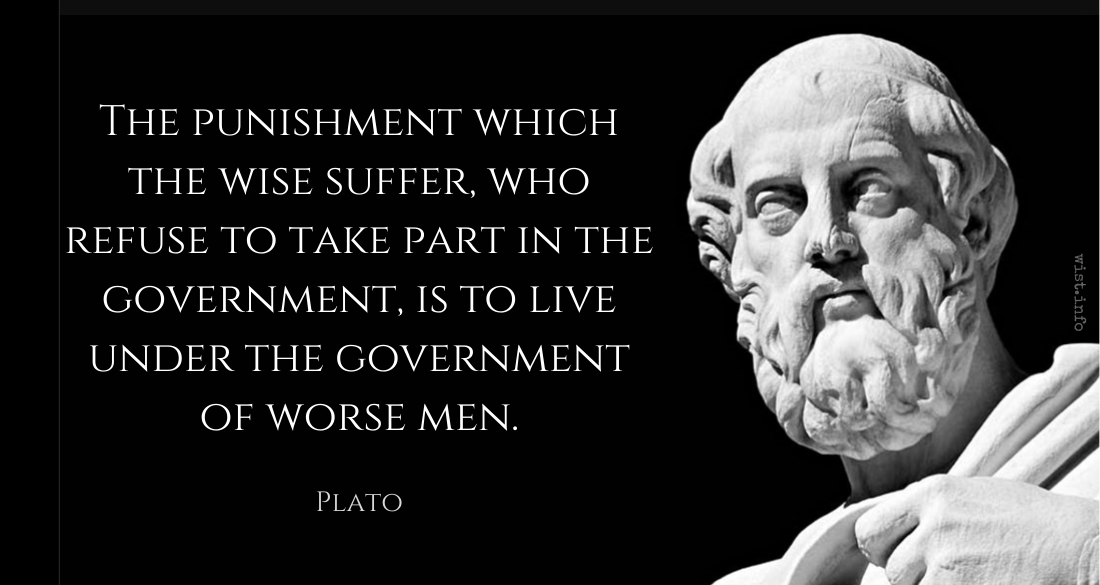
Injustice anywhere is a threat to justice everywhere. We are caught in an inescapable network of mutuality, tied in a single garment of destiny. Whatever affects one directly, affects all indirectly.
Martin Luther King, Jr. (1929–1968) American clergyman, civil rights leader, social activist, preacher
Letter from Birmingham Jail (16 Apr 1963)
(Source)
Another phrase King used on repeated occasions, e.g., "Injustice anywhere is a threat to justice everywhere. Therefore, no American can afford to be apathetic about the problem of racial justice. It is a problem that meets every man at his front door" -- "The Rising Tide of Racial Consciousness," Speech, National Urban League, New York (6 Sep 1960).

The substitution of force for persuasion, among its other disadvantages, has this further drawback, from our present point of view, that it lessens the conscience of a society and breeds hypocrisy. You have not converted a man, because you have silenced him.
John Morley (1838–1923) English statesman, journalist, writer [John, Viscount Morley]
On Compromise, ch. 5 “Realization of Opinion” (1874)
(Source)
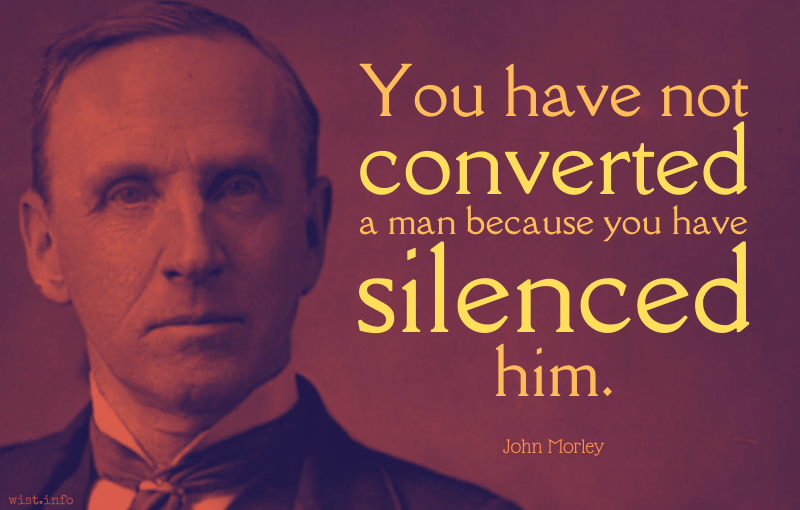
You do not examine legislation in the light of the benefits it will convey if properly administered, but in the light of the wrongs it would do and the harms it would cause if improperly administered.
Lyndon B. Johnson (1908–1973) American politician, educator, US President (1963–69)
(Attributed)
Widely attributed to Johnson, and in keeping with his reputation as a wily legislator, but no actual source found.
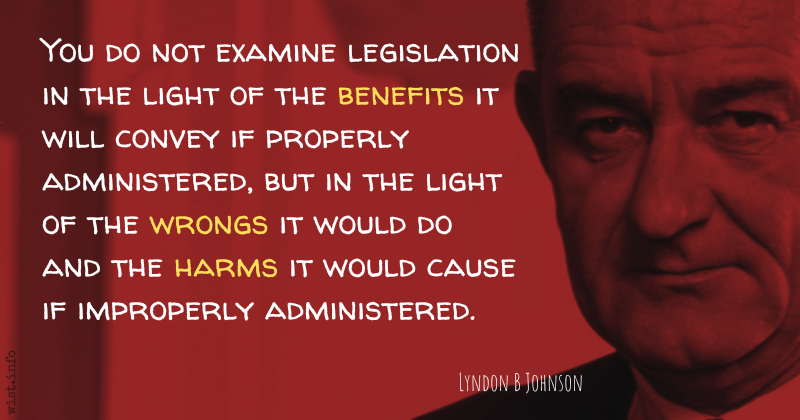
Flattery is counterfeit money which, but for vanity, would have no circulation.
[La flatterie est une fausse monnaie qui n’a de cours que par notre vanité]
François VI, duc de La Rochefoucauld (1613–1680) French epigrammatist, memoirist, noble
Réflexions ou sentences et maximes morales [Reflections; or Sentences and Moral Maxims], ¶158 (1665-1678) [tr. Kronenberger (1959)]
(Source)
First present in the 5th ed. (1678).
(Source (French)). Other translations:Flattery is like false Money, and if it were not for our own Vanity could never pass in Payment.
[tr. Stanhope (1694), Book 2, ¶104; Stanhope (1706 ed.), ¶517]Flattery is a sort of bad money, to which our vanity gives currency.
[pub. Donaldson (1783), ¶145; ed. Lepoittevin-Lacroix (1797), ¶152]Flattery may be considered as a sort of bad money, to which our vanity gives currency.
[ed. Carvill (1835), ¶128]Flattery is a false coin, which only derives its currency from our vanity.
[ed. Gowens (1851), ¶270]Flattery is base coin to which only our vanity gives currency.
[tr. Bund/Friswell (1871), ¶158]Flattery is a counterfeit coinage, current only because our vanity accepts it.
[tr. Heard (1917), ¶266]Flattery is a counterfeit coinage to which our vanity alone gives currency.
[tr. Stevens (1939), ¶158; tr. FitzGibbon (1957), ¶158]Flattery is a spurious coinage only made current by our vanity.
[tr. Tancock (1959), ¶158]Flattery is a kind of counterfeit currency, which is put in circulation only by our vanity.
[tr. Whichello (2016) ¶158]
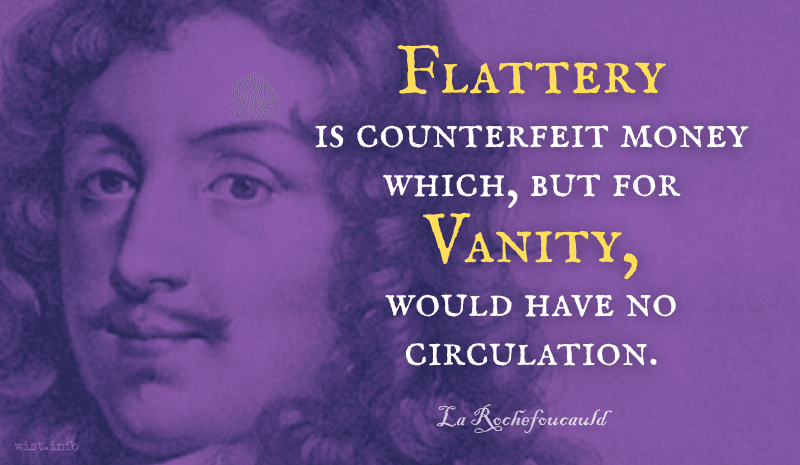

Without deviation from the norm, progress is not possible.
Frank Zappa (1940–1993) American singer-songwriter
A Day with Frank Zappa, Part 5, documentary, dir. Roelof Kiers, VPRO-TV (1971-02-11)
Widely attributed to Zappa in various forms, but with very few actual citations.
The Kiers documentary gave the quotation twice. First (Source, Video):Well I think that progress is not possible without deviation. And I think that it's important that people be aware of some of the creative ways in which some of their fellow men are deviating from the norm, because in some instances they might find these deviations inspiring and might suggest further deviations which might cause progress, you never know.
Second (Source, Video):KIERS: What kind of influence did the Mothers [of Invention] have, you think?
ZAPPA: Well, we had some, but not very much, because of the size of our audience was so small.
KIERS: But, what kind of influence?
ZAPPA: Well, I think we perhaps inspired some of the people who liked what we do to get a little bit looser and a little bit more devious, and as I said before about progress not being possible without some sort of deviation. We need a few deviants.
A variant of this quote shows up in a photo essay titled "A Quarter Century of Gay Life in New York," New York Magazine (1994-06-20). It is attributed to Zappa (who had died the previous December), and is dated (without citation) to 1966:My attitude toward anybody's sexual persuasion is this: without deviation from the norm, progress is not possible.
The quotation also shows up in Leigh Rutledge, The Gay Book of Lists (1987) and his Unnatural Quotations (1988).
Rosemary Silva's Lesbian Quotations (1993) mentions this latter Rudtledge book as a citation, but gives a date on the quote as 1980.
I have not been able to find an earlier source of this variant.
Another use by Zappa can be found in his autobiography, The Real Frank Zappa Book, ch. 8 "All About Music" [with Peter Occhiogrosso] (1989):One of the things I've said before in interviews is: "Without deviation (from the norm), 'progress' is not possible."
In order for one to deviate successfully, one has to have at least a passing acquaintance with whatever norm one expects to deviate from.
The section this text begins is titled "Deviation from the Norm" -- Zappa is speaking here about music, "radio music norms," and enjoying "nuking those norms" when prepping touring arrangements. (He also gives a lengthy critique of the classical / symphonic music realm and their rigid adherence to their norms).
See also Shaw (1903).

Be at War with your Vices, at Peace with your Neighbours, and let every New-Year find you a better Man.
Benjamin Franklin (1706–1790) American statesman, scientist, philosopher, aphorist
Poor Richard’s Almanack (1755)
More information on this quotation here.
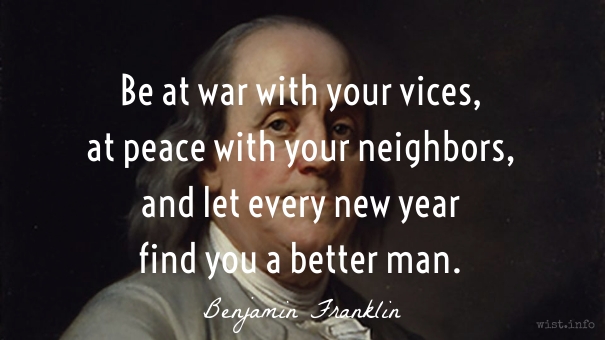
The President is merely the most important among a large number of public servants. He should be supported or opposed exactly to the degree which is warranted by his good conduct or bad conduct, his efficiency or inefficiency in rendering loyal, able, and disinterested service to the nation as a whole. Therefore it is absolutely necessary that there should be full liberty to tell the truth about his acts, and this means that it is exactly as necessary to blame him when he does wrong as to praise him when he does right. Any other attitude in an American citizen is both base and servile. To announce that there must be no criticism of the President, or that we are to stand by the President, right or wrong, is not only unpatriotic and servile, but is morally treasonable to the American public. Nothing but the truth should be spoken about him or any one else. But it is even more important to tell the truth, pleasant or unpleasant, about him than about any one else.
Theodore Roosevelt (1858–1919) American politician, statesman, conservationist, writer; US President (1901–09)
Essay (1918-05-07), “Sedition, A Free Press, and Personal Rule,” Kansas City Star
(Source)
This passage was added to later editions of his essay, "Lincoln and Free Speech,", as printed in The Works of Theodore Roosevelt, vol. 21, The Great Adventure, ch. 7 (1925). It does not appear in the original version of the essay or book.
See also Roosevelt and Roosevelt.
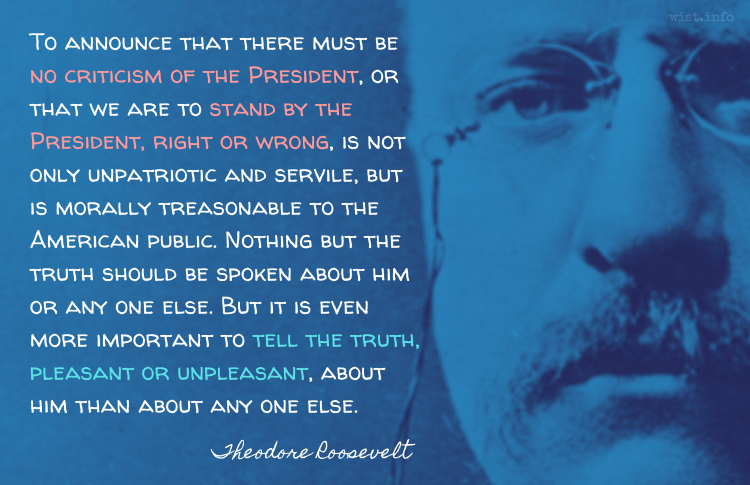
The good neighbor looks beyond the external accidents, and discerns those inner qualities that make all men human and, therefore, brothers.
Martin Luther King, Jr. (1929–1968) American clergyman, civil rights leader, social activist, preacher
“On Being a Good Neighbor,” sec. 1, sermon, A Gift of Love (1963)
(Source)
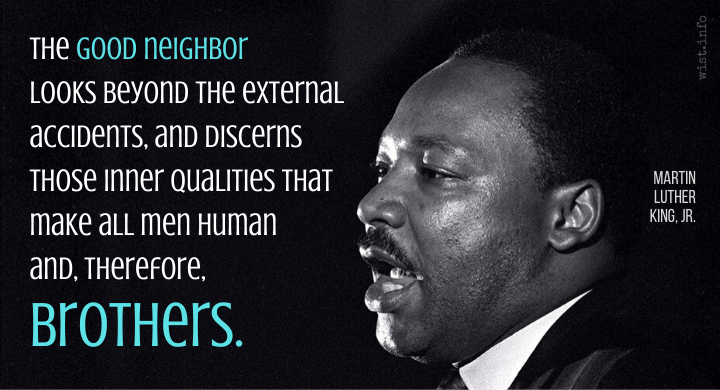
Travel is fatal to prejudice, bigotry, and narrow-mindedness, and many of our people need it sorely on these accounts. Broad, wholesome, charitable views of men and things can not be acquired by vegetating in one little corner of the earth all one’s lifetime.
Mark Twain (1835–1910) American writer [pseud. of Samuel Clemens]
The Innocents Abroad, “Conclusion” (1869)
(Source)
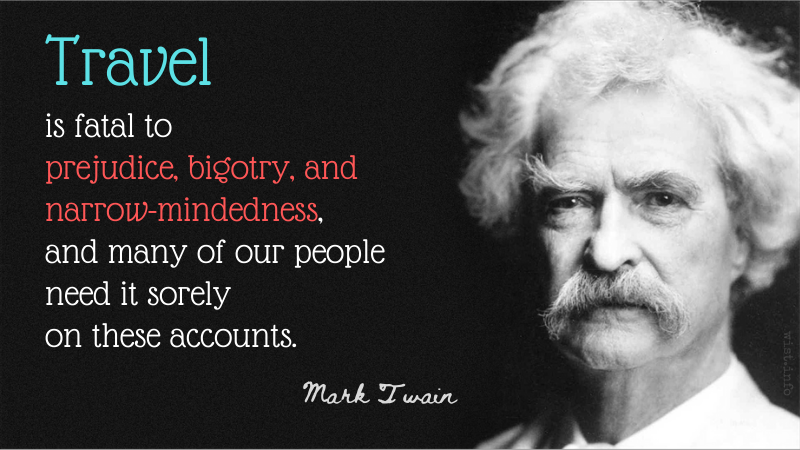
He, who will not reason, is a bigot; he, who cannot, is a fool; and he, who dares not, is a slave.
William Drummond of Logie-Almond (1770–1828) Scottish classical scholar, philosopher, diplomat, politician
Academical Questions, Preface (1805)
(Source)
Sometimes misattributed to Byron.


Explanations exist; they have existed for all time; there is always a well-known solution to every human problem — neat, plausible, and wrong.
H. L. Mencken (1880–1956) American writer and journalist [Henry Lewis Mencken]
“The Divine Afflatus,” New York Evening Mail (16 Nov 1917)
(Source)
Reprinted in Prejudices: Second Series (1920) and A Mencken Chrestomathy, ch. 25 (1949).
Variants:
- "There is always an easy solution to every human problem -- neat, plausible, and wrong."
- "For every complex problem, there is a solution that is simple, neat, and wrong."
There is nowhere you can go and only be with people who are like you. Give it up.
Bernice Johnson Reagon (b. 1942) American song leader, composer, scholar, social activist
“Coalition Politics: Turning the Century,” presentation, West Coast Women’s Music Festival, Yosemite (1981)
(Source)
Money, it turned out, was exactly like sex, you thought of nothing else if you didn’t have it and thought of other things if you did.
Children have never been very good at listening to their elders, but they have never failed to imitate them.
May the forces of evil become confused on the way to your house.
George Carlin (1937–2008) American comedian
Show (1986-05-02), “Hello-Goodbye,” Playin’ With Your Head, Beverly Theatre, Los Angeles (HBO)
Explained in the routine as part of a series of rotating "good-bye" phrases he uses.
(Source (Video)). Routine collected in Napalm & Silly Putty (2001).

No one wants advice — only corroboration.
John Steinbeck (1902–1968) American writer
The Winter of Our Discontent, Part I, ch. 6 (1961)
(Source)

Let me never fall into the vulgar mistake of dreaming that I am persecuted whenever I am contradicted.
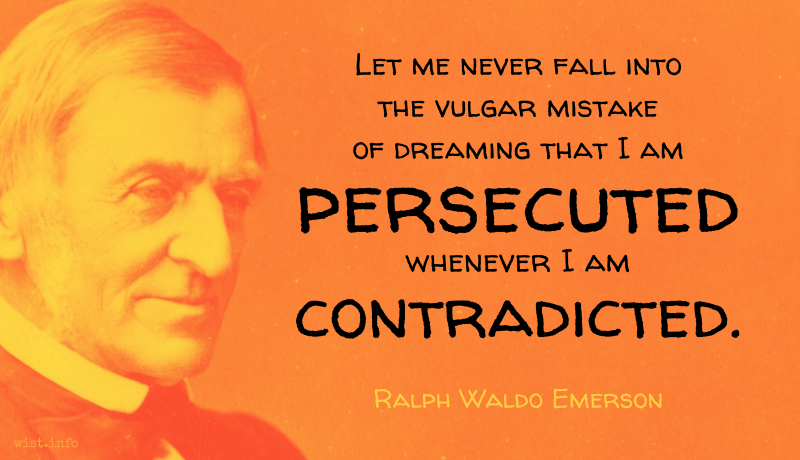
Every man takes the limits of his own field of vision for the limits of the world.
[Jeder hält das Ende seines Gesichtskreises für das der Welt.]
Arthur Schopenhauer (1788–1860) German philosopher
Parerga and Paralipomena, Vol. 2, ch. 26 “Psychological Observations [Psychologische Bemerkungen],” § 338 (1851) [tr. Saunders (1890)]
(Source)
(Source (German)). Another translation:Everyone regards the limits of his field of vision as those of the world.
[tr. Payne (1974)]
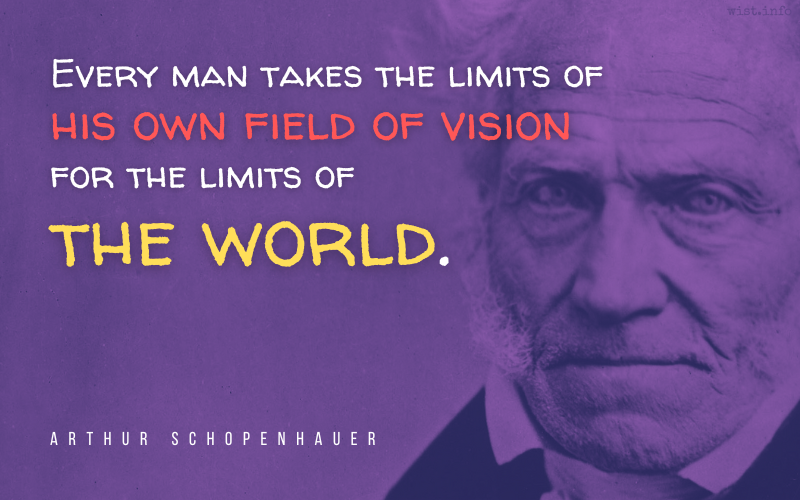

There is no cure for birth and death save to enjoy the interval.
George Santayana (1863–1952) Spanish-American poet and philosopher [Jorge Agustín Nicolás Ruíz de Santayana y Borrás]
Essay (1916 ca.), “War Shrines,” Soliloquies in England, ch. 24 (1922)
(Source)

We trained hard, but it seemed that every time we were beginning to form up into teams we would be reorganized. Presumably the plans for our employment were being changed. I was to learn later in life that, perhaps because we are so good at organizing, we tend as a nation to meet any new situation by reorganizing; and a wonderful method it can be for creating the illusion of progress while producing confusion, inefficiency and demoralization.
Charlton Ogburn, Jr. (1911–1998) American journalist, author
“Merrill’s Marauders: The truth about an incredible adventure,” Harper’s Magazine (Jan 1957)
In his 1959 book, The Marauders, Ogburn rephrased this as: "As a result, I suppose, of high-level changes of mind about how we were to be used, we went through several reorganizations. Perhaps because Americans as a nation have a gift for organizing, we tend to meet any new situation by reorganization, and a wonderful method it is for creating the illusion of progress at a mere cost of confusion, inefficiency and demoralization."
Sometimes incorrectly cited to Gaius Petronius Arbiter. For more on this quotation, see here.
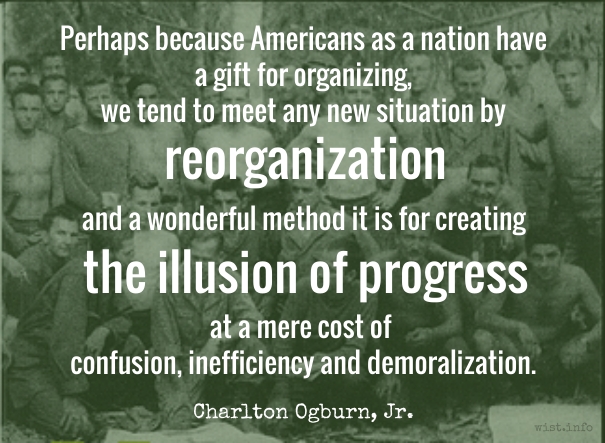
The art of progress is to preserve order amid change, and to preserve change amid order.
Alfred North Whitehead (1861–1947) English mathematician and philosopher
Process and Reality: An Essay in Cosmology (1929)
(Source)
Based on his Gifford Lectures, University of Edinburgh (1927-28), on process philosophy.
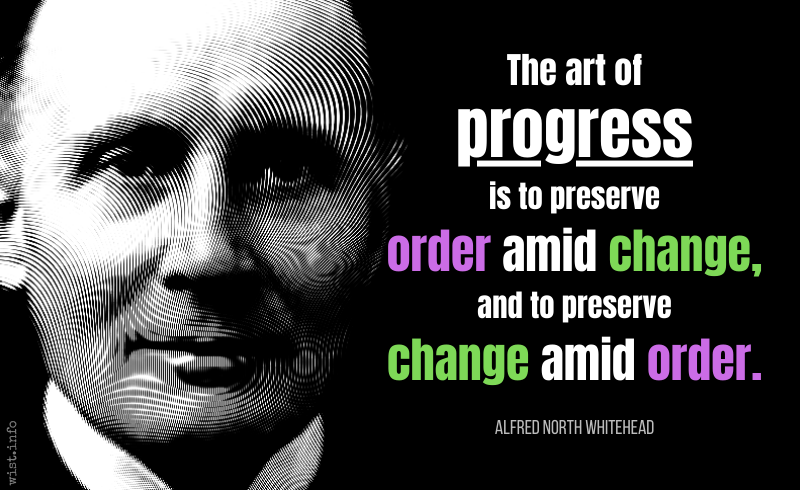
In literature, as in love, we are astonished at what is chosen by others.
[En littérature comme en amour, on est surpris par les choix des autres.]
André Maurois (1885–1967) French author [b. Émile Salomon Wilhelm Herzog]
The Art of Living [Un Art de Vivre], ch. 6 “The Art of Working” (1939) [tr. Whitall (1940)]
(Source)
(Source (French)). Sometimes cited to the New York Times, but only because it was reprinted there in the article “Reading Matter: Some Bookish Quotes” (1963-04-14).
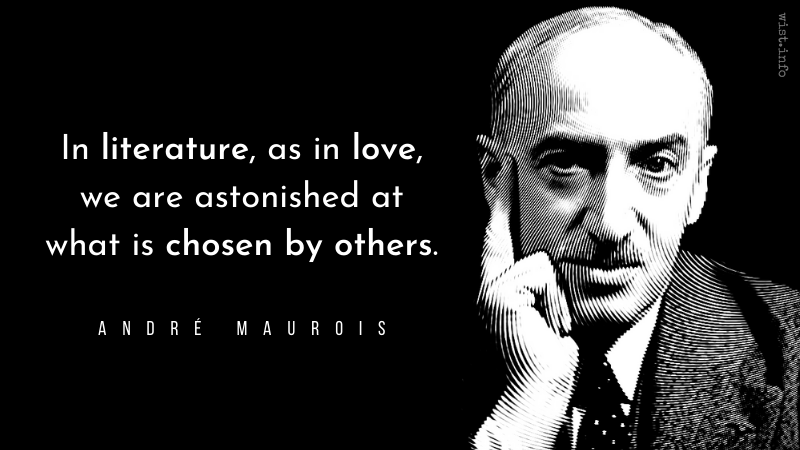
One of the advantages of being disorderly is that one is constantly making exciting discoveries.
A. A. Milne (1882–1956) English poet and playwright [Alan Alexander Milne]
Year In, Year Out, “July” (1952)
(Source)

ALBANY: Wisdom and goodness to the vile seem vile.
Filths savor but themselves.
William Shakespeare (1564–1616) English dramatist and poet
King Lear, Act 4, sc. 2, l. 47ff (4.2.47-48) (1606)
(Source)
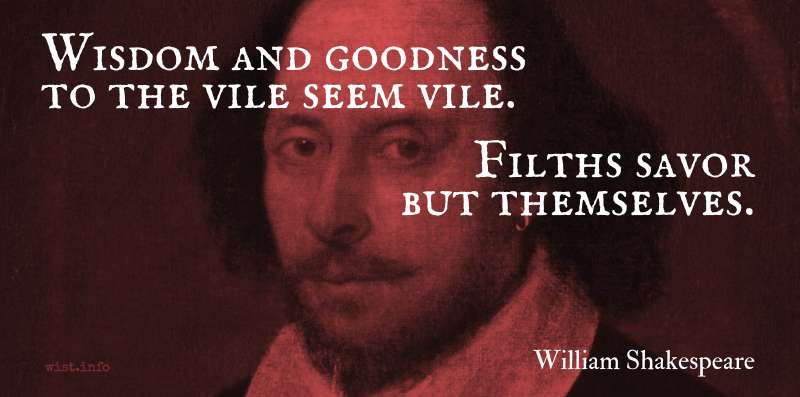
No man, for any considerable period, can wear one face to himself, and another to the multitude, without finally getting bewildered as to which may be the true.
Nathaniel Hawthorne (1804–1864) American writer
The Scarlet Letter, ch. 20 “The Minister in a Maze” (1850)
(Source)
See La Rochefoucauld.

Never open the door to a lesser evil, for other and greater ones invariably slink in after it.
[Nunca se le ha de abrir la puerta al menor mal, que siempre vendrán tras él otros muchos, y mayores, en celada.]
Baltasar Gracián y Morales (1601–1658) Spanish Jesuit priest, writer, philosopher
The Art of Worldly Wisdom [Oráculo Manual y Arte de Prudencia], § 31 (1647) [tr. Jacobs (1892)]
(Source)
(Source (Spanish)). Other translations:We must not open the door to the least evil, for others, and those greater too, which lie in ambush come always after.
[Flesher ed. (1685)]Never open the door to an evil, however small, for other and greater ones will creep in after it from their ambush.
[tr. Duff (1877)]Never open the door to a small misfortune, for many more always creep in behind it, and greater ones, under its protection.
[tr. Fischer (1937)]Never open the door to the least of evils, for many other, greater ones lurk outside.
[tr. Maurer (1992)]
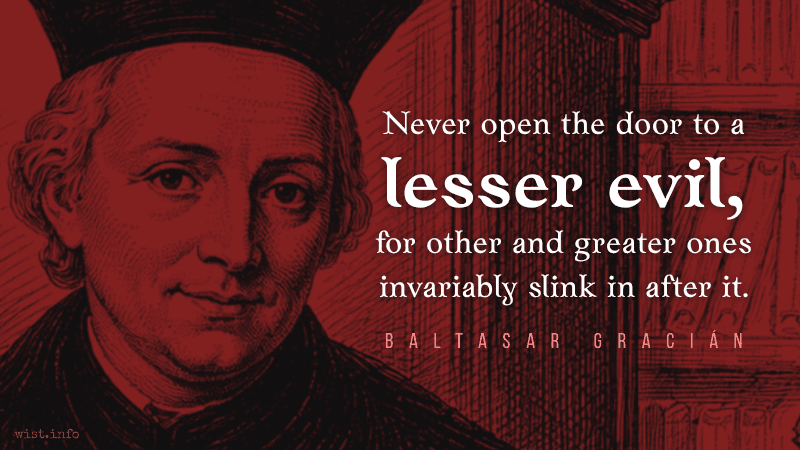

Only those who will risk going too far can possibly find out how far one can go.
T. S. Eliot (1888–1965) American-British poet, critic, playwright [Thomas Stearns Eliot]
Preface to Transit of Venus: Poems by Harry Crosby (1931)
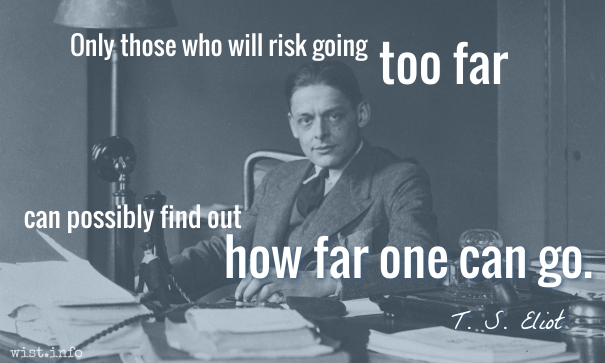
The spirit of liberty is the spirit which is not too sure that it is right; the spirit of liberty is the spirit which seeks to understand the mind of other men and women; the spirit of liberty is the spirit which weighs their interests alongside its own without bias; the spirit of liberty remembers that not even a sparrow falls to earth unheeded; the spirit of liberty is the spirit of Him who, near two thousand years ago, taught mankind that lesson it has never learned but never quite forgotten; that there may be a kingdom where the least shall be heard and considered side by side with the greatest.
Learned Hand (1872–1961) American jurist
“The Spirit of Liberty,” speech, “I Am an American Day,” New York (1941-05-21)
(Source)
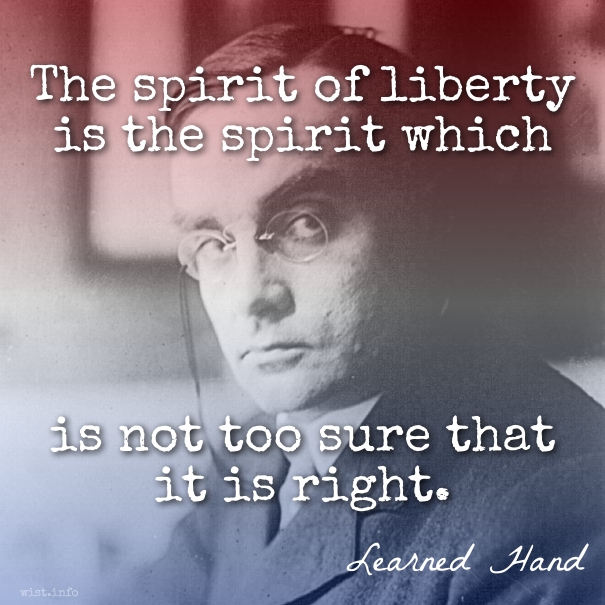
All change is not growth; all movement is not forward.
Ellen Glasgow (1874–1945) American author
In Clifton Fadiman, I Believe: The Personal Philosophies of Certain Eminent Men and Women of Our Time (1939 ed.)
(Source)
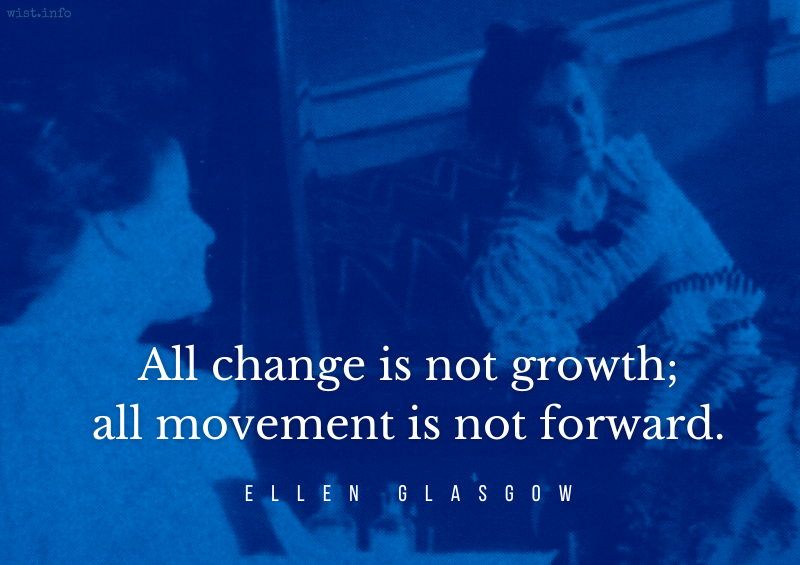
One half of the world cannot understand the pleasures of the other.
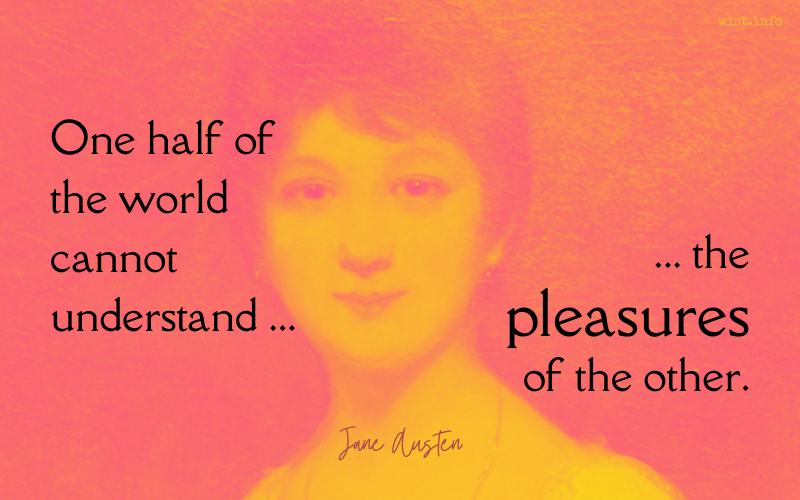

I love America more than any other country in the world and, exactly for this reason, I insist on the right to criticize her perpetually.
James Baldwin (1924–1987) American novelist, playwright, activist
Notes of a Native Son, “Autobiographical Notes” (1955)
(Source)

Wherever they burn books they will also, in the end, burn human beings.
[Dort, wo man Bücher verbrennt, verbrennt man auch am Ende Menschen.]
Heinrich Heine (1797–1856) German poet and critic
Almansor: A Tragedy, l. 245 (1823)
Alt trans:
- "Where they burn books, at the end they also burn people."
- "Where they burn books, they will also burn people."
- "It is there, where they burn books, that eventually they burn people."
- "Where they burn books, so too will they in the end burn human beings."
- "Where they burn books, they also burn people."
- "Them that begin by burning books, end by burning men."
- "Wherever books are burned, sooner or later men are also burned."
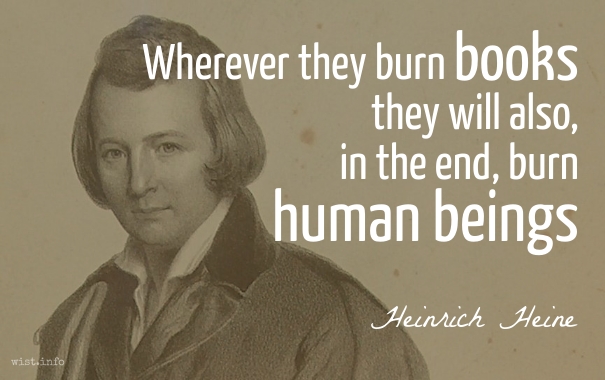
I am enough of an artist to draw freely upon my imagination. Imagination is more important than knowledge. For knowledge is limited, whereas imagination embraces the entire world, stimulating progress, giving birth to evolution.
Albert Einstein (1879–1955) German-American physicist
“What Life Means to Einstein,” Interview with G. Viereck, Saturday Evening Post (26 Oct 1929)
(Source)
Quoted as "I am enough of an artist to draw freely upon my imagination. Imagination is more important than knowledge. Knowledge is limited. Imagination encircles the world," in Viereck, Glimpses of the Great (1930).
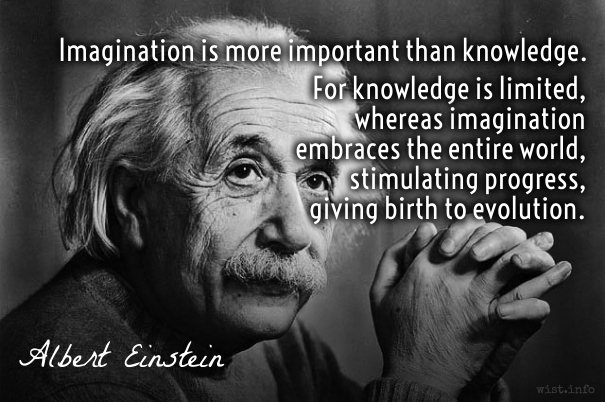
Our debt to tradition through reading and conversation is so massive, our protest or private addition so rare and insignificant, — and this commonly on the ground of other reading or hearing, — that, in a large sense, one would say there is no pure originality. All minds quote. Old and new make the warp and woof of every moment. There is no thread that is not a twist of these two strands. By necessity, by proclivity, and by delight, we all quote.
Ralph Waldo Emerson (1803–1882) American essayist, lecturer, poet
“Quotation and Originality,” Letters and Social Aims (1876)
(Source)
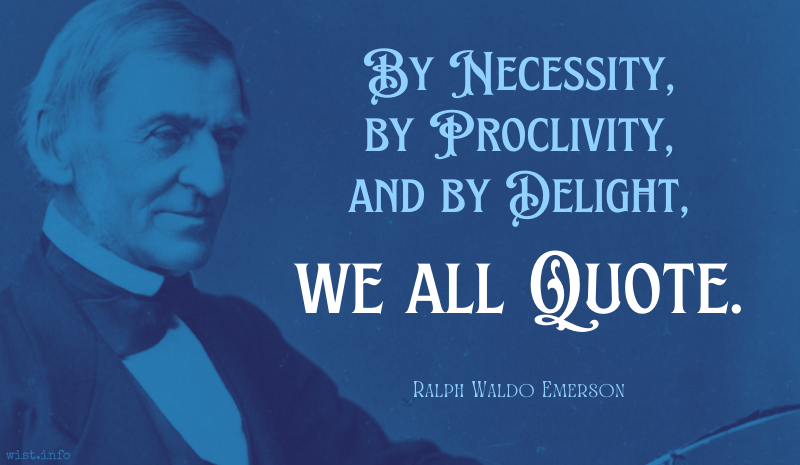
None are more hopelessly enslaved than those who falsely believe they are free.
[Niemand ist mehr Sklave als der sich für frei hält ohne es zu sein.]
Johann Wolfgang von Goethe (1749–1832) German poet, statesman, scientist
Elective Affinities [Die Wahlverwandtschaften], Part 2, ch. 5, “From Ottilie’s Journal [Aus Ottiliens Tagebuche]” (1809) [tr. Wenckstern (1853)]
(Source)
(Source (German)). Another translation:No one is more a slave than the man who thinks himself free while he is not.
[Niles ed. (1872)]No one is more a slave than he who thinks he is free without being so.
[tr. Hollingdale (1971)]
Men never do evil so completely and cheerfully as when they do it from religious convictions.
[Jamais on ne fait le mal si pleinement et si gaiement, que quand on le fait par un faux principe de conscience.]
Blaise Pascal (1623–1662) French scientist and philosopher
Pensées, ch. 14, Appendix: Polemical Fragments #895 (1669) [tr. Trotter (1910)]
(Source)
Also labeled as Part 2, Article 17, # 53. Sometimes also shown in slightly shorter French as "Jamais on ne fait le mal si pleinement et si gaiement que quand on le fait par conscience."(Source (French)). Other translations:
- "We never do evil so fully and cheerfully as when we do it out of conscience." [#813 (#895), tr. Krailsheimer]
- "We never do evil so completely and cheerfully as when we do it out of conscience." [Miscellaneous Thoughts 7: Sellier #658/Lafuma #813, tr. Ariew]
- "Men never do evil so completely and cheerfully as when they do it conscientiously."
He who imposes his argument by bravado and command shows that it is weak in reason.
[Qui establit son discours par braverie et commandement, montre que la raison y est foible.]
Michel de Montaigne (1533–1592) French essayist
Essays, Book 3, ch. 11 (3.11), “Of Cripples [Des Boyteux]” (1587) [tr. Frame (1943)]
(Source)
(Source (French)). Other translations:He that with braverie and by comaundement will establish his discourse, declareth his reason to be weake.
[tr. Florio (1603), "Of the Lame or Cripple"]Who will establish his Discourse by Authority and Huffing, discovers his Reason to be very weak.
[tr. Cotton (1686)]He who will establish this proposition by authority and huffing discovers his reason to be very weak.
[tr. Cotton/Hazlitt (1877), "On the Lame"]He who establishes his argument by defiance and by command shews that his reasoning is weak.
[tr. Ives (1925)]Any man who supports his opinion with challenges and commands demonstrates that his reasons for it are weak.
[tr. Screech (1987), "On the Lame"]He who establishes his argument by noise and command shows that his reason is weak.
[Source]
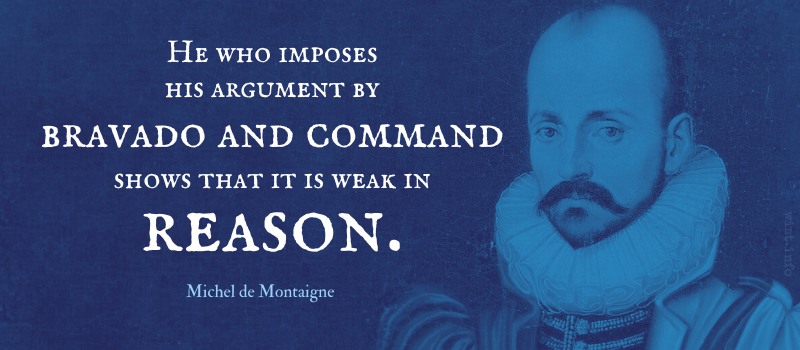
It is not best that we should all think alike; it is differences of opinion that make horse races.
Mark Twain (1835–1910) American writer [pseud. of Samuel Clemens]
The Tragedy of Pudd’nhead Wilson, ch. 19, epigraph (1894)

Certainly, Gentlemen, it ought to be the happiness and glory of a representative to live in the strictest union, the closest correspondence, and the most unreserved communication with his constituents. Their wishes ought to have great weight with him; their opinions high respect; their business unremitted attention. It is his duty to sacrifice his repose, his pleasure, his satisfactions, to theirs, — and above all, ever, and in all cases, to prefer their interest to his own.
But his unbiased opinion, his mature judgment, his enlightened conscience, he ought not to sacrifice to you, to any man, or to any set of men living. These he does not derive from your pleasure, — no, nor from the law and the Constitution. They are a trust from Providence, for the abuse of which he is deeply answerable. Your representative owes you, not his industry only, but his judgment; and he betrays, instead of serving you, if he sacrifices it to your opinion.
Edmund Burke (1729–1797) Anglo-Irish statesman, orator, philosopher
Speech to the electors of Bristol (3 Nov 1774)

The sad truth of the matter is that most evil is done by people who never made up their minds to be or do either evil or good.
Hannah Arendt (1906–1975) German-American philosopher, political theorist
Life of the Mind, Vol. 1 “Thinking,” Part 3, ch. 18 “The two-in-one” (1977)
(Source)
Sometimes shortened as: "The sad truth is that most evil is done by people who never make up their minds to be good or evil."
Originally printed as an essay (1977-11-28), "Thinking -- III," The New Yorker (1977-12-05). That version is slightly longer:The sad truth of the matter is that most evil is done by people who never made up their minds to be either good or bad or to do either good or evil.
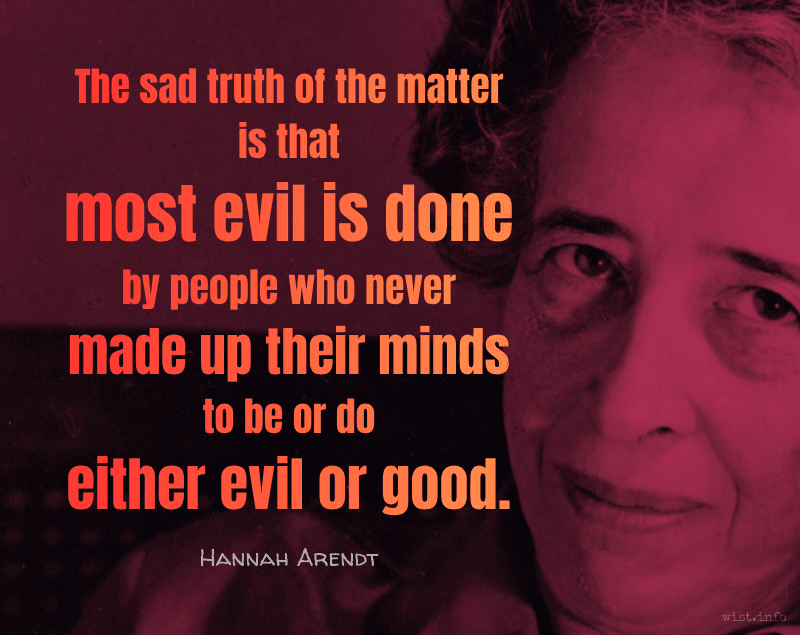

One of the symptoms of approaching nervous break-down is the belief that one’s work is terribly important, and that to take a holiday would bring all kinds of disaster.
Bertrand Russell (1872–1970) English mathematician and philosopher
Conquest of Happiness, Part 1, ch. 5 “Fatigue” (1930)
(Source)

It is true, the bill is said to be founded on necessity; but what is this? Is it not necessity, which has always been the plea of every illegal exertion of power, or exercise of oppression? Is not necessity the pretence of every usurpation? Necessity is the plea for every infringement of human freedom. It is the argument of tyrants; it is the creed of slaves.
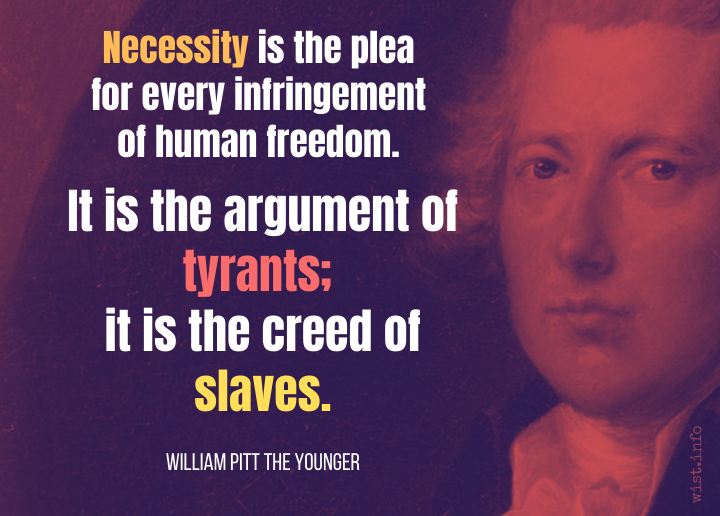
All movements go too far.
Bertrand Russell (1872–1970) English mathematician and philosopher
“On Being Modern-Minded,” The Nation (1937-01-09)
(Source)
Full context:All movements go too far, and this is certainly true of the movement toward subjectivity, which began with Luther and Descartes as an assertion of the individual and has culminated by an inherent logic in his complete subjection.
Collected in Unpopular Essays (1950).
When peace has been broken anywhere, the peace of countries everywhere is in danger.
Franklin Delano Roosevelt (1882–1945) American lawyer, politician, statesman; US President (1933–45)
Speech (1939-09-03), “Fireside Chat” (radio broadcast)
(Source)

Not everything that is faced can be changed, but nothing can be changed until it is faced.
James Baldwin (1924–1987) American novelist, playwright, activist
Essay (1962-01-14), “As Much Truth as One Can Bear,” New York Times Book Review
(Source)
If you would know what the Lord God thinks of money, you have only to look at those to whom He gives it.
Maurice Baring (1874–1945) English man of letters, writer, essayist, translator
(Attributed)
(Source)
Quoted by Dorothy Parker in "The Art of Fiction," interview by Marion Capron, The Paris Review #13 (Summer 1956) (reprinted in The Portable Dorothy Parker (1944)). Not found in Baring's writings. The quotation is often attributed to Parker, especially in simpler forms, e.g., "If you want to know what God thinks of money, just look at the people he gave it to."
Nothing is more terrible than ignorance in action.
Johann Wolfgang von Goethe (1749–1832) German poet, statesman, scientist
Sprüche in Prosa: Maximen und Reflexionen [Proverbs in Prose: Maxims and Reflections] (1833) [tr. Saunders (1893)]
(Source)
Goethe's use of this phrase comes up twice in the Maxims and Reflections. Other translations:
From Art and Antiquity, Vol. 5, #3, Individual Points (1826):Es ist nichts schrecklicher als eine tätige Unwissenheit.
(Source (German))Nothing is more terrible than ignorance in action.
[tr. Saunders (1893), "Life and Character," sec. 3, #231]There is nothing more frightful than ignorance in action.
[tr. Rönnfeldt (1900)]There is nothing more dreadful than active ignorance.
[tr. Stopp (1995), #367]
From Wilhelm Meister's Journeyman Years (1829):Auch nichts schrecklicher ist, als die Unwissenheit handeln zu sehen.
(Source(German))There is no more terrible sight than ignorance in action.
[tr. Saunders (1893), "Life and Character," sec. 1, #52]There is nothing more terrible than to see ignorance in action.
[tr. Rönnfeldt (1900)]Nothing is more frightful than to see ignorance in action.
[tr. Stopp (1995), #367]

There are a thousand hacking at the branches of evil to one who is striking at the root.
Henry David Thoreau (1817–1862) American philosopher and writer
Walden; or, Life in the Woods, ch. 1 “Economy” (1854)
(Source)

You get ideas from daydreaming. You get ideas from being bored. You get ideas all the time. The only difference between writers and other people is we notice when we’re doing it.
Neil Gaiman (b. 1960) British author, screenwriter, fabulist
“Where Do You Get Your Ideas?” (1997)
(Source)
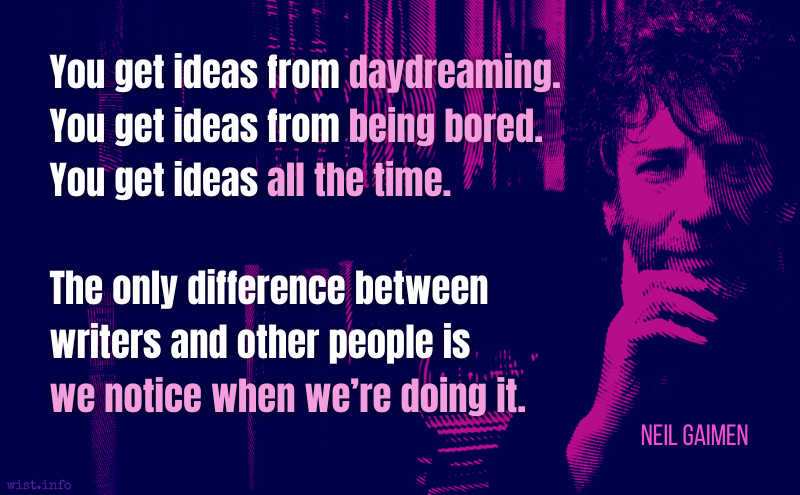
The greatest test of courage is to bear defeat without losing heart.
Robert Green Ingersoll (1833–1899) American lawyer, freethinker, orator
Speech (1876-07-04), “Centennial Oration [The Declaration of Independence],” Peoria, Illinois
(Source)