Violence, in short, is the norm of our economic life and our national security. The line that connects the bombing of a civilian population to the mountain “removed” by strip mining to the gullied and poisoned field to the clear-cut watershed to the tortured prisoner seems to run pretty straight.
Wendell Berry (b. 1934) American farmer, educator, poet, conservationist
Speech (2005-05-14), Commencement, Lindsey Wilson College, Columbia, Kentucky
(Source)
This was either excerpted from, or included in, his undated essay "Letter to Daniel Kemmis," collected in The Way of Ignorance and Other Essays, Part 2 (2005).
Quotations about:
economy
Note not all quotations have been tagged, so Search may find additional quotes on this topic.
There was a stag, once, who could always defeat a stallion
And drive him out of their pasture — until, tired of losing,
The horse begged help of man, and got a bridle in return.
He beat the stag, all right, and he laughed — but then the rider
Stayed on his back, and the bit stayed in his mouth.
Give up your freedom, more worried about poverty than something
Greater than any sum of gold, and become a slave and stay
A slave forever, unable to live on only enough.[Cervus equum pugna melior communibus herbis
pellebat, donec minor in certamine longo
imploravit opes hominis frenumque recepit;
sed postquam victor violins discessit ab hoste,
non equitem dorso, non frenum depulit ore.
Sic qui pauperiem veritus potiore metallis
libertate caret, dominum vehet improbus atque
serviet aeternum, quia parvo nesciet uti.]Horace (65–8 BC) Roman poet, satirist, soldier, politician [Quintus Horatius Flaccus]
Epistles [Epistularum, Letters], Book 1, ep. 10 “To Aristius Fuscus,” l. 34ff (1.10.34-41) (20 BC) [tr. Raffel (1983)]
(Source)
Source of the shortened proverb, "He will always be a slave who does not know how to live upon a little."
(Source (Latin)). Other translations:An hart the better chevalier as it came then to passe
Did chase an horse that fed with him from eating of the grasse.
The tryumpher after that he was parted from his foe
The man from backe, the bitt from mouthe he could not rid them fro.
So, he that feareth povertie his fredom cannot houlde.
Fredome, better then mettells all better then choysest goulde.
That foole shall beare in dede a Lorde, and lyve a dayly thrall,
For that he will not knowe to use and lyve upon a small.
[tr. Drant (1567)]The Stagg superior both in Arms and Force,
Out of the Common-Pasture drove the Horse:
Untill the vanquish'd after a long fight
Pray'd Man's assistance, and receiv'd the Bit:
But, having beat the Victor, could not now
Bit from his Mouth, nor Man from his Back throw.
So He that fearing Poverty, hath sold
Away his Liberty; better then Gold,
Shall carry a proud Lord upon his back,
And serve for ever, 'cause he could not lack.
[tr. Fanshawe; ed. Brome (1666)]Both fed together, till with injur'ous force,
The stoutest Deer expell'd the weaker Horse:
He beaten, flyes to Man to right his Cause,
Begs help, and takes the Bridle in his Jaws.
Yet tho He Conquer'd, tho He rul'd the Plain,
He bore the Rider still, and felt the Rein.
Thus the mean Wretch, that fearing to be poor,
Doth sell his Liberty for meaner Ore:
Must bear a Lord, He must be still a Slave,
That cannot use the little Nature gave.
[tr. Creech (1684)]A lordly stag, arm'd with superior force,
Drove from their common field a vanquisht horse,
Who for revenge to man his strength enslav'd,
Took up his rider, and the bitt received:
But, though he conquer'd in the martial strife,
He felt his rider's weight, and champt the bitt for life.
So he, who poverty with horror views,
Nor frugal nature's bounty knows to use;
Who sells his freedom in exchange for gold
(Freedom for mines of wealth too cheaply sold),
Shall make eternal servitude his fate,
And feel a haughty master's galling weight.
[tr. Francis (1747)]It chanced that after many a well-fought bout
The Stag contrived to put the Horse to rout;
'Till, from his pasture driven, the foe thought fit
To ask the aid of man and took the bit.
He conquer'd; but, his triumph o'er, began
To find he could shake off nor bit nor man.
such is the fate of him who, if he please,
Might rest in humble competence and ease,
Yet through the dread of penury has sold
That independence which surpasses gold.
Henceforth he'll serve a tyrant for his pains,
And stand or budge as avarice pulls the reins.
[tr. Howes (1845)]The stag, superior in fight, drove the horse from the common pasture, till the latter, worsted in the long contest, implored the aid of man and received the bridle; but after he had parted an exulting conqueror from his enemy, he could not shake the rider from his back, nor the bit from his mouth. So he who, afraid of poverty, forfeits his liberty, more valuable than mines, avaricious wretch, shall carry a master, and shall eternally be a slave, for not knowing how to use a little.
[tr. Smart/Buckley (1853)]The stag was wont to quarrel with the steed,
Nor let him graze in common on the mead:
The steed, who got the worst in each attack,
Asked help from man, and took him on his back:
But when his foe was quelled, he ne'er got rid
Of his new friend, still bridled and bestrid.
So he who, fearing penury, loses hold
Of independence, better far than gold,
Will toil, a hopeless drudge, till life is spent,
Because he'll never, never learn content.
[tr. Conington (1874)]Once on a time a stag, at antlers' point,
Expelled a horse he'd worsted, from the joint
Enjoyment of the pasture both had cropped:
Still, when he ventured near it, rudely stopped.
The steed called in man's aid, and took the bit:
Thus backed, he charged the stag, and conquered it.
But woe the while! nor rider, bit, nor rein
Could he shake off, and be himself again.
So he who, fearing poverty, hath sold
His freedom, better than uncounted gold.
Will bear a master and a master's laws.
And be a slave unto the end, because
He will not learn, what fits him most to know.
How far, discreetly used, small means will go.
[tr. Martin (1881)]The stag, being the more powerful animal in fight, was accustomed to drive off the horse from the open pasture until the latter, feeling his inferiority, after a protracted contest, implored the help of man, and received the rein. But after that, a revengeful victor, he had left his foe he threw not off the rider from his back nor the bit from his mouth. In a like manner the man who, through a dread of a small income, possesses not freedom -- preferable to metallic treasure -- will, basely, carry a master and yield him perpetual servitude, because he knows not how to enjoy a little.
[tr. Elgood (1893)]The stag could best the horse in fighting and used to drive him from their common pasture, until the loser in the long contest begged the help of man and took the bit. But after that, in overweening triumph, he parted from his foe, he did not dislodge the rider from his back or the bit from his mouth. So he who through fear of poverty forfeits liberty, which is better than mines of wealth, will in his avarice carry a master, and be a slave for ever, not knowing how to live on little.
[tr. Fairclough (Loeb) (1926)]The stag, victorious in fight, in course
Drove from the common pasturage the horse,
Until the horse, at last forced to submit,
Called in the help of man and took the bit;
But, when he had subdued his foe by force,
The rider from his back he couldn't divorce,
Nor from his mouth the bit. So, if in dread
Of Want, wone has one's freedom forfeited --
Freedom more precious than a mine outspread --
A master he will carry for his greed,
And always be a slave, because in deed
He knows not how to make a little do.
[tr. A. F. Murison (1931)]The stag, in time past, could drive
The horse from the feeding ground, and beat him in fighting,
Until the perpetual loser came crying to man
To ask for his help, and accepted the bit. Then the horse
Fought the stag once again to a bitter conclusion, and won.
He walked off and left his foe, but now couldn’t shake
The bit from his mouth or the rider down from his back.
So one who, fearing poverty, loses the liberty
That is worth even more than a gold mine will carry a master,
And cravenly slave for another, simply because
He can't subsist on a little.
[tr. Palmer Bovie (1959)]A stag battled a horse for the best grass in a field
And kept on winning until the loser in that long war
approached a man to beg his help, and took the bit.
But when it had won the bloody clash and routed its foe,
it could neither shake out the bit nor shake off the rider.
Anyone so scared of poverty he'd rather lose his freedom
than his mines is such a fool he bears a rider, a master
he'll obey forever, since he never learned to live on little.
[tr. Fuchs (1977)]The stag was a better fighter than the horse
And often drove him out of their common pasture,
Until the horse, the loser, asked man's help
And acquiesced in taking the bit in his mouth.
But after his famous victory in this battle
He couldn't get the rider off his back
And he couldn't get the bit out of his mouth.
The man who'se afraid to be poor and therefore gives
His liberty away, worth more than gold,
Will carry a master on his back and be
A slave forever, not knowing how to live
On just a little.
[tr. Ferry (2001)]The stag, being stronger than the horse, drove him away from the pasture
they shared, until, having had the worse of the age-old struggle,
the horse turned for help to man, and accept the bit.
But after routing his enemy and leaving the field in triumph
he never dislodged the rider from his back or the bit from his mouth.
So the man who, in fear of poverty, forgoes his independence
(a thing more precious than metals) has the shame of carrying a master;
he's a slave for life, as he will not make the best of a little.
[tr. Rudd (2005 ed.)]The stag could always better the horse in conflict,
And drive him from open ground, until the loser
In that long contest, begging man’s help, took the bit:
Yet, disengaged from his enemy, as clear victor,
He couldn’t shed man from his back, the bit from his mouth.
So the perverse man who forgoes his freedom, worth more
Than gold, through fear of poverty, suffers a master
And is a slave forever, by failing to make much
Of little.
[tr. Kline (2015)]
I believe that the recent course of our history has demonstrated that, while we may utilize their expert knowledge of certain problems and the special facilities with which they are familiar, we cannot allow our economic life to be controlled by that small group of men whose chief outlook upon the social welfare is tinctured by the fact that they can make huge profits from the lending of money and the marketing of securities — an outlook which deserves the adjectives “selfish” and “opportunist.”
Franklin Delano Roosevelt (1882–1945) American lawyer, politician, statesman; US President (1933–45)
Speech (1932-05-22), Commencement, Oglethorpe University, Atlanta, Georgia
(Source)
Chuse such Pleasures, as recreate much, and cost little.
Thomas Fuller (1654–1734) English physician, preacher, aphorist, writer
Introductio ad Prudentiam, Vol. 1, # 61 (1725)
(Source)
My friend, brag not yet of our American cousins! Their quantity of cotton, dollars, industry and resources, I believe to be almost unspeakable; but I can by no means worship the like of these. What great human soul, what great thought, what great noble thing that one could worship, or loyally admire, has yet been produced there? None: the American cousins have yet done none of these things.
Thomas Carlyle (1795–1881) Scottish essayist and historian
Essay (1850-02-01), “The Present Time,” Latter-Day Pamphlets, No. 1
(Source)
A Penny sav’d is Twopence clear,
A Pin a day is a Groat a Year.
Save and have.
Every little makes a mickle.Benjamin Franklin (1706–1790) American statesman, scientist, philosopher, aphorist
Poor Richard (1737 ed.)
(Source)
Greed is not good. Being rapacious doesn’t make you a capitalist, it makes you a sociopath. And in an economy as dependent upon cooperation at scale as ours, sociopathy is as bad for business as it is for society.
Nick Hanauer (b. 1959) American entrepreneur and venture capitalist [Nicolas Joseph Hanauer]
Lecture (2019-07) “The Dirty Secret of Capitalism — and a New Way Forward,” TEDsummit, Edinburgh
(Source)
(Source (Video), 14:19)

Machines are a great thing, but if one replaces a hundred men, it don’t buy anything, it don’t eat anything, while the hundred men spend theirs back for food, shelter, and hundreds of various commodities for them and their families.
By virtue of exchange, one man’s prosperity is beneficial to all others.
In a predatory economy, the rules imagined by the law and economics crowd don’t apply. There’s no market discipline. Predators compete not by following the rules but by breaking them. They take the business-school view of law: Rules are not designed to guide behavior but laid down to define the limits of unpunished conduct. Once one gets close to the line, stepping over it is easy. A predatory economy is criminogenic: It fosters and rewards criminal behavior.
John Kenneth Galbraith (1908–2006) Canadian-American economist, diplomat, author
“The Predator State,” Mother Jones (May/Jun 2006)
(Source)
As far as the advocacy of peace rests on material motives like economy and prosperity, it is the service of Mammon; and the bottom of the platform will drop out when Mammon thinks that war will pay better.
A. T. Mahan (1840–1914) American admiral, strategist, historian [Alfred Thayer Mahan]
(Attributed)
(Source)
Attributed in William Ralph Inge, "The Indictment against Christianity" (1917), Outspoken Essays, ch. 10 (1919).
The art of living easily as to money, is to pitch your scale of living one degree below your means.
Henry Taylor (1800–1886) English dramatist, poet, bureaucrat, man of letters
Notes from Life, “Of Money” (1853)
(Source)
Just as the commandment “Thou shalt not kill” sets a clear limit in order to safeguard the value of human life, today we also have to say “thou shalt not” to an economy of exclusion and inequality. Such an economy kills. How can it be that it is not a news item when an elderly homeless person dies of exposure, but it is news when the stock market loses two points? This is a case of exclusion. Can we continue to stand by when food is thrown away while people are starving? This is a case of inequality. Today everything comes under the laws of competition and the survival of the fittest, where the powerful feed upon the powerless. As a consequence, masses of people find themselves excluded and marginalized: without work, without possibilities, without any means of escape.
Francis I (1936–2025) Argentinian Catholic Pope (2013–2025) [b. Jorge Mario Bergoglio]
Evangelii Gaudium, sec. 53 (24 Nov 2013)
(Source)
One cause of this situation is found in our relationship with money, since we calmly accept its dominion over ourselves and our societies. The current financial crisis can make us overlook the fact that it originated in a profound human crisis: the denial of the primacy of the human person! We have created new idols. The worship of the ancient golden calf has returned in a new and ruthless guise in the idolatry of money and the dictatorship of an impersonal economy lacking a truly human purpose. The worldwide crisis affecting finance and the economy lays bare their imbalances and, above all, their lack of real concern for human beings; man is reduced to one of his needs alone: consumption.
Francis I (1936–2025) Argentinian Catholic Pope (2013–2025) [b. Jorge Mario Bergoglio]
Evangelii Gaudium, sec. 55 (24 Nov 2013)
(Source)
The practical work of today is to abolish the cannibals of competition, warriors of supply and demand, tyrants of monopoly, monsters of the market, devourers of men, women and children, buyers and sellers of life.
Henry Demarest Lloyd (1847–1903) American political activist and journalist
Man, the Social Creator, ch. 5 (1906)
(Source)
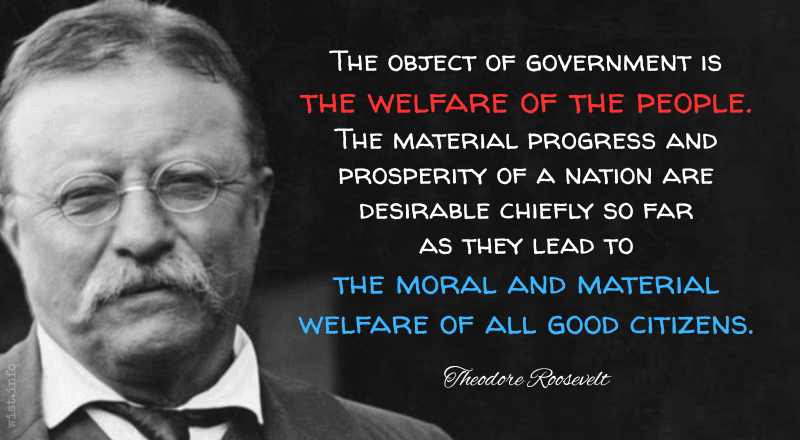
The object of government is the welfare of the people. The material progress and prosperity of a nation are desirable chiefly so far as they lead to the moral and material welfare of all good citizens.
Theodore Roosevelt (1858–1919) American politician, statesman, conservationist, writer; US President (1901–09)
Speech (1910-08-31), “The New Nationalism,” John Brown Memorial Park dedication, Osawatomie, Kansas
(Source)
That this economic system persists and grows larger and stronger in spite of its evident failure has nothing to do with rationality or, for that matter, with evidence. It persists because, embodied now in multinational corporations, it has discovered a terrifying truth: If you can control a people’s economy, you don’t need to worry about its politics; its politics have become irrelevant. If you control people’s choices as to whether or not they will work, and where they will work, and what they will do, and how well they will do it, and what they will eat and wear, and the genetic makeup of their crops and animals, and what they will do for amusement, then why should you worry about freedom of speech? In a totalitarian economy, any “political liberties” that the people might retain would simply cease to matter. If, as is often the case already, nobody can be elected who is not wealthy, and if nobody can be wealthy without dependence on the corporate economy, then what is your vote worth? The citizen thus becomes an economic subject.
Wendell Berry (b. 1934) American farmer, educator, poet, conservationist
Speech (1994-09-29), “Conserving Forest Communities,” Kentucky Forest Summit, Louisville
(Source)
Collected in Another Turn of the Crank (1995).
Prosperity is only an instrument to be used, not a deity to be worshiped.
Calvin Coolidge (1872–1933) American lawyer, politician, US President (1925–29)
Speech, Boston (11 Jun 1928)