

I find it difficult to see how talk about sex can be placed under the kind of censorship the Court here approves without subjecting our society to more dangers than we can anticipate at the moment. It was to avoid exactly such dangers that the First Amendment was written and adopted. For myself I would follow the course which I believe is required by the First Amendment, that is, recognize that sex at least as much as any other aspect of life is so much a part of our society that its discussion should not be made a crime.
Hugo Black (1886–1971) American politician and jurist; US Supreme Court Justice (1937–71)
Ginzburg v. United States, 383 U.S. 463, 482 (1966) [dissent]
(Source)
Quotations about:
SCOTUS
Note not all quotations have been tagged, so Search may find additional quotes on this topic.
Today, as in ages past, we are not without tragic proof that the exalted power of some governments to punish manufactured crime dictatorially is the handmaid of tyranny. Under our constitutional system, courts stand against any winds that blow as havens of refuge for those who might otherwise suffer because they are helpless, weak, outnumbered, or because they are non-conforming victims of prejudice and public excitement. Due process of law, preserved for all by our Constitution, commands that no such practice as that disclosed by this record shall send any accused to his death. No higher duty, no more solemn responsibility, rests upon this Court, than that of translating into living law and maintaining this constitutional shield deliberately planned and inscribed for the benefit of every human being subject to our Constitution — of whatever race, creed or persuasion.
Hugo Black (1886–1971) American politician and jurist; US Supreme Court Justice (1937–71)
Chambers v. Florida, 309 U.S. 227, 241 (1940) [majority opinion]
(Source)
Finding coerced confessions that led to the death penalty conviction of four Black men in Florida were a violation of the Due Process clause of the 14th Amendment.
History should teach us then, that in times of high emotional excitement minority parties and groups which advocate extremely unpopular social or governmental innovations will always be typed as criminal gangs and attempts will always be made to drive them out. It was knowledge of this fact, and of its great dangers, that caused the Founders of our land to enact the First Amendment as a guarantee that neither Congress nor the people would do anything to hinder or destroy the capacity of individuals and groups to seek converts and votes for any cause, however radical or unpalatable their principles might seem under the accepted notions of the time.
Hugo Black (1886–1971) American politician and jurist; US Supreme Court Justice (1937–71)
Barenblatt v. United States, 360 U.S. 109, 151 (1959) [dissent]
(Source)
Our Constitution assumes that the common sense of the people and their attachment to our country will enable them, after free discussion, to withstand ideas that are wrong. To say that our patriotism must be protected against false ideas by means other than these is, I think, to make a baseless charge. Unless we can rely on these qualities—if, in short, we begin to punish speech — we cannot honestly proclaim ourselves to be a free Nation and we have lost what the Founders of this land risked their lives and their sacred honor to defend.
Hugo Black (1886–1971) American politician and jurist; US Supreme Court Justice (1937–71)
Barenblatt v. United States, 360 U.S. 109, 146 (1959) [dissent]
(Source)
The First Amendment means to me, however, that the only constitutional way our Government can preserve itself is to leave its people the fullest possible freedom to praise, criticize or discuss, as they see fit, all governmental policies and to suggest, if they desire, that even its most fundamental postulates are bad and should be changed.
Hugo Black (1886–1971) American politician and jurist; US Supreme Court Justice (1937–71)
Barenblatt v. United States, 360 U.S. 109, 145–46 (1959) [dissent]
(Source)
It is this right, the right to err politically, which keeps us strong as a Nation. For no number of laws against communism can have as much effect as the personal conviction which comes from having heard its arguments and rejected them, or from having once accepted its tenets and later recognized their worthlessness.
Hugo Black (1886–1971) American politician and jurist; US Supreme Court Justice (1937–71)
Barenblatt v. United States, 360 U.S. 109, 144 (1959) [dissent]
(Source)
The interest of the people as a whole [lies] in being able to join organizations, advocate causes, and make political “mistakes” without later being subjected to governmental penalties for having dared to think for themselves.
Hugo Black (1886–1971) American politician and jurist; US Supreme Court Justice (1937–71)
Barenblatt v. United States, 360 U.S. 109, 144 (1959) [dissent]
(Source)
The very reason for the First Amendment is to make the people of this country free to think, speak, write and worship as they wish, not as the Government commands.
Hugo Black (1886–1971) American politician and jurist; US Supreme Court Justice (1937–71)
Machinists v. Street, 367 U.S. 740, 788 (1961) [dissenting]
(Source)
The case is frequently called "IAM v. Street" (International Association of Machinists).
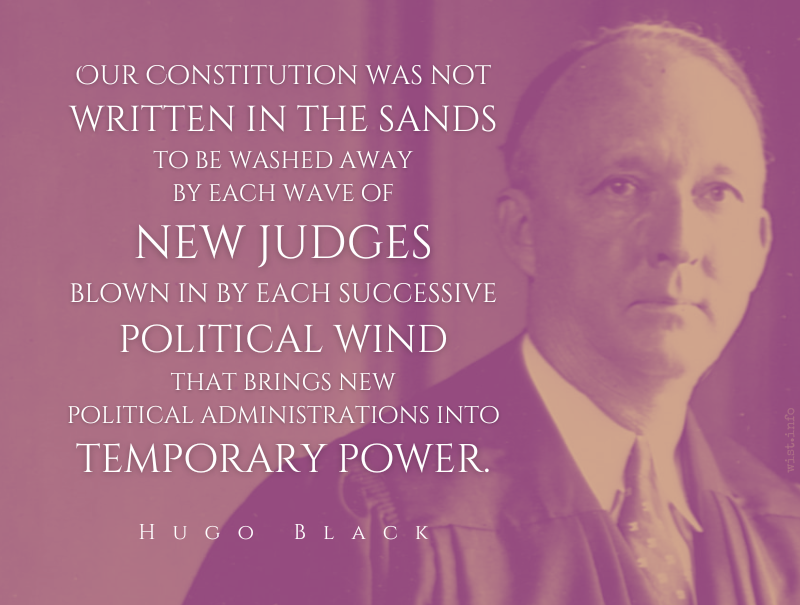
Our Constitution was not written in the sands to be washed away by each wave of new judges blown in by each successive political wind that brings new political administrations into temporary power.
Hugo Black (1886–1971) American politician and jurist; US Supreme Court Justice (1937–71)
Turner v. United States, 396 U.S. 398, 426 (1970) [dissenting]
(Source)
There can be no equal justice where the kind of trial a man gets depends on the amount of money he has.
Hugo Black (1886–1971) American politician and jurist; US Supreme Court Justice (1937–71)
Griffin v. Illinois, 351 US 12, 19 (1956) [majority opinion]
(Source)
On the Constitutional requirement for states to ensure not only that trial defense is available to poor defendants, but that appeals costs be addressed as well.
The prayer of each man from his soul must be his and his alone. This is the genius of the First Amendment. If there is anything clear in the First Amendment, it is that the right of the people to pray in their own way is not be controlled by the election return.
Hugo Black (1886–1971) American politician and jurist; US Supreme Court Justice (1937–71)
Engel v. Vitale, 370 U.S. 421, 425 (1962) [extemporaneous remarks]
(Source)
Added by Black during his reading of the majority opinion, and not part of the written ruling. The passage follows, "It is no part of the business of government to compose official prayers for any group of the American people to recite as a part of a religious program carried on by government."
There can, of course, be no doubt that New York’s program of daily classroom invocation of God’s blessings as prescribed in the Regents’ prayer is a religious activity. […] We think that the constitutional prohibition against laws respecting an establishment of religion must at least mean that, in this country, it is no part of the business of government to compose official prayers for any group of the American people to recite as a part of a religious program carried on by government.
Hugo Black (1886–1971) American politician and jurist; US Supreme Court Justice (1937–71)
Engel v. Vitale, 370 U.S. 421, 424–425 (1962) [majority opinion]
(Source)
This case ruled that organized school prayer was unconstitutional. The prayer in question, to be recited by each class before their teacher each day, read: "Almighty God, we acknowledge our dependence upon Thee, and we beg Thy blessings upon us, our parents, our teachers and our Country."
Any test that turns on what is offensive to the community’s standards is too loose, too capricious, too destructive of freedom of expression to be squared with the First Amendment. Under that test, juries can censor, suppress, and punish what they don’t like, provided the matter relates to “sexual impurity” or has a tendency “to excite lustful thoughts”. This is community censorship in one of its worst forms. It creates a regime where in the battle between the literati and the Philistines, the Philistines are certain to win.
William O. Douglas (1898–1980) American jurist; US Supreme Court Justice (1939–75)
Roth v. United States, 354 U.S. 476, 512 (1957) [dissent]
(Source)
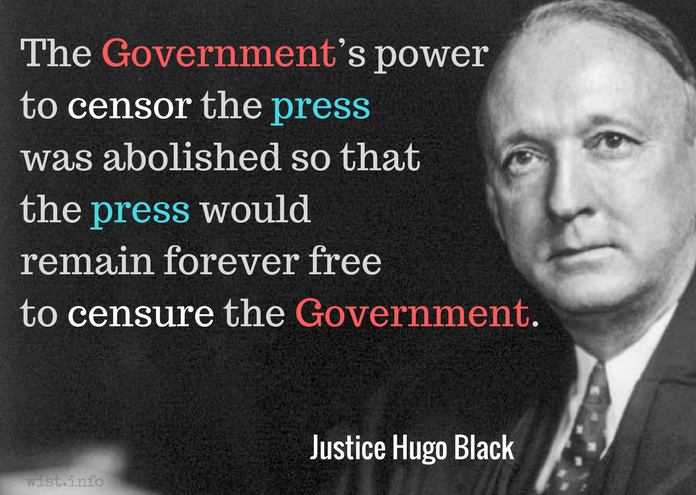
In the First Amendment, the Founding Fathers gave the free press the protection it must have to fulfill its essential role in our democracy. The press was to serve the governed, not the governors. The Government’s power to censor the press was abolished so that the press would remain forever free to censure the Government. The press was protected so that it could bare the secrets of government and inform the people. Only a free and unrestrained press can effectively expose deception in government. And paramount among the responsibilities of a free press is the duty to prevent any part of the government from deceiving the people and sending them off to distant lands to die of foreign fevers and foreign shot and shell.
Hugo Black (1886–1971) American politician and jurist; US Supreme Court Justice (1937–71)
New York Times Co. v. United States 403 U.S. 713, 717 (1971) [concurring]
(Source)
The ruling in this case held that the President Nixon could not preemptively block publication of the Pentagon Papers by the New York Times and Washington Post, and that prior restraint of the press was unconstitutional unless the government could show publication would cause "grave and irreparable" danger.
Thus, if the First Amendment guarantee of freedom of speech and press is to mean anything in this field, it must allow protests even against the moral code that the standard of the day sets for the community. In other words, literature should not be suppressed merely because it offends the moral code of the censor.
William O. Douglas (1898–1980) American jurist; US Supreme Court Justice (1939–75)
Roth v. United States, 354 U.S. 476, 512 (1957) [dissent]
(Source)
It is one of the happy incidents of the federal system that a single courageous State may, if its citizens choose, serve as a laboratory; and try novel social and economic experiments without risk to the rest of the country.
Louis Brandeis (1856–1941) American lawyer, jurist, activist; US Supreme Court Justice (1916–39)
New State Ice Co. v. Liebmann, 285 U.S. 311 (1932) [dissent]
The prevalence of the corporation in America has led men of this generation to act, at times, as if the privilege of doing business in corporate form were inherent in the citizen; and has led them to accept the evils attendant upon the free and unrestricted use of the corporate mechanism as if these evils were the inescapable price of civilized life, and, hence to be borne with resignation.
Louis Brandeis (1856–1941) American lawyer, jurist, activist; US Supreme Court Justice (1916–39)
Liggett Co. v. Lee, 288 U.S. 517 (1933) [dissent]
Stare decisis is usually the wise policy, because in most matters it is more important that the applicable rule of law be settled than that it be settled right. … This is commonly true even where the error is a matter of serious concern, provided correction can be had by legislation. But in cases involving the Federal Constitution, where correction through legislative action is practically impossible, this court has often overruled its earlier decisions. The court bows to the lessons of experience and the force of better reasoning, recognizing that the process of trial and error, so fruitful in the physical sciences, is appropriate also in the judicial function.
Louis Brandeis (1856–1941) American lawyer, jurist, activist; US Supreme Court Justice (1916–39)
Burnet v. Coronado Oil & Gas Co., 285 U.S. 393 (1932) [dissent]
If we would guide by the light of reason, we must let our minds be bold.
Louis Brandeis (1856–1941) American lawyer, jurist, activist; US Supreme Court Justice (1916–39)
New State Ice Co. v. Liebmann, 285 U.S. 262 (1932) [dissent]
At the foundation of our civil liberty lies the principle which denies to government officials an exceptional position before the law and which subjects them to the same rules of conduct that are commands to the citizen.
Louis Brandeis (1856–1941) American lawyer, jurist, activist; US Supreme Court Justice (1916–39)
Burdeau v. McDowell, 256 U.S. 465, 477 (1921) [dissent]
Another purpose of the Establishment Clause rested upon an awareness of the historical fact that governmentally established religions and religious persecutions go hand in hand. The Founders knew that only a few years after the Book of Common Prayer became the only accepted form of religious services in the established Church of England, an Act of Uniformity was passed to compel all Englishmen to attend those services and to make it a criminal offense to conduct or attend religious gatherings of any other kind — a law which was consistently flouted by dissenting religious groups in England and which contributed to widespread persecutions of people like John Bunyan who persisted in holding “unlawful [religious] meetings … to the great disturbance and distraction of the good subjects of this kingdom ….” And they knew that similar persecutions had received the sanction of law in several of the colonies in this country soon after the establishment of official religions in those colonies. It was in large part to get completely away from this sort of systematic religious persecution that the Founders brought into being our Nation, our Constitution, and our Bill of Rights with its prohibition against any governmental establishment of religion.
Hugo Black (1886–1971) American politician and jurist; US Supreme Court Justice (1937–71)
Engel v. Vitale, 370 U.S. 421, 424–425 (1962) [majority opinion]
(Source)
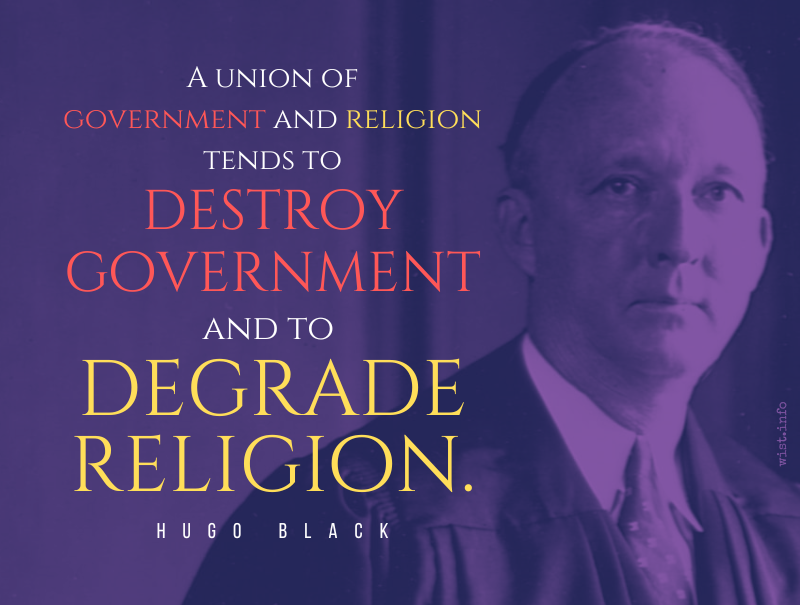
But the purposes underlying the Establishment Clause go much further than that. Its first and most immediate purpose rested on the belief that a union of government and religion tends to destroy government and to degrade religion. The history of governmentally established religion, both in England and in this country, showed that whenever government had allied itself with one particular form of religion, the inevitable result had been that it had incurred the hatred, disrespect and even contempt of those who held contrary beliefs. That same history showed that many people had lost their respect for any religion that had relied upon the support of government to spread its faith.
The Establishment Clause thus stands as an expression of principle on the part of the Founders of our Constitution that religion is too personal, too sacred, too holy, to permit its “unhallowed perversion” by a civil magistrate.
Hugo Black (1886–1971) American politician and jurist; US Supreme Court Justice (1937–71)
Engel v. Vitale, 370 U.S. 421, 431–432 (1962) [majority opinion]
(Source)
Our Founders were no more willing to let the content of their prayers and their privilege of praying whenever they pleased be influenced by the ballot box than they were to let these vital matters of personal conscience depend upon the succession of monarchs. The First Amendment was added to the Constitution to stand as a guarantee that neither the power nor the prestige of the Federal Government would be used to control, support or influence the kinds of prayer the American people can say — that the people’s religions must not be subjected to the pressures of government for change each time a new political administration is elected to office. Under that Amendment’s prohibition against governmental establishment of religion, as reinforced by the provisions of the Fourteenth Amendment, government in this country, be it state or federal, is without power to prescribe by law any particular form of prayer which is to be used as an official prayer in carrying on any program of governmentally sponsored religious activity.
Hugo Black (1886–1971) American politician and jurist; US Supreme Court Justice (1937–71)
Engel v. Vitale, 370 U.S. 421, 429–30 (1962) [majority opinion]
(Source)
Bad men, like good men, are entitled to be tried and sentenced in accordance with law, and when it is shown to us that a person is serving an illegal sentence our obligation is to direct that proper steps be taken to correct the wrong done, without regard to the character of a particular defendant or to the possible effect on others who might also want to challenge the legality of their sentences as they have the right to do “at any time” under Rule 35. If it has any relevance at all, the fact that there may be other prisoners in this country’s jails serving illegal sentences would seem to me to make it all the more imperative that we grant appropriate relief in this case rather than search for some obviously dubious excuse to deny this petitioner’s claim.
Hugo Black (1886–1971) American politician and jurist; US Supreme Court Justice (1937–71)
Green v. United States, 365 U.S. 301, 309–310 (1961) [dissent]
(Source)
Certainly the First Amendment’s language leaves no room for inference that abridgments of speech and press can be made just because they are slight. That Amendment provides, in simple words, that “Congress shall make no law … abridging the freedom of speech, or of the press.” I read “no law … abridging” to mean no law abridging.
Hugo Black (1886–1971) American politician and jurist; US Supreme Court Justice (1937–71)
Smith v. California, 361 U.S. 147, 157 (1959) [concurring]
(Source)
To hold that a state cannot, consistently with the First and Fourteenth Amendments, utilize its public school system to aid any or all religious faiths or sects in the dissemination of their doctrines and ideals does not, as counsel urge, manifest a governmental hostility to religion or religious teachings. A manifestation of such hostility would be at war with our national tradition as embodied in the First Amendment’s guaranty of the free exercise of religion. For the First Amendment rests upon the premise that both religion and government can best work to achieve their lofty aims if each is left free from the other within its respective sphere.
Hugo Black (1886–1971) American politician and jurist; US Supreme Court Justice (1937–71)
McCollum v. Board of Education, 333 U.S. 203, 211–212 (1948) [majority opinion]
(Source)
There can be no assumption that today’s majority is “right” and the Amish and others like them are “wrong.” A way of life that is odd or even erratic but interferes with no rights or interests of others is not to be condemned because it is different.
That [First] Amendment requires the state to be a neutral in its relations with groups of religious believers and nonbelievers; it does not require the state to be their adversary. State power is no more to be used so as to handicap religions than it is to favor them.
Hugo Black (1886–1971) American politician and jurist; US Supreme Court Justice (1937–71)
Everson v. Board of Education, 330 U.S. 1, 18 (1947) [majority opinion]
(Source)
Under our constitutional system, courts stand against any winds that blow as havens of refuge for those who might otherwise suffer because they are helpless, weak, outnumbered, or because they are nonconforming victims of prejudice and public excitement. Due process of law, preserved for all by our Constitution, commands that no such practice as that disclosed by this record shall send any accused to his death. No higher duty, no more solemn responsibility, rests upon this Court than that of translating into living law and maintaining this constitutional shield deliberately planned and inscribed for the benefit of every human being subject to our Constitution — of whatever race, creed or persuasion.
Hugo Black (1886–1971) American politician and jurist; US Supreme Court Justice (1937–71)
Chambers v. Florida, 309 U.S. 227, 241 (1940) [majority opinion]
(Source)
Overturning a state murder conviction obtained through a coerced confession.
From this day forward, I no longer shall tinker with the machinery of death. For more than 20 years I have endeavored — indeed, I have struggled — along with a majority of this Court, to develop procedural and substantive rules that would lend more than the mere appearance of fairness to the death penalty endeavor. Rather than continue to coddle the Court’s delusion that the desired level of fairness has been achieved and the need for regulation eviscerated, I feel morally and intellectually obligated simply to concede that the death penalty experiment has failed. It is virtually self-evident to me now that no combination of procedural rules or substantive regulations ever can save the death penalty from its inherent constitutional deficiencies. The basic question — does the system accurately and consistently determine which defendants “deserve” to die? — cannot be answered in the affirmative. […] The problem is that the inevitability of factual, legal, and moral error gives us a system that we know must wrongly kill some defendants, a system that fails to deliver the fair, consistent, and reliable sentences of death required by the Constitution.
Harry Blackmun (1908–1999) American lawyer, jurist; US Supreme Court Justice (1970–1994) [Harold Andrew Blackmun]
Callins v. Collins, 510 U.S. 1141 (1994) [dissent from denial of certiori]
(Source)
The “establishment of religion” clause of the First Amendment means at least this: Neither a state nor the Federal Government can set up a church. Neither can pass laws which aid one religion, aid all religions, or prefer one religion over another. Neither can force nor influence a person to go to or to remain away from church against his will or force him to profess a belief or disbelief in any religion. No person can be punished for entertaining or professing religious beliefs or disbeliefs, for church attendance or non-attendance. No tax in any amount, large or small, can be levied to support any religious activities or institutions, whatever they may be called, or whatever form they may adopt to teach or practice religion. Neither a state nor the Federal Government can, openly or secretly, participate in the affairs of any religious organizations or groups and vice versa. In the words of Jefferson, the clause against establishment of religion by law was intended to erect “a wall of separation between Church and State.”
The First Amendment has erected a wall between church and state. That wall must be kept high and impregnable. We could not approve the slightest breach.
Hugo Black (1886–1971) American politician and jurist; US Supreme Court Justice (1937–71)
Everson v. Board of Education, 330 U.S. 1, 18 (1947) [majority opinion]
(Source)
The makers of our Constitution undertook to secure conditions favorable to the pursuit of happiness. They recognized the significance of man’s spiritual nature, of his feelings and of his intellect. They knew that only a part of the pain, pleasure and satisfactions of life are to be found in material things. They sought to protect Americans in their beliefs, their thoughts, their emotions and their sensations. They conferred, as against the government, the right to be let alone — the most comprehensive of rights and the right most valued by civilized men.
Louis Brandeis (1856–1941) American lawyer, jurist, activist; US Supreme Court Justice (1916–39)
Olmstead v. United States, 277 U.S. 438 (1928) [dissent]
(Source)
Any departure from absolute regimentation may cause trouble. Any variation from the majority’s opinion may inspire fear. Any word spoken, in class, in the lunchroom, or on the campus, that deviates from the view of another person may start an argument or cause a disturbance. But our Constitution says we must take this risk, and our history says that it is this sort of hazardous freedom — this kind of openness — that is the basis of our national strength and of the independence and vigor of Americans who grow up and live in this relatively permissive, often disputatious, society.
Abraham Fortas (1910–1982) American academic, jurist, lawyer; US Supreme Court Justice (1965–69)
Tinker v. Des Moines Independent Community School District, 393 U.S. 503, 508 (1969) [majority opinion]
(Source)
Regarding the First Amendment right of public school students and teachers to non-disruptive protest against the Vietnam War.
Those who won our independence by revolution were not cowards. They did not fear political change. They did not exalt order at the cost of liberty. To courageous, self-reliant men, with confidence in the power of free and fearless reasoning applied through the processes of popular government, no danger flowing from speech can be deemed clear and present, unless the incidence of the evil apprehended is so imminent that it may befall before there is opportunity for full discussion. If there be time to expose through discussion the falsehood and fallacies, to avert the evil by the processes of education, the remedy to be applied is more speech, not enforced silence.
Louis Brandeis (1856–1941) American lawyer, jurist, activist; US Supreme Court Justice (1916–39)
Whitney v California, 274 US 357, 377 (1927) (concurring)
(Source)
If nowhere else, in the relation between Church and State, “good fences make good neighbors.”
Felix Frankfurter (1882–1965) American jurist, teacher; US Supreme Court Justice (1939–62)
McCollum v. Board of Education, 333 U.S. 232 (1948) [concurring]
(Source)
Ruling that public schools could not let religious groups use their property for religious education to children.
The quoted reference is to a poem by Robert Frost.
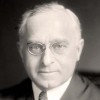
Those who won our independence believed that the final end of the State was to make men free to develop their faculties. … They valued liberty both as an end and as a means. They believed liberty to be the secret of happiness and courage to be the secret of liberty. They believed that freedom to think as you will and to speak as you think are means indispensable to the discovery and spread of political truth; that without free speech and assembly discussion would be futile; that with them, discussion affords ordinarily adequate protection against the dissemination of noxious doctrine; that the greatest menace to freedom is an inert people; that public discussion is a political duty; and that this should be a fundamental principle of the American Government.
Louis Brandeis (1856–1941) American lawyer, jurist, activist; US Supreme Court Justice (1916–39)
Whitney v. California, 274 U.S. 357 (1927) [concurring]
The Fathers of the Constitution were not unaware of the varied and extreme views of religious sects, of the violence of disagreement among them, and of the lack of any one religious creed on which all men would agree. They fashioned a charter of government which envisaged the widest possible toleration of conflicting views. Man’s relation to his God was made no concern of the state. He was granted the right to worship as he pleased and to answer to no man for the verity of his religious views. The religious views espoused by respondents might seem incredible, if not preposterous, to most people. But if those doctrines are subject to trial before a jury charged with finding their truth or falsity, then the same can be done with the religious beliefs of any sect.
William O. Douglas (1898–1980) American jurist; US Supreme Court Justice (1939–75)
United States v. Ballard, 322 U.S. 78 (1944) [majority opinion]Full text.
Freedom of thought, which includes freedom of religious belief, is basic in a society of free men. It embraces the right to maintain theories of life and of death and of the hereafter which are rank heresy to followers of the orthodox faiths. Heresy trials are foreign to our Constitution. Men may believe what they cannot prove. They may not be put to the proof of their religious doctrines or beliefs. Religious experiences which are as real as life to some may be incomprehensible to others.
William O. Douglas (1898–1980) American jurist; US Supreme Court Justice (1939–75)
United States v. Ballard, 322 U.S. 78 (1944) [majority opinion]Full text.
Free speech is not to be regulated like diseased cattle and impure butter. The audience (in this case the judge or jury) that hissed yesterday may applaud today, even for the same performance.
William O. Douglas (1898–1980) American jurist; US Supreme Court Justice (1939–75)
Kingsley Books, Inc. v. Brown, 354 U.S. 436, 447 (1957) [dissent]
The court ruled 5-4 to allow banning the sale of obscene books.
The right to be let alone is indeed the beginning of all freedoms.
William O. Douglas (1898–1980) American jurist; US Supreme Court Justice (1939–75)
Public Utilities Commission of the District of Columbia v. Pollack, 343 U.S. 451 (1952) [dissent]
The 7-1 ruling held that a streetcar company's playing of the radio was constitutional, and that the PUC could regulate same.
In revealing the workings of government that led to the Vietnam War, the newspapers nobly did precisely that which the Founders hoped and trusted they would do.
Hugo Black (1886–1971) American politician and jurist; US Supreme Court Justice (1937–71)
New York Times Co. v. United States, 403 U.S. 713, 717 (1971) [concurring]
(Source)
Decency, security and liberty alike demand that government officials shall be subjected to the same rules of conduct that are commands to the citizen. In a government of laws, existence of the government will be imperiled if it fails to observe the law scrupulously.
Louis Brandeis (1856–1941) American lawyer, jurist, activist; US Supreme Court Justice (1916–39)
Olmstead v. United States, 277 US 438 (1928) [dissent]
(Source)
The doctrine of the separation of powers was adopted by the Convention of 1787, not to promote efficiency but to preclude the exercise of arbitrary power. The purpose was, not to avoid friction, but, by means of the inevitable friction incident to the distribution of the governmental powers among three departments, to save the people from autocracy.
Louis Brandeis (1856–1941) American lawyer, jurist, activist; US Supreme Court Justice (1916–39)
Myers v. United States, 272 U.S. 293 (1926) [dissent]
Citizenship is no light trifle to be jeopardized any moment Congress decides to do so under the name of one of its general or implied grants of power.
Hugo Black (1886–1971) American politician and jurist; US Supreme Court Justice (1937–71)
Afroyim v. Rusk, 387 U.S. 253, 267–68 (1967) [majority opinion]
(Source)
I would give the broad sweep of the First Amendment full support. I have the same confidence in the ability of our people to reject noxious literature as I have in their capacity to sort out the true from the false in theology, economics, or any other field.
William O. Douglas (1898–1980) American jurist; US Supreme Court Justice (1939–75)
Roth v. United States, 354 U.S. 476, 512 (1957) [dissent]
(Source)
Marriage is a coming together for better or for worse, hopefully enduring, and intimate to the degree of being sacred.
William O. Douglas (1898–1980) American jurist; US Supreme Court Justice (1939–75)
Griswold v. Connecticut, 381 U.S. 470 (1965) [concurrence]
Living in Los Angeles is not blameworthy per se.
William O. Douglas (1898–1980) American jurist; US Supreme Court Justice (1939–75)
Lambert v. California, 355 U.S. 225 (1957) [concurrence]
Full and free expression of the right by the citizen is ordinarily also his duty; for its exercise is more important to the Nation than it is to himself. Like the course of the heavenly bodies, harmony in national life is a resultant of the struggle between contending forces. In the frank expression of conflicting opinions lies the greatest promise of wisdom in governmental action.
Louis Brandeis (1856–1941) American lawyer, jurist, activist; US Supreme Court Justice (1916–39)
Gilbert v. Minnesota, 254 US 325 (1920) [dissent]
The right to be let alone is indeed the beginning of all freedom.
William O. Douglas (1898–1980) American jurist; US Supreme Court Justice (1939–75)
Roth v. United States, 354 U.S. 476, 512 (1957) [dissent]
Experience should teach us to be most on our guard to protect liberty when the government’s purposes are beneficial. Men born to freedom are naturally alert to repel invasion of their liberty by evil-minded rulers. The greater dangers to liberty lurk in insidious encroachment by men of zeal, well-meaning but without understanding.
Louis Brandeis (1856–1941) American lawyer, jurist, activist; US Supreme Court Justice (1916–39)
Olmstead v. United States, 277 US 438 (1928) [dissent]
(Source)
Our government is the potent, the omnipresent teacher. For good or for ill, it teaches the whole people by its example. Crime is contagious. If the government becomes a lawbreaker, it breeds contempt for law; it invites every man to become a law unto himself; it invites anarchy. To declare that in the administration of criminal law the end justifies the means — to declare that the government may commit crimes in order to secure the conviction of a private criminal — would bring terrible retribution.
Louis Brandeis (1856–1941) American lawyer, jurist, activist; US Supreme Court Justice (1916–39)
Olmstead v. United States, 277 US 438 (1928) [dissent]
(Source)
One of the prerogatives of American citizenship is the right to criticize public men and measures — and that means not only informed and responsible criticism, but the freedom to speak foolishly and without moderation.
Felix Frankfurter (1882–1965) American jurist, teacher; US Supreme Court Justice (1939–62)
Baumgartner v. United States, 322 U.S. 664 (1944) [majority opinion]
(Source)
Ruling that the government could not strip a naturalized citizen of their citizenship simply for expressing political views, such as admiration for Adolph Hitler.
Freedom to discuss public affairs and public officials is unquestionably, as the Court today holds, the kind of speech the First Amendment was primarily designed to keep within the area of free discussion. To punish the exercise of this right to discuss public affairs or to penalize it through libel judgments is to abridge or shut off discussion of the very kind most needed. This Nation, I suspect, can live in peace without libel suits based on public discussions of public affairs and public officials. But I doubt that a country can live in freedom where its people can be made to suffer physically or financially for criticizing their government, its actions, or its officials.
Hugo Black (1886–1971) American politician and jurist; US Supreme Court Justice (1937–71)
New York Times Co. v. Sullivan, 376 U.S. 254, 296–297 (1964) [concurring]
(Source)
Fear of serious injury alone cannot justify oppression of free speech and assembly. Men feared witches and burnt women. It is the function of speech to free men from the bondage of irrational fears.
Louis Brandeis (1856–1941) American lawyer, jurist, activist; US Supreme Court Justice (1916–39)
Whitney v. California, 274 U.S. 357 (1927) [concurring]