

The quickest way to take the starch out ov a man who iz allwuss blameing himself, is to agree with him, this aint what he iz looking for.
[The quickest way to take the starch out of a man who is always blaming himself, is to agree with him; this ain’t what he is looking for.]
Josh Billings (1818-1885) American humorist, aphorist [pseud. of Henry Wheeler Shaw]
Josh Billings’ Farmer’s Allminax, 1875-11 (1875 ed.)
(Source)
Quotations about:
self-serving
Note not all quotations have been tagged, so Search may find additional quotes on this topic.

Fascism was a fairly popular political philosophy which made sacred whatever nation and race the philosopher happened to belong to.
Kurt Vonnegut, Jr. (1922-2007) American novelist, journalist
Breakfast of Champions, ch. 17 (1973)
(Source)

Yet a personal God can become a grave liability. He can be a mere idol carved in our own image, a projection of our limited needs. fears and desires. We can assume that he loves what we love and hates what we hate, endorsing our prejudices instead of compelling us to transcend them. … Instead of pulling us beyond our limitations, “he” can encourage us to remain complacently within them; “he” can make us a cruel, callous, self-satisfied and partial as “he” seems to be. Instead of inspiring the compassion that should characterize all advanced religion, “he” can encourage us to judge, condemn and marginalize.
Karen Armstrong (b. 1944) British author, comparative religion scholar
A History of God, ch. 7 “The God of the Mystics” (1993)
(Source)

When plunder has become a way of life for a group of men living together in society, they create for themselves in the course of time a legal system that authorizes it and a moral code that glorifies it.
[Lorsque la Spoliation est devenue le moyen d’existence d’une agglomération d’hommes unis entre eux par le lien social, ils se font bientôt une loi qui la sanctionne, une morale qui la glorifie.]
Frédéric Bastiat (1801-1850) French philosopher, economist, politician
Economic Sophisms [Sophismes Économiques], 2nd Series, ch. 1 “Physiology of Plunder [Physiologie de la Spoliation]” (1848) [tr. Goddard (1964)]
(Source)
(Source (French)). Other translations:When Spoliation has once become the recognised means of existence of a body of men united and held together by social ties, they soon proceed to frame a law which sanctions it, and to adopt a system of morals which sanctifies it.
[tr. Stirling (1873)]When Plunder becomes a way of life for a group of men in a society, over the course of time they create for themselves a legal system that authorizes it and a moral code that glorifies it.
[tr. Goddard (variant/paraphrase)]
Serve self you serve society.
Serve society serve yourself.Ralph Waldo Emerson (1803-1882) American essayist, lecturer, poet
Notebook F, #1, p. 28 (1836-1840)
(Source)

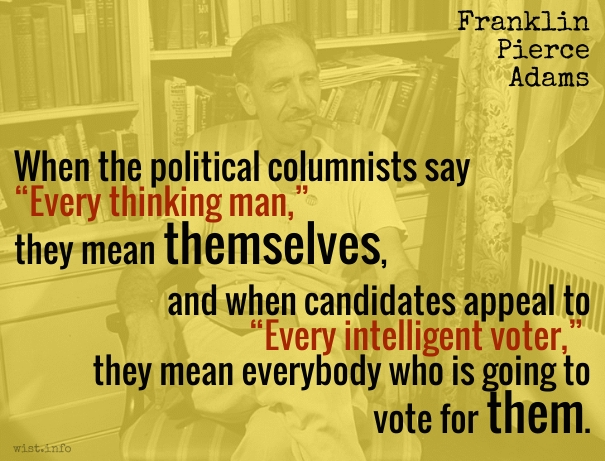
When the political columnists say “Every thinking man,” they mean themselves, and when candidates appeal to “Every intelligent voter,” they mean everybody who is going to vote for them.
Franklin Pierce Adams (1881-1960) American journalist and humorist ["F. P. A."]
Nods and Becks, “Inside ‘Information, Please!'” (1944)
(Source)

I don’t trust a man who talks about ethics when he’s picking my pockets.
Robert A. Heinlein (1907-1988) American writer
Time Enough For Love (1973)
When he noticed how the guests chose the places of honor, he told them a parable. “When you are invited by someone to a wedding banquet, do not sit down at the place of honor, in case someone more distinguished than you has been invited by your host, and the host who invited both of you may come and say to you, ‘Give this person your place,’ and then in disgrace you would start to take the lowest place.
“But when you are invited, go and sit down at the lowest place, so that when your host comes, he may say to you, ‘Friend, move up higher’; then you will be honored in the presence of all who sit at the table with you.
“For all who exalt themselves will be humbled, and those who humble themselves will be exalted.”[Ἔλεγεν δὲ πρὸς τοὺς κεκλημένους παραβολήν, ἐπέχων πῶς τὰς πρωτοκλισίας ἐξελέγοντο, λέγων πρὸς αὐτούς, Ὅταν κληθῇς ὑπό τινος εἰς γάμους, μὴ κατακλιθῇς εἰς τὴν πρωτοκλισίαν, μήποτε ἐντιμότερός σου ᾖ κεκλημένος ὑπ᾽ αὐτοῦ, καὶ ἐλθὼν ὁ σὲ καὶ αὐτὸν καλέσας ἐρεῖ σοι, Δὸς τούτῳ τόπον, καὶ τότε ἄρξῃ μετὰ αἰσχύνης τὸν ἔσχατον τόπον κατέχειν.
ἀλλ᾽ ὅταν κληθῇς, πορευθεὶς ἀνάπεσε εἰς τὸν ἔσχατον τόπον, ἵνα ὅταν ἔλθῃ ὁ κεκληκώς σε ἐρεῖ σοι, Φίλε, προσανάβηθι ἀνώτερον· τότε ἔσται σοι δόξα ἐνώπιον πάντων τῶν συνανακειμένων σοι.
ὅτι πᾶς ὁ ὑψῶν ἑαυτὸν ταπεινωθήσεται, καὶ ὁ ταπεινῶν ἑαυτὸν ὑψωθήσεται.]The Bible (The New Testament) (AD 1st - 2nd C) Christian sacred scripture
Luke 14: 7-11 (Jesus) [NRSV (2021 ed.)]
(Source)
No Synoptic parallels.
(Source (Greek)). Alternate translations:And he put forth a parable to those which were bidden, when he marked how they chose out the chief rooms; saying unto them, 8 When thou art bidden of any man to a wedding, sit not down in the highest room; lest a more honourable man than thou be bidden of him; and he that bade thee and him come and say to thee, Give this man place; and thou begin with shame to take the lowest room.
But when thou art bidden, go and sit down in the lowest room; that when he that bade thee cometh, he may say unto thee, Friend, go up higher: then shalt thou have worship in the presence of them that sit at meat with thee.
For whosoever exalteth himself shall be abased; and he that humbleth himself shall be exalted.
[KJV (1611)]He then told the guests a parable, because he had noticed how they picked the places of honour. He said this, "When someone invites you to a wedding feast, do not take your seat in the place of honour. A more distinguished person than you may have been invited, and the person who invited you both may come and say, 'Give up your place to this man.' And then, to your embarrassment, you would have to go and take the lowest place.
"No; when you are a guest, make your way to the lowest place and sit there, so that, when your host comes, he may say, 'My friend, move up higher.' In that way, everyone with you at the table will see you honoured.
"For everyone who exalts himself will be humbled, and the man who humbles himself will be exalted."
[JB (1966)]He then told the guests a parable, because he had noticed how they picked the places of honour. He said this, "When someone invites you to a wedding feast, do not take your seat in the place of honour. A more distinguished person than you may have been invited, and the person who invited you both may come and say, 'Give up your place to this man.' And then, to your embarrassment, you will have to go and take the lowest place.
"No; when you are a guest, make your way to the lowest place and sit there, so that, when your host comes, he may say, 'My friend, move up higher.' Then, everyone with you at the table will see you honoured.
"For everyone who raises himself up will be humbled, and the one who humbles himself will be raised up."
[NJB (1985)]Jesus noticed how some of the guests were choosing the best places, so he told this parable to all of them: “When someone invites you to a wedding feast, do not sit down in the best place. It could happen that someone more important than you has been invited, and your host, who invited both of you, would have to come and say to you, ‘Let him have this place.’ Then you would be embarrassed and have to sit in the lowest place.
"Instead, when you are invited, go and sit in the lowest place, so that your host will come to you and say, ‘Come on up, my friend, to a better place.’ This will bring you honor in the presence of all the other guests.
"For those who make themselves great will be humbled, and those who humble themselves will be made great.”
[GNT (1992 ed.)]When Jesus noticed how the guests sought out the best seats at the table, he told them a parable. “When someone invites you to a wedding celebration, don’t take your seat in the place of honor. Someone more highly regarded than you could have been invited by your host. The host who invited both of you will come and say to you, ‘Give your seat to this other person.’ Embarrassed, you will take your seat in the least important place.
"Instead, when you receive an invitation, go and sit in the least important place. When your host approaches you, he will say, ‘Friend, move up here to a better seat.’ Then you will be honored in the presence of all your fellow guests.
"All who lift themselves up will be brought low, and those who make themselves low will be lifted up."
[CEB (2011)]

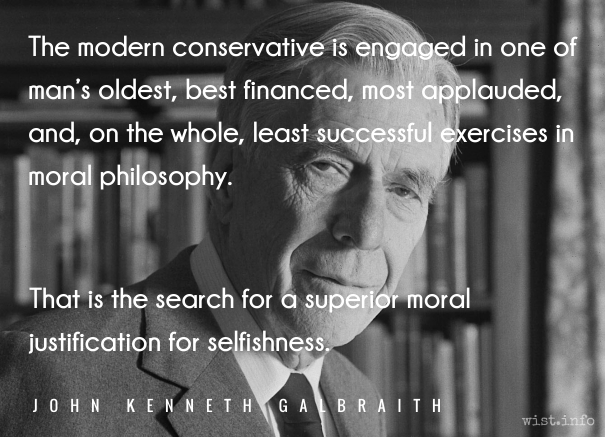
The modern conservative is not even especially modern. He is engaged, on the contrary, in one of man’s oldest, best financed, most applauded, and, on the whole, least successful exercises in moral philosophy. That is the search for a superior moral justification for selfishness. It is an exercise which always involves a certain number of internal contradictions and even a few absurdities. The conspicuously wealthy turn up urging the character-building value of privation for the poor. The man who has struck it rich in minerals, oil, or other bounties of nature is found explaining the debilitating effect of unearned income from the state. The corporate executive who is a superlative success as an organization man weighs in on the evils of bureaucracy. Federal aid to education is feared by those who live in suburbs that could easily forgo this danger, and by people whose children are in public schools. Socialized medicine is condemned by men emerging from Walter Reed Hospital. Social Security is viewed with alarm by those who have the comfortable cushion of an inherited income. Those who are immediately threatened by public efforts to meet their needs — whether widows, small farmers, hospitalized veterans, or the unemployed — are almost always oblivious to the danger.
John Kenneth Galbraith (1908-2006) Canadian-American economist, diplomat, author
Speech (1963-12-13), “Wealth and Poverty,” National Policy Committee on Pockets of Poverty
(Source)
Galbraith used variations on this quote over the years.
- The above quotation was from a speech given, that was then entered into the Congressional Record, Vol. 109, Senate (1963-12-18).
- This material was reworked into an article "Let us begin: An invitation to action on poverty," in Harper's (1964-03), which was in turn again entered into the Congressional Record, Vol. 110 (1964).
- One of the last is most often cited: "The modern conservative is engaged in one of man’s oldest exercises in moral philosophy, that is the search for a superior moral justification for selfishness. It is an exercise which always involves a certain number of internal contradictions and even a few absurdities. The conspicuously wealthy turn up urging the character-building value of privation for the poor." ["Stop the Madness," Interview with Rupert Cornwell, Toronto Globe and Mail (2002-07-06)]
To Joanna
My brilliant and beautiful wife
without whom I would be nothing.
She always comforts and consoles,
never complains or interferes,
asks nothing and endures all,
and writes my dedications.Albert Paul Malvino (b. 1931) American electrical engineer, educational writer
Electronic Principles, Dedication (1993)
(Source)
