‘Pon my word, Watson, you are coming along wonderfully. You have really done very well indeed. It is true that you have missed everything of importance, but you have hit upon the method, and you have a quick eye for colour. Never trust to general impressions, my boy, but concentrate yourself upon details.
Arthur Conan Doyle (1859–1930) British writer and physician
Story (1891-09), “A Case of Identity,” [Holmes], The Strand Magazine, Vol. 2, No. 3
(Source)
Quotations about:
compliment
Note not all quotations have been tagged, so Search may find additional quotes on this topic.
It is always safe to tell people that they’re looking wonderful.
Mignon McLaughlin (1913–1983) American journalist and author
The Neurotic’s Notebook, ch. 3 (1963)
(Source)

The kiss originated when the first male reptile licked the first female reptile, implying in a subtle, complimentary way that she was as succulent as the small reptile he had for dinner the night before.
F. Scott Fitzgerald (1896–1940) American writer [Francis Scott Key Fitzgerald]
Notebook E “Epigrams, Wisecracks and Jokes,” § 436 (1932-1940)
Originally collected in Edmund Wilson, ed., The Crack-Up (1945), then in the unexpurgated Matthew Bruccoli, ed., Notebooks of F. Scott Fitzgerald (1978).
Compliments make me vain: & when I am vain, I am insolent & overbearing. It is a pity, too, because I love compliments. I love them even when they are not so. My child, I can live on a good compliment two weeks with nothing else to eat.
Mark Twain (1835–1910) American writer [pseud. of Samuel Clemens]
Letter to Gertrude Natkin (1906-03-02)
(Source)
In a similar vein, his biographer, Albert Bigelow Paine, in Mark Twain: A Biography, Vol. 4, ch. 250 (1912), recalled Clemens saying: "I can live for two months on a good compliment."

To be trusted is a greater compliment than to be loved.
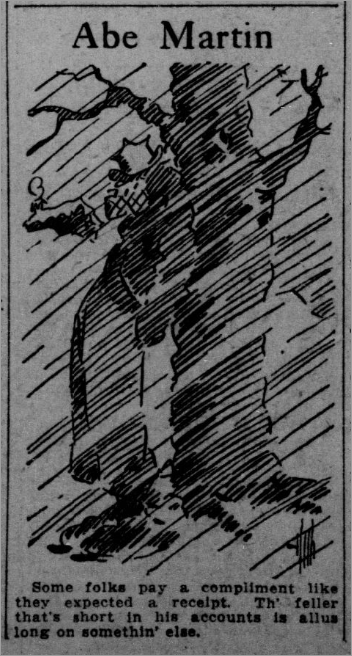
Some folks pay a compliment like they expected a receipt.
Frank McKinney "Kin" Hubbard (1868–1930) American caricaturist and humorist
“Abe Martin” comic, San Francisco Call (1912-02-07)
(Source)
Through his Abe Martin character, Hubbard used this phrase in a variety of forms, popularizing (though not originating) it. More discussion about this: “Some people pay a compliment as if they expected a receipt” - The Big Apple - Barry Popik.
Nothing is so silly as the expression of a man who is being complimented.
André Gide (1869–1951) French author, Nobel laureate
Journal (1906-02-13) [tr. O’Brien (1947)]
(Source)
No cook can ignore the opinion of a man who asks for three helpings. One is politeness, two is hunger, but three is a true and cherished compliment.
Kerry Greenwood (b. 1954) Australian author and lawyer
Phryne Fisher, Book 5, The Green Mill Murder, ch. 6 (1993)
(Source)

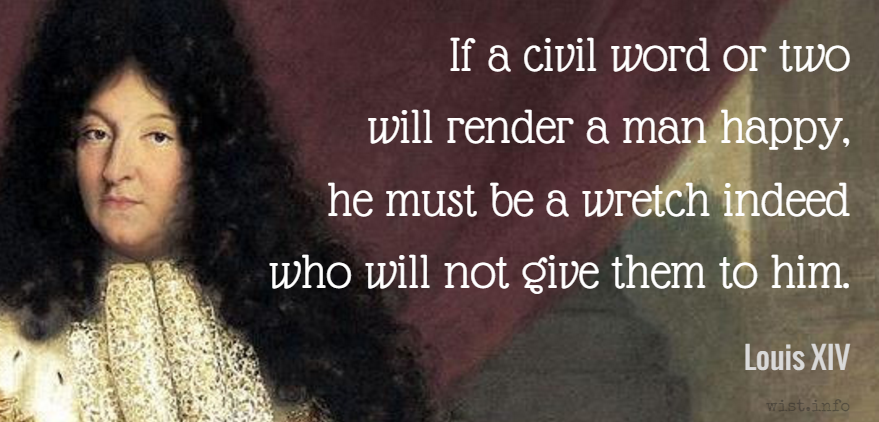
If a civil word or two will render a man happy, he must be a wretch indeed who will not give them to him.
Louis XIV (1638–1715) French monarch (1643–1715) [Louis the Great, the Sun King)
(Attributed)
(Source)
Quoted in William Seward, Anecdotes of Distinguished Persons, Vol 4, 5th ed. (1804).

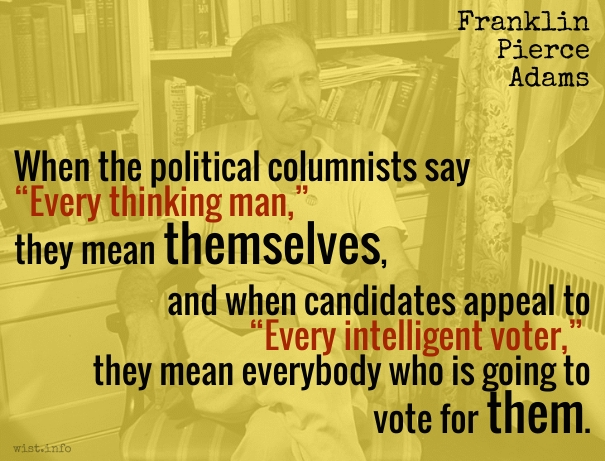
When the political columnists say “Every thinking man,” they mean themselves, and when candidates appeal to “Every intelligent voter,” they mean everybody who is going to vote for them.
Franklin Pierce Adams (1881–1960) American journalist and humorist ["F. P. A."]
Nods and Becks, “Inside ‘Information, Please!'” (1944)
(Source)

Too often we underestimate the power of a touch, a smile, a kind word, a listening ear, an honest compliment, or the smallest act of caring, all of which have the potential to turn a life around.
Leo Buscaglia (1925–1998) American psychologist, writer
Born For Love: Reflections on Loving (1992)

Some reproaches praise; some praises reproach.
[Il y a des reproches qui louent, et des louanges qui médisent.]
François VI, duc de La Rochefoucauld (1613–1680) French epigrammatist, memoirist, noble
Réflexions ou sentences et maximes morales [Reflections; or Sentences and Moral Maxims], ¶148 (1665-1678) [tr. Bund/Friswell (1871)]
(Source)
Present in the 1st ed. (1665). Also see Pope (1724).
(Source (French)). Other translations:There are some who commend when they make account to reproach; and others whose praises are detractions.
[tr. Davies (1669), ¶166]Some Censures are a Commendation, and some Commendations are no better than Scandal.
[tr. Stanhope (1694), ¶149]There are reproaches that praise, and praises that reproach.
[pub. Donaldson (1783), ¶369; ed. Lepoittevin-Lacroix (1797), ¶142]There are reproaches which give praise, and there are praises which reproach.
[ed. Carvill (1835), ¶323]There are reproaches which praise, and praises which convey satire.
[ed. Gowens (1851), ¶151]Censure often praises, and praise as frequently censures.
[tr. Heard (1917), ¶148]Some reproaches are compliments, and some compliments slanders.
[tr. Stevens (1939), ¶148]Hard words can be praise, and praises can be slander.
[tr. FitzGibbon (1957), ¶148]There are reproaches that compliment, and compliments that disparage.
[tr. Kronenberger (1959), ¶148]Some strictures can be compliments, and some compliments can be slanderous.
[tr. Tancock (1959), ¶148]There are reproaches which praise, and praises which slander.
[tr. Whichello (2016) ¶148]

Whenever you commend, add your reasons for doing so; it is this which distinguishes the approbation of a man of sense from the flattery of sycophants and admiration of fools.
Richard Steele (1672–1729) Anglo-Irish writer, journalist, playwright, politician
Essay (1713-04-08), The Guardian, No. 24
(Source)

Never fish for praise; it is not worth the bait.
James Burgh (1714–1775) British politician and writer
The Dignity of Human Nature, Sec. 5 “Miscellaneous Thoughts on Prudence in Conversation” (1754)
(Source)

Praise your friends, and let your friends praise you.
James Burgh (1714–1775) British politician and writer
The Dignity of Human Nature, Sec. 5 “Miscellaneous Thoughts on Prudence in Conversation” (1754)
(Source)
I’ve had a perfectly wonderful evening. But this wasn’t it.
Groucho Marx (1890–1977) American comedian [b. Julius Henry Marx]
(Spurious)
Groucho (in 1962) denied ever using the phrase (attributed to him as early as 1941). The earliest, somewhat dubious instance of it found is in 1936, attributed to comedian Hugh Hubert. More here.