

An old English judge once said: “Necessitous men are not free men.” Liberty requires opportunity to make a living — a living decent according to the standard of the time, a living which gives man not only enough to live by, but something to live for.
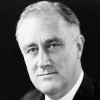
Franklin Delano Roosevelt (1882–1945) American lawyer, politician, statesman; US President (1933–45)
Speech (1936-06-27), Acceptance for Renomination for President, Democratic National Convention, Philadelphia
(Source)
Franklin was quoting Lord Henley, in a milestone English contract law case, Vernon v. Bethell (1762), extending its application to the social contract.
He reiterated during his State of the Union speech (1944-01-11) (delivered by text to Congress, then read by him on a radio broadcast), also known as his "Second Bill of Rights" speech:True individual freedom cannot exist without economic security and independence. "Necessitous men are not free men." People who are hungry and out of a job are the stuff of which dictatorships are made.
Variant: "Necessitous people are not free people."
Quotations about:
take advantage
Note not all quotations have been tagged, so Search may find additional quotes on this topic.
Necessitous men are not, truly speaking, free men, but, to answer a present exigency, will submit to any terms the crafty may impose upon them.
Robert Henley (1708–1772), English jurist, politician; 1st Earl of Northington, Lord High Chancellor of Great Britain (1761–67)
Vernon v. Bethell, 28 Eng. Rep. 838, 839 (Ch. 1762)
(Source)
The case was about a deeply indebted man (Vernon) who agreed to unfair terms in securing a loan against his Antigua sugar plantation from a wealthy customer (Bethell). Henley ruled that Vernon was in such dire financial straits that he was not truly free to negotiate a fair contract.
For more about the court case see here and here.
The core phrase here was adopted by Franklin Roosevelt is some of his speeches, extending the context from contract law to the social contract.

CALVIN’S MOM: There would be more civility in this world if people didn’t take it as an invitation to walk on you.


A critic is someone who enters the battlefield after the war is over and shoots the wounded.
Murray Kempton (1917–1997) American journalist.
(Attributed)
Generally attributed to Kempton (though sometimes as being about editorial writers rather than critics) without specific citation. More on this quote here.

There are but two ways of rising in the world: either by your own industry or by the folly of others.
[Il n’y a au monde que deux manières de s’élever, ou par sa propre industrie, ou par l’imbécillité des autres.]
Jean de La Bruyère (1645–1696) French essayist, moralist
The Characters [Les Caractères], ch. 6 “Of Gifts of Fortune [Des Biens de Fortune],” § 52 (6.52) (1688) [tr. Van Laun (1885)]
(Source)
(Source (French)). Other translations:There is but two ways of rising in the World, by your own Industry, and another's Weakness.
[Bullord ed. (1696)]There are only two ways of rising in the World, by your own Industry, or by the Weakness of others.
[Curll ed. (1713)]There are but two ways of rising in the World, by your own Industry, or the Weakness of others.
[Browne ed. (1752)]There are only two ways of getting on in the world: either by one's own cunning efforts, or by other people's foolishness.
[tr. Stewart (1970)]

You can easily judge the character of a man by how he treats those who can do nothing for him.
Malcolm Forbes (1919–1990) American billionaire
(Attributed)
Quoted in Earl Wilson, "Coco Offered Fatty Arbuckle Role," Hartford Courant (1972-08-06), the earliest reference found for Forbes.
A variant is found (without citation) in The Sayings of Chairman Malcolm (1978):You can easily judge the character of others by how they treat those who can do nothing for them or to them.
Earlier versions of the sentiment can be found by Charles Spurgeon and Paul Eldridge.

Don’t fight forces, use them.
Buckminster Fuller (1895–1983) American architect, engineer
Shelter Magazine (Nov 1932)
The motto of Shelter magazine, when renamed and repurposed by Fuller in 1932 from Philadelphia's old T-Square Club Journal.