All for each, and each for all, is a good motto; but only on condition that each works with might and main to so maintain himself as not to be a burden to others.
Theodore Roosevelt (1858–1919) American politician, statesman, conservationist, writer; US President (1901–09)
Autobiography, Introduction (1913)
(Source)
Quotations about:
mutual responsibility
Note not all quotations have been tagged, so Search may find additional quotes on this topic.
The teaching which I received was genuinely democratic in one way. It was not so democratic in another. I grew into manhood thoroughly imbued with the feeling that a man must be respected for what he made of himself. But I had also, consciously or unconsciously, been taught that socially and industrially pretty much the whole duty of the man lay in thus making the best of himself; that he should be honest in his dealings with others and charitable in the old-fashioned way to the unfortunate; but that it was no part of his business to join with others in trying to make things better for the many by curbing the abnormal and excessive development of individualism in a few.
Theodore Roosevelt (1858–1919) American politician, statesman, conservationist, writer; US President (1901–09)
Autobiography, ch. 1 “Boyhood and Youth” (1913)
(Source)
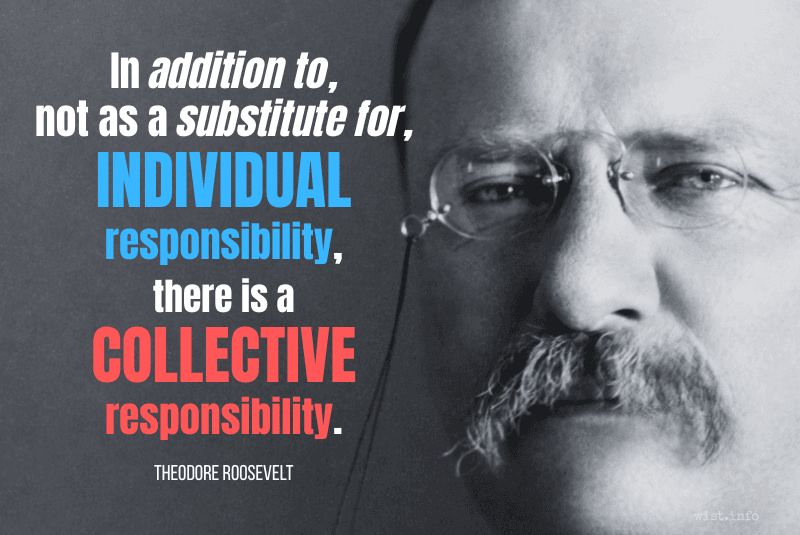
In addition to, not as a substitute for, individual responsibility, there is a collective responsibility.
Theodore Roosevelt (1858–1919) American politician, statesman, conservationist, writer; US President (1901–09)
Autobiography, ch. 1 “Boyhood and Youth” (1913)
(Source)
The first fundamental of successful city life: People must take a modicum of responsibility for each other even if they have no ties to each other. This is a lesson no one learns by being told. It is learned from the experience of having other people without ties of kinship or close friendship or formal responsibility to you take a modicum of responsibility for you.
Jane Jacobs (1916–2006) American-Canadian journalist, author, urban theorist, activist
The Death and Life of Great American Cities, Part 1, ch. 4 (1961)
(Source)

It takes two to speak the truth, — one to speak, and another to hear.
Henry David Thoreau (1817–1862) American philosopher and writer
A Week on the Concord and Marrimack Rivers, “Wednesday” (1849)
(Source)
The care of the Earth is our most ancient and most worthy, and after all, our most pleasing responsibility. To cherish what remains of it, and to foster its renewal, is our only hope.
Wendell Berry (b. 1934) American farmer, educator, poet, conservationist
The Unsettling of America: Culture & Agriculture, ch. 1 (1977)
(Source)