All for each, and each for all, is a good motto; but only on condition that each works with might and main to so maintain himself as not to be a burden to others.
Theodore Roosevelt (1858–1919) American politician, statesman, conservationist, writer; US President (1901–09)
Autobiography, Introduction (1913)
(Source)
Quotations about:
personal responsibility
Note not all quotations have been tagged, so Search may find additional quotes on this topic.
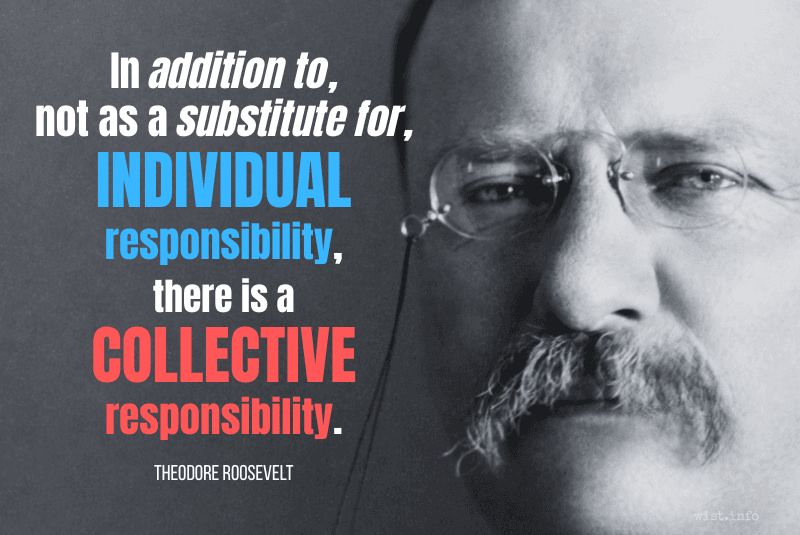
In addition to, not as a substitute for, individual responsibility, there is a collective responsibility.
Theodore Roosevelt (1858–1919) American politician, statesman, conservationist, writer; US President (1901–09)
Autobiography, ch. 1 “Boyhood and Youth” (1913)
(Source)
[… T]he individual virtues, and the necessity of character as the chief factor in any man’s success — a teaching in which I now believe as sincerely as ever, for all the laws that the wit of man can devise will never make a man a worthy citizen unless he has within himself the right stuff, unless he has self-reliance, energy, courage, the power of insisting on his own rights and the sympathy that makes him regardful of the rights of others.
Theodore Roosevelt (1858–1919) American politician, statesman, conservationist, writer; US President (1901–09)
Autobiography, ch. 1 “Boyhood and Youth” (1913)
(Source)
There is also this: when we renounce the self and become part of a compact whole, we not only renounce personal advantage but are also rid of personal responsibility. There is no telling to what extremes of cruelty and ruthlessness a man will go when he is freed from the fears, hesitations, doubts and the vague stirrings of decency that go with individual judgement. When we lose our individual independence in the corporateness of a mass movement, we find a new freedom — freedom to hate, bully, lie, torture, murder and betray without shame and remorse. Herein undoubtedly lies part of the attractiveness of a mass movement.
Eric Hoffer (1902–1983) American writer, philosopher, longshoreman
True Believer: Thoughts on the Nature of Mass Movements, Part 3, ch. 14, § 77 (3.14.77) (1951)
(Source)
One’s philosophy is not best expressed in words; it is expressed in the choices one makes. In stopping to think through the meaning of what I have learned, there is much that I believe intensely, much I am unsure of. In the long run, we shape our lives and we shape ourselves. The process never ends until we die. And, the choices we make are ultimately our own responsibility.
Eleanor Roosevelt (1884–1962) American politician, diplomat, activist; First Lady of the US (1933–45)
You Learn by Living, Foreword (1960)