

FOREIGNER, n. A villain regarded with various and varying degrees of toleration, according to his conformity to the eternal standard of our conceit and the shifting one of our interests.
Ambrose Bierce (1842–1914?) American writer and journalist
“Foreigner,” “Devil’s Dictionary” column, San Francisco Wasp (1884-09-13)
(Source)
Not collected in later books.
Quotations about:
similarity
Note not all quotations have been tagged, so Search may find additional quotes on this topic.

Differences between nations, so long as they do not lead to hostility, are by no means to be deplored. Living for a time in a foreign country makes us aware of merits in which our own country is deficient, and this is true whichever country our own may be. The same thing holds of differences between different regions within one country, and of the differing types produced by different professions. Uniformity of character and uniformity of culture are to be regretted. Biological evolution has depended upon inborn differences between individuals or tribes, and cultural evolution depends upon acquired differences. When these disappear, there is no longer any material for selection. In the modern world, there is a real danger of too great similarity between one region and another in cultural respects. One of the best ways of minimising this evil is an increase in the autonomy of different groups.
Bertrand Russell (1872–1970) English mathematician and philosopher
Lecture (1949-01-23), “Control and Initiative: Their Respective Spheres,” Reith Lecture, “Authority and the Individual” No. 5, BBC Radio
(Source)

I am old now, or at least, I am no longer young, and everything I see reminds me of something else I’ve seen, such that I see nothing for the first time. A bonny girl, her hair fiery red, reminds me only of another hundred such lasses, and their mothers, and what they were as they grew, and what they looked like when they died. It is the curse of age, that all things are reflections of other things.
Neil Gaiman (b. 1960) British author, screenwriter, fabulist
Story (2010), “The Truth Is a Cave in the Black Mountains,” Stories: All-New Tales
(Source)
Reprinted in Trigger Warning (2015).

The delight of social relations between friends is fostered by a shared attitude to life, together with certain differences of opinion on intellectual matters, through which either one is confirmed in one’s own views, or else one gains practice and instruction through argument.
[Le plaisir de la société entre les amis se cultive par une ressemblance de goût sur ce qui regarde les moeurs, et par quelques différences d’opinions sur les sciences: par là ou l’on s’affermit dans ses sentiments, ou l’on s’exerce et l’on s’instruit par la dispute.]
Jean de La Bruyère (1645–1696) French essayist, moralist
The Characters [Les Caractères], ch. 5 “Of Society and Conversation [De la Société et de la Conversation],” § 61 (5.61) (1688) [tr. Stewart (1970)]
(Source)
(Source (French)). Other translations:The pleasure of Society amongst Friends is cultivated by a likeness of Inclinations, as to Manners; and a difference in Opinion, as to Sciences: the one confirms and humours us in our sentiments; the other exercises and instructs us by disputation.
[Bullord ed. (1696)]The Pleasure of Society amongst Friends, is cultivated by a likeness of Inclinations, as to Manners, and by some difference in Opinion, as to Sciences: The one confirms us in our Sentiments, the other exercises and instructs us by Disputation.
[Curll ed. (1713)]The pleasure of social intercourse amongst friends is kept up by a similarity of morals and manners, and by slender differences in opinion about science; this confirms us in our sentiments, exercises our faculties or instructs us through arguments.
[tr. Van Laun (1885)]

History, indeed, is like a picture gallery in which there are few originals and many copies.
[On voit que l’histoire est une galerie de tableaux où il y a peu d’originaux et beaucoup de copies.]
Alexis de Tocqueville (1805–1859) French writer, diplomat, politician
The Old Regime and the Revolution [L’Ancien régime et la Révolution], Book 2, ch. 6 (1856) [tr. Gilbert (1955)]
(Source)
Other translations:History, it is easily perceived, is a picture-gallery containing a host of copies and very few originals.
[tr. Bonner (1856)]One sees that history is an art gallery where there are few originals and many copies.
[tr. Kahan]History is a gallery of pictures in which there are many copies and few originals.

Human beings are more alike than unalike. There’s no real mystique. Every human being, every Jew, Christian, back-slider, Muslim, Shintoist, Zen Buddhist, atheist, agnostic, every human being wants a nice place to live, a good place for the children to go to school, healthy children, somebody to love, the courage, the unmitigated gall, to accept love in return, some place to relax on Saturday or Sunday night, and some place to experience their God.
Maya Angelou (1928–2014) American poet, memoirist, activist [b. Marguerite Ann Johnson]
“The Art of Fiction,” Paris Review, #116, Interview with George Plimpton (1990)
(Source)
A similar passage, from a speech at Ohio Dominican College (9 Dec 1993): "Humans are wonderfully different and marvelously alike. Human being are more alike than unalike. Whether in Paris, Texas, or Paris, France, we all want to have good jobs where we are needed and respected and paid just a little more than we deserve. We want healthy children, safe streets, to be loved and have the unmitigated gall to accept love. If we are religious, we want a place to perpetuate God. If not, we want a good lecture every once in a while. And everyone wants someplace to party on Saturday nights."

Being like everybody is like being nobody.
Rod Serling (1924–1975) American screenwriter, playwright, television producer, narrator
(Attributed)
(Source)
Frequently attributed, but never cited. In the Twilight Zone episode, "Number 12 Looks Just Like You" (ep 05x17), the protagonist comments, "But is that good, being like everybody? I mean, isn't that the same as being nobody?" That episode is credited to Charles Beaumont and John Tomerlin.

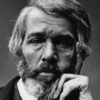
I don’t like to talk much with people who always agree with me. It is amusing to coquette with an echo for a little while, but one soon tires of it.
Thomas Carlyle (1795–1881) Scottish essayist and historian
(Attributed)
Widely attributed to Carlyle, but not found in his writings.This quotation first appears in the late 19th Century -- overlapping Carlyle's actual life -- but I cannot find it any of his written works, and no references I could find provide a source. The likely (non-exclusive) options:Even the early sources I do find use it as column filler, as a stand-alone quotation, or in passing in another writing.
- It was recorded (in an unknown source) from something Carlyle said in conversation or in a lecture not elsewhere recorded.
- The phrasing was early on distorted from Carlyle's actual speech or writing, e.g., for simplification, and that's the version that stuck in popular culture.
In sum, Carlyle very likely said this, or something like it, but it's original source is not recorded online at the present time.
- New England Journal of Education, Vol. 6, No. 10 (1877-09-13)
- Queen's Collage Journal (Supplement), Vol. 5, No. 12 (1878-04-27)
- The Argonaut (1878-07-06)
- Edward C. Bass (ed.), Biographical Hand-Book of the Gem Portrait Gallery, "Gems of Prose and Poetry" (1886)
- Tryon Edwards (ed.), Dictionary of Thoughts, "Conversation" (1891)
- Ann Bachelor (ed.), The Carlyle Year-Book, February 6 (1900)
If men would consider not so much wherein they differ, as wherein they agree, there would be far less of uncharitableness and angry feeling in the world.
Joseph Addison (1672–1719) English essayist, poet, statesman
(Attributed)
Disputed. First attributed to "Addison" in the early 20th Century, in a paper by A. L. Evans, "Unity in Diversity," read before the Massachusetts Osteopathic Society (17 Mar 1906), and by Tryon Edwards, A Dictionary of Thoughts (1908). But this may have been a reference to another man of the same last name who was credited with publishing Interesting Anecdotes, Memoirs, Allegories, Essays, and Poetical Fragments (1794).
