

The various codes which were presented to you at Crossgates — religious, moral, social, and intellectual — contradicted one another of you worked out their implications. The essential conflict was between the tradition of nineteenth-century asceticism and the actually existing luxury and snobbery of the pre-1914 age. On the one side were low-church Bible Christianity, sex puritanism, insistence on hard work, respect for academic distinction, disapproval of self-indulgence: on the other, contempt for “braininess” and worship of games, contempt for foreigners and the working class, an almost neurotic dread of poverty, and, above all, the assumption not only that money and privilege are the things that matter, but that it is better to inherit them than to have to work for them. Broadly, you were bidden to be at once a Christian and a social success, which is impossible.
George Orwell (1903–1950) English journalist, essayist, writer [pseud. of Eric Arthur Blair]
Essay (1948-06), “‘Such, Such Were the Joys …’,” sec. 5, Partisan Review (1952-09)
(Source)
Speaking of the school he attended. This autobiographical essay was drafted around 1939, revised around 1946, and then completed in May or June of 1948. Collected in Such, Such Were the Joys, essay 8 (1953), though the full, unredacted version was not published until 2000.
Quotations about:
social conventions
Note not all quotations have been tagged, so Search may find additional quotes on this topic.

Inherited ideas are a curious thing, and interesting to observe and examine. I had mine, the king and his people had theirs. In both cases they flowed in ruts worn deep by time and habit, and the man who should have proposed to divert them by reason and argument would have had a long contract on his hands.
Mark Twain (1835–1910) American writer [pseud. of Samuel Clemens]
Novel (1889), A Connecticut Yankee in King Arthur’s Court, Part 3 “The Tale of the Lost Land,” ch. 8 “The Boss”
(Source)

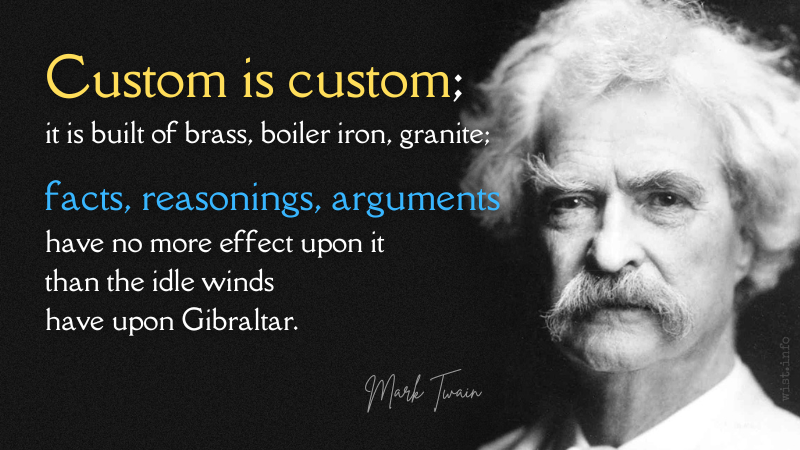
Custom is custom; it is built of brass, boiler iron, granite; facts, reasonings, arguments have no more effect upon it than the idle winds have upon Gibraltar.
Mark Twain (1835–1910) American writer [pseud. of Samuel Clemens]
Essay (1906), “The Gorky Incident,” Letters from the Earth (c. 1909; pub. 1962) [ed. DeVoto (1939)]
(Source)
Commenting on the eviction of Maxim Gorky from multiple hotels in New York City because the woman he was traveling with was not his wife. Twain was a supporter of Gorky's efforts to foment revolution in Tsarist Russia.
The essay was not published in Twain's lifetime. It's original publication was in the Slavonic and East European Review (1944-08), also edited by DeVoto.
Customs do not concern themselves with right or wrong or reason. But they have to be obeyed; one may reason all around them until he is tired, but he must not transgress them, it is sternly forbidden.
Mark Twain (1835–1910) American writer [pseud. of Samuel Clemens]
Essay (1906), “The Gorky Incident,” Letters from the Earth (c. 1909; pub. 1962) [ed. DeVoto (1939)]
(Source)
Commenting on the eviction of Maxim Gorky from multiple hotels in New York City because the woman he was traveling with was not his wife. Twain was a supporter of Gorky's efforts to foment revolution in Tsarist Russia.
The essay was not published in Twain's lifetime. It's original publication was in the Slavonic and East European Review (1944-08), also edited by DeVoto.
Laws are coldly reasoned out and established upon what the lawmakers believe to be a basis of right. But customs are not. Customs are not enacted, they grow gradually up, imperceptibly and unconsciously, like an oak from its seed. In the fullness of their strength they can stand up straight in front of a world of argument and reasoning and yield not an inch.
Mark Twain (1835–1910) American writer [pseud. of Samuel Clemens]
Essay (1906), “The Gorky Incident,” Letters from the Earth (c. 1909; pub. 1962) [ed. DeVoto (1939)]
(Source)
Commenting on the eviction of Maxim Gorky from multiple hotels in New York City because the woman he was traveling with was not his wife. Twain was a supporter of Gorky's efforts to foment revolution in Tsarist Russia.
The essay was not published in Twain's lifetime. It's original publication was in the Slavonic and East European Review (1944-08), also edited by DeVoto.
“Conversation is a minefield until you learn the conventions, Jane dear.”
“I’ll never learn all the rules,” muttered Jane.
“Yes, you will,” said Phryne. “Then you can bend them.”Kerry Greenwood (b. 1954) Australian author and lawyer
Phryne Fisher, Book 13, The Castlemaine Murders, ch. 4 (2003)
(Source)

Laws are sand, customs are rock. Laws can be evaded and punishment escaped, but an openly transgressed custom brings sure punishment. The penalty may be unfair, unrighteous, illogical, and a cruelty; no mater, it will be inflicted, just the same.
Mark Twain (1835–1910) American writer [pseud. of Samuel Clemens]
Essay (1906), “The Gorky Incident,” Letters from the Earth (c. 1909; pub. 1962) [ed. DeVoto (1939)]
(Source)
Commenting on the eviction of Maxim Gorky from multiple hotels in New York City because the woman he was traveling with was not his wife. Twain was a supporter of Gorky's efforts to foment revolution in Tsarist Russia.
The essay was not published in Twain's lifetime. It's original publication was in the Slavonic and East European Review (1944-08), also edited by DeVoto.