When we observe the lives of those whom an ample inheritance has let loose to their own direction, what do we discover that can excite our envy? Their time seems not to pass with much applause from others, or satisfaction to themselves: many squander their exuberance of fortune in luxury and debauchery, and have no other use of money than to inflame their passions, and riot in a wide range of licentiousness; others, less criminal indeed, but surely not much to be praised, lie down to sleep, and rise up to trifle, are employed every morning in finding expedients to rid themselves of the day, chase pleasure through all the places of publick resort, fly from London to Bath, and from Bath to London, without any other reason for changing place, but that they go in quest of company as idle and as vagrant as themselves, always endeavouring to raise some new desire, that they may have something to pursue, to rekindle some hope which they know will be disappointed, changing one amusement for another which a few months will make equally insipid, or sinking into languor and disease for want of something to actuate their bodies or exhilarate their minds.
Samuel Johnson (1709-1784) English writer, lexicographer, critic
Essay (1753-11-27), The Adventurer, No. 111
(Source)
Quotations about:
inheritance
Note not all quotations have been tagged, so Search may find additional quotes on this topic.
But there is another form that life can take. We can learn about it from exceptional people of our own culture, and from other cultures less destructive than ours. I am speaking of the life of a man who knows that the world is not given by his fathers, but borrowed from his children; who has undertaken to cherish it and do it no damage, not because he is duty-bound, but because he loves the world and loves his children; whose work serves the earth he lives on and from and with, and is therefore pleasurable and meaningful and unending; whose rewards are not deferred until “retirement,” but arrive daily and seasonally out of the details of the life of his place; whose goal is the continuance of the life of the world, which for a while animates and contains him, and which he knows he can never encompass with his understanding or desire.
Wendell Berry (b. 1934) American farmer, educator, poet, conservationist
The Unforeseen Wilderness: An Essay on Kentucky’s Red River Gorge, ch. 2 “The One-Inch Journey” (1971)
(Source)
In the quotation above is embedded "the world is not given by his fathers, but borrowed from his children," which appears to be the modern origin of a wide array of quotations to that effect.
The chapter was reprinted as "The One-Inch Journey" in Audubon magazine (1971-05).
The basic phrase and variants first achieved popularity in the early 1970s, showing up in a variety of forms (and often attributed to J. J. Audubon himself). Among those variants:Those variants, and more discussion about the origins of this quotation, can be found at: Quote Origin: We Do Not Inherit the Earth from Our Ancestors; We Borrow It from Our Children – Quote Investigator®.
- We have not inherited the land from our fathers, we have borrowed it from our children.
- We have not inherited the earth from our fathers and are hence entitled to use it according to our wishes. We have rather borrowed it from our children ...
- The world is not given by his fathers but borrowed from his children.
- We don’t inherit the earth from our fathers, we borrow it from our children.
- We have not inherited the earth from our fathers, we are borrowing it from our children.
- We have not inherited the earth from our parents, we have borrowed it from our children.
- We have not inherited the land from our parents, we are borrowing it from our children.
- We do not inherit the Earth from our ancestors, we borrow it from our children.
- We did not inherit the earth from our ancestors; we borrowed it from our descendants.
- We did not inherit our future from our ancestors, we have borrowed it from our children..
Note that in the 1991 edition, the passage in question is omitted in the re-edit:But there is another form that life can take. We can learn about it from exceptional people of our own culture, and from other cultures less destructive than ours. I am speaking of the lives of people who have undertaken to cherish the world and do it no damage, not because they are duty-bound, but because they love the world and love their children; whose work serves the earth they live on and from and with, and is therefore pleasurable and meaningful and unending; whose rewards are not deferred until “retirement,” but arrive daily and seasonally out of the details of the life of their place; whose goal is the continuance of the life of the world, which for a while animates and contains them, and which they know they can never encompass with their understanding or desire.


They exchanged rings. The rings were a matching pair of gold bands, left to Daniel by his parents, who had known he could never afford to buy his own. It gave her pause for thought, how after all these years, somehow, the dead still looked after the living.
Joan Slonczewski (b. 1956) American microbiologist and writer
The Wall around Eden, ch. 25 (1989)
(Source)

The rich man’s son inherits cares;
The bank may break, the factory burn,
A breath may burst his bubble shares,
And soft, white hands could hardly earn
A living that would serve his turn;
A heritage, it seems to me,
One would not care to hold in fee.James Russell Lowell (1819-1891) American diplomat, essayist, poet
Poem (1843-12), “The Heritage,” st. 2, The Knickerbocker, Vol. 22., No. 6
(Source)
In later collections, the last line reads, "One scarce would wish to hold in fee."
ORESTES: Ye Gods! There’s no art to tell a decent man,
since generations work haphazardly.
I’ve encountered worthless men, the sons
of noble fathers; good men born from bad;
and I’ve seen hunger in a rich man’s mind,
a poor man’s body housing thoughts sublime.[ὈΡΈΣΤΗΣ: φεῦ:
οὐκ ἔστ᾽ ἀκριβὲς οὐδὲν εἰς εὐανδρίαν:
ἔχουσι γὰρ ταραγμὸν αἱ φύσεις βροτῶν.
ἤδη γὰρ εἶδον ἄνδρα γενναίου πατρὸς
τὸ μηδὲν ὄντα, χρηστά τ᾿ ἐκ κακῶν τέκνα,
λιμόν τ᾿ ἐν ἀνδρὸς πλουσίου φρονήματι,
γνώμην δὲ μεγάλην ἐν πένητι σώματι.]Euripides (485?-406? BC) Greek tragic dramatist
Electra [Ἠλέκτρα], l. 367ff (c. 420 BC) [tr. Wilson (2016)]
(Source)
(Source (Greek)). Alternate translations:There is no certain mark of generous souls:
For in the tempers of mankind prevails
A strange confusion. I have seen the son
Of a great father dwindle into nothing.
And virtuous children spring from wicked Sires;
Among the rich a mean contracted spirit
Have I discover'd, and the poor man's breast
Withi most exalted sentiments inspir'd.
[tr. Wodhull (1809)]Ah! there is no sure mark to recognize a man's worth; for human nature hath in it an element of confusion. For I have seen ere now the son of a noble sire prove himself a worthless knave, and virtuous children sprung from evil parents; likewise dearth in a rich man's spirit, and in a poor man's frame a mighty soul.
[tr. Coleridge (1891)]Alas! there is no sure mark of manliness; for the natures of mortals exhibit a confusion. For already have I seen a man who was naught sprung from a noble sire, and good children [sprung] from bad [fathers[,. and hunger in the spirit of a rich man, and a great mind in a poor body.
[tr. Buckley (1892)]Lo, there is no sure test for manhood’s worth:
For mortal natures are confusion-fraught. --
I have seen ere now a noble father’s son
Proved nothing-worth, seen good sons of ill sires,
Starved leanness in a rich man’s very soul,
And in a poor man’s body a great heart.
[tr. Way (1896)]How dark lies honour hid! And what turmoil
In all things human: sons of mighty men
Fallen to naught, and from ill seed again
Good fruit: yea, famine in the rich man's scroll
Writ deep, and in poor flesh a lordly soul.
[tr. Murray (1905)]Ah! There is no exact way to test a man's worth; for human nature has confusion in it. I have seen before now the son of a noble father worth nothing, and good children from evil parents; famine in a rich man's spirit, and a mighty soul in a poor man's body.
[tr. Coleridge (1938 ed.)]It is impossible to judge a man’s virtue with accuracy. There’s always great confusion in the nature of mortals. I, myself, have seen worthless children born of a virtuous man and from evil parents born brilliant children. I have seen a small, poor mind in a wealthy man and in the soul of a poor man, a great one.
[tr. Theodoridis (2006)]Well, nothing is precise
when it comes to how a man is valued --
men’s natures are confusing. Before this,
I’ve seen a man worth nothing, yet he had
a noble father; I’ve known evil parents
with outstanding children, seen famine
in a rich man’s mind and a great spirit
in a poor man’s body.
[tr. Johnston (2009)]I have known a man of a noble father who turns out
To be nothing while powerful men can rise from the low.
I have seen emptiness in a rich man’s thought
And great judgement in a poor person’s frame.
[tr. @sententiq (2020)]
Earthly riches can neither bless us nor our children with happiness; we must either lose them in this life or leave them to be enjoyed after our death by one, we cannot tell whom, perhaps by those we would not should have them.
[Felices enim uel nos uel filios nostros non diuitiae terrenae faciunt aut nobis uiuentibus amittendae aut nobis mortuis a quibus nescimus uel forte a quibus nolumus possidendae.]Augustine of Hippo (354-430) Christian church father, philosopher, saint [b. Aurelius Augustinus]
City of God [De Civitate Dei], Book 5, ch. 18 (5.18) (AD 412-416) [tr. Healey (1610)]
(Source)
(Source (Latin)). Alternate translations:For it is not earthly riches which make us or our sons happy; for they must either be lost by us in our lifetime, or be possessed when we are dead, by whom we know not, or perhaps by whom we would not.
[tr. Dods (1871)]The riches of this earth can make neither us nor our children happy, if they are to be lost while we are alive or, after we are dead, are to pass to people we do not know or, perhaps, dislike.
[tr. Zema/Walsh (1950)]For neither we nor our children are made happy by earthly riches, since they are bound either to be lost while we are living or to be acquired after our death by persons unknown and perhaps unwelcome.
[tr. Green (Loeb) (1963)]Happiness, whether for us or for our children, is not the result of earthly riches, which must either be lost by us in our lifetime or else must pass after our death into the possession of those we do not know or, it may be, of those whom we do not wish to have them.
[tr. Bettenson (1972)]For neither we nor our sons are made happy by earthly riches. These things must either be lost while we are still alive or, after we are dead, acquired by someone whom we do not know, or perhaps by someone whom we would not wish to have them.
[tr. Dyson (1998)]For earthly riches do not make either us or our children happy; they will either be lost while we are still alive or will pass, after our death, to someone we do not know or even to someone we do not want.
[tr. Babcock (2012)]

Thou art an heyre to fayre lyving, that is nothing, if thou be disherited of learning, for better were it to thee to inherite righteousnesse then riches, and far more seemely were it for thee to have thy Studie full of bookes, then thy pursse full of mony: to get goods is the benefit of Fortune, to keepe them the gift of Wisedome.
[Thou art an heir to fair living; that is nothing if thou be disinherited of learning, for better were it to thee to inherit righteousness than riches and far more seemly were it for thee to have thy study full of books than thy purse full of money. To get goods is the benefit of fortune, to keep them the gift of wisdom. (1916 ed.)]John Lyly (c. 1553-1606) was an English writer [also Lilly or Lylie]
Euphues: The Anatomy of Wit, “Letter to Alcius” (1579)
(Source)

Whence had you this illustrious name?
From virtue and unblemish’d fame.
By birth the name alone descends;
Your honour on yourself depends:
Think not your coronet can hide
Assuming ignorance and pride.
Learning by study must be won,
‘Twas ne’er entail’d from son to son.John Gay (1685-1732) English poet and playwright
“The Pack-Horse and Carrier (To a young Nobleman),” ll. 41-42
(Source)
Some printings of the poem leave off the prologue, of which this is a part.
The root of human virtue seldom bears
Like branches; and the Giver wills it so,
That men may know it is His gift, not theirs.
[Rade volte risurge per li rami
l’umana probitate; e questo vole
quei che la dà, perché da lui si chiami.]Dante Alighieri (1265-1321) Italian poet
The Divine Comedy [Divina Commedia], Book 2 “Purgatorio,” Canto 7, l. 121ff (7.121-123) (1314) [tr. Sayers (1955)]
(Source)
Dante noting that the sons of great kings rarely measure up to their fathers, a reminder from God that those who would be great must seek His blessing, not rely on their heritage.
(Source (Italian)). Alternate translations:Rarely into the branches of the tree
Doth human worth mount up; and so ordains
He who bestows it, that as his free gift
It may be call’d.
[tr. Cary (1814)]Rarely shoots merit up into the boughs,
Or human worth; and such the will of Him,
That from the Donor they should seem to come.
[tr. Bannerman (1850)]Not oftentimes upriseth through the branches
The probity of man; and this He wills
Who gives it, so that we may ask of Him.
[tr. Longfellow (1867)]Seldom rises human goodness through the branches; and this wills He who gives it in order that from Him it may be claimed.
[tr. Butler (1885)]But rarely in the branch again is grown
Our human excellence, so willeth He
Who gives it, that the boon be called His own.
[tr. Minchin (1885)]Rarely doth human goodness rise through the branches, and this He wills who gives it, in order that it may be asked from Him.
[tr. Norton (1892)]Rarely doth human probity rise through the sons branches:
and this he wills who giveth it,
so that it may be prayed for from him.
[tr. Okey (1901)]Rarely does human worth rise through the branches, and this He wills who gives it, that it may be sought from Him.
[tr. Sinclair (1939)]Full seldom human virtue rises through
The branches; and the Giver wills it so,
That they to him for such a gift may sue.
[tr. Binyon (1943)]Rare is the tree that lifts to every limb
the sap of merit -- He who gives, so wills
that men may learn to beg their best from Him.
[tr. Ciardi (1961)]Rarely does human worth rise through the branches, and this He wills who gives it, in order that it may be asked from Him.
[tr. Singleton (1973)]Not often does the sap of virtue rise
to all the branches. This is His own gift,
and we can only beg that He bestow it.
[tr. Musa (1981)]Rarely does human worth rise through the branches;
That is the will of him whose gift it is,
So that it should be matter for petition.
[tr. Sisson (1981)]How seldom human worth ascends from branch to branch,
and this is willed by Him who grants that gift,
that one may pray to Him for it!
[tr. Mandelbaum (1982)]Seldom does human probity rise up through the branches, and this is willed by him who gives it, that it may be attributed to him.
[tr. Durling (2003)]Human worth rarely increases through its branches: and this He wills who creates it, so that it may be asked for of him.
[tr. Kline (2002)]It seldom happens that man’s probity
will rise through every branch. He wills it thus,
so, given from beyond, it’s known as His.
[tr. Kirkpatrick (2007)]Rarely does human worth rise through the branches.
And this He wills who gives it,
so that it shall be sought from Him.
[tr. Hollander/Hollander (2007)]Goodness rarely flows to the spreading branches
Of a family tree, for God who gives it decrees
That since the gift is His, humans must ask it.
[tr. Raffel (2010)]

“Yet doth he live!” exclaims th’ impatient heir,
And sighs for sables which he must not wear.
But the best inheritance that fathers can give their children, more precious than any patrimony however large, is a reputation for virtue and for worthy deeds, which if the child disgraces, his conduct should be branded as infamous and impious.
[Optima autem hereditas a patribus traditur liberis omnique patrimonio praestantior gloria virtutis rerumque gestarum, cui dedecori esse nefas et vitium iudicandum est.]
Marcus Tullius Cicero (106-43 BC) Roman orator, statesman, philosopher
De Officiis [On Duties; On Moral Duty; The Offices], Book 1, ch. 33 (1.33) / sec. 121 (44 BC) [tr. Peabody (1883)]
(Source)
(Source (Latin)). Alternate translation:Now the noblest inheritance that can ever be left by a father to his son, and far exceeding that of houses and lands, is the fame of his virtues and glorious actions; and for a son to live so, as is unworthy of the name and reputation of his ancestors, is the basest and most abominable thing in the world.
[tr. Cockman (1699)]The best inheritance left by a father to his children, superior to every other patrimony, is the honor of a virtuous conduct, and the glory of his public transactions. And it is base and criminal by an unworthy conduct, to bring disgrace upon a father's reputation.
[tr. McCartney (1798)]Now, the best inheritance a parent can leave a child -- more excellent than any patrimony -- is the glory of his virtue and his deeds; to bring disgrace on which ought to be regarded as wicked and monstrous.
[tr. Edmonds (1865)]The noblest heritage, the richest patrimony a father can bequeath to his children is a reputation for virtue and noble deeds. To tarnish his good name is a sin and a crime.
[tr. Gardiner (1899)]The best legacy a father can leave to his children, a legacy worth far more than the largest patrimony, is the fame of a virtuous and well-spent life. He who disgraces such a bequest is deserving of infamy.
[ed. Harbottle (1906)]The noblest heritage, however, that is handed down from fathers to children, and one more precious than any inherited wealth, is a reputation for virtue and worthy deeds; and to dishonour this must be branded as a sin and a shame.
[tr. Miller (1913)]The best heritage that descends from fathers to sons is the fame for honesty and great deeds. Such fame surpasses any legacy. We must judge it a crime and a shame to disgrace it.
[tr. Edinger (1974)]
Be civil, then, to young and old,
Especially to persons who
Possess a quantity of gold
Which they might leave to you.
The more they have, it seems to me,
The more polite you ought to be.Harry Graham (1874-1936) English journalist, poet, stage lyricist
“Politeness”
I will enjoy the pleasure of what I give by giving it alive, and seeing another enjoy it. When I die, I should be ashamed to leave enough to build me a monument if there were a wanting friend above ground.
Alexander Pope (1688-1744) English poet
Letter to Jonathan Swift (9 Oct 1729)
If your descent is from heroic sires,
Show in your life a remnant of their fires.[Si vous êtes sorti de ces héros fameux,
Montrez-nous cette ardeur qu’on vit briller en eux.]Nicolas Boileau-Despréaux (1636-1711) French poet and critic
Satires, Satire 5, l. 43 (1716)
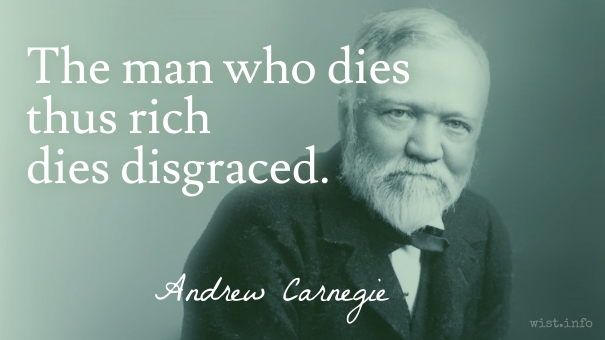
Yet the day is not far distant when the man who dies leaving behind him millions of available wealth, which was his to administer during his life, will pass away “unwept, unhonoured and unsung,” no matter to what uses he leaves the dross which he cannot take with him. The man who dies thus rich dies disgraced.
Andrew Carnegie (1835-1919) American industrialist and philanthropist
“The Gospel of Wealth,” Part 1, North American Review (1889-06)
(Source)
Collected in The Gospel of Wealth and Other Timely Essays (1900).
Of all the questions which can come before this nation, short of the actual preservation of its existence in a great war, there is none which compares in importance with the great central task of leaving this land even a better land for our descendants than it is for us, and training them into a better race to inhabit the land and pass it on. Conservation is a great moral issue for it involves the patriotic duty of insuring the safety and continuance of the nation.
Theodore Roosevelt (1858-1919) American politician, statesman, conservationist, writer, US President (1901-1909)
Speech (1910-08-31), “The New Nationalism,” John Brown Memorial Park dedication, Osawatomie, Kansas
(Source)
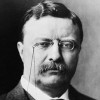
Conservation means development as much as it does protection. I recognize the right and duty of this generation to develop and use the natural resources of our land; but I do not recognize the right to waste them, or to rob, by wasteful use, the generations that come after us. I ask nothing of the nation except that it so behave as each farmer here behaves with reference to his own children. That farmer is a poor creature who skins the land and leaves it worthless to his children. The farmer is a good farmer who, having enabled the land to support himself and to provide for the education of his children leaves it to them a little better than he found it himself. I believe the same thing of a nation.
Theodore Roosevelt (1858-1919) American politician, statesman, conservationist, writer, US President (1901-1909)
Speech (1910-08-31), “The New Nationalism,” John Brown Memorial Park dedication, Osawatomie, Kansas
(Source)
No man should receive a dollar unless that dollar has been fairly earned. Every dollar received should represent a dollar’s worth of service rendered — not gambling in stocks, but service rendered. The really big fortune, the swollen fortune, by the mere fact of its size acquires qualities which differentiate it in kind as well as in degree from what is possessed by men of relatively small means. Therefore, I believe in a graduated income tax on big fortunes, and in another tax which is far more easily collected and far more effective — a graduated inheritance tax on big fortunes, properly safeguarded against evasion and increasing rapidly in amount with the size of the estate.
Theodore Roosevelt (1858-1919) American politician, statesman, conservationist, writer, US President (1901-1909)
Speech (1910-08-31), “The New Nationalism,” John Brown Memorial Park dedication, Osawatomie, Kansas
(Source)
Therefore it is fitting for the women to be married at about the age of eighteen and the men at thirty-seven or a little before — for that will give long enough for the union to take place with their bodily vigor at its prime, and for it to arrive with a convenient coincidence of dates at the time when procreation ceases. Moreover the succession of the children to the estates, if their birth duly occurs soon after the parents marry, will take place when they are beginning their prime, and when the parents’ period of vigor has now come to a close, towards the age of seventy.
Aristotle (384-322 BC) Greek philosopher
Politics [Πολιτικά], Book 7, ch. 16 / 1335a.27 [tr. Rackham (1932)]
(Source)
Alt. trans.:And so it is best to unite women of about eighteen years of age and men of thirty-seven or less; for by such an arrangement the union will be during their greatest physical perfection, and will, as the years pass reach the limit of child-begetting at the right time. Again, the succession of children will be secured, as the younger generation will be having children at the beginning of their prime, supposing some to be born at once, as we may expect, and as the right age has passed away from the older generation as they approach the limit of seventy years.
[tr. Bolland (1877)]Women should marry when they are about eighteen years of age, and men at seven and thirty; then they are in the prime of life, and the decline in the powers of both will coincide. Further, the children, if their birth takes place soon, as may reasonably be expected, will succeed in the beginning of their prime, when the fathers are already in the decline of life, and have nearly reached their term of three-score years and ten.
[tr. Jowett (1885)]For which reason the proper time for a woman to marry is eighteen, for a man thirty-seven, a little more or less; for when they marry at that time their bodies are in perfection, and they will also cease to have children at a proper time; and moreover with respect to the succession of the children, if they have them at the time which may reasonably be expected, they will be just arriving into perfection when their parents are sinking down under the load of seventy years.
[tr. Ellis (1912)]Hence it is fitting for women to unite in marriage around the age of eighteen, and for men at thirty-seven or a little before. At such an age, union will occur when their bodies are in their prime, and will arrive at its conclusion conveniently for both of them with respect to the cessation of procreation. Further, the succession of the offspring -- if birth occurs shortly after marriage, as can reasonably be expected -- will be for them at the beginning of their prime, while for the fathers it will be when their age has already run its course toward the seventieth year.
[tr. Lord (1984)]