CHORUS: It is right for women to stand by a woman’s cause.
[ΧΟΡΟΣ: γυναῖκα γὰρ δὴ συμπονεῖν γυναικὶ χρή.]
Euripides (485?-406? BC) Greek tragic dramatist
Helen [Ἑλένη], l. 329 (412 BC) [tr. Lattimore (1956)]
(Source)
Encouraging Helen to learn more about her husband's fate from the prophetess Theonoë, and offering to go with her.(Source (Greek)). Other translations:Thus a woman ought
With friendly aid to share a woman's cares.
[tr. Potter (1783), l. 370ff]For 'tis a woman's duty to exert
Her utmost efforts in a woman's cause.
[tr. Wodhull (1809)]For it is meet that a woman should with a woman labor.
[tr. Buckley (1850)]For, truly, women ought to help each other.
[tr. Coleridge (1891)]That woman woman's burden share, is meet.
[tr. Way (Loeb) (1912)]Women in woman's need must sympathise.
[tr. Sheppard (1925)]For women ought to give each other helping hands.
[tr. Warner (1951)]Women ought to help each other.
[tr. Vellacott (1954)]We are all women;
and it is right for us to shoulder one another's burdens.
[tr. Meagher (1986)]Women should support one another.
[tr. Davie (2002)]For 'tis a woman's bounden duty to share a sister's trouble.
[tr. Athenian Society (2006)]Women should stick together, and help each other out.
[tr. A. Wilson (2007)]We women must help one another.
[tr. Theodoridis (2011)]For woman must with woman toil.
[tr. Ambrose et al. (2018)]For, truly, women ought to help each other.
[tr. Coleridge / Helen Heroization Team]
Quotations about:
mutual support
Note not all quotations have been tagged, so Search may find additional quotes on this topic.
Great perils have this beauty, that they bring to light the fraternity of strangers.
[Les grands périls ont cela de beau qu’ils mettent en lumière la fraternité des inconnus.]
Victor Hugo (1802-1885) French writer
Les Misérables, Part 4 “Saint Denis,” Book 12 “Corinth,” ch. 4 (4.12.4) (1862) [tr. Wilbour (1862)]
(Source)
On the varied Parisians working together at building the barricades.
(Source (French)). Alternate translations:Great dangers have this beauty about them, that they throw light on the fraternity of strangers.
[tr. Wraxall (1862)]Great perils have this fine characteristic, that they bring to light the fraternity of strangers.
[tr. Hapgood (1887)]It is the ennobling quality of danger that it brings to light the fraternity of strangers.
[tr. Denny (1976)]Great perils share this beauty, that they bring to light the fraternity of strangers.
[tr. Wilbour/Fahnestock/MacAfee (1987)]That is the beauty of great danger, it brings out the fraternity of strangers.
[tr. Donougher (2013)]
Cry with me;
for sharing tears with others is relief in hardship.[συνάλγησον, ὡς ὁ κάμνων
δακρύων μεταδοὺς ἔχει
χουφότητα μόχϑων.]Euripides (485?-406? BC) Greek tragic dramatist
Andromeda [Ανδρομέδα], frag. 119 (TGF) (412 BC)
(Source)
Nauck frag. 119, Barnes frag. 51, Musgrave frag. 22. (Source (Greek)). Alternate translation.Come, let us weep together; for the unhappy
Find social tears their poignant griefs assuage.
[tr. Wodhull (1809)]
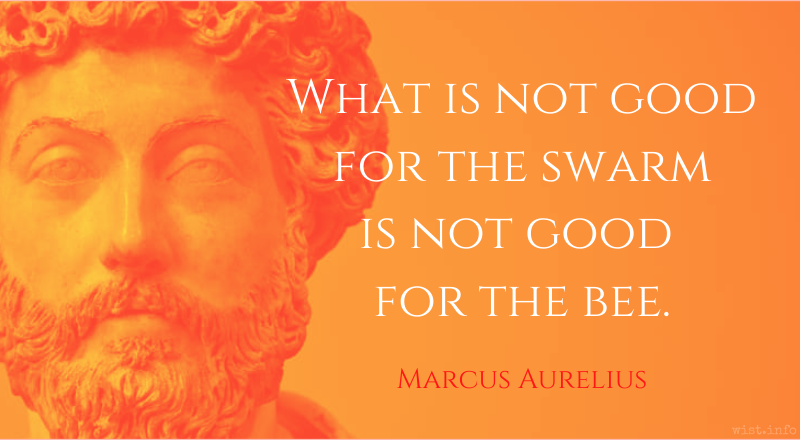
What is not good for the swarm is not good for the bee.
[Τὸ τῷ σμήνει μὴ συμφέρον οὐδὲ τῇ μελίσσῃ συμφέρει.]
Marcus Aurelius (AD 121-180) Roman emperor (161-180), Stoic philosopher
Meditations [To Himself; Τὰ εἰς ἑαυτόν], Book 6, ch. 54 (6.54) (AD 161-180) [tr. Rendall (1898)]
(Source)
(Source (Greek)). Alternate translations:That which is not good for the beehive, cannot be good for the bee.
[tr. Casaubon (1634), 6.49]That which is not for the Interest of the whole Swarm, is not for the Interest of a single Bee.
[tr. Collier (1701); Collier/Zimmern (1887)]What is not the interest of the hive, is not the interest of the bee.
[tr. Hutcheson/Moor (1742)]That which is not for the interest of the whole hive, cannot be so for any single bee.
[tr. Graves (1792), 6.48]That which is not good for the swarm, neither is it good for the bee.
[tr. Long (1862)]What profits not the swarm profits not the bee.
[tr. Hutcheson/Chrystal (1902)]That which is not in the interests of the hive cannot be in the interests of the bee.
[tr. Haines (Loeb) (1916)]What does not benefit the hive is no benefit to the bee.
[tr. Farquharson (1944)]What is no good for the hive is no good for the bee.
[tr. Staniforth (1964)]What brings no benefit to the hive brings none to the bee.
[tr. Hard (1997 ed.)]What injures the hive injures the bee.
[tr. Hays (2003)]What does not benefit the hive does not benefit the bee either.
[tr. Hammond (2006)]What brings no benefit to the hive brings none to the bee.
[tr. Hard (2011 ed.)]What does not benefit the hive does not benefit the bee.
[tr. Gill (2013)]

Nothing is to be done out of jealousy or vanity; instead, out of humility of mind everyone should give preference to others, everyone pursuing not selfish interests but those of others.
[μηδὲν κατ᾽ ἐριθείαν μηδὲ κατὰ κενοδοξίαν ἀλλὰ τῇ ταπεινοφροσύνῃ ἀλλήλους ἡγούμενοι ὑπερέχοντας ἑαυτῶν, μὴ τὰ ἑαυτῶν ἕκαστος σκοποῦντες ἀλλὰ [καὶ] τὰ ἑτέρων ἕκαστοι.]
The Bible (The New Testament) (AD 1st - 2nd C) Christian sacred scripture
Philippians 2: 3-4 [NJB (1985)]
(Source)
(Source (Greek)). Alternate translations:Let nothing be done through strife or vainglory; but in lowliness of mind let each esteem other better than themselves. Look not every man on his own things, but every man also on the things of others.
[KJV (1611)]There must be no competition among you, no conceit; but everybody is to be self-effacing. Always consider the other person to be better than yourself, so that nobody thinks of his own interests first but everybody thinks of other s people's interests instead.
[JB (1966)]Don't do anything from selfish ambition or from a cheap desire to boast, but be humble toward one another, always considering others better than yourselves. And look out for one another's interests, not just for your own.
[GNT (1992 ed.)]Don’t do anything for selfish purposes, but with humility think of others as better than yourselves. Instead of each person watching out for their own good, watch out for what is better for others.
[CEB (2011)]Do nothing from selfishness or empty conceit, but with humility consider one another as more important than yourselves; do not merely look out for your own personal interests, but also for the interests of others.
[NASB (2020 ed)]Do nothing from selfish ambition or empty conceit, but in humility regard others as better than yourselves. Let each of you look not to your own interests but to the interests of others.
[NRSV (2021 ed.)]

To be of no church is dangerous. Religion, of which the rewards are distant, and which is animated only by faith and hope, will glide by degrees out of the mind unless it be invigorated and reimpressed by external ordinances, by stated calls to worship, and the salutary influence of example.
Samuel Johnson (1709-1784) English writer, lexicographer, critic
Lives of the Most Eminent English Poets, “Milton” (1781)
(Source)
Also known as Lives of English Poets and Lives of the Poets.