

You quickly remove something from your eye that hurts it:
if rot is eating at your soul, why postpone the cure a year?[Nam cur
quae laedunt oculum festinas demere; si quid
est animum, differs curandi tempus in annum?]Horace (65–8 BC) Roman poet, satirist, soldier, politician [Quintus Horatius Flaccus]
Epistles [Epistularum, Letters], Book 1, ep. 2 “To Lollius,” l. 37ff (1.2.37-39) (20 BC) [tr. Fuchs (1977)]
(Source)
(Source (Latin)). Other translations:Yea, thoughe thou be awake,
A little mote out of thyne eye why doste thou haste to take?
If oughte there be that noyes thy minde moste parte thou arte contente
Or thou begin to cure the same to seeke an whole yeare spente.
[tr. Drant (1567)]If a Fly
Get in thy Eye, 'tis puld out instantly:
But if thy Mindes Ey's hurt, day after day
That Cure's deferr'd.
[tr. Fanshawe; ed. Brome (1666)]You'l move an Eye-soar streight; and is it sence,
To let the Mind be cur'd a Twelve-moneth hence?
[tr. "Dr. W."; ed. Brome (1666)]For why, when any thing offends thy Eyes,
Dost thou streight seek for ease, and streight advise
Yet if it shall oppress thy Mind, endure
The ills with Patience, and defer the Cure?
[tr. Creech (1684)]For the hurt eye an instant cure you find;
Then why neglect, for years, the sickening mind?
[tr. Francis (1747)]How strange is this! if ought the eye offends,
You straight remove it and the anguish ends;
If ought corrodes the mind, some slight pretence
Serves to protract the cure a twelve-month hence.
[tr. Howes (1845)]For why do you hasten to remove things that hurt your eyes, but if any thing gnaws your mind, defer the time of curing it from year to year?
[tr. Smart/Buckley (1853)]You lose no time in taking out a fly,
Or straw, it may be, that torments your eye;
Why, when a thing devours your mind, adjourn
Till this day year all thought of the concern?
[tr. Conington (1874)]Let but a speck of dust distress your eye,
You rest not till you're rid of it; then why,
If 'tis your mind that's out of sorts, will you
Put off the cure with "Any time will do"?
[tr. Martin (1881)]Anything which injures eyesight you will at once remove, why then, if anything injures the mind, do you delay for a whole year to heal it?
[tr. Elgood (1893)]Why indeed are you in a hurry to remove things which hurt the eye, while if aught is eating into your soul, you put off the time for cure till next year?
[tr. Fairclough (Loeb) (1926)]Why hurry so to take out that mote from your eye,
But put off until next year the time to take steps
To arrest your soul erosion?
[tr. Palmer Bovie (1959)]You run to the doctor if anything sticks in your eye,
But leave your sick soul to be cured some other time,
Some other year!
[tr. Raffel (1983)]If you had a sty, you'd be in a hurry to cure it;
If the sickness is in your soul, why put it off?
[tr. Ferry (2001)]Why so quick to remove
a speck of dirt from your eye? And yet, if anything eats at
your soul, you say: ‘Time enough to attend to it next year’.
[tr. Rudd (2005 ed.)]Why so quick to remove a speck from your eye, when
If it’s your mind, you put off the cure till next year?
[tr. Kline (2015)]
Quotations about:
mental health
Note not all quotations have been tagged, so Search may find additional quotes on this topic.
A good conscience is to the Soul what health is to the body; it preserves a constant ease and serenity within us, and more than countervails all the calamities and afflictions which can possibly befall us.
Joseph Addison (1672-1719) English essayist, poet, statesman
Essay (1713-08-15), The Guardian, No. 135
(Source)
The ability to play is one of the principal criteria of mental health.
Ashley Montagu (1905-1999) British-American anthropologist and humanist [b. Israel Ehrenberg, a/k/a Montague Francis Ashley-Montagu]
Growing Young (1981)
(Source)
In the 2nd edition (1989), Montagu rephrased this a bit less prosaically: "Play is, of course, among the clearest of neotenous behavioral traits; it is the neoteny of the intellect, a principal criterion of mental health." Montagu uses the term "neoteny" to mean "growing young."
For such is the work of philosophy. It cures souls, draws off vain anxieties, confers freedom from desires, drives away fears.
[Nam efficit hoc philosophia: medetur animis, inanes sollicitudines detrahit, cupiditatibus liberat, pellit timores.]
Marcus Tullius Cicero (106-43 BC) Roman orator, statesman, philosopher
Tusculan Disputations [Tusculanae Disputationes], Book 2, ch. 4 (2.4) / sec. 11 [Marcus] (45 BC) [tr. Peabody (1886)]
(Source)
Original Latin. Alternate translations:This is the proper work of Philosophy, it healeth the Distempers of the mind, removeth vain Disquiets, sets free from impetuous Desires, banisheth Fears
[tr. Wase (1643)]For it is the effect of philosophy, which is the medicine of our souls; it discharges all groundless apprehensions, frees us from desires, drives away fears.
[tr. Main (1824)]For such is the effect of philosophy. She heals the mind, banishes its vain solicitudes, delivers it from the chains of cupidity, expels its fearful apprehensions.
[tr. Otis (1839)]It is the effect of philosophy, which is the medicine of our souls; it banishes all groundless apprehensions, frees us from desires, and drives away fears.
[tr. Yonge (1853)]It is the effect of philosophy. It provides medicine for teh soul, takes away futile worries, frees us from desires, banishes fears.
[tr. Davie (2017)]
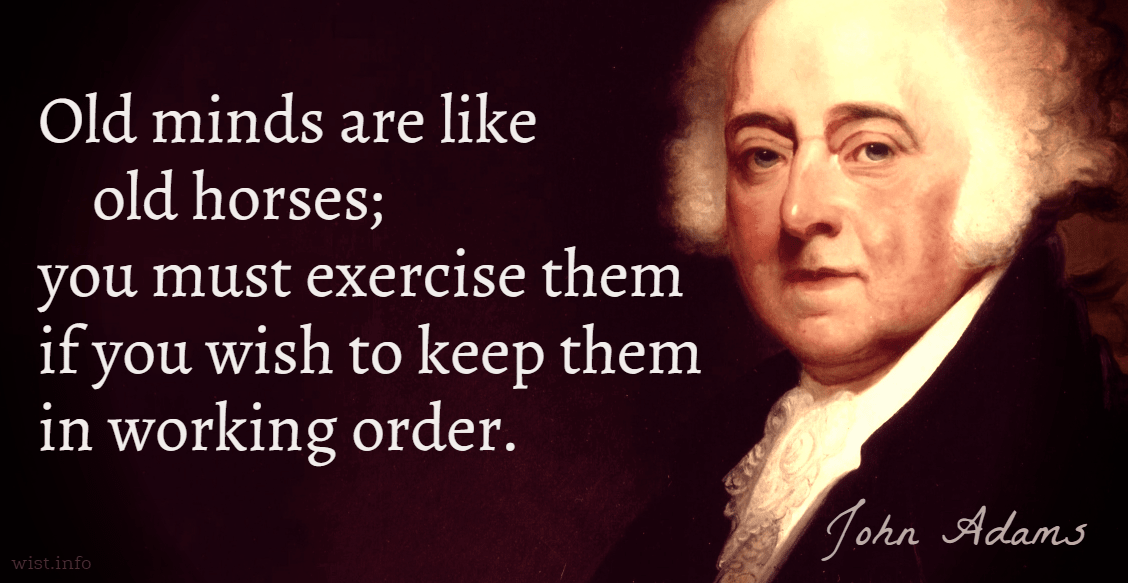
Old minds are like old horses; you must exercise them if you wish to keep them in working order.
John Adams (1735–1826) American lawyer, Founding Father, statesman, US President (1797–1801)
(Attributed)
(Source)
Attributed by Josiah Quincy III, as described anecdotally in L. Maria Child's essay "Hints About Health," collected in her book Looking Toward Sunset: From Sources Old and New, Original and Selected (1865). Child describes Quincy attributing his own long life and acuity to the above advice given by Adams when Adams was asked how his mind was so vigorous in old age.
At one point I had this exchange sourced as being a letter from Adams to Quincy (1825-02-14). I am at present unable to find a record or reference online of such a letter.
Sometimes (perhaps due to the recipient's name), the quote is misattributed to Adams' son, John Quincy Adams.

Philosophy directs us first to seek the goods of the mind, and the rest will either be supplied, or are not much wanted.
Francis Bacon (1561-1626) English philosopher, scientist, author, statesman
Advancement of Learning, 8.2 (1605)

For the renown which riches or beauty confer is fleeting and frail; mental excellence is a splendid and lasting possession.
[Nam divitiarum et formae gloria fluxa atque fragilis est, virtus clara aeternaque habetur.]
Sallust (c. 86-35 BC) Roman historian and politician [Gaius Sallustius Crispus]
Bellum Catilinae [The War of Catiline; The Conspiracy of Catiline], ch. 1, sent. 4 [tr. Rolfe (1931)]
(Source)
Original Latin. Alt. trans.:
- "For what are all the advantages of wealth, and all the graces of form and feature? mere precarious gifts, that soon fade and moulder away. It is virtue, and virtue only, that ennobles the human character, and lives in the memory of the after-times." [tr. Murphy (1807)]
- "For the splendour derived from riches and beauty is short-lived and frail, virtue alone confers immortality." [tr. Rose (1831)
- "For the glory of riches and beauty is fickle and frail; virtue is accounted bright and everlasting." [Source (1841)]
- "For the glory of wealth and beauty is fleeting and perishable; that of intellectual power is illustrious and immortal." [tr. Watson (1867)]
- "The glory of wealth and beauty is fleeting and frail, but personal merit is held in eternal honour." [tr. Pollard (1882)]
- "The glory of riches and appearance is fleeting and fragile, but to have prowess is something distinguished and everlasting. [tr. Woodman (2007)]
- "For the fame of riches and beauty is fickle and frail, while virtue is eternally excellent."
Reading is to the mind, what exercise is to the body: as by the one, health is preserved, strengthened, and invigorated; by the other, virtue, which is the health of the mind, is kept alive, cherished, and confirmed.
Joseph Addison (1672-1719) English essayist, poet, statesman
Essay (1709-03-18), The Tatler, No. 147