CHORUS: Why have the sons of Priam
Received each his portion in chambers of quiet earth,
When reasonable words could have solved the quarrel for Helen?
Now they live deep in the lap of Death;
And flames leaping like Zeus’s thunderbolt
Have levelled their walls with dust.[ΧΟΡΟΣ: ᾇ Πριαμίδος γᾶς ἔλαχον θαλάμους,
ἐξὸν διορθῶσαι λόγοις
1160σὰν ἔριν, ὦ Ἑλένα.
νῦν δ᾽ οἳ μὲν Ἅιδᾳ μέλονται κάτω,
τείχεα δὲ φλογμὸς ὥστε Διός ἐπέσυτο φλόξ,
ἐπὶ δὲ πάθεα πάθεσι φέρεις
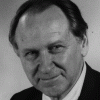
† ἀθλίοις συμφοραῖς αἰλίνοις.]Euripides (485?-406? BC) Greek tragic dramatist
Helen [Ἑλένη], l. 1158ff, Stasimon 1, Antistrophe 2 (412 BC) [tr. Vellacott (1954), Strophe 2]
(Source)
(Source (Greek)). Other translations:Outrageous to destroy
The spear hath desolation spread,
With slaughter stain'd the widow'd bed,
And desolated Troy.
Yet well might Reason's suasive charms
Have made each warring foe a friend:
But many in the shock of arms
To Pluto's dreary realms descend;
Fires, like the flames of Jove, the walls surround,
And Ilium's ramparts smoke upon the ground.
[tr. Potter (1783), Antistrophe 2]Hence from her home departs each Phrygian wife,
O Helen, when the cruel strife
Which from thy chamors arose,
One conference might have closed: now myriads dwell
With Pluto in the shades of Hell,
And flames, as when Jove's vengeance throws
The bolt, have caught her towers and finished Ilion's woes.
[tr. Wodhull (1809)]Which left the dwellings of the land of Priam, when it was in their power to decide by words the strife concerning thee, O Helen. But now they indeed are the care of Hades below, and fire, like the lightning of Jove, has fallen on their walls.
[tr. Buckley (1850)]By it [strife] they won as their lot bed-chambers of Priam's earth, when they could have set right by discussion the strife over you, O Helen. And now they are below in Hades' keeping, and fire has darted onto the walls like the bolt of Zeus.
[tr. Coleridge (1891)]The maidens of the land of Priam left their bridal bowers, though arbitration might have put thy quarrel right, O Helen. And now Troy's sons are in Hades' keeping in the world below, and fire hath darted on her walls, as darts the flame of Zeus.
[tr. Coleridge (alt.)]Lo, how its storm o'er homes of Ilium brake,
Yea, though fair words might once have wrought amending,
Helen, of wrong, of quarrel for thy sake!
Now are her sons in depths of Hades lying;
Flame o'er her walls leapt, like Zeus' levin-glare.
[tr. Way (Loeb) (1912)]So to Priam's people came
Madness in the midst of ease,
Lust of battle. No man sought
Peace by suasion. Still they fought
For Helen's sake, and still from Greece
Thronged the fighters. Low they lie.
Death has won the victory.
The bolt of Zeus struck home. The towers of Troy
Perished for Helen's sake. Yet Helen hath no joy.
[tr. Sheppard (1925)]It was that fate came to the homes
of Priam's land when, Helen, that strife of yours
still could have bene set aright by argument.
And now there are some in Hades' power
below, and upon the walls, like the flame of the lightning,
the fire has crept.
[tr. Warner (1951)]By hate they won the chambers of Priam's city;
they could have solved by reason and words
the quarrel, Helen, for you.
Now these are given to the Death God below.
On the walls the flame, as of Zeus, lightened and fell.
[tr. Lattimore (1956)]They received each one his portion of Trojan earth to slumber in, when reasoned argument might have solved the dispute you roused, Helen. Now they lie deep in Hades' lap, and Troy's walls, as if struck by Zeus' fiery thunderbolt, lie levelled.
[tr. Davie (2002)]This time the Trojans won
The boxes, underground --
They could have talked,
Settled their quarrel over you, Helen,
With words.
Now they march in the ranks of Death,
While searing flames destroy their walls --
Downed by a force like
Zeus' lightning.
[tr. A. Wilson (2007)]War, Helen, brought them their death on Priam’s land, when they argued about you, yet they could have resolved their differences about you with words alone.
Now they are in the hands of Hades!
Flames, shot like arrows from Zeus have spread across their towers.
[tr. Theodoridis (2011)]Strife it was that won them chambers in Priam’s soil
They could have straightened out with words,
your quarrel, O Helen, ah!
As things are, Hades below welcomes them
and a deadly fire, like Zeus’, swept over the walls of Troy.
[tr. Ambrose et al. (2018), Antistrophe B]By it they won as their lot bed-chambers of Priam’s earth, when they could have set right by discussion the strife [eris] over you, O Helen. And now they are below in Hādēs’ keeping, and fire has darted onto the walls like the bolt of Zeus.
[tr. Coleridge / Helen Heroization Team]
Quotations about:
negotiation
Note not all quotations have been tagged, so Search may find additional quotes on this topic.
For heaven’s sake beware, lest in the hope of maintaining peace now, we lose the chance of a lasting peace hereafter.
[Cavete, per deos immortales! patres conscripti, ne spe praesentis pacis perpetuam pacem amittatis.]
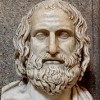
Marcus Tullius Cicero (106-43 BC) Roman orator, statesman, philosopher
Philippics [Philippicae; Antonian Orations], No. 7, ch. 8 / sec. 25 (7.8/7/25) (43-01 BC) [ed. Harbottle (1906)]
(Source)
Urging the Senate to discontinue negotiations with Mark Antony.
(Source (Latin)). Other translations:Beware, I entreat you by the immortal gods, O conscript fathers, that out of hope of present peace you do not lose perpetual peace.
[tr. Yonge (1903)]Take care in Heaven's name, Conscript Fathers, that you do not, in the hope of present peace, lose the peace that will endure.
[tr. Ker (Loeb) (1926)]By the Immortal Gods!, Members of the Senate, beware of losing a lasting peace in the hope of immediate peace.
[tr. Manuwald (2007)]
FEISAL: Young men make wars — and the virtues of war are the virtues of young men — courage and hope for the future. Then old men make the peace, and the vices of peace are the vices of old men — mistrust and caution.
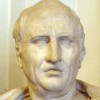
Robert Bolt (1924-1995) English dramatist
Lawrence of Arabia, Part 2, sc. 411 (1962) [with Michael Wilson]
(Source)

There is nothing I hate more than haggling. It is simply a petty and brazen business: Two parties will negotiate and argue for an hour only to walk away from what they have solemnly agreed to over five pennies’ worth of overcharge.
[Il n’est rien que je haysse comme à marchander : c’est un pur commerce de trichoterie et d’impudence. Apres une heure de debat et de barguignage, l’un et l’autre abandonne sa parolle et ses sermens pour cinq sous d’amendement.]
Michel de Montaigne (1533-1592) French essayist
Essays, Book 1, ch. 14 (1.14), “The Taste of Good and Bad Things Depends Mostly on the Opinion We Have of Them [Que le goust des biens et des maux despend en bonne partie de l’opinion que nous en avons]” (1572) [tr. HyperEssays (2023)]
(Source)
Though this chapter was written around 1572 for the 1580 edition, this text was added for the 1588 edition. The chapter as a whole was numbered ch. 14 in the 1580 and 1588 editions, moved to ch. 40 for the 1595 ed. Most modern translations use the original numbering.
(Source (French)). Alternate translations:There is nothing I hate more then driving of bargains: It is a meere commerce of dodging and impudencie. After an houres debating and paltring, both parties will goe from their wordes and oathes for the getting or saving of a shilling.
[tr. Florio (1603), ch. 40]There is nothing I hate so much, as driving a Bargain; ’tis a meer Traffick of Couzenage and Impudence; where after an Hours cheapning and dogding, both Parties abandon their Word and Oath for Five Sols profit, or abatement.
[tr. Cotton (1686), ch. 40]There is nothing I hate so much as driving a bargain; 'tis a mere traffic of cozenage and impudence, where, after an hour's cheapening and hesitating, both parties abandon their word and oath for five sols' abatement.
[tr. Cotton/Hazlitt (1877), ch. 40]There is nothing that I hate so much as haggling; it is a mere interchange of cheating and impudence. Afer an hour of wrangling and chaffering, one and the other side sacrifices his word and his oaths for a charge of five sous.
[tr. Ives (1925)]There is nothing I hate like bargaining. It is a pure interchange of trickery and shamelessness: after an hour of disputing and haggling both men go back on their word and their oath for a gain of five sous.
[tr. Frame (1943)]There is nothing I hate more than bargaining. It is a pure exchange of trickery and effrontery: after hours of arguing and haggling both sides go back on their pledged word to gain a few pence more.
[tr. Screech (1987)]

Of course, somehow, these champions of free market, these lovers of the invisible hand, cannot figure out that if people won’t sell you a good or service under the terms you set, free market competition demands that you offer better terms and conditions. It’s as simple as that. If you can’t buy a Porsche for $1.98, that doesn’t mean there’s an automobile shortage.
Peter Greene (contemp.) American teacher, blogger
“Florida’s Teacher Gap Is No Mystery,” Huffington Post (21 Nov 2017)
(Source)

The hard line, which has always been arguable in theory and which has had some success in practice, views the imperatives of the cold war as an ineluctable challenge, has encouraged a skeptical view of the limits of negotiation, and has placed its primary trust in ample reserves of strength.
The pseudo-conservative line is distinguishable from this not alone in being more crusade-minded and more risk-oriented in its proposed policies but also in its conviction that those who place greater stress on negotiation and accommodation are either engaged in treasonable conspiracy (the Birch Society’s view) or are guilty of well-nigh criminal failings in moral and intellectual fiber (Goldwater’s).Richard Hofstadter (1916-1970) American historian and intellectual
“Goldwater and Pseudo-Conservative Politics,” sec. 4 (1965)
(Source)
If you aren’t at the table, you’re on the menu.
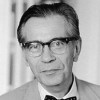
Ann Richards (1933-2006) American politician [Dorothy Ann Willis Richards]
(Attributed)
Richards regularly used the phrase, but it's unclear if she originated it. See here for more discussion.

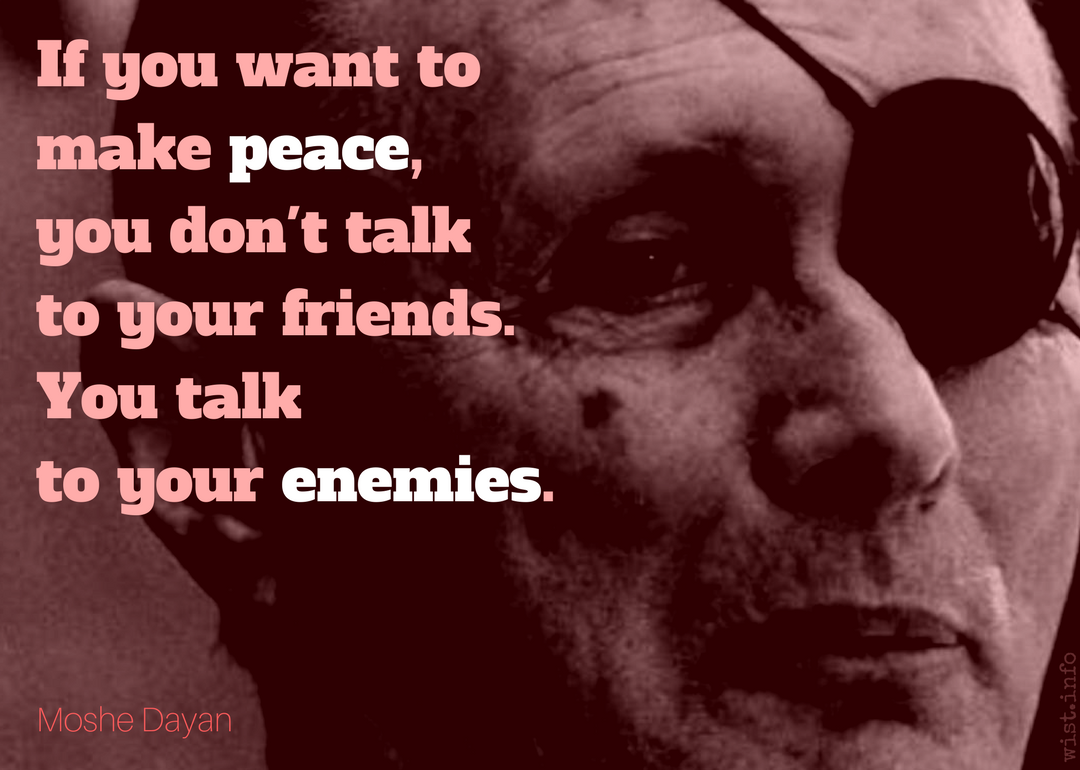
If you want to make peace, you don’t talk to your friends. You talk to your enemies.
Moshe Dayan (1915-1981) Israeli military leader and politician
In Newsweek (17 Oct 1977)

Tact is the art of putting your foot down without stepping on anyone’s toes.
Lawrence J. Peter (1919-1990) American educator, management theorist
Peter’s Almanac, “July 26” (1982)
(Source)
Discourage litigation. Persuade your neighbors to compromise whenever you can. Point out to them how the nominal winner is often a real loser — in fees, and expenses, and waste of time. As a peacemaker the lawyer has a superior opertunity [sic] of being a good man. There will still be business enough.
Abraham Lincoln (1809-1865) American lawyer, politician, US President (1861-65)
“Notes on the Practice of Law” (1850?)

It would be some time before I fully realized that the United States sees little need for diplomacy; power is enough. Only the weak rely on diplomacy. This is why the weak are so deeply concerned with the democratic principle of the sovereign equality of states, as a means of providing some small measure of equality for that which is not equal in fact. Coming from a developing country, I was trained extensively in international law and diplomacy and mistakenly assumed that the great powers, especially the United States, also trained their representatives in diplomacy and accepted the value of it. But the Roman Empire had no need for diplomacy. Nor does the United States. Diplomacy is perceived by an imperial power as a waste of time and prestige and a sign of weakness.
Boutros Boutros-Ghali (1922-2016) Egyptian politician, diplomat, UN Secretary-General (1992-1996)
Unvanquished: A U.S.-U.N. Saga (1999)
Someone sends me a clipping from Columnist Lyons with this honey: “They are telling this of Lord Beaverbrook and a visiting Yankee actress. In a game of hypothetical questions, Beaverbrook asked the lady: ‘Would you live with a stranger if he paid you one million pounds?’ She said she would. ‘And if be paid you five pounds?’ The irate lady fumed: ‘Five pounds. What do you think I am?’ Beaverbrook replied: ‘We’ve already established that. Now we are trying to determine the degree.'”
Max Aitken, Lord Beaverbrook (1879-1964) Anglo-Canadian business tycoon, publisher, politician, writer
“As O. O. McIntyre Sees It,” syndicated column (2 Jan 1937)
This anecdote has been attributed to a number of people, including Winston Churchill and George Bernard Shaw, usually in a bawdier form, e.g.:SHAW: [To a woman seated by him at a dinner party.] Madam, if I gave you a million pounds, would you sleep with me?
WOMAN: I think I would.
SHAW: Would you do it for five?
WOMAN: Sir, what kind of woman do you think I am?
SHAW: I thought we had established that, and were merely haggling over the price.
The above, attributing the exchange to Lord Beaverbrook, is the earliest version found. See here and here for more discussion and research into its origins.

So let us begin anew — remembering on both sides that civility is not a sign of weakness, and sincerity is always subject to proof. Let us never negotiate out of fear. But let us never fear to negotiate.
John F. Kennedy (1917-1963) American politician, author, journalist, US President (1961–63)
Inaugural Address (20 Jan 1961)
(Source)
Visible goodwill is the strongest negotiation strategy. Don’t let somebody else determine your behavior.
(Other Authors and Sources)
S. U. Sunrei

Diplomacy is the art of saying, “Nice doggie,” until you can find a rock.
Will Rogers (1879-1935) American humorist
(Misattributed)
Actually said by Wynn Catlin.
For more information on the background of this quotation, see Quote Origin: Diplomacy Frequently Consists in Soothingly Saying “Nice Doggie” Until You Have a Chance to Pick Up a Rock – Quote Investigator®.
Appeasement does not always lead to war; sometimes it leads to surrender.
William Safire (1929-2009) American author, columnist, journalist, speechwriter
“Giving War a Chance,” New York Times (2 Nov 1989)