

Regard your good name as the richest jewel you can possibly be possessed of — for credit is like fire; when once you have kindled it you may easily preserve it, but if you once extinguish it, you will find it an arduous task to rekindle it again. The way to gain a good reputation is to endeavor to be what you desire to appear.
Quotations by:
Socrates
If the whole world depends on today’s youth, I can’t see the world lasting another 100 years.
Socrates (c.470-399 BC) Greek philosopher
(Attributed)
By all means marry. If you get a good wife, you’ll be happy. If you get a bad one, you’ll become a philosopher.
Socrates (c.470-399 BC) Greek philosopher
(Attributed)
Nature has given us two ears, two eyes and but one tongue, to the end that we should hear and see more than we speak.
Socrates (c.470-399 BC) Greek philosopher
(Attributed)
In Robert Christy, Proverbs, Maxims and Phrases of All Ages (1887). Unable to find an actual citation; closest is Plutarch, Essays, "On Listening", 39B [tr. Waterfield (1992)], quoting Zeno of Citium: "And it is said that Nature gave each of us two ears, but one tongue, because we should listen more than we speak."
The beginning of wisdom is the definition of terms.
[Η αρχή της σοφίας είναι ο καθορισμός των όρων]
Socrates (c.470-399 BC) Greek philosopher
(Paraphrase)
Frequently attributed to Socrates (or, our source for most Socratic material, Plato), but not found as such in their works.
That said, there are places where Socrates indicates that searching out the meanings of ambiguities is important, and his "Socratic method" often involves calling definitions (or their implications) into question.
For example, in Phaedrus, 256d [tr. Jowett (1892)], Plato has Socrates note:
First, the comprehension of scattered particulars in one idea; as in our definition of love, which whether true or false certainly gave clearness and consistency to the discourse, the speaker should define his several notions and so make his meaning clear.
[εἰς μίαν τε ἰδέαν συνορῶντα ἄγειν τὰ πολλαχῇ διεσπαρμένα, ἵνα ἕκαστον ὁριζόμενος δῆλον ποιῇ περὶ οὗ ἂν ἀεὶ διδάσκειν ἐθέλῃ. ὥσπερ τὰ νυνδὴ περὶ Ἔρωτος -- ὃ ἔστιν ὁρισθέν -- εἴτ᾽ εὖ εἴτε κακῶς ἐλέχθη, τὸ γοῦν σαφὲς καὶ τὸ αὐτὸ αὑτῷ ὁμολογούμενον διὰ ταῦτα ἔσχεν εἰπεῖν ὁ λόγος.]
Possibly from this sentiment, Socrates' student Antisthenes said the very similar to the subject quotation, As recorded in Arrianus, The Discourses of Epictetus [Epictetus Diatibai], Book 1, ch. 17 [tr. Long (1877)]:
The beginning of education is the examination of terms.
[ἀρχὴ παιδεύσεως ἡ τῶν ὀνομάτων ἐπίσκεψις]
Arrianus was a student of Epictetus, who had been a pupil of Antisthenes. In the full passage, Epictetus ties this phrase back to Antisthenes and Socrates, possibly establishing the phrasing as a something directly said by Socrates.
More discussion of this quotation:
The children now love luxury; they have bad manners, contempt for authority; they show disrespect for elders and love chatter in place of exercise. Children are now tyrants, not the servants of their households. They no longer rise when elders enter the room. They contradict their parents, chatter before company, gobble up dainties at the table, cross their legs, and tyrannize their teachers.
Socrates (c.470-399 BC) Greek philosopher
(Spurious)
Often claimed as a passage from Socrates via Plato, but actually a paraphrase from a synthesis of complaints about youth in antiquity by Kenneth John Freeman, in his 1907 Cambridge dissertation "Schools of Hellas: an Essay on the Practice and Theory of Ancient Greek Education from 600 to 300 BC." See here for more discussion.
When the debate is lost, slander becomes the tool of the loser.
Socrates (c.470-399 BC) Greek philosopher
(Spurious)
Of recent coinage. See here for more discussion.
It takes two to make a quarrel.
Socrates (c.470-399 BC) Greek philosopher
In Diogenes Laertius, Lives of Eminent Philosophers, 2.5 [tr. Hicks (1925)]
There is only one good, knowledge, and one evil, ignorance.
Socrates (c.470-399 BC) Greek philosopher
In Diogenes Laertius’ Lives of Eminent Philosophers “Socrates,” 14
Alt. trans.: "The only good is knowledge and the only evil is ignorance."
Well I am certainly wiser than this man. It is only too likely that neither of us has any knowledge to boast of; but he thinks that he knows something which he does not know, whereas I am quite conscious of my ignorance. At any rate it seems that I am wiser than he is to this small extent, that I do not think that I know what I do not know.
Socrates (c.470-399 BC) Greek philosopher
In Plato, Apology, sec. 19
A man who is good for anything ought not to calculate the chance of living or dying; he ought only to consider whether in doing anything he is doing right or wrong — acting the part of a good man or a bad.
Socrates (c.470-399 BC) Greek philosopher
In Plato, Apology, sec. 28b [tr. Jowett]
(Source)
Alternate translations:
- "Thou doest wrong to think that a man of any use at all is to weigh the risk of life or death, and not to consider one thing only, whether when he acts he does the right thing or the wrong, performs the deeds of a good man or a bad." ["No Evil Can Happen to a Good Man"]
- "You are mistaken, my friend, if you think that a man who is worth anything ought to spend his time weighing up the prospects of life and death. He has only one thing to consider in performing any action -- that is, whether he is acting rightly or wrongly, like a good man or a bad one." [tr. Trendennick]
For to fear death, my friends, is only to think ourselves wise without really being wise, for it is to think that we know what we do not know. For no one knows whether death may not be the greatest good that can happen to man. But men fear it as if they knew quite well that it was the greatest of evils.
Socrates (c.470-399 BC) Greek philosopher
In Plato, Apology, sec. 29
O, men of Athens … either acquit me or not; but whichever you do, understand that I shall never alter my ways, not even if I have to die many times.
Socrates (c.470-399 BC) Greek philosopher
In Plato, Apology, sec. 29 [tr. Jowett (1894)]
Men of Athens, I honor and love you; but I shall obey God rather than you, and while I have life and strength I shall never cease from the practice and teaching of philosophy, exhorting anyone whom I meet and saying to him after my manner: You, my friend — a citizen of the great and mighty and wise city of Athens — are you not ashamed of heaping up the greatest amount of money and honor and reputation, and caring so little about wisdom and truth and the greatest improvements of the soul, which you never regard or heed at all?
Socrates (c.470-399 BC) Greek philosopher
In Plato, Apology, sec. 29 [tr. Jowett (1894)]
The unexamined life is not worth living for a human being.
[ho de anexetastos bios ou biôtos anthrôpôi]
Socrates (c.470-399 BC) Greek philosopher
In Plato, Apology, sec. 38
Var. trans:
- The unexamining life is not worth living for a human being.
- The life which is unexamined is not worth living.
- An unexamined life is not worth living.
- The unexamined life is not the life for man.
- The unexamined life is not worth living for man.
- If I tell you that I would be disobeying the god and on that account it is impossible for me to keep quiet, you won’t be persuaded by me, taking it that I am ironizing. And if I tell you that it is the greatest good for a human being to have discussions every day about virtue and the other things you hear me talking about, examining myself and others, and that the unexamined life is not livable for a human being, you will be even less persuaded.
If you think that by killing men you can prevent someone from censuring your evil lives, you are mistaken. That is not a way of escape which is either possible or honorable. The easiest and noblest way is not to be disabling others, but to be improving yourselves.
Socrates (c.470-399 BC) Greek philosopher
In Plato, Apology, sec. 39 [tr. Jowett (1894)]
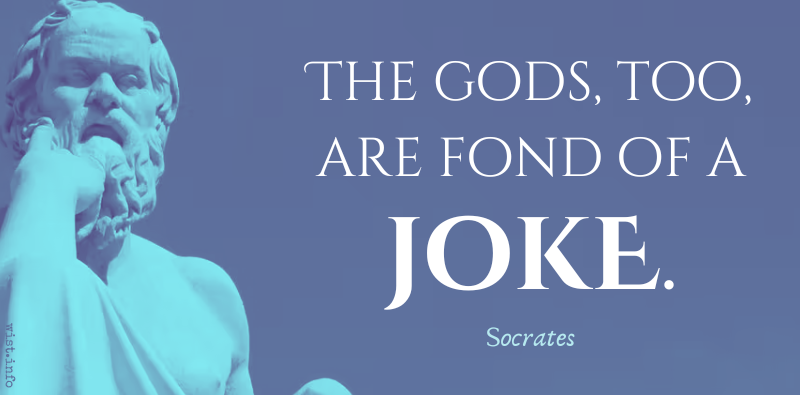
For the name of these gods there is both a serious and a humorous explanation; the serious explanation is not to be had from me, but there is no hindrance to my offering the humorous one, for the gods too are fond of a joke.
[ἀλλὰ ἔστι γὰρ καὶ σπουδαίως εἰρημένος ὁ τρόπος τῶν ὀνομάτων τούτοις τοῖς θεοῖς καὶ παιδικῶς. τὸν μὲν οὖν σπουδαῖον ἄλλους τινὰς ἐρώτα, τὸν δὲ παιδικὸν οὐδὲν κωλύει διελθεῖν: φιλοπαίσμονες γὰρ καὶ οἱ θεοί.]
Socrates (c.470-399 BC) Greek philosopher
In Plato, Cratylus [Κρατύλος], ch. 23 / 406c [tr. Hyers (1969)]
(Source)
The final phrase, "The gods, too, are fond of a joke," is broadly misattributed to Aristotle, without any citation. It is also sometimes misattributed to Edward Albee.
Cratylus is dialogue about the nature of names. Socrates, here, has been asked about the origins of the names of the gods, Dionysus and Aphrodite. Burges (below) notes that Plato had been "partly initiated into the mysteries of Demeter and Dionysus," part of which dealt seriously with the meanings of those deities' names; his avoiding the "serious explanation" is not betray his oath of secrecy to the cult.
(Source (Greek)). Alternate translations:
But the mode of nomination, belonging to these divinities, is both serious and jocose. Ask therefore others about the serious mode; but nothing hinders us from relating the jocose; for these deities are lovers of jesting and sport.
[tr. Taylor (1804)]
But the manner of the appellations given to these divinities, has been said to be both serious and jocose. Ask therefore others about the serious manner; but nothing hinders us from relating the jocose; for these deities are lovers of jesting and sport.
[tr. Burges (1850)]
There is a serious and also a facetious explanation of both these names; the serious explanation is not to be had from me, but there is no objection to your hearing the facetious one; for the Gods too love a joke.
[tr. Jowett (1892)]
You see there is both a serious and a facetious account of the form of the name of these deities. You will have to ask others for the serious one; but there is nothing to hinder my giving you the facetious account, for the gods also have a sense of humor.
[tr. Fowler (1926)]
Speech is a kind of action.
Socrates (c.470-399 BC) Greek philosopher
In Plato, Cratylus (c. 360 BC)
tr. B. Jowett (1894)
The worst of all deceptions is self-deception.
Socrates (c.470-399 BC) Greek philosopher
In Plato, Cratylus (c. 360 BC)
False words are not only evil in themselves, but they infect the soul with evil.
Socrates (c.470-399 BC) Greek philosopher
In Plato, Phaedo, 91
For the partisan, when he is engaged in a dispute, cares nothing about the rights of the question, but is anxious only to convince his hearers of his own assertions.
In every one of us there are two ruling and directing principles, whose guidance we follow wherever they may lead; the one being an innate desire of pleasure; the other, an acquired judgment which aspires after excellence.
Socrates (c.470-399 BC) Greek philosopher
In Plato, Phaedrus
Oh dear Pan and all the other Gods of this place, grant that I may be beautiful inside. Let all my external possessions be in friendly harmony with what is within. May I consider the wise man rich. As for gold, let me have as much as a moderate man could bear and carry with him.
Socrates (c.470-399 BC) Greek philosopher
In Plato, Phaedrus, 279 (Socrates’ Prayer)
The blame is his who chooses: God is blameless.
Socrates (c.470-399 BC) Greek philosopher
In Plato, Republic, Book 10, sec. 617
The blame is his who chooses: God is blameless.
Socrates (c.470-399 BC) Greek philosopher
In Plato, The Republic, Bk. 10, sec. 617
If all our misfortunes were laid in one common heap, whence everyone must take an equal portion, most people would be content to take their own and depart.
Socrates (c.470-399 BC) Greek philosopher
In Plutarch, Consolation to Apollonius
Alt trans.: "If all misfortunes were laid in one common heap, whence everyone must take an equal portion, most persons would be contented to take their own and depart."
Bad men live that they may eat and drink, whereas good men eat and drink that they may live.
Socrates (c.470-399 BC) Greek philosopher
In Plutarch, How a Young Man Ought to Hear Poems. ch. 4.
I observe, besides, that men who abandon themselves to the debauches of wine or women find it more difficult to apply themselves to things that are profitable, and to abstain from what is hurtful. For many who live frugally before they fall in love become prodigal when that passion gets the mastery over them; insomuch that after having wasted their estates, they are reduced to gain their bread by methods they would have been ashamed of before. What hinders then, but that a man, who has been once temperate, should be so no longer, and that he who has led a good life at one time should not do so at another? I should think, therefore, that the being of all virtues, and chiefly of temperance, depends on the practice of them: for lust, that dwells in the same body with the soul, incites it continually to despise this virtue, and to find out the shortest way to gratify the senses only.
Socrates (c.470-399 BC) Greek philosopher
In Xenophon, Memorabilia Book I, ch.2 [tr. E. Bysshe (1712)]
Full text.
If I am to live longer, perhaps I must live out my old age, seeing and hearing less, understanding worse, coming to learn with more difficulty and to be more forgetful, and growing worse than those to whom I was once superior. Indeed, life would be unliveable, even if I did not notice the change. And if I see the change, how could life not be even more wretched and unpleasant?
Socrates (c.470-399 BC) Greek philosopher
In Xenophon, Memorabilia Book IV, ch.8, sec.8
(sometimes cited to Plato, Apology)
Alt. trans.:
- "If my life is to be prolonged now, I know that I must live out my old age, seeing worse, hearing less, learning with more difficulty, and forgetting more and more of what I have learned. If I see myself growing worse and reproach myself for it, tell me, how could I continue to live pleasantly? Perhaps even the god in his kindness is offering to end my life not only at the right time, but also in the easiest way possible."
- "If I were to live longer, perhaps I should fall into the inconveniences of old age: perhaps my sight should grow dim, my hearing fail me, my judgment become weak, and I should have more trouble to learn, more to retain what I had learnt; perhaps, too, after all, I should find myself incapable of doing the good I had done before. And if, to complete my misery, I should have no sense of my wretchedness, would not life be a burden to me? And, on the other hand, say I had a sense of it, would it not afflict me beyond measure?" [tr. E. Bysshe (1712)]
The shortest and surest way to live with honour in the world is to be in reality what we would appear to be: and if we observe, we will find that all human virtues increase and strengthen themselves by the practice and experience of them.
No man undertakes a trade he has not learned, even the meanest; yet everyone thinks himself sufficiently qualified for the hardest of all trades — that of government.
Socrates (c.470-399 BC) Greek philosopher
Paraphrased from Plato, Protagoras, 319b-d
In Henry St. John Bolingbroke, Political Writings (1736). Original Plato passage (tr. Jowett) here (search).