

And always, in our highly regularised way of life, [the modern man] is obsessed by thoughts of the morrow. Of all the precepts in the Gospels the one that Christians have most neglected is the commandment to take no thought for the morrow. If a man is prudent, thought for the morrow will lead him to save; if he is imprudent, it will make him apprehensive of being unable to pay his debts. In either case the moment loses its savour. Everything is organised, nothing is spontaneous.
Bertrand Russell (1872–1970) English mathematician and philosopher
Lecture (1949-01-09), “The Role of Individuality,” Reith Lecture, “Authority and the Individual” No. 3, BBC Radio
(Source)
Quotations about:
live for the day
Note not all quotations have been tagged, so Search may find additional quotes on this topic.
’Mid hopes and fears and passion’s stormy strife
Think, every day that dawns, the last of life:
Thus shall each hour that lengthens nature’s treat,
By coming unexpected, come more sweet.[Inter spem curamque, timores inter et iras,
Omnem crede diem tibi diluxisse supremum:
Grata superveniet quae non sperabitur hora.]Horace (65–8 BC) Roman poet, satirist, soldier, politician [Quintus Horatius Flaccus]
Epistles [Epistularum, Letters], Book 1, ep. 4 “To Albius Tibullus,” l. 12ff (1.4.12-14) (20 BC) [tr. Howes (1845)]
(Source)
(Source (Latin)). Other translations:Twixte hope to have, and care to kepe, twixte feare and wrathe, awaye
Consumes the time: eche daye that cummes thinke it the latter daye,
The hower that cummes unloked for shall cum more welcum ay.
[tr. Drant (1567)]When thou'rt tost up and down' twixt hope and care,
Enflam'd with anger and shrunk up with fear:
As soon as such a day is overpast,
Comfort thy self, that that's to be the last:
When an hour comes that brings thee joy and bliss,
If unexpected, Oh! how grateful is!
[tr. A. B.; ed. Brome (1666)]Whilst mid'st strong hopes and fears thy time doth wast,
Think every rising Sun will be thy last;
And so the grateful unexpected Hour
Of Life prolong'd, when come, will please the more.
[tr. Creech (1684)]By hope inspir'd, deprest with fear,
By passion warm'd, perplext with care,
Believe that every morning's ray
Hath lighted up thy latest day;
Then, if to-morrow's sun be thine,
With double lustre shall it shine.
[tr. Francis (1747)]In the midst of hope and care, in the midst of fears and disquietudes, think every day that shines upon you is the last. [Thus] the hour, which shall not be expected, will come upon you an agreeable addition.
[tr. Smart/Buckley (1853)]Let hopes and sorrows, fears and angers be,
And think each day that dawns the last you'll see;
For so the hour that greets you unforeseen
Will bring with it enjoyment twice as keen.
[tr. Conington (1874)]'Twixt hopes and tremors, fears and frenzies passed,
Regard each day as though it were thy last.
So shall chance seasons of delight arise.
And overtake thee with a sweet surprise.
[tr. Martin (1881)]Unswayed then either by hopes or fears, by apprehensive or angry feelings, regard each day, as it shines upon you, as your last. death will one day come upon you acceptably because unexpectedly.
[tr. Elgood (1893)]Amid hopes and cares, amid fears and passions, believe that every day that has dawned is your last. Welcome will come to you another hour unhoped for.
[tr. Fairclough (Loeb) (1926)]Between your hopes
And cares, between your rages and fears, believe
That each day's down is the last to shine upon you:
The unhoped-for hours will be welcome.
[tr. Palmer Bovie (1959)]Among men’s cares and hopes, their fears and rages,
count as your last each morning that illuminates the sky:
then the next day, unhoped for, will always please you.
[tr. Fuchs (1977)]Live with hope and with fear, with worry and with angry passion,
But expect every hour to be your last:
Days come even more delightful, unexpected.
[tr. Raffel (1983)]Between hope and discouragement, fears, and angers, and such,
Treat every new day as the last you're going to have,
Then welcome the next as unexpectedly granted.
[tr. Ferry (2001)]In a world torn by hope and worry, dread and anger,
imagine every day that dawns is the last you'll see;
the hour you never hoped for will prove a happy surprise.
[tr. Rudd (2005 ed.)]Beset by hopes and anxieties, indignation and fear,
Treat every day that dawns for you as the last.
The unhoped-for hour’s ever welcome when it comes.
[tr. Kline (2015)]
Remember, all
Who live on earth are mortal, great and small:
Then take, good sir, your pleasure while you may;
With life so short ’twere wrong to lose a day.[Carpe viam, mihi crede, comes, terrestria quando
mortalis animas vivunt sortita neque ulla est
aut magno aut parvo leti fuga: quo, bone, circa,
dum licet, in rebus jucundis vive beatus;
vive memor quam sis aevi brevis.]Horace (65–8 BC) Roman poet, satirist, soldier, politician [Quintus Horatius Flaccus]
Satires [Saturae, Sermones], Book 2, # 6 “Hoc erat in votis,” l. 93ff (2.6.93-97) (30 BC) [tr. Conington (1874)]
(Source)
The (Epicurean) town mouse encouraging the country mouse to come visit the city.
(Source (Latin)). Other translations:Our earthelie soule is ruinouse, not possible to flye
From dinte of death, by any meanes, the longeste livde muste dye.
Wherfore good sister, whilste thou maiste, do bayth they selfe in blisse,
Remember aye, how shadowye, and shorte this lyfe time is.
[tr. Drant (1567)]Since all shall die, and when
We go, our Mortal souls resolve to dust,
Live happy whil'st thou may'st, as one that must
Be nothing a while hence.
[tr. R. Fanshawe; ed. Brome (1666)]Since all must dye, and must resign their Breath,
Nor great, nor little is secure from Death;
Then spend thy days in Pleasure, Mirth and Sport.
And live like One, that Minds his Life is short.
[tr. Creech (1684)]Consider, Mice, like Men, must die,
Both small and great, both you and I:
Then spend your life in Joy and Sport,
(This doctrine, Friend, I learnt at Court.)
[tr. Pope (1733–38)]Since animals but draw their breath,
And have no being after death;
Since nor the little, nor the great,
Can shun the rigour of their fate;
At least be merry while you may,
The life of mice is but a day:
Come then, my friend, to pleasure give
The little life you have to live.
[tr. Francis (1747)]And, since in every creature upon earth
Lurk seeds of dissolution from its birth, --
Since soon or late, however great or small,
Inexorable Death awaits us all, --
Be wise, be happy; revel while you may,
And lengthen by enjoyment life's short day.
[tr. Howes (1845)]Since mortal lives are allotted to all terrestrial animals, nor is there any escape from death, either for the great or the small. Wherefore, my good friend, while it is in your power, live happy in joyous circumstances: live mindful of how brief an existence you are.
[tr. Smart/Buckley (1853)]Since creatures earthly all possess by lot but transitory lives, and since and following few lines, there's no escape from death for great or small: -- because of this, I say, dear friend, while you've the chance, live happy in a pleasant state, and well remember how short-lived you are.
[tr. Millington (1870)]Since all that is on earth is mortal, and there is no escape from death for great or small, draw the true conclusion, my dear sir, and live whilst you may in the enjoyment of what is pleasant; live, and remember how short the time is!
[tr. Wickham (1903)]Inasmuch as all creatures that live on earth have mortal souls, and for neither great nor small is there escape from death, therefore, good sir, while you may, live happy amid joys; live mindful ever of how brief your time is!
[tr. Fairclough (Loeb) (1926)]All earthly creatures, after all, have drawn as their lot
A mortal life: there is no escape from death
For large or small. Therefore, while you still can,
Enjoy a happy career, my good man, live well;
Live mindful of how short life really is.
[tr. Palmer Bovie (1959)]For nature gives
us earthly creatures mortal souls, and there's no escaping death
for anyone, large or small. That's why I say, old buddy,
live happily while you can with things that you enjoy;
live mindful of the shortness of your time.
[tr. Fuchs (1977)]For no one
Lives forever, not on this earth, and everyone
Dies, rich and poor alike. So
Be happy, live well, while you can.
Remember, it’s not for long!
[tr. Raffel (1983)]All earth's creatures
have mortal souls. And there is no way
to flee this destiny, neither for the great
nor for the humble; all the more reason,
my dear fellow, to live happily
so long as you can amidst pleasures,
keeping ever in mind how brief
are your days.
[tr. Alexander (1999)]We're all slated for death,
whether we be grand or ordinary;
thus we should avidly pursue life's joys
the whole of our short course on earth.
[tr. Matthews (2002)]All earthly creatures have been given mortal souls;
large or small they have no means of escaping death.
So my dear chap, while there's still time, enjoy the good things
of life, and never forget your days are numbered.
[tr. Rudd (2005 ed.)]Since all terrestrial creatures
Are mortal, and there’s no escape from death for great
Or small, then live happily, good friend, while you may
Surrounded by joyful things: mindful while you live
How brief existence is.
[tr. Kline (2015)]
Since Life is so very short, live as much as thou canst in so short a Time.
Thomas Fuller (1654–1734) English physician, preacher, aphorist, writer
Introductio ad Prudentiam, Vol. 1, # 1757 (1725)
(Source)
You’ll “start living tomorrow”? Start living today already, Postumus, you’re running out of time. Anyone with sense started living yesterday.
[Cras vives? hodie iam vivere, Postume, serum est:
Ille sapit, quisquis, Postume, vixit heri.]Martial (AD c.39-c.103) Spanish Roman poet, satirist, epigrammatist [Marcus Valerius Martialis]
Epigrams [Epigrammata], Book 5, epigram 58 (5.58.7-8) (AD 90) [tr. Nisbet (2015)]
(Source)
(Source (Latin)). See a related sentiment by Martial in 1.15. Other translations:Thou'lt live to morrow? -- 'tis too late to day:
Hee's wise who yesterday, I liv'd, can say.
[tr. Sherburne (1651)]Thou'lt live tomorrow? -- this day's life's too late:
He's wise that lived before the present date.
[tr. Fletcher (1656)]Tomorrow will I live, the fool does say;
Today itself's too late; the wise lived yesterday.
[tr. Cowley (1668), in Hay, "Appendix," ep. 59]Today to live, ev'n that's too late I say.
The wiseman, Posthumus, liv'd Yesterday.
[tr. Oldmixon (1728)]You will live, you say, tomorrow; it is late, Posthumus, to live today; he is wise who lived yesterday.
[tr. Amos (1858), ch. 3, ep. 46, noted as Martial Book 5, ep. 59]You will live tomorrow: even today it is too late to begin to live. He is the wise man, Postumus, who lived yesterday.
[tr. Bohn's Classical (1859)]To live today, Postumus, is already too late. He is wise, whoever he be, Postumus, who "lived" yesterday.
[tr. Ker (1919)]"Tomorrow": -- nay, do not this moment delay.
The wise man is he who has lived yesterday.
[tr. Pott & Wright (1921)]You'll live tomorrow? Now's too late, I say.
He's wise, my Postumus, who lived yesterday.
[tr. Francis & Tatum (1924), #255]Yes, this is what wise Martial says,
Though in another way:
"It's much too late today to live!
The wise lived yesterday!"
[tr. Marcellino (1968), "To a Crass Procrastinator"]"Tomorrow"? -- Postumus, today's too late.
The wise man, Postumus, lived yesterday.
[tr. Whigham (1987)]Will you live tomorrow? It's already overlate, Postumus, to live today. He is wise, Postumus, who lived yesterday.
[tr. Shackleton Bailey (1993)]Tomorrow? It’s already too late to live today:
He who lived yesterday, Postumus, he is wise.
[tr. Kline (2006)]Forget tomorrow's teasing long delay.
To make life pleasant, dwell on yesterday.
[tr. Wills (2007)]Will you live then? Today is late already.
He's wise who did his living yesterday.
[tr. McLean (2014)]Believe me, wise men don’t say “I shall live to do that,”
Tomorrow’s life is too late; live today.
MAME: Yes! Life is a banquet, and most poor sons-of-bitches are starving to death! Live!
Jerome Lawrence (1915–2004) American playwright and author [b. Jerome Lawrence Schwartz]
Auntie Mame, Act 2, sc. 6 (1956) [with Robert E. Lee]
Based on the novel Patrick Dennis, Auntie Mame (1955), turned first into this Broadway play by Lawrence and Lee, a 1958 movie, then the musical Mame (1966), followed by a movie of the musical (1974). The line is original with Lawrence and Lee.
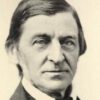
To finish the moment, to find the journey’s end in every step of the road, to live the greatest number of good hours, is wisdom.
Ralph Waldo Emerson (1803–1882) American essayist, lecturer, poet
“Experience,” Essays: Second Series (1844)
(Source)
‘Tis not, believe me, a wise man’s part to say, “I will live.” Tomorrow’s life is too late: live today.
[Non est, crede mihi, sapientis dicere “Vivam”:
Sera nimis vita est crastina: vive hodie.]Martial (AD c.39-c.103) Spanish Roman poet, satirist, epigrammatist [Marcus Valerius Martialis]
Epigrams [Epigrammata], Book 1, epigram 15 (1.15.11-12) (AD 85-86) [tr. Bohn’s (1859)]
(Source)
A sentiment echoed in 5.58. (Source (Latin)). Other translations:Trust me, it is not wise to say,
I'll live; 'twill be too late tomorrow,
Live if thou'rt wise today.
[tr. Oldmixon (1728)]"I'll live tomorrow," will a wise man say?
Tomorrow is too late, then live today.
[tr. Hay (1755), quoted in Bohn's, but not in Hay's own book]Tomorrow I shall live, the fool will say. [...]
Wouldst thou be sure of living? Live today.
[tr. Elphinston (1782), Book 2, ep. 45]No wisdom 'tis to say "I'll soon begin to live."
'Tis late to live tomorrow; live today.
[ed. Harbottle (1897)]It sorts not, believe me, with wisdom to say "I shall live."
Too late is tomorrow's life; live thou today.
[tr. Ker (1919)]"I'll live tomorrow," no wise man will say;
Tomorrow is too late. Then live today.
[tr. Francis & Tatum (1924), #10]To say, "I mean to live," is folly's place:
Tomorrow's life comes late; live, then, today.
[tr. Duff (1929)]It's not a wise man's part to say
"I'll live," Tomorrow's life is much to late.
Live! Today.
[tr. Bovie (1970)]Believe me, the wise man does not say "1 shall live." Tomorrow's life is too late. Live today.
[tr. Shackleton Bailey (1993)]No sage will e'er "I'll live tomorrow" say:
Tomorrow is too late: live thou today.
[tr. WSB]
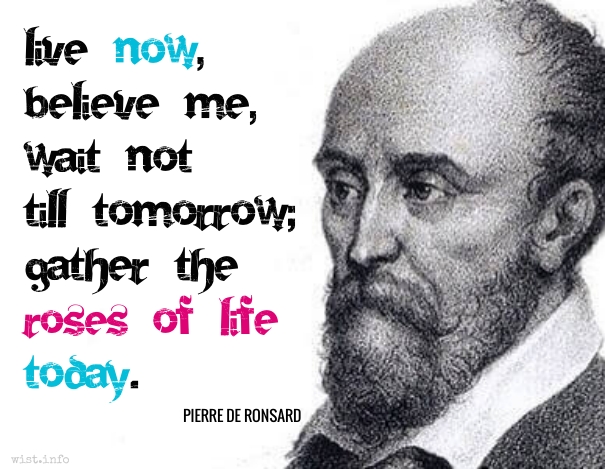
Live now, believe me, wait not till tomorrow;
Gather the roses of life today.[Vivez, si m’en croyez, n’attendez à demain;
Cueillez dés aujourd’huy les roses de la vie.]
Pierre de Ronsard (1524–1585) French poet
“Quand vous serez bien vieille, au soir, à la chandelle,” l. 13, Sonnets pour Hélène (1578)
(Source)
Every day should be passed as if it were to be our last.
Publilius Syrus (d. 42 BC) Assyrian slave, writer, philosopher [less correctly Publius Syrus]
Sententiae [Moral Sayings], # 633
Happy the Man, and happy he alone,
He who can call today his own:
He who, secure within, can say,
Tomorrow do thy worst, for I have lived today.
Be fair or foul or rain or shine
The joys I have possessed, in spite of fate, are mine.
Not Heav’n it self upon the past has pow’r,
But what has been, has been, and I have had my hour.
[Ille potens sui
laetusque deget cui licet in diem
dixisse “Vixi: cras vel atra
nube polum pater occupato
vel sole puro; non tamen inritum
quodcumque retro est efficiet neque
diffinget infectumque reddet
quod fugiens semel hora vexit.”]Horace (65–8 BC) Roman poet, satirist, soldier, politician [Quintus Horatius Flaccus]
Odes [Carmina], Book 3, # 29, l. 41ff (3.29.41-48) (23 BC) [tr. Dryden (1685)]
(Source)
"To Maecenas." (Source (Latin)). Other translations:He's Master of himself alone,
He lives, that makes each day his own:
He lives that can distinctly say
It is enough, for I have liv'd to day:
Let Jove to morrow smiling rise,
Or let dark Clouds spread o're the Skys:
He cannot make the pleasures void
Nor sower the sweets I have enjoy'd,
Nor call that back which winged hours have born away.
[tr. Creech (1684)]Happy he,
Self-centred, who each night can say,
“My life is lived: the morn may see
A clouded or a sunny day:
That rests with Jove: but what is gone,
He will not, cannot turn to nought;
Nor cancel, as a thing undone,
What once the flying hour has brought.
[tr. Conington (1872)]That man is master of himself and shall live happy, who has it in his power to say, "I have lived to-day: to-morrow let the Sire invest the heaven, either with a black cloud, or with clear sunshine; nevertheless he shall not render ineffectual what is past, nor undo or annihilate what the fleeting hour has once carried off.
[tr. Smart/Buckley (1853)]Lord of himself that man will be,
And happy in his life alway.
Who still at eve can say with free
Contented soul, "I've lived to-day!
Let Jove to-morrow, if he will,
With blackest clouds the welkin fill,
Or flood it all with sunlight pure.
Yet from the past he cannot take
Its influence, for that is sure.
Nor can he mar, or bootless make
Whate'er of rapture and delight
The hours have borne us in their flight."
[tr. Martin (1864)]Happy indeed is he,
Lord of himself, to whom
’Tis given to say, as each day ends, “I have lived:”
To-morrow let the Sire invest the heaven
With darkest cloud or “purest ray serene,”
He mars not what has been,
Nor from Time's sum blots out one fleeted hour.
[tr. Bulwer-Lytton (1870)]That man will live in happiness and self-command who can say at the close of each day, "I have lived. To-morrow let the Great Father fill the sky with black cloud or bright sunshine, yet can he not make void that which is to come, nor cause that not to have been which the flying hour hath once carried away on its wings."
[tr. Elgood (1893)]Self-ruled, light-hearted shall he be,
Who daily 'I have lived,' can say,
Dark tempests let the Sire decree,
Or brightness, for the coming day.
Yet cannot he the bygone days
Unmake, or hold the past undone,
Nor can with utmost might erase
The work of hours whose glass is run.
[tr. Gladstone (1894)]He will, his soul possessing, live joyfully,
Who, as each day goes by, can say, "I have liv'd;
To-morrow let th' Almighty Father
Either fill up with the darkling storm-cloud,
Or the pure sunlight! That which is past, e'en He
Cannot undo and cause to have never been,
Nor can He by his pow'r demolish
Bliss that the past fleeting hour has given."
[tr. Phelps (1897)]That man will be
Master of self, and pass in joy, who daily may
Declare "I have lived*: to-morrow let the Father
Encompass heaven, or with black cloud,
Or sunshine clear: still that which is behind
He will not render void nor forge anew
Nor make as though undone,
Whate'er the flying hour has once removed.
[tr. Garnsey (1907)]Self-centred he,
And blest, who can make boast each coming night
"This day I've lived." Or dark or bright
To-morrow's dawn may be,
As Jove shall please. But never deed that's done
Can ev'n high Heaven make as 'twere thing of naught;
Or act, by Time to issue brought,
Cancel as though 'twere none.
[tr. Marshall (1908)]Master of himself and joyful will that man live who day by day can say: "I have lived to-day ; to-morrow let the Father fill the heaven with murky clouds, or radiant sunshine! Yet will he not render vain whatever now is past, nor will he alter and undo what once the fleeting hour has brought.
[tr. Bennett (Loeb) (1912)]Lord of himself, and happy, will
He be, who can from day to day
Say, "I have lived; let Jove fulfill
Tomorrow's sky with leaden-grey
Clouds or with shine, he can't undo
What has been done, nor make as naught,
No, nor reforge and shape anew,
What once the flying hour has brought.
[tr. Mills (1924)]Call him happy
And lord of his own soul who every evening
Can say, "Today I have lived.
Tomorrow Jove may blot the sky with cloud
Or fill it with pure sunshine, yet he cannot
Devalue what has once been held as precious,
Or tarnish nor melt back
The gold the visiting hour has left behind."
[tr. Michie (1963)]A man is his own
Master, is happy, Maecenas, saluting
The sun and saying “Today I’ve been
Alive.” The gods can let tomorrow’s
Sky glow or be black with clouds,
But tomorrow's tomorrow, I've got what I've got,
Nothing I've had in my hands will be nothing,
Though time takes it.
[tr. Raffel (1983)]Happy the man who has earned the right to say:
"I've lived my life. There may be storms tomorrow,
Maybe fair weather. Nobody knows for sure.
What I have had in the past cannot be taken
Away from me now."
[tr. Ferry (1997)]Master of himself and joyful
will that man live who is able
every day to say: "I have lived."
Tomorrow let the Father fill the sky
either with dark clouds or radiant sunshine.
But even he cannot undo that which is done
or render vain the past
or alter what the fleeting hour has once wrought.
[tr. Alexander (1999)]He’s happy, he’s his own master, who can say
each day: ‘I’ve lived: tomorrow, the Father may
fill the heavens with darkening cloud,
or fill the sky with radiant sunshine:
yet he can’t render whatever is past as
null and void, he can never seek to alter,
or return and undo, whatever
the fleeting moment tosses behind it.
[tr. Kline (2015)]