

Having many cats is good. If you feel bad, you look at the cats and you feel better, because they know that everything is just the way it is. You don’t have to be nervous about anything. And they know it. They are saviors. The more cats you have, the longer you will live. If you have a hundred cats, you will live ten times longer than if you have ten. One day, this will be known and people will have thousands of cats. It’s truly ridiculous.
Charles Bukowski (1920-1994) German-American author, poet
Interview (1987-09) by Sean Penn, “Tough Guys Write Poetry,” Interview Magazine, Vol. 17, No. 19
(Source)
Collected in Bukowski, Sunlight Here I Am (2003) [ed. David Calonne].
Quotations about:
serenity
Note not all quotations have been tagged, so Search may find additional quotes on this topic.

Upon the whole, a contented mind is the greatest blessing a man can enjoy in this world.
Joseph Addison (1672-1719) English essayist, poet, statesman
Essay (1714-07-30), The Spectator, No. 574
(Source)

JANE: Some people think that external beauty comes from inner tranquility. Of course, some people think it comes from drinking the blood of virgins, so there’s quite a range there.
Steven Moffat (b. 1961) Scottish television writer, producer
Coupling, 03×01 “Split” (2002-09-23)
(Source)

A good conscience is to the Soul what health is to the body; it preserves a constant ease and serenity within us, and more than countervails all the calamities and afflictions which can possibly befall us.
Joseph Addison (1672-1719) English essayist, poet, statesman
Essay (1713-08-15), The Guardian, No. 135
(Source)
A good conscience is to the Soul what health is to the body; it preserves constant ease and serenity within us; and more than countervails all the calamities and afflictions which can befall us from without.
Joseph Addison (1672-1719) English essayist, poet, statesman
Essay (1713-08-15), The Guardian, No. 135
(Source)
“Ah, I expect you’ll be wanting to pay for that paper, then, won’t you, Mr. Dirk, sir?” said the newsagent, trotting gently after him.
“Ah, Bates,” said Dirk loftily, “you and your expectations. Always expecting this and expecting that. May I recommend serenity to you? A life that is burdened with expectations is a heavy life. Its fruit is sorrow and disappointment. Learn to be one with the joy of the moment.”Douglas Adams (1952-2001) English author, humourist, screenwriter
Dirk Gently, No. 2, The Long Dark Tea-Time of the Soul, ch. 4 (1988)
(Source)

Bless us Lord, this Christmas, with quietness of mind;
Teach us to be patient and always to be kind.Helen Steiner Rice (1900-1981) American poet, businesswoman
(Attributed)

We therefore say once more that a strong mind is not one that is merely capable of strong emotions, but one that under stress of the strongest emotions keeps its balance, so that in spite for the storms within the breast, judgment and conviction can act with perfect freedom, like the needle of the compass on a storm-tossed ship.
[Wir sagen es also noch einmal: Ein starkes Gemüth ist nicht ein solches, welches bloss starker Regungen fähig ist, sondern dasjenige, welches bei den stärksten Regungen im Gleichgewicht bleibt, so dass trotz den Stürmen in der Brust der Einsicht und Ueberzeugung wie der Nadel des Kompasses auf dem sturmbewegten Schiff das feinste Spiel gestattet ist.]
Karl von Clausewitz (1780-1831) Prussian soldier, historian, military theorist
On War [Vom Kriege], Book 1, ch. 3 “On Military Genius [Der Kriegerische Genius],” (1.3) (1832) [tr. Jolles (1943)]
(Source)
(Source (German)). Alternate translations:We, therefore, say once more a strong mind is not one that is merely susceptible of strong excitement, but one which can maintain its serenity under the most powerful excitement; so that, in spite of the storm in the breast, the perception and judgment can act with perfect freedom, like the needle of the compass in the storm-tossed ship.
[tr. Graham (1873)]We repeat: strength of character does not consist solely in having powerful feelings, but in maintaining one’s balance in spite of them. Even with the violence of emotion, judgment and principle must still function like a ship’s compass, which records the slightest variations however rough the sea.
[tr. Howard & Paret (1976)]

Age puzzles me. I thought it was a quiet time. My seventies were interesting and fairly serene, but my eighties are passionate. I grow more intense as I age.
Florida Scott-Maxwell (1883-1979) American-British playwright, author, psychologist
The Measure of My Days (1968)
(Source)
I feel my heart glow with an enthusiasm which elevates me to heaven, for nothing contributes so much to tranquillize the mind as a steady purpose — a point on which the soul may fix its intellectual eye.

Anger blows out the lamp of the mind. In the examination of a great and important question, every one should be serene, slow-pulsed and calm.
Robert Green Ingersoll (1833-1899) American lawyer, freethinker, orator
“The Christian Religion,” Article 3, The North American Review (1881)
(Source)
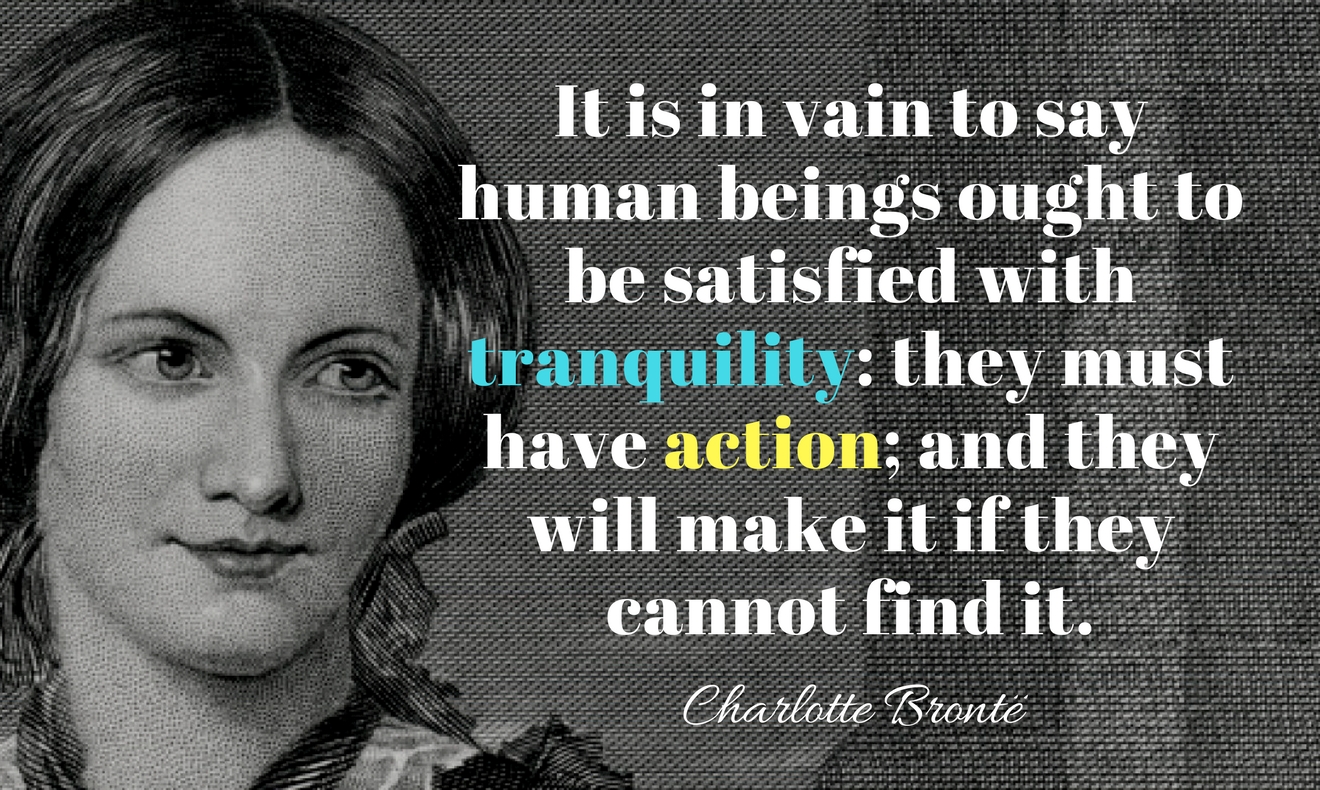
It is in vain to say human beings ought to be satisfied with tranquility: they must have action; and they will make it if they cannot find it.
Charlotte Brontë (1816-1855) British novelist [pseud. Currer Bell]
Jane Eyre, ch. 12 [Jane] (1847)
(Source)

There is no such thing as inner peace. There is only nervousness or death.

I have always preferred cheerfulness to mirth. The latter I consider as an act, the former as an habit of mind. Mirth is short and transient, cheerfulness fixed and permanent. Those are often raised into the greatest transports of mirth who are subject to the greatest depressions of melancholy. On the contrary, cheerfulness, though it does not give the mind such an exquisite gladness, prevents us from falling into any depths of sorrow. Mirth is like a flash of lightning, that breaks through a gloom of clouds, and glitters for a moment; cheerfulness keeps up a kind of daylight in the mind, and fills it with a steady and perpetual serenity.
Joseph Addison (1672-1719) English essayist, poet, statesman
Essay (1712-05-17), The Spectator, No. 381
(Source)
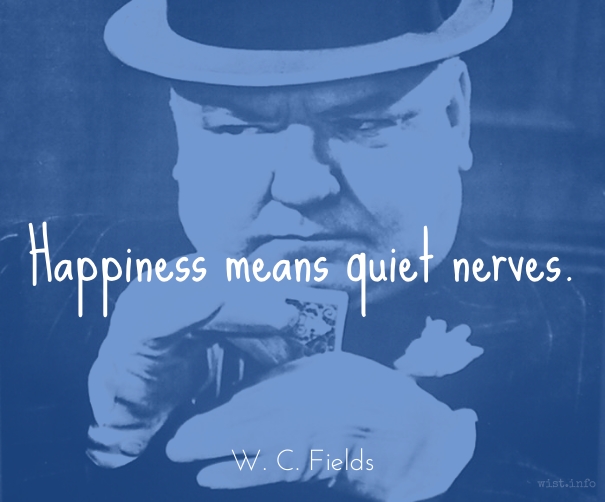
Happiness means quiet nerves.
W. C. Fields (1880-1946) American entertainer [b. William Claude Dukenfield]
(Attributed)
Quoted in Robert Lewis Taylor, W.C. Fields, His Follies and Fortunes (1949).
Always behave as if nothing had happened, no matter what has happened.
Arnold Bennett (1867-1931) English writer, novelist, journalist
Denry the Audacious, ch. 10 “His Infamy” (1911)

Ah, Bates, you and your expectations. Always expecting this and expecting that. May I recommend serenity to you? A life that is burdened with expectations is a heavy life. Its fruit is sorrow and disappointment. Learn to be one with the joy of the moment.
Douglas Adams (1952-2001) English author, humourist, screenwriter
Dirk Gently, No. 2, The Long Dark Tea-Time of the Soul, ch. 4 [Dirk] (1988)
(Source)
It is one of the most difficult yet necessary things in life to learn to disdain. Disdain protects and crushes. It is a breastplate and a club. You have enemies? Why, it is the story of every man who has done a great deed or created a new idea. It is the cloud which thunders around everything, which shines. Fame must have enemies, as light must have gnats. Do not bother yourself about it; disdain. Keep your mind serene as you keep your life clear. Do not give your enemies the satisfaction of thinking that they cause you grief or pain. Be happy, be cheerful, be disdainful, be firm.
[C’est une des choses les plus difficiles et les plus nécessaires de la vie que d’apprendre à dédaigner. Le dédain protège et écrase. C’est une cuirasse et une massue. Vous avez des ennemis? Mais c’est l’histoire de tout homme qui a fait une action grande ou créé une idée neuve. C’est la nuée qui bruit autour de tout ce qui brille. Il faut que la renommée ait des ennemis comme il faut que la lumière ait des moucherons. Ne vous en inquiétez pas; dédaignez! Ayez la sérénité dans votre esprit comme vous avez la limpidité dans votre vie. Ne donnez pas à vos ennemis cette joie de penser qu’ils vous affligent et qu’ils vous troublent. Soyez content, soyez joyeux, soyez dédaigneux, soyez fort.]
Victor Hugo (1802-1885) French writer
Diary (1845-12-07), “Villemain,” Things Seen [Choses Vues], Vol. 1 (1887)
(Source)
Dictated 1845-12-03 by Hugo to Juliette Drouet.
(Source (French)). Another translation:One of the hardest and most important things in life is learning to treat things with disdain. Disdain can protect, it can crush; it’s a breastplate and a club. You’ve got enemies? Why, that’s the story of every man who has done a great deed or come up with a new idea. It’s the thundercloud around everything that shines. Fame will attract enemies just as light will attract insects. Don’t fret about it. Treat it with disdain. Keep your mind calm, just as you keep your life clean. Don’t give your enemies the satisfaction of thinking that they’re hurting you and upsetting you. Be happy and cheerful and disdainful and strong.
[tr. Blackmore (2004)]

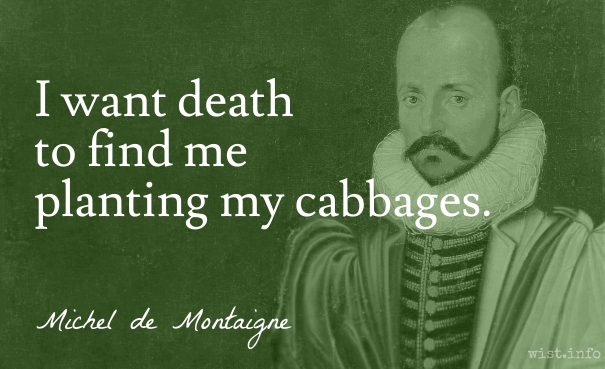
I want a man to act, and to prolong the functions of life as long as he can; and I want death to find me planting my cabbages, but careless of death, and still more of my unfinished garden.
[Je veux qu’on agisse, et qu’on allonge les offices de la vie, tant qu’on peut: et que la mort me trouve plantant mes choux ; mais nonchallant d’elle, et encore plus de mon jardin imparfait.]
Michel de Montaigne (1533-1592) French essayist
Essays, Book 1, ch. 19 (1.19), “That to Philosophize Is to Learn to Die [Que Philosopher, c’est apprendre à mourir]” (1572-03) [tr. Frame (1943)]
(Source)
Published in the 1580 ed.; the second clause (on prolonging the normal activities of life as long as possible) was added in the 1595 ed.
(Source (French)). Alternate translations:I would have a man to be doing, and to prolong his lives offices, as much as lieth in him, and let death seize upon me, whilst I am setting my cabiges, carelesse of her darte, but more of my unperfect garden.
[tr. Florio (1603)]I would always have a man to be doing, and, as much as in him lies, to extend, and spin out the Offices of life; and then let Death take me planting Cabages, but without any careful thought of him, and much less of my Garden’s not being finished.
[tr. Cotton (1686)]I would always have a man to be doing, and spinning out the offices of life as far as possible; and though death should seize me planting my cabbages, I should not be concerned at it, much less for leaving my garden unfinished.
[tr. Friswell (1868)]I would always have a man to be doing, and, as much as in him lies, to extend and spin out the offices of life; and then let death take me planting my cabbages, indifferent to him, and still less of my gardens not being finished.
[tr. Cotton/Hazlitt (1877)]I desire that a man should act, and prolong the employments of life as long as he can, and that death may find me planting my cabbages, but indifferent regarding it, and even more regarding my unfinished garden.
[tr. Ives (1925)]I want death to find me planting my cabbages, but caring little for it, and even less about the imperfections of my garden.
[tr. Rat (1958)]I want us to be doing things, prolonging life’s duties as much as we can; I want Death to find me planting my cabbages, neither worrying about it nor the unfinished gardening.
[tr. Screech (1987)]I wish for us to be doing, and to carry on with our responsibilities in life while we still can. I want death to find me planting my cabbages, indifferent to it, with my garden still a work in progress.
[tr. HyperEssays (2024)]

Serenely full, the epicure would say,
Fate cannot harm me, I have dined to-day.Sydney Smith (1771-1845) English clergyman, essayist, wit
Memoir of the Reverend Sydney Smith, by His Daughter, Lady Holland, Vol. 1, ch. 11 (1855)
(Source)
At the end of a recipe for highly praised potato salad dressing.

CALVIN: I’m at peace with the world. I’m completely serene.
HOBBES: Why is that?
CALVIN: I’ve discoved my purpose in life. I know why I was put here and why everything exists.
HOBBES: Oh, really?
CALVIN: Yes. I am here so everybody can do what I want.
HOBBES: It’s nice to have that cleared up.
CALVIN: Once everyone accepts it, they’ll be serene, too.


Cheerfulness keeps up a kind of daylight in the mind, and fills it with a steady and perpetual serenity.
Joseph Addison (1672-1719) English essayist, poet, statesman
Essay (1712-05-17), The Spectator, No. 381
(Source)