Fascism, at any rate the German version, is a form of capitalism that borrows from socialism just such features as will make it efficient for war purposes.
Internally, Germany has a good deal in common with a Socialist state. Ownership has never been abolished, there are still capitalists and workers, and — this is the important point, and the real reason why rich men all over the world tend to sympathise with Fascism — generally speaking the same people are capitalists and the same people workers as before the Nazi revolution. But at the same time the State, which is simply the Nazi Party, is in control of everything. […]
But the idea underlying Fascism is irreconcilably different from that which underlies Socialism. Socialism aims, ultimately, at a world-state of free and equal human beings. It takes equality of human rights for granted. Nazism assumes just the opposite. The driving force behind the Nazi movement is the belief in human inequality, the superiority of Germans to all other races, the right of Germany to rule the world.George Orwell (1903-1950) English journalist, essayist, writer [pseud. of Eric Arthur Blair]
Essay (1941-02-19), “The Lion and the Unicorn: Socialism and the English Genius,” Part 2 “Shopkeepers at War,” sec. 1, The Searchlight Books [ed. Fyvel and Orwell]
(Source)
Quotations about:
socialism
Note not all quotations have been tagged, so Search may find additional quotes on this topic.

We grudge no man a fortune which represents his own power and sagacity, when exercised with entire regard to the welfare of his fellows. […] We grudge no man a fortune in civil life if it is honorably obtained and well used. It is not even enough that it should have gained without doing damage to the community. We should permit it to be gained only so long as the gaining represents benefit to the community. This, I know, implies a policy of a far more active governmental interference with social and economic conditions in this country than we have yet had, but I think we have got to face the fact that such an increase in governmental control is now necessary.
Theodore Roosevelt (1858–1919) American politician, statesman, conservationist, writer, US President (1901–1909)
Speech (1910-08-31), “The New Nationalism,” John Brown Memorial Park dedication, Osawatomie, Kansas
(Source)
A “communist/socialist/progressive” is an oxymoron, like an “atheist/evangelical Christian/Muslim.”
Hendrik Hertzberg (b. 1943) American journalist, editor, speech writer, political commentator
“Ask the Author Live: Hendrik Hertzberg on George Soros,” The New Yorker (19 Nov 2010)
(Source)

Monsieur, my son is twenty-two years old. If he had not become a Communist at twenty-two, I would have disowned him. If he is still a Communist at thirty, I will do it then.
Georges Clemenceau (1841–1929) French statesman, physician, journalist
(Attributed)
Response to someone who was alarmed about his son being a Communist, as attributed in Bennett Cerf, Try and Stop Me (1944).
This may be the source of the quote also attributed to Clemenceau, “Any man who is not a socialist at age twenty has no heart. Any man who is still a socialist at age forty has no head.” Later, George Seldes attributed to David Lloyd George: "A young man who isn’t a socialist hasn’t got a heart; an old man who is a socialist hasn’t got a head.” François Guizot in the mid-19th Century was said to have said, “Not to be a republican at twenty is proof of want of heart; to be one at thirty is proof of want of head.”
The earliest version of this comes from a public letter by Anselme Polycarpe Batbie (1828-1887), who attributed this to Edmund Burke: "Anyone who is not a republican at twenty casts doubt on the generosity of his soul; but he who, after thirty years, perseveres, casts doubt on the soundness of his mind. [Celui qui n’est pas républicain à vingt ans fait douter de la générosité de son âme; mais celui qui, après trente ans, persévère, fait douter de la rectitude de son esprit.]" This has not been found in Burke's writings.
Variants have also been attributed to Benjamin Disraeli, Dean Inge, George Bernard Shaw, Winston Churchill, Otto von Bismarck, and Bertrand Russell.
Further discussion of this quotation:
Men use up their lives in heart-breaking political struggles, or get themselves killed in civil wars, or tortured in the secret prisons of the Gestapo, not in order to establish some central-heated, air-conditioned, strip-lighted Paradise, but because they want a world in which human beings love one another instead of swindling and murdering one another. And they want that world as a first step. Where they go from there is not so certain, and the attempt to foresee it in detail merely confuses the issue.
George Orwell (1903-1950) English journalist, essayist, writer [pseud. of Eric Arthur Blair]
“Can Socialists Be Happy?” Tribune (1943-12-20) [as John Freeman]
(Source)
Except for the field organizers of strikes, who were pretty tough monkeys and devoted, most of the so-called Communists I met were middle-class, middle-aged people playing a game of dreams. I remember a woman in easy circumstances saying to another even more affluent: “After the revolution even we will have more, won’t we, dear?” Then there was another lover of proletarians who used to raise hell with Sunday picnickers on her property.
I guess the trouble was that we didn’t have any self-admitted proletarians. Everyone was a temporarily embarrassed capitalist. Maybe the Communists so closely questioned by the investigation committees were a danger to America, but the ones I knew — at least they claimed to be Communists — couldn’t have disrupted a Sunday-school picnic. Besides they were too busy fighting among themselves.
John Steinbeck (1902-1968) American writer
Essay (1960-06-01), “A Primer on the Thirties,” Esquire
(Source)
Collected in Esquire: The Best of Forty Years (1973).
A portion of this was paraphrased in Ronald Wright, A Short History of Progress, ch. 5 "The Rebellion of the Tools" (2004):John Steinbeck once said that socialism never took root in America because the poor see themselves not as an exploited proletariat but as temporarily embarrassed millionaires.
That paraphrase has, in turn, been frequently given as a direct quotation of Steinbeck.
But the modern right wing, as Daniel Bell has put it, feels dispossessed: America has been largely taken away from them and their kind, though they are determined to try to repossess it and to prevent the final destructive act of subversion. The old American virtues have already been eaten away by cosmopolitans and intellectuals; the old competitive capitalism has been gradually undermined by socialistic and communistic schemers; the old national security and independence have been destroyed by treasonous plots, having as their most powerful agents not merely outsiders and foreigners as of old but major statesmen who are at the very centers of American power. Their predecessors had discovered conspiracies; the modern radical right finds conspiracy to be betrayal from on high.
Richard Hofstadter (1916-1970) American historian and intellectual
“The Paranoid Style in American Politics,” Herbert Spencer Lecture, Oxford (Nov 1963)
(Source)
Reprinted in Harpers (Nov 1964).

The American People will take Socialism, but they won’t take the label. I certainly proved it in the case of EPIC. Running on the Socialist ticket I got 60,000 votes, and running on the slogan to “End Poverty in California” I got 879,000. I think we simply have to recognize the fact that our enemies have succeeded in spreading the Big Lie. There is no use attacking it by a front attack, it is much better to out-flank them.
Upton Sinclair (1878-1968) American writer, journalist, activist, politician
Letter to Norman Thomas (25 Sep 1951)
(Source)
The important thing for Government is not to do things which individuals are doing already, and to do them a little better or a little worse; but to do those things which at present are not done at all.

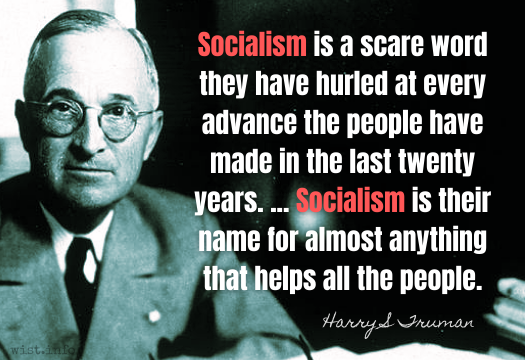
Taft explained that the great issue in this campaign is “creeping socialism.” Now that is the patented trademark of the special interest lobbies. Socialism is a scare word they have hurled at every advance the people have made in the last twenty years. Socialism is what they called public power. Socialism is what they called Social Security. Socialism is what they called farm prices supports. Socialism is what they called bank deposit insurance. Socialism is what they called the growth of free and independent labor organizations. Socialism is their name for almost anything that helps all the people.
Harry S Truman (1884-1972) US President (1945-1953)
Speech (1952-10-10), Syracuse, New York
(Source)
Referring to Sen. Robert A. Taft (R-Ohio).
Audio recording (the quotation is at 6:35 into the speech).
When I put a question to him about socialism in agriculture, he explained with glee how he had incited the poorer peasants against the richer ones, “and they soon hanged them from the nearest tree — ha! ha! ha!” His guffaw at the thought of those massacred made my blood run cold.
Bertrand Russell (1872-1970) English mathematician and philosopher
Unpopular Essays, “Eminent Men I Have Known” (1950)
Referring to an 1920 interview in Moscow with V. Lenin.

The urge to distribute wealth equally, and still more the belief that it can be brought about by political action, is the most dangerous of all popular emotions. It is the legitimation of envy, of all the deadly sins the one which a stable society based on consensus should fear the most. The monster state is a source of many evils; but it is, above all, an engine of envy.
Paul Johnson (b. 1928) English journalist, historian, speechwriter, author
The Recovery of Freedom (1980)
It is not private ownership, but private ownership divorced from work, which is corrupting to the principle of industry; and the idea of some socialists that private property in land or capital is necessarily mischievous is a piece of scholastic pedantry as absurd as that of those conservatives who would invest all property with some kind of mysterious sanctity.
R. H. Tawney (1880-1962) English writer, economist, historian, social critic [Richard Henry Tawney]
The Acquisitive Century, ch. 5 “The Functional Society” (1920)
(Source)
Revolutions, as a long and bitter experience reveals, are apt to take their colour from the régime which they overthrow. Is it any wonder that the creed which affirms the absolute rights of property should sometimes be met with a counter-affirmation of the absolute rights of labour, less anti-social, indeed, and inhuman, but almost as dogmatic, almost as intolerant and thoughtless as itself.
R. H. Tawney (1880-1962) English writer, economist, historian, social critic [Richard Henry Tawney]
The Acquisitive Century, ch. 3 “The Acquisitive Society” (1920)
(Source)
By concentrating on what is good in people, by appealing to their idealism and their sense of justice, and by asking them to put their faith in the future, socialists put themselves at a severe disadvantage.
Ian McEwan (b. 1948) English novelist and screenwriter
City Limits (London, May 27, 1983)

We have passed beyond the time of what they call the laisser-faire school which believes that the Government ought to do nothing but run a police force.
William Howard Taft (1857-1930) US President (1909-13) and Chief Justice (1921-1930)
Speech, Milwaukee (17 Sep 1909)
(Source)
We believe in a single fundamental idea that describes better than most textbooks and any speech that I could write what a proper government should be: the idea of family, mutuality, the sharing of benefits and burdens for the good of all, feeling one another’s pain, sharing one another’s blessings — reasonably, honestly, fairly, without respect to race, or sex, or geography, or political affiliation.
Mario Cuomo (1932-2015) American politician
Commencement Address, Iona College (3 Jun 1984)

The first and highest form of the state and of the government and of the law is that which there prevails most widely the ancient saying, that “Friends have all things in common.”
Plato (c.428-347 BC) Greek philosopher
Plato, Laws, 5.739 [tr. Jowett (1894)]

Sir, there is one Mrs. Macaulay in this town, a great republican. One day when I was at her house, I put on a very grave countenance, and said to her, “Madam, I am now become a convert to your way of thinking. I am convinced that all mankind are upon an equal footing; and to give you an unquestionable proof, Madam, that I am in earnest, here is a very sensible, civil, well-behaved fellow-citizen, your footman; I desire that he may be allowed to sit down and dine with us.” I thus, Sir, shewed her the absurdity of the levelling doctrine. She has never liked me since. Sir, your levellers wish to level down as far as themselves; but they cannot bear levelling up to themselves.
Samuel Johnson (1709-1784) English writer, lexicographer, critic
Comment (12 Jul 1763)
In James Boswell, The Life of Samuel Johnson (1791)

It is not from the benevolence of the butcher, the brewer, or the baker, that we expect our dinner, but from their regard to their own interests. We address ourselves, not to their humanity but to their self-love, and never talk to them of our own necessities but of their advantage. Nobody but a beggar chooses to depend chiefly upon the benevolence of his fellow-citizens. Even a beggar does not depend upon it entirely.
Adam Smith (1723-1790) Scottish economist
The Wealth of Nations, 1.2 (1776)

All skill ought to be exerted for universal good; every man has owed much to others, and ought to repay the kindness that he has received.
Samuel Johnson (1709-1784) English writer, lexicographer, critic
The History of Rasselas, Prince of Abissinia, ch. 6 (1759)
We Americans live in a nation where the medical-care system is second to no one in the world, unless you count maybe 25 or 30 little scuzzball countries like Scotland that we could vaporize in seconds if we felt like it.
Dave Barry (b. 1947) American humorist
Stay Fit and Healthy Until You’re Dead (1985)

Furthering the common good does not require that we forego self-interest, but rather that we are able to see our own interests linked to those of others. It requires a society that enables citizens to express the very human need to act on our deepest values as well as on our private interests.
Frances Moore Lappé (b. 1944) American writer, activist
Rediscovering America’s Values, ch. 6 “Summing Up the Dialogue” (1989)
A few timid people who fear progress have tried to give you new and strange names for what we are doing. Sometimes they will call it “Fascism.” Sometimes “Communism.” Sometimes “Regimentation.” Sometimes “Socialism.” But in so doing, they are trying to make very complex and theoretical something that is really very simple and very practical.
I believe in practical explanations and in practical policies. I believe what we are doing today is a necessary fulfillment of what Americans have always been doing, a fulfilment of old and tested American ideals.Franklin Delano Roosevelt (1882–1945) American lawyer, politician, statesman, US President (1933–1945)
Radio Broadcast (1934-06-27), “Fireside Chat: Report on Recovery”
(Source)
All of you, I am sure, have heard many cries about Government interference with business and about “creeping socialism.” I should like to remind the gentlemen who make these complaints that if events had been allowed to continue as they were going prior to March 4, 1933, most of them would have no businesses left for the Government or for anyone else to interfere with — and almost surely we would have socialism in this country, real socialism, not the kind they define.
The chief difference between free capitalism and State socialism seems to be this: that under the former a man pursues his own advantage openly, frankly, and honestly, whereas under the latter he does so hypocritically and under false pretences.
H. L. Mencken (1880-1956) American writer and journalist [Henry Lewis Mencken]
Minority Report: H.L. Mencken’s Notebooks, #397 (1956)
The inherent vice of capitalism is the unequal sharing of blessings. The inherent virtue of socialism is the equal sharing of miseries.
Winston Churchill (1874-1965) British statesman and author
Speech, House of Commons (22 Oct 1945)
(Source)