

We look not at the things which are seen, but at the things which are not seen: for the things which are seen are temporal; but the things which are not seen are eternal.
[μὴ σκοπούντων ἡμῶν τὰ βλεπόμενα ἀλλὰ τὰ μὴ βλεπόμενα· τὰ γὰρ βλεπόμενα πρόσκαιρα, τὰ δὲ μὴ βλεπόμενα αἰώνια.]
The Bible (The New Testament) (AD 1st - 2nd C) Christian sacred scripture
Book 8. 2nd Letter to the Corinthians 4:18 (2 Cor 4:18) 4: 18 [KJV (1611)]
(Source)
(Source (Greek)). Alternate translations:And so we have no eyes for things that are visible, but only for things that are invisible; for visible things last only for a time, and the invisible things are eternal.
[JB (1966)]What we aim for is not visible but invisible. Visible things are transitory, but invisible things eternal.
[NJB (1985)]For we fix our attention, not on things that are seen, but on things that are unseen. What can be seen lasts only for a time, but what cannot be seen lasts forever.
[GNT (1992 ed.)]We don’t focus on the things that can be seen but on the things that can’t be seen. The things that can be seen don’t last, but the things that can’t be seen are eternal.
[CEB (2011)]We look not at what can be seen but at what cannot be seen, for what can be seen is temporary, but what cannot be seen is eternal.
[NRSV (2021 ed.)]
Quotations about:
transience
Note not all quotations have been tagged, so Search may find additional quotes on this topic.

Nothing flourishes for ever; each generation gives place to its successor.
[Nihil enim semper floret; aetas succedit aetati.]
Marcus Tullius Cicero (106–43 BC) Roman orator, statesman, philosopher
Philippics [Philippicae; Antonian Orations], No. 11, ch. 15 / sec. 39 (11.15/11.39) (43-02 BC) [ed. Harbottle (1897)]
(Source)
(Source (Latin)). Other translations:For there is nothing which flourishes for ever. Age succeeds age.
[tr. Yonge (1903)]For nothing is for ever flourishing; age succeeds to age.
[tr. Ker (Loeb) (1926)]
GAUNT: His rash fierce blaze of riot cannot last,
For violent fires soon burn out themselves;
Small showers last long, but sudden storms are short;
He tires betimes that spurs too fast betimes;
With eager feeding food doth choke the feeder;
Light vanity, insatiate cormorant,
Consuming means, soon preys upon itself.William Shakespeare (1564–1616) English dramatist and poet
Richard II, Act 2, sc. 1, l. 37ff (2.1.37-44) (1595)
(Source)

The first quarter-century of your life was doubtless lived under the cloud of being too young for things, while the last quarter-century would normally be shadowed by the still darker cloud of being too old for them; and between those two clouds, what small and narrow sunlight illumines a human lifetime!
James Hilton (1900–1954) Anglo-American novelist and screenwriter
Lost Horizon, ch. 8 [High Lama] (1933)
(Source)

Soon you will have forgotten the world, and soon the world will have forgotten you.
[Ἐγγὺς μὲν ἡ σὴ περὶ πάντων λήθη, ἐγγὺς δὲ ἡ πάντων περὶ σοῦ λήθη.]
Marcus Aurelius (AD 121–180) Roman emperor (161–180), Stoic philosopher
Meditations [To Himself; Τὰ εἰς ἑαυτόν], Book 7, ch. 21 (7.21) (AD 161-180) [tr. Staniforth (1964)]
(Source)
(Source (Greek)). Alternate translations:The time when thou shalt have forgotten all things, is at hand. And that time also is at hand, when thou thyself shalt be forgotten by all.
[tr. Casaubon (1634), 7.16]'Twill not be long before you will have forgotten all the World; and in a little time, to be even, all the World will forget you too.
[tr. Collier (1701)]The time approaches when you shall forget all things, and be forgotten by all.
[tr. Hutcheson/Moor (1742)]The time is speedily approaching, when you will have forgotten every one, and every one will have forgotten you.
[tr. Graves (1792), 7.19]Near is thy forgetfulness of all things; and near the forgetfulness of thee by all.
[tr. Long (1862)]It will not be long before you will have forgotten all the world, and in a little time all the world will forget you too.
[tr. Collier/Zimmern (1887)]Soon you will have forgotten all; soon all will have forgotten you.
[tr. Rendall (1898)]The time is at hand when you shall forget all things, and when all shall forget you.
[tr. Hutcheson/Chrystal (1902)]A little while and thou wilt have forgotten everything, a little while and everything will have forgotten thee.
[tr. Haines (Loeb) (1916)]Near at hand is your forgetting all; near, too, all forgetting you.
[tr. Farquharson (1944)]Close is the time when you will forget all things; and close, too, thie time when all will forget you.
[tr. Hard (1997 ed.)]Close to forgetting it all, close to being forgotten.
[tr. Hays (2003)]Soon you will have forgotten all things: soon all things will have forgotten you.
[tr. Hammond (2006)]Close is the time when you will forget all things; and close, too, the time when all will forget you.
[tr. Hard (2011 ed.)]

As nought good endures beneath the skies,
So ill endures no more.[Come cosa buona non si trova
Che duri sempre, così ancor né ria.]

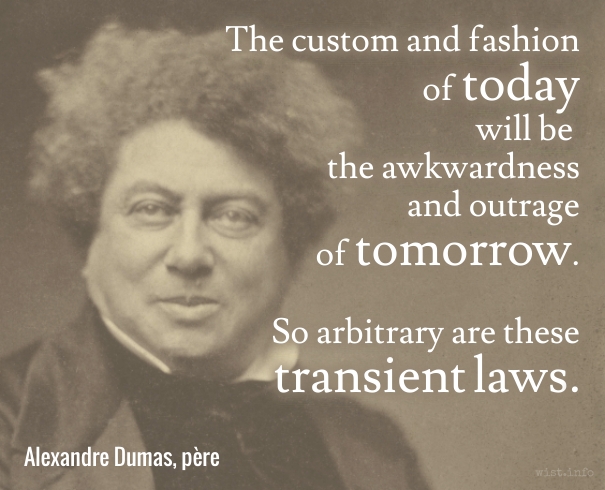
The custom and fashion of to-day will be the awkwardness and outrage of to-morrow. So arbitrary are these transient laws.
Alexandre Dumas, père (1802–1870) French novelist and dramatist
(Attributed)
Quoted in James Comper Gray, The Biblical Museum: Old Testament, vol. 3 (1878 ed.).
HENRY: A speaker is but a prater, a rhyme is but a ballad, a good leg will fall, a straight back will stoop, a black beard will turn white, a curled pate will grow bald, a fair face will wither, a full eye will wax hollow, but a good heart, Kate, is the sun and the moon, or rather the sun and not the moon, for it shines bright and never changes but keeps his course truly. If thou would have such a one, take me.